• KGS/USD = 0.01144 0%
  • KZT/USD = 0.00216 0%
  • TJS/USD = 0.10663 0%
  • UZS/USD = 0.00008 0%
  • TMT/USD = 0.28530 0%
  • KGS/USD = 0.01144 0%
  • KZT/USD = 0.00216 0%
  • TJS/USD = 0.10663 0%
  • UZS/USD = 0.00008 0%
  • TMT/USD = 0.28530 0%
  • KGS/USD = 0.01144 0%
  • KZT/USD = 0.00216 0%
  • TJS/USD = 0.10663 0%
  • UZS/USD = 0.00008 0%
  • TMT/USD = 0.28530 0%
  • KGS/USD = 0.01144 0%
  • KZT/USD = 0.00216 0%
  • TJS/USD = 0.10663 0%
  • UZS/USD = 0.00008 0%
  • TMT/USD = 0.28530 0%
  • KGS/USD = 0.01144 0%
  • KZT/USD = 0.00216 0%
  • TJS/USD = 0.10663 0%
  • UZS/USD = 0.00008 0%
  • TMT/USD = 0.28530 0%
  • KGS/USD = 0.01144 0%
  • KZT/USD = 0.00216 0%
  • TJS/USD = 0.10663 0%
  • UZS/USD = 0.00008 0%
  • TMT/USD = 0.28530 0%
  • KGS/USD = 0.01144 0%
  • KZT/USD = 0.00216 0%
  • TJS/USD = 0.10663 0%
  • UZS/USD = 0.00008 0%
  • TMT/USD = 0.28530 0%
  • KGS/USD = 0.01144 0%
  • KZT/USD = 0.00216 0%
  • TJS/USD = 0.10663 0%
  • UZS/USD = 0.00008 0%
  • TMT/USD = 0.28530 0%

Viewing results 1 - 6 of 78

Kyrgyzstan Seeks to Deepen Economic Ties with Germany

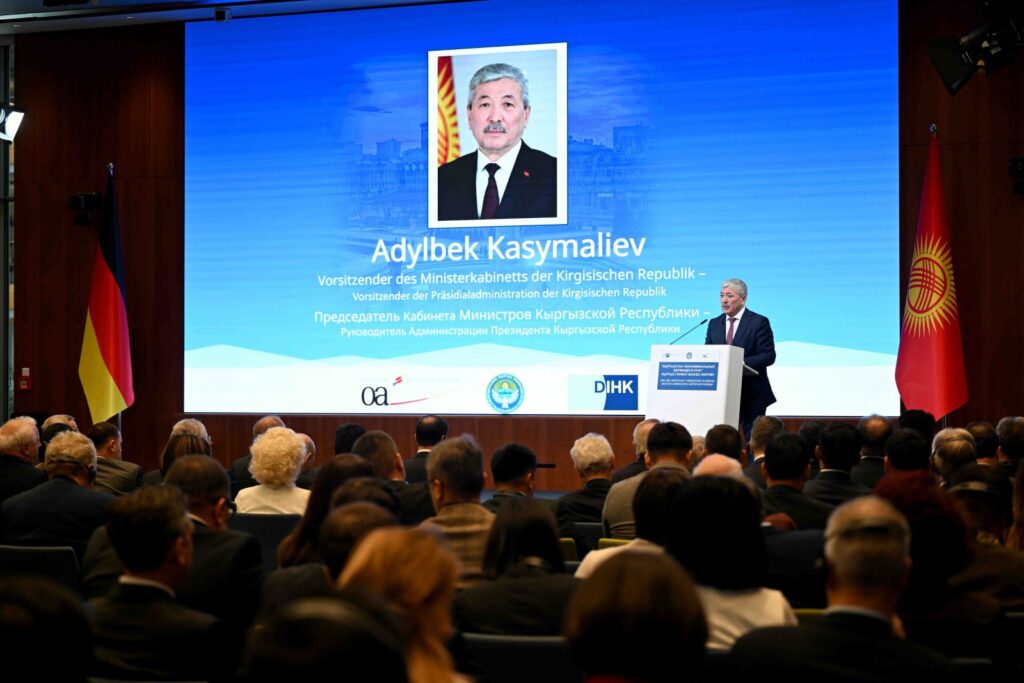
On November 28, Berlin hosted the Kyrgyz-German Business Forum and the fifth meeting of the Kyrgyz-German Business Council, with the participation of Adylbek Kasymaliev, Chairman of the Cabinet of Ministers of Kyrgyzstan. The event was organized by Kyrgyzstan’s National Investment Agency, the Eastern Committee of the German Economy, and the German Chamber of Commerce and Industry. It brought together over 300 participants from government agencies, financial institutions, and business sectors of both countries. Key areas of cooperation included the implementation of a dual vocational education system based on the German model, legal and organized labor migration from Kyrgyzstan to Germany, and joint projects in energy, green technologies, information technology, and agriculture. During the forum, Kasymaliev called on German companies to deepen engagement with Kyrgyzstan, from supplying equipment to investing in sustainable and green development initiatives. The primary purpose of Kasymaliev’s visit was to launch the second cycle of the “Days of the Economy of Kyrgyzstan and Germany,” a bilateral initiative aimed at strengthening economic cooperation and attracting foreign investment. At the Business Council meeting, Kasymaliev outlined three priority areas for collaboration. The first is financial and banking integration. He proposed establishing direct correspondent banking relationships between Kyrgyz and German financial institutions to enhance trade transparency, expedite transactions, and ensure greater security in bilateral trade. The second priority is cooperation in education and vocational training. Kyrgyzstan seeks to expand partnerships between universities, vocational schools, and industry centers, as well as to develop academic exchange and joint educational programs modeled on Germany’s experience. The third area of focus is labor migration. “Kyrgyzstan proposes to jointly develop targeted training programs, including professional and language training, as well as mechanisms for recognizing professional qualifications,” Kasymaliev stated. He emphasized that such cooperation would ensure fair working conditions and safeguard the rights of Kyrgyz citizens while addressing labor shortages in Germany. On November 29, Kasymaliev also visited the international postal exchange center of Kyrgyz Pochtasy (Kyrgyz Post) OJSC in Berlin. He noted that the establishment of such a center in the heart of Europe represents an important step toward boosting Kyrgyzstan’s export potential and expanding access for Kyrgyz businesses to European markets.

Germany Increases Imports of Kazakh Oil Amid Shift Away from Russian Supplies

Germany has significantly increased its imports of Kazakh oil, receiving 225,000 tons via the Druzhba pipeline in October, 25% more than in September, according to Deutsche Welle. Regular deliveries of Kazakh crude to Germany began in 2023, following Berlin’s decision to halt Russian oil imports in response to the war in Ukraine and EU sanctions. In 2024, Germany imported 1.5 million tons of oil from Kazakhstan. By the end of 2025, Berlin aims to raise that figure to 1.7 million tons, with potential growth to 2.5 million tons annually. In October, KazMunayGas (KMG) Chairman Askhat Hasenov and Johannes Bremer, CEO of Rosneft Deutschland GmbH, signed an agreement extending the oil supply arrangement through the end of 2026. The updated deal increases monthly volumes from 100,000 to 130,000 tons. The additional crude will come from the Karachaganak field, with Germany also set to begin receiving oil from the Kashagan field in 2024 and the Tengiz field in 2025. According to KMG, approximately 1.5 million tons of Kazakh oil were delivered to Germany’s Schwedt refinery between January and September 2025. Rosneft Deutschland GmbH, which manages a stake in the Schwedt refinery and ranks as Germany’s third-largest oil refiner, is currently under German government control. The move was part of Berlin’s strategy to reduce reliance on Russian energy following the invasion of Ukraine. The Druzhba pipeline, which originates in Samara, Russia, splits after Bryansk and Mozyr. Its northern branch runs through Belarus to Poland and Germany, while the southern branch passes through Ukraine to Hungary, Slovakia, and the Czech Republic.

Kazakhstan and Germany Partner on Sustainable Water Management

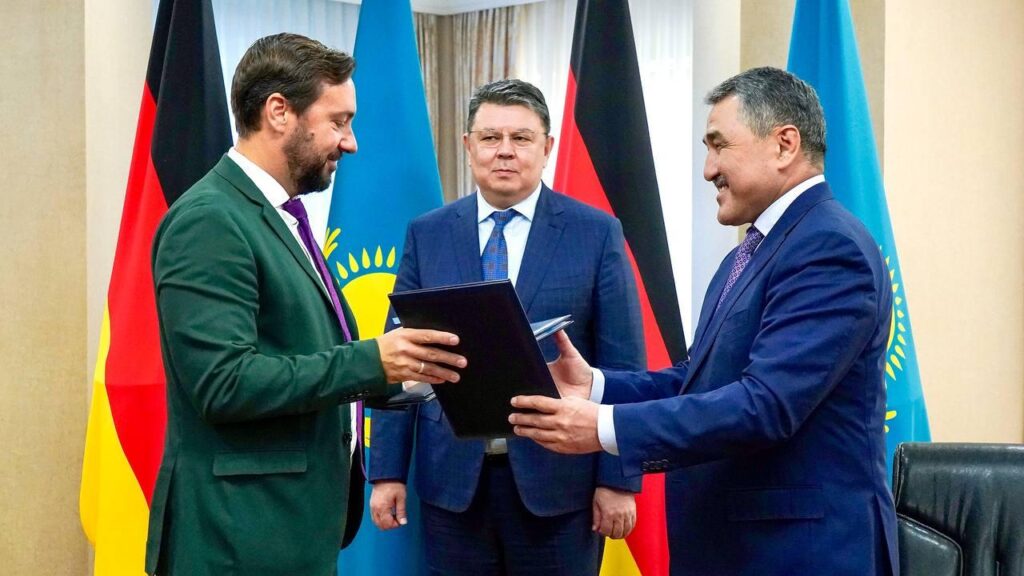
Kazakhstan’s Ministry of Water Resources and Irrigation and the German Water Partnership (GWP) signed a Strategic Partnership Agreement on October 8 aimed at enhancing bilateral cooperation in sustainable water management. The agreement will allow Kazakhstan to adopt international best practices and advanced water-saving technologies, strengthen climate resilience in the water sector, improve flood and drought response, and expand training for water-sector professionals. GWP is Germany’s leading water-sector network with a strong international focus. It brings together around 300 companies, trade associations, and institutions from business, science, and research. German expertise is already contributing to Kazakhstan’s digital projects in water resource forecasting, modeling, and accounting. German technologies are also being used in the construction of hydraulic infrastructure across the country. Following the signing, Deputy Prime Minister Kanat Bozumbayev and GWP Managing Director Boris Greifeneder discussed plans to deepen cooperation. One key proposal was the establishment of a Kazakh-German Water Innovation Hub, to be housed at the Information and Analytical Center of the Ministry of Water Resources and Irrigation, with GWP’s support. In a related initiative, the Kazakh-German University (DKU), the National Academy of Sciences of Kazakhstan, and the Kazakh National Agrarian Research University, supported by Germany’s Hanns Seidel Foundation, recently launched a new scientific and educational hub: the Kazakh-German Nexus Institute. Headquartered in Almaty, the Nexus Institute will focus on developing evidence-based policies for sustainable land and water use in Central Asia. Water resource management remains a critical priority for Kazakhstan, particularly in the country’s arid southern regions where agriculture depends heavily on efficient irrigation systems.

Kazakhstan and Germany Extend Business Partnership Program Through 2028

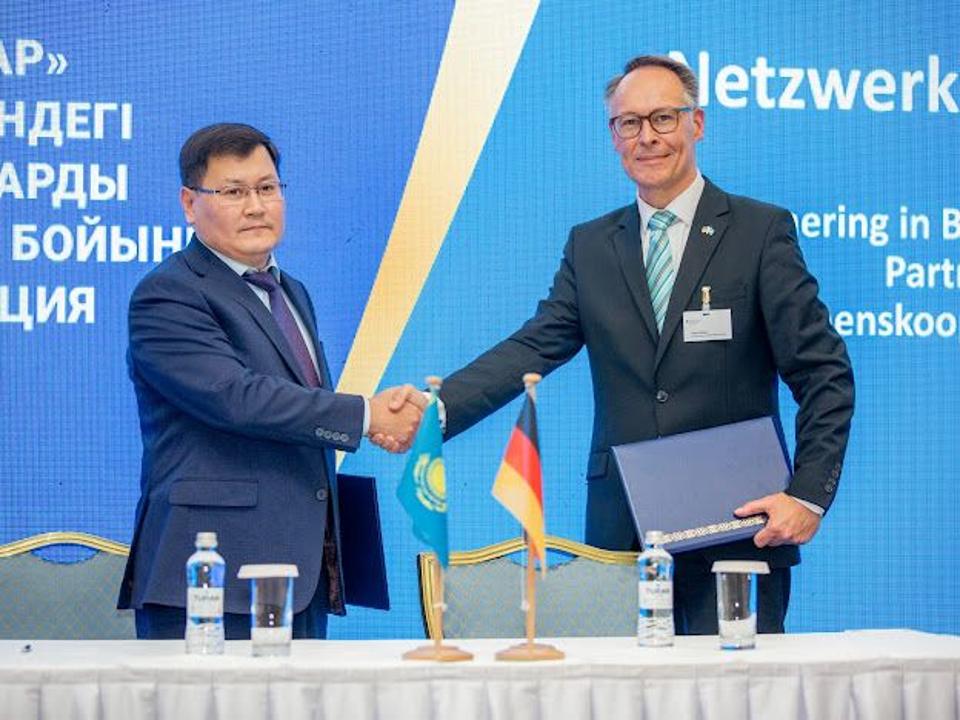
Kazakhstan and Germany have signed an agreement to extend their long-running “Partnering in Business with Germany” program until 2028, reinforcing bilateral economic cooperation with a particular focus on small and medium-sized enterprises (SMEs). Jointly implemented by Kazakhstan’s Ministry of National Economy and Germany’s Federal Ministry for Economic Affairs and Energy, the program has been in operation for 15 years. More than 800 Kazakhstani entrepreneurs have participated, gaining hands-on training in Germany, learning best business practices, modernizing their operations, and securing contracts, licenses, and franchise agreements. In 2025, the German side will continue to fully cover costs for participants, including training, insurance, and accommodation. Deputy Minister of National Economy Yerlan Sagnayev emphasized that the program not only fosters professional development among Kazakhstani entrepreneurs but also contributes to deepening long-term economic ties between the two nations. Germany is Kazakhstan’s largest trading partner within the European Union. At the 16th Kazakhstan-German Business Council meeting held in Astana in May, it was revealed that Kazakhstan ranked 43rd among Germany’s global trade partners in 2024 and accounted for 83% of Germany’s trade volume with Central Asia. Energy remains a central pillar of bilateral cooperation. Kazakhstan began exporting crude oil to Germany via the Druzhba pipeline in 2023, with volumes expected to rise to 1.5 million tons in 2025, up from 993,000 tons in 2023.

Kyrgyzstan Seeks German Investment in Green Energy, Logistics, and Tourism

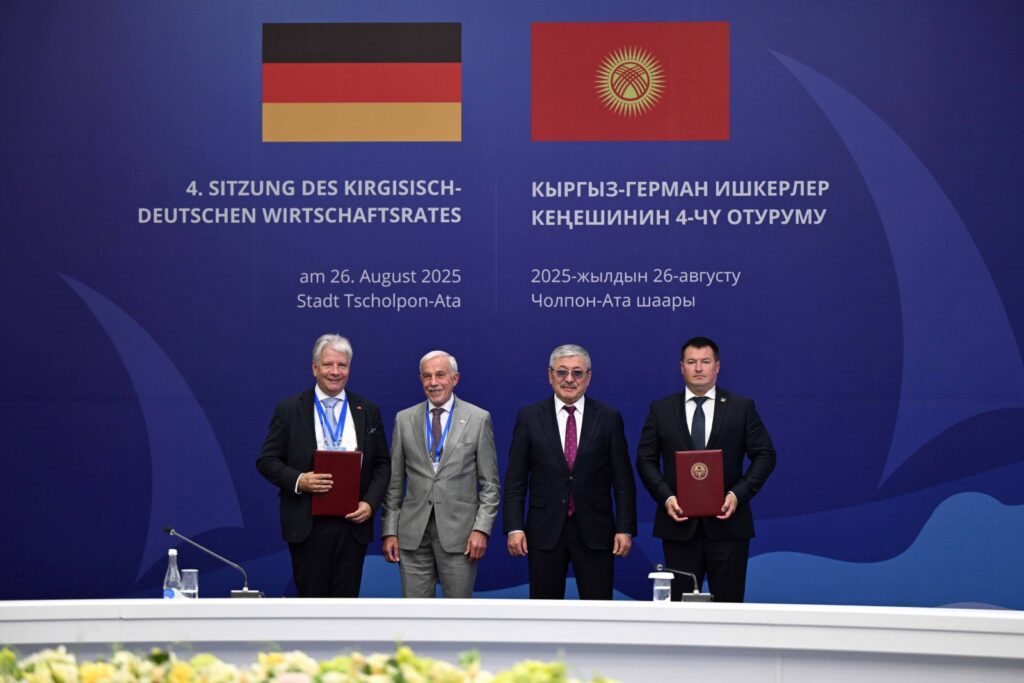
On August 26, the resort city of Cholpon-Ata on Lake Issyk-Kul hosted the Day of German Economy in Kyrgyzstan, alongside the 4th meeting of the Kyrgyz-German Business Council. Opening remarks were delivered by Adylbek Kasymaliyev, Chairman of the Cabinet of Ministers of Kyrgyzstan, and Professor Reinhold Krämmel, Honorary Consul of Kyrgyzstan in Bavaria and Thuringia and Deputy Co-Chairman of the Business Council. Calls for Green Investment and Innovation Kasymaliyev highlighted Kyrgyzstan’s interest in attracting German investment and advanced technologies to modernize its industries, create jobs, and strengthen export potential. He identified key areas for cooperation, including renewable energy, green technologies, transport and logistics infrastructure, and the financial sector. Environmental issues featured prominently in the discussions. Kasymaliyev further emphasized the threat of rapidly melting glaciers, which he said "requires the consolidation of efforts and joint initiatives." “We know Germany as one of the most active defenders of nature. Unfortunately, environmental problems are worsening each year. Glaciers in our mountains are melting and shrinking drastically. Addressing such critical issues requires joint efforts,” he said. Youth and Education as Bridges of Cooperation Kasymaliyev also underlined the importance of youth in Kyrgyzstan’s development and in strengthening bilateral ties. He noted a growing interest among young Kyrgyz citizens in the German language, culture, and vocational education, elements he described as forming the foundation for long-term partnership. While acknowledging current progress, Kasymaliyev stressed that Kyrgyz-German economic relations have significant untapped potential. New Agreements and Sectoral Priorities Following the meeting, a memorandum of cooperation was signed between Kyrgyz Temir Jolu, the national railway company, and Rhenus SE & Co. KG to jointly explore logistics and transit infrastructure opportunities. Kasymaliyev also held bilateral talks with Michael Harms, Executive Director of the Eastern Committee of the German Economy. He underscored Germany’s growing importance as a trade partner, noting that bilateral trade had nearly quadrupled between 2020 and 2024. The Kyrgyz side presented several promising areas for German investment, including the IT sector, data center and logistics hub development, renewable energy and green hydrogen production, and mining. “Kyrgyzstan is fully committed to supporting German companies interested in launching investment projects in our country,” Kasymaliyev stated. Tourism Growth Highlighted Tourism was also spotlighted as a rising sector of bilateral engagement. Germany is now among Kyrgyzstan’s top tourism partners, with more than 23,000 German visitors recorded in 2024, and over 10,000 arriving in the first half of 2025 alone.

Cholpon-Ata to Host ‘Day of German Economy in Kyrgyzstan’

On August 26, Kyrgyzstan will host one of its most prominent international business events of the year, the Day of German Economy in Kyrgyzstan, alongside the 4th meeting of the Kyrgyz-German Business Council. The events are organized by the National Investment Agency under the President of the Kyrgyz Republic. According to the agency, the forum will take place at two venues in the resort city of Cholpon-Ata: the Rukh Ordo Cultural Center and the No. 2 State Residence of the President of the Kyrgyz Republic. The event is expected to bring together high-level participants, including government officials, business leaders, industry associations, and investors from both Germany and Kyrgyzstan. Welcoming remarks will be delivered by Adylbek Kasymaliyev, Chairman of the Cabinet of Ministers of Kyrgyzstan, and Professor Reinhold Krämmel, Honorary Consul of Kyrgyzstan in Munich and Deputy Co-Chairman of the Kyrgyz-German Business Council. The forum will feature two thematic panel sessions: "Energy Projects for German-Kyrgyz Economic Cooperation" - focusing on opportunities in green energy and infrastructure development. "Export Potential and Logistics in the Transition Period: Opportunities of the Middle Corridor" - examining evolving trade routes and modern logistical challenges. In addition, Kasymaliyev will attend the meeting of the Kyrgyz-German Business Council. Discussions will center on the theme: “Kyrgyz-German Trade, Economic and Investment Cooperation: Finance as an Integral Part of the Partnership.” The primary aim of the event is to deepen economic dialogue, enhance trade and investment relations, and strengthen the strategic partnership between Kyrgyzstan and Germany.