• KGS/USD = 0.01144 0%
  • KZT/USD = 0.00216 0%
  • TJS/USD = 0.10659 0%
  • UZS/USD = 0.00008 0%
  • TMT/USD = 0.28530 0%
  • KGS/USD = 0.01144 0%
  • KZT/USD = 0.00216 0%
  • TJS/USD = 0.10659 0%
  • UZS/USD = 0.00008 0%
  • TMT/USD = 0.28530 0%
  • KGS/USD = 0.01144 0%
  • KZT/USD = 0.00216 0%
  • TJS/USD = 0.10659 0%
  • UZS/USD = 0.00008 0%
  • TMT/USD = 0.28530 0%
  • KGS/USD = 0.01144 0%
  • KZT/USD = 0.00216 0%
  • TJS/USD = 0.10659 0%
  • UZS/USD = 0.00008 0%
  • TMT/USD = 0.28530 0%
  • KGS/USD = 0.01144 0%
  • KZT/USD = 0.00216 0%
  • TJS/USD = 0.10659 0%
  • UZS/USD = 0.00008 0%
  • TMT/USD = 0.28530 0%
  • KGS/USD = 0.01144 0%
  • KZT/USD = 0.00216 0%
  • TJS/USD = 0.10659 0%
  • UZS/USD = 0.00008 0%
  • TMT/USD = 0.28530 0%
  • KGS/USD = 0.01144 0%
  • KZT/USD = 0.00216 0%
  • TJS/USD = 0.10659 0%
  • UZS/USD = 0.00008 0%
  • TMT/USD = 0.28530 0%
  • KGS/USD = 0.01144 0%
  • KZT/USD = 0.00216 0%
  • TJS/USD = 0.10659 0%
  • UZS/USD = 0.00008 0%
  • TMT/USD = 0.28530 0%

Viewing results 1 - 6 of 78

German University Launches Bachelor’s Programs in Kazakhstan

Germany’s Anhalt University of Applied Sciences has opened a branch campus in Almaty, marking a new milestone in German-Kazakh educational cooperation. The new campus, based at Energo University, is now accepting applications for bachelor’s programs in Biomedical Engineering and Electrical Engineering and Information Technology. The initiative is supported by Kazakhstan’s Ministry of Science and Higher Education and the German Consulate General in Almaty. According to the ministry, the programs were selected to align with current demands in Kazakhstan’s labor market. Graduates will receive dual diplomas, one from Anhalt University and one from a Kazakhstani institution. A total of 100 state-funded scholarships will be awarded to students who qualify through a competitive selection process. The Almaty campus features modern classrooms and laboratories equipped for practical and research-based instruction in electronics, biomedical science, and information technology. “This is a large-scale initiative for young people in Kazakhstan who are eager to learn,” said Jörg Bagdahn, President of Anhalt University. “They now have the opportunity to obtain a German engineering degree without leaving their country.” Courses will be taught by faculty from Germany, and German language instruction is included in the curriculum. “Partnership with Anhalt University is a strategic step for Energo University,” said Rector Gani Cosmetology. “We are creating a platform to deliver top-tier European education locally.”

Kazakhstan’s Oil Exports to Germany Drop Sharply in June

Kazakhstan’s oil exports to Germany via the Druzhba pipeline fell by 1.4 times in June 2025 compared to May, according to new data from KazTransOil. Supply Targets vs. Delivery Volumes In June, KazTransOil transported 160,000 tonnes of crude oil to Germany through the Russian Transneft pipeline network, down from 230,000 tonnes in May. The shipments were delivered to the Adamova Zastava entry point on the German border. KazTransOil has not yet disclosed its supply plans for July. Despite the recent dip, Kazakhstan plans to export 1.5 million tonnes of oil to Germany in 2025, mirroring the 2024 target. In 2023, the volume reached 993,000 tonnes. Kazakhstan's Energy Minister Erlan Akkenzhenov stated in May that Astana is in talks with partners to potentially increase the annual supply to 2.2 million tonnes. His predecessor, Almasadam Satkaliyev, had earlier voiced similar intentions, indicating the figure could be raised to 2 million tonnes if demand from Germany rises. President Kassym-Jomart Tokayev has also expressed readiness to boost exports. Deepening Energy Ties Kazakhstan launched regular oil deliveries to Germany through Druzhba in 2023 as part of its broader strategy to diversify export routes. The first shipment was dispatched in February of that year. KazTransOil received a 2023 quota from Transneft for 1.2 million tonnes of oil, and in August, Karachaganak Petroleum Operating (KPO), operator of the Karachaganak field, announced plans to maintain that volume in 2024. In June 2023, KazMunayGas signed a supply agreement with Rosneft Deutschland GmbH for monthly deliveries of 100,000 tonnes to the PCK Raffinerie in Schwedt, Germany. The contract involved KazMunayGas Trading AG as the seller and Rosneft Deutschland, one of the refinery’s co-owners, as the buyer. Why Use the Druzhba Pipeline? The Druzhba pipeline originates in Samara, Russia, and branches into two routes after Bryansk and Mozyr: the northern branch runs through Belarus to Poland and Germany, while the southern route passes through Ukraine to Hungary, Slovakia, and the Czech Republic. Following Germany’s decision to halt imports of Russian oil in early 2023, capacity became available within the Druzhba system. Kazakhstan capitalized on this opening, with oil shipments technically routed through Russia’s Transneft network under intergovernmental agreements. Germany, in its search for alternatives to Russian crude, has turned to Kazakhstan as a reliable supplier. Technical compatibility with the Druzhba pipeline and Kazakhstan’s neutral foreign policy have made it a strategic energy partner.

German Firm to Build New Cargo and Passenger Airport in Kazakhstan

Kazakhstan’s Prime Minister, Olzhas Bektenov, has met with Dr. Christine Grötzbach, board member and co-founder of the German aviation company Skyhansa, to finalize the construction timeline for a new cargo and passenger airport in the Zhetysu region. The first phase of the project is expected to be completed by 2027. The facility will be built within the Khorgos - Eastern Gate special economic zone (SEZ), located on Kazakhstan’s border with China. The project envisions the creation of a multifunctional aviation hub designed to meet ICAO international standards and will be developed in phases, according to a government announcement. The initiative is being carried out under a framework agreement between Kazakhstan’s Ministry of Transport and the Kazakh-German consortium Skyhansa. On the German side, the project is led by the Hansa Consortium, an aviation infrastructure specialist, while the Kazakh side is represented by Skymax Technologies, a regional logistics and infrastructure operator active in Central Asia and the Caucasus. The total investment in the airport project is projected at $500 million. Dr. Grötzbach emphasized that the vision extends far beyond a standard airport facility. “We are creating not just an airport, but a comprehensive infrastructure: cargo and passenger terminals, a fuel and refueling complex, an aviation technical center, a business center, and hotels,” she stated. “Its strategic location near China, combined with access to rail and road transport, positions it as a key logistics node on the New Silk Road.” Bektenov echoed this sentiment, stating that the project will significantly enhance Kazakhstan’s transport and logistics capabilities. “The implementation of this project will give a powerful impetus to the development of transport infrastructure and reinforce Kazakhstan’s role as a bridge between China, Central Asia, and Europe,” he said. This announcement follows a similar initiative by Kazakhstan’s Ministry of Transport, which recently signed an investment agreement with Terminals Astana Airport Limited, a subsidiary of a UAE-based holding company. That project involves a $1.1 billion investment in the development of the Astana Aerotropolis, as reported by The Times of Central Asia.

Uzbekistan and Germany Partner on Green Industrialization with €3 Million Grant

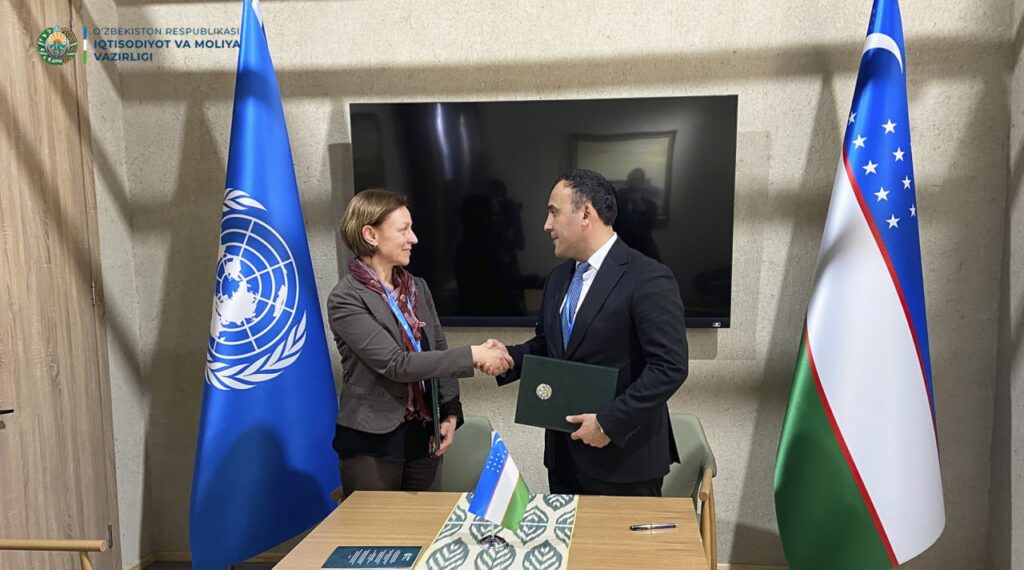
On November 13, at the 29th UN Climate Change Conference (COP29) in Azerbaijan's capital Baku, Uzbekistan's Ministry of Economy and Finance signed a memorandum with the German International Cooperation Society (GIZ) to secure additional funding for a project aimed at supporting the private sector in green industrialization. As part of the initiative, Germany has allocated €9 million to help Uzbekistan’s private sector transition to a green economy. The project is designed to assist the Uzbek government in implementing economic reforms and fostering sustainable economic development, focusing on enhancing the capacity of both the public and private sectors to adopt green industrialization practices. The initiative will also provide technical expertise in measuring and certifying greenhouse gas emissions, supporting Uzbekistan’s participation in international carbon trading mechanisms, and aligning with the European Union’s Cross-Border Adjustment Mechanism (CBAM). Additionally, it aims to promote resource-saving and sustainable production by encouraging the private sector to adopt green technologies, including circular economy practices and green industrial park models. To further bolster the project, a €3 million grant was approved during the conference. This funding will complement the ongoing initiative, titled “Support to the Private Sector and Advice on Economic Policy in Uzbekistan.”

Germany Deports Tajik Political Activist Dilmurod Ergashev

Germany has decided to deport Dilmurod Ergashev, a political activist and member of the Movement for Reforms and Development of Tajikistan, who had applied for asylum in Germany. This is despite requests from international human rights organizations such as Human Rights Watch and the Helsinki Committee not to deport Ergashev because of the risk of him being tortured in Tajikistan. Friends of the activist said Ergashev was told to report to the deportation center and prepare to leave. The activist, who has lived in Germany for the past 13 years, was detained in the town of Kleve on October 28 and taken to the administrative court, where his deportation was ordered. According to associates, the court should have considered that another administrative court was still considering Ergashev's application for political asylum. Sharofiddin Gadoev, leader of the Movement for Reforms and Development, confirmed that the deportation process has already begun. Ergashev is likely to be sent back to Tajikistan on November 6. “The decision to deport Ergashev strengthens the authoritarian system in Tajikistan and increases fear among political activists,” Gadoev said. He said there may be an agreement between Germany and Tajikistan to deport activists forcibly. Ergashev's lawyer has filed an appeal with the Supreme Court but is unavailable for comment. Dozens of Tajik citizens have moved to Europe in recent years, many of whom disagree with their country's policies. Germany has previously deported activists such as Abdullo Shamsiddin and Bilol Kurbonaliev, who were sentenced to long prison terms upon their return home. Also extradited from Austria to Tajikistan in 2020 was Hizbullo Shovalizoda, a member of the banned Islamic Renaissance Party of Tajikistan. He has been sentenced to 20 years in prison.

Germany Closes Money Laundering Case Against Uzbek-Russian Billionaire Usmanov

The Frankfurt Prosecutor’s Office has completed its money laundering investigation against Uzbek-Russian businessman Alisher Usmanov. The case was settled on October 11, 2024, when Usmanov agreed to pay 1.5 million euros to non-profit organizations and 2.5 million euros to the German treasury. When these payments are completed, the case will be completely closed. Prosecutors say the alleged actions in question occurred long ago and did not cause financial damage in Germany. This decision was made under section 153a of the German Criminal Procedure Code, which allows cases to be dropped if the crime is minor and prosecution isn’t in the public interest. Usmanov’s lawyers praised the result, calling it a step towards restoring his reputation. They noted that the investigation found no evidence to support money laundering charges. Usmanov has now decided not to file a counter lawsuit against prosecutors or demand damages. In 2022, a Frankfurt court deemed the searches of properties linked to Usmanov in Germany illegal, and all seized items were ordered to be returned. However, in 2023, the German Constitutional Court declined Usmanov’s complaint over the searches, stating that he had not exhausted all legal options before filing the complaint. Previously, The Times of Central Asia reported that the news from the Hamburg court about Usmanov as broadcast by the German TV channel ARD was found to be unreliable. ARD accused Usmanov of creating a system of bribing International Fencing Federation (FIE) judges. According to the report, the court found the information published by the ARD channel unreliable and banned its distribution as “inappropriate news based on suspicion.” If the court order is violated, the party found to be in violation can be fined up to 250,000 euros per episode or face imprisonment.