• KGS/USD = 0.01144 0%
  • KZT/USD = 0.00201 0%
  • TJS/USD = 0.10567 -0.09%
  • UZS/USD = 0.00008 0%
  • TMT/USD = 0.28571 0%
  • KGS/USD = 0.01144 0%
  • KZT/USD = 0.00201 0%
  • TJS/USD = 0.10567 -0.09%
  • UZS/USD = 0.00008 0%
  • TMT/USD = 0.28571 0%
  • KGS/USD = 0.01144 0%
  • KZT/USD = 0.00201 0%
  • TJS/USD = 0.10567 -0.09%
  • UZS/USD = 0.00008 0%
  • TMT/USD = 0.28571 0%
  • KGS/USD = 0.01144 0%
  • KZT/USD = 0.00201 0%
  • TJS/USD = 0.10567 -0.09%
  • UZS/USD = 0.00008 0%
  • TMT/USD = 0.28571 0%
  • KGS/USD = 0.01144 0%
  • KZT/USD = 0.00201 0%
  • TJS/USD = 0.10567 -0.09%
  • UZS/USD = 0.00008 0%
  • TMT/USD = 0.28571 0%
  • KGS/USD = 0.01144 0%
  • KZT/USD = 0.00201 0%
  • TJS/USD = 0.10567 -0.09%
  • UZS/USD = 0.00008 0%
  • TMT/USD = 0.28571 0%
  • KGS/USD = 0.01144 0%
  • KZT/USD = 0.00201 0%
  • TJS/USD = 0.10567 -0.09%
  • UZS/USD = 0.00008 0%
  • TMT/USD = 0.28571 0%
  • KGS/USD = 0.01144 0%
  • KZT/USD = 0.00201 0%
  • TJS/USD = 0.10567 -0.09%
  • UZS/USD = 0.00008 0%
  • TMT/USD = 0.28571 0%
23 February 2026

Viewing results 1 - 6 of 10

Central Asia and the Global Water Crisis: A Test of Governance and Cooperation

Water scarcity is rapidly transforming from a regional environmental concern into one of the defining global security challenges of the 21st century. UN-linked assessments estimate that around four billion people experience severe water scarcity for at least one month each year, and nearly three-quarters of the global population lives in countries facing water insecurity. Against this backdrop, Central Asia is not an exception but rather a concentrated example of global dynamics: climate pressure, population growth, and inefficient resource management. Regional initiatives, including proposals put forward by Kazakhstan, therefore have the potential to contribute not only to stability in Central Asia but to the development of a more coherent global water governance architecture. The Water Crisis as a Global Reality Water is increasingly regarded as a strategic resource on par with energy and food. Climate change is intensifying droughts, floods, and the degradation of aquatic ecosystems across all regions, from Africa and the Middle East to South Asia, Europe, and North America. Recent mapping and analysis by investigative groups and international media indicate that half of the world’s 100 largest cities experience high levels of water stress, with dozens classified as facing extremely high levels. Major urban centers, including Beijing, New York, Los Angeles, Rio de Janeiro, and Delhi, are among those under acute pressure, while cities such as London, Bangkok, and Jakarta are also categorized as highly stressed. In this context, Central Asia is not an outlier. It is confronting today what may soon become the global norm. Central Asia: Where Global Trends Converge A defining feature of the current environmental situation is that factors beyond natural ones drive the water crisis. Experts increasingly stress that shortages are often less about absolute physical scarcity and more about outdated management systems, infrastructure losses, and inefficient consumption patterns. In this respect, Central Asia can be seen as a testing ground for global water challenges, where multiple stress factors converge. The region, with mountain peaks exceeding 7,000 meters, contains some of the largest ice reserves outside the polar regions. The Pamir and Hindu Kush ranges, together with the Tibetan Plateau, the Himalayas, and the Tien Shan, form part of what is sometimes referred to as the “Third Pole,” the largest concentration of ice after the Arctic and Antarctic. [caption id="attachment_13410" align="aligncenter" width="2560"] The White Horse Pass, Tajikistan; image: TCA, Stephen M. Bland[/caption] However, the pace of change is alarming. By 2030-2040, water scarcity in Central Asia risks becoming chronic. Glaciers in the Western Tien Shan, for example, have reportedly shrunk by roughly 27% over the past two decades and continue to retreat, posing a direct threat to the flow of the Amu Darya and Syr Darya rivers. These rivers increasingly fail to reach the Aral Sea in sufficient volume, while the exposed seabed has become a major source of salt and dust storms. [caption id="attachment_21928" align="aligncenter" width="2560"] Moynaq, Karakalpakstan; image: TCA, Stephen M. Bland[/caption] Infrastructure inefficiencies compound the problem. Estimates suggest that in some systems, 40-50% of water can be lost in deteriorating...

Glacier Shift in Tajikistan Triggers Fears of Flood and Landslide

A significant portion of the Didal Glacier in Tajikistan’s Tajikabad district has detached and slid more than five kilometers downslope, according to a report by Russian state news agency TASS, citing the Agency for Hydrometeorology of Tajikistan. Experts from the agency’s Center for Glaciology confirmed that the glacier has continued to shift over the past three days, advancing an additional 72 meters and remaining in an “unstable” state. A field expedition to the Surkhob River basin revealed that the detached ice mass measures between 1.3 and 1.5 kilometers in length, 170-200 meters in width, and 25-50 meters in height. Satellite imagery reviewed by glaciologists confirmed the glacier’s ongoing movement and indicated significant displacement since its initial shift began in September. Experts attribute the detachment to unusually high temperatures during the summer and autumn months. The Geophysical Service of the National Academy of Sciences noted that seismic activity may also be a contributing factor. On November 3, an earthquake struck the region at 01:29 local time, with tremors measuring four points in Dushanbe and six to seven in northern Afghanistan, the location of the epicenter. Scientists believe the combination of warming temperatures and recent seismic shocks has rendered the glacier’s behavior increasingly unpredictable. Officials from the Hydrometeorology Agency warned that continued movement of the Didal Glacier could lead to the formation of glacial lakes and possible outburst floods, endangering downstream settlements and infrastructure. The unstable ice mass also raises the risk of secondary natural hazards such as landslides and mudflows. Monitoring teams are conducting regular field assessments to track developments. Authorities have described the glacier's shift as a broader warning about the urgency of climate adaptation and glacier conservation. Tajikistan, 93 percent of which is mountainous, hosts roughly 14,000 glaciers that supply nearly 60 percent of Central Asia’s water resources. Of these, approximately 1,300 have already melted completely, and the rate of glacial retreat is accelerating. Earlier this year, President Emomali Rahmon warned of the growing threat posed by glacial lake outbursts, noting their potential to destroy villages and infrastructure and potential to cause casualties. He cited climate change, air pollution, and heavy dust deposits as key factors driving glacier loss. A similar incident occurred on October 25, when a large section of the Ismoil Somoni Glacier broke away in the same district. Emergency services quickly contained the situation, though authorities warned that continued rainfall and further collapse remained possible.

Kyrgyzstan Draws International Attention to Glacier Meltdown

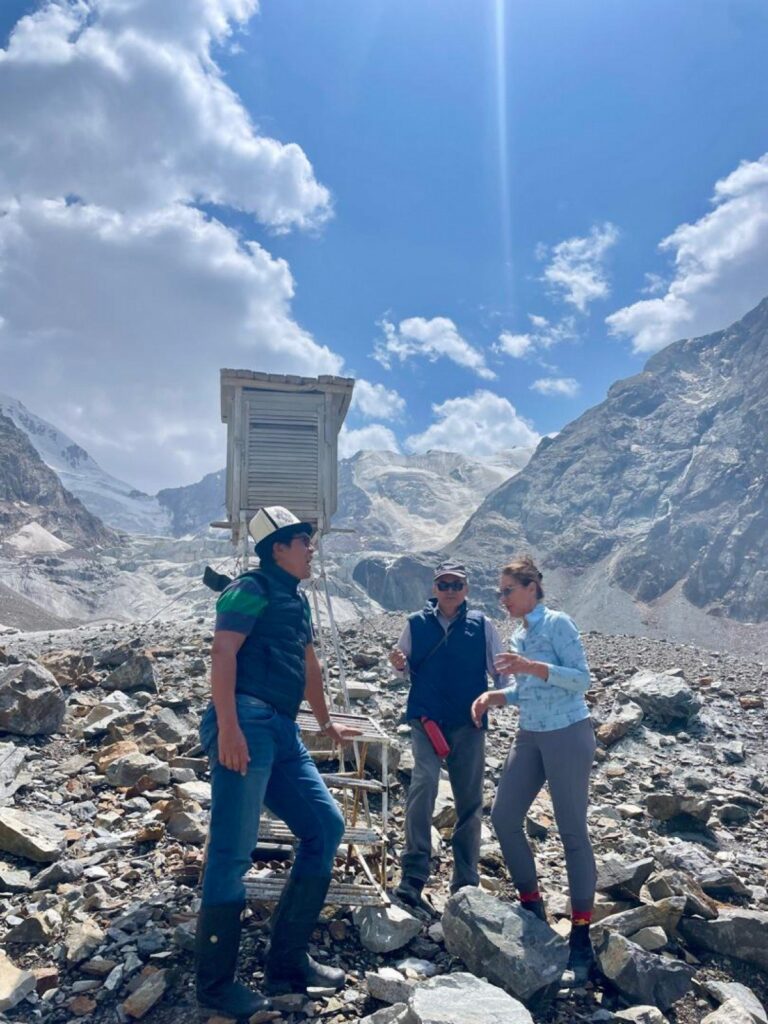
Kyrgyzstan is intensifying efforts to combat climate change and safeguard its rapidly melting glaciers through continued collaboration with the United Nations and international partners. Officials emphasize that glacier preservation is key to ensuring long-term water security for the region. On August 15, Deputy Chairman of the Cabinet of Ministers Edil Baisalov and UN Resident Coordinator in the Kyrgyz Republic Antje Grawe visited the Tien-Shan High-Altitude Physical and Geographical Station of Kyrgyzstan’s National Academy of Sciences. The joint expedition aimed to raise both domestic and global awareness of the alarming retreat of Kyrgyz glaciers, particularly the Kara-Batkak glacier, a vital source of freshwater for Kyrgyzstan and the broader Central Asian region. Located in the Terskey Ala-Too range of the Inner Tien Shan mountains, south of Lake Issyk-Kul, the Kara-Batkak glacier has long served as a key indicator of climate change. At the research station, Baisalov and Grawe reviewed decades of scientific observations and discussed policies for climate adaptation, biodiversity protection, and water resource management. “Kyrgyzstan is a land of glaciers, and it is our duty to safeguard this unique resource,” Baisalov said. “The shrinking of our glaciers is not just an environmental concern, it is a matter of national security, water stability, and the country’s future development.” Grawe underscored the broader global significance of Kyrgyz scientific research and stressed the urgency of climate finance for mountain nations: “Research on the Kara-Batkak glacier matters far beyond Kyrgyzstan. It guides national strategies and strengthens global climate action. Protecting glaciers also preserves biodiversity and sustains the ecosystems communities rely on. Therefore, climate finance must reach mountain countries like Kyrgyzstan to scale up adaptation, safeguard nature, and secure the water future of millions in Kyrgyzstan and beyond.” Also present was Rysbek Satylkanov, Director of the Institute of Water Problems and Hydropower, who presented the latest scientific data on glacial retreat and its impact on national water systems. Established in 1957, the Tien-Shan station is a unique high-altitude research facility conducting glaciological, meteorological, and hydrological monitoring. The Kara-Batkak glacier, within its observation zone, remains a crucial barometer of climate change in Central Asia. According to the World Meteorological Organization and the World Glacier Monitoring Service, five of the past six years have witnessed the fastest glacier retreat ever recorded. The years 2022-2024 marked the most significant three-year loss of glacier mass in history. Glaciers once considered “eternal ice” may not survive the 21st century. There are over 275,000 glaciers worldwide, covering approximately 700,000 square kilometers and storing about 70% of the Earth’s freshwater. Their disappearance poses a severe threat to water supplies for hundreds of millions of people. In response, the UN General Assembly has declared 2025 the International Year of Glaciers’ Preservation and designated March 21 as the annual World Day for Glaciers. The initiative aims to raise awareness of the essential role glaciers play in global climate and hydrological systems, and their significance to ecological and economic stability.

Central Asian Glaciers Shrinking Irreversibly, Expert Warns

Glaciers in Central Asia are melting at an alarming rate with no signs of recovery, according to Tohir Majitov, head of the Uzbek public organization "Suvchi," in an interview with Kazinform. Majitov highlighted the escalating pressure on water supplies due to population growth and agricultural expansion across the region. "In 1991, Central Asia had nearly 6 million hectares of irrigated land. By 2024, this figure has grown to over 10 million hectares. The population has also increased from around 45 million to more than 80 million. Water supply for this growing population is now a serious issue," he explained. He noted that Uzbekistan and Kazakhstan heavily depend on the Syr Darya and Amu Darya rivers, which originate in the mountainous regions of Kyrgyzstan and Tajikistan. A critical challenge arises from the differing water needs: upstream countries store water during summer for hydropower generation in autumn and winter, while downstream nations like Kazakhstan and Uzbekistan require substantial water primarily during the summer growing season. Majitov issued a stark warning about the region's largest glacier, Tajikistan's Fedchenko Glacier, which has reportedly lost over 40% of its mass. "Between 1990 and 2005, the glacier shrank by 50 meters," he stated. "Its length is 77 kilometers, width 2.4 kilometers, and depth reaches one kilometer. Glaciers in Kyrgyzstan have also lost over 30% of their mass." To tackle these pressing water challenges, Majitov proposed the formation of a regional body. "We suggest creating an Aral Sea Committee to improve water management and ensure food security. It may take several years, but all Central Asian countries should take part," he urged. He believes that efficient water use could enable the region to expand irrigated land by 2-3 million hectares, potentially feeding up to 100 million people. Previously, The Times of Central Asia reported concerns from other experts on the region's water crisis. A fundamental conflict exists between upstream countries, like Kyrgyzstan and Tajikistan, which have water but need to release it in winter for electricity generation, and downstream countries, such as Uzbekistan and Turkmenistan, that require that water in summer for agricultural purposes. What was once primarily a technical concern has now evolved into a complex regional problem, exacerbated by climate change. Nations are increasingly constructing dams, engaging in disputes over water allocation, and experiencing a decline in mutual trust. The future stability of Central Asia may hinge on its capacity to effectively manage this escalating water crisis.

Global Declaration on Saving Disappearing Glaciers Signed in Dushanbe

The first high-level international conference focused on the global crisis of glacier melt concluded this week in Dushanbe, marking a major milestone in global environmental cooperation. The event brought together over 2,500 participants from 80 countries, including scientists, NGO representatives, heads of delegations, and international donors. The Dushanbe Declaration A key outcome of the conference was the adoption of the Dushanbe Declaration, a collective commitment to coordinated international action to safeguard glaciers. The document outlines urgent concerns: glaciers are retreating at an alarming rate, threatening the freshwater supply of millions who rely on mountain rivers. “Every piece of glacier lost is a step toward greater threats to the future of humanity,” said Tajikistan's President Emomali Rahmon. The declaration calls for immediate measures including reductions in greenhouse gas emissions, shifts to environmentally sustainable production, and the implementation of advanced monitoring systems. An international coalition was also announced, comprising states, scientific institutions, civil society organizations, and environmental movements. This coalition will oversee the declaration's implementation, facilitate knowledge exchange, attract investment, and foster climate technology innovation. Glacier Protection and Knowledge Access Fund To support practical initiatives, participants agreed to establish an international Glacier Protection and Knowledge Access Fund. The fund will finance scientific expeditions, the installation of glacier monitoring systems, freshwater source restoration projects, and the dissemination of eco-friendly technologies. Countries with limited resources will be prioritized. Education emerged as another central theme. The conference advocated for integrating glacier studies into school and university curricula, and for community-based environmental literacy programs, particularly for youth. Greater public awareness, participants emphasized, is essential for fostering long-term climate resilience. Andrea Celeste Saulo, Secretary-General of the World Meteorological Organization, highlighted the chronic underfunding of climate science. “Funding for science remains extremely limited, even though it is science that enables us to predict risks and develop response measures,” she said, urging both governments and businesses to invest in sustainable monitoring systems. Tajikistan Joins IUCN A significant development during the conference was Tajikistan’s accession to the International Union for Conservation of Nature (IUCN), joining over 1,400 global members. This move grants Tajikistan access to a broad network of expertise, funding opportunities, and international partnerships, thereby enhancing its role in global environmental policy. In his speech, Rahmon shared sobering statistics: in 2023 alone, glaciers lost an estimated 600 gigatons of fresh water, contributing to rising sea levels and ecosystem instability. Since 2000, the world has lost nearly one-third of its mountain glaciers, and a projected two-degree rise in temperature could eliminate another third. He proposed a seven-point plan, including strengthening international cooperation, early warning systems, and resource mobilization. Central Asia Under Threat The urgency is particularly acute for Central Asia. Over the last 50-60 years, Tajikistan has lost up to 30% of its glacier area and about 20% of its volume. More than 1,000 glaciers have vanished in the past 23 years. According to the UN Environment Programme, over 50% of Central Asia’s glaciers could disappear by 2050, endangering water access for over 64 million people, especially in rural and...

Artificial Glaciers Created in Kyrgyzstan for Sustainable Agriculture and Climate Change Adaptation

As the international community observed the first-ever World Day for Glaciers on March 21, a project led by the Food and Agriculture Organization of the United Nations (FAO) has demonstrated how artificial glaciers can help rural communities in Kyrgyzstan adapt to the effects of climate change. As part of the FAO initiative, seven artificial glaciers were constructed in villages across the Batken region of southern Kyrgyzstan in late autumn 2024​. Over the winter, these glaciers accumulated more than 1.5 million cubic meters of ice. As spring temperatures rise, the ice begins to melt, providing essential irrigation water for downstream agricultural lands. According to FAO experts, more than 1,750 hectares of land, equivalent to 2,451 football fields, can be irrigated using furrow irrigation. If modern systems are introduced, this could expand to as much as 15,000 hectares. These artificial glaciers are relatively simple structures designed to collect and freeze water in winter for agricultural use in summer, including for irrigation and livestock. On average, one glacier can support irrigation on 300 to 500 hectares. “The key is to choose the right location,” said Matraim Jusupov, FAO expert on water-saving technologies. “We channel water from a mountain spring through a pipeline ending in a vertical pipe 10-15 meters high. The elevation difference generates pressure, which allows us to spray water into the air. At sub-zero temperatures, it freezes and gradually forms an ice cone.” To build the glaciers, 6,956 meters of pipeline were laid. FAO supplied construction materials and technical guidance, while the work was carried out by local residents. The FAO office in Kyrgyzstan has since developed universal guidelines for building artificial glaciers and distributed them across the country. Based on this experience, new glacier construction is already underway in other regions. Global Glacier Melt According to the World Meteorological Organization (WMO) and the World Glacier Monitoring Service (WGMS), five of the past six years have seen the fastest glacier retreat ever recorded. The years 2022–2024 marked the largest three-year loss of glacier mass in history​. Once regarded as “eternal ice,” many glaciers are now unlikely to survive the 21st century. There are more than 275,000 glaciers worldwide, covering approximately 700,000 square kilometers. Along with ice sheets, glaciers store about 70% of the planet’s freshwater. Their depletion threatens water supplies for hundreds of millions of people. In response to this growing crisis, the UN General Assembly declared 2025 the International Year of Glaciers’ Preservation and designated March 21 as the annual World Day for Glaciers. The initiative aims to raise awareness of the critical role glaciers play in the global climate and hydrological systems, and their significance to economic and ecological stability. UNESCO and WMO are leading the global coordination effort, supported by over 200 organizations and 35 countries. Kyrgyzstan’s Initiatives A Kyrgyz delegation led by Dinara Kemelova, the President’s Special Representative for the Five Years of Action for Mountain Regions Development, participated in World Day for Glaciers events at UNESCO headquarters in Paris on March 20-21​. The meetings focused on...