• KGS/USD = 0.01144 0%
  • KZT/USD = 0.00206 0%
  • TJS/USD = 0.10833 -0.09%
  • UZS/USD = 0.00008 0%
  • TMT/USD = 0.28490 0%
  • KGS/USD = 0.01144 0%
  • KZT/USD = 0.00206 0%
  • TJS/USD = 0.10833 -0.09%
  • UZS/USD = 0.00008 0%
  • TMT/USD = 0.28490 0%
  • KGS/USD = 0.01144 0%
  • KZT/USD = 0.00206 0%
  • TJS/USD = 0.10833 -0.09%
  • UZS/USD = 0.00008 0%
  • TMT/USD = 0.28490 0%
  • KGS/USD = 0.01144 0%
  • KZT/USD = 0.00206 0%
  • TJS/USD = 0.10833 -0.09%
  • UZS/USD = 0.00008 0%
  • TMT/USD = 0.28490 0%
  • KGS/USD = 0.01144 0%
  • KZT/USD = 0.00206 0%
  • TJS/USD = 0.10833 -0.09%
  • UZS/USD = 0.00008 0%
  • TMT/USD = 0.28490 0%
  • KGS/USD = 0.01144 0%
  • KZT/USD = 0.00206 0%
  • TJS/USD = 0.10833 -0.09%
  • UZS/USD = 0.00008 0%
  • TMT/USD = 0.28490 0%
  • KGS/USD = 0.01144 0%
  • KZT/USD = 0.00206 0%
  • TJS/USD = 0.10833 -0.09%
  • UZS/USD = 0.00008 0%
  • TMT/USD = 0.28490 0%
  • KGS/USD = 0.01144 0%
  • KZT/USD = 0.00206 0%
  • TJS/USD = 0.10833 -0.09%
  • UZS/USD = 0.00008 0%
  • TMT/USD = 0.28490 0%

Viewing results 1 - 6 of 89

Central Asia to Develop a Unified Platform for Electricity Trade

Uzbekistan's Deputy Minister for Energy Umid Mamadaminov announced at the European Economic Days in Tashkent on November 6 that a unified platform for electricity trade is being developed in Central Asia. Mamadaminov said that Uzbekistan is developing this platform with the support of the World Bank and other partners. “Infrastructure is very important for integrating renewable energy sources such as wind and solar, and many countries face this problem. We need at least 5,000 km of power lines, including 500 kV and 200 kV high-voltage lines and substations,” Mamadaminov said. At least 2,000 km of power lines should be built in the next two years. “We have already signed contracts to install more than 2,000 MW of energy storage systems with a total capacity of more than 400 MW, as each is a two-cycle network. We will have at least 4,000 MW of basic capacity in the next two years. This helps to respond to fluctuations in solar energy production quickly,” the deputy minister said. According to Mamadaminov, automation is the main problem in integrating renewable energy sources into the electric grid because the system cannot be controlled without it. In addition, this year, reforms to modernize and regulate energy consumption, including a new plan developed by the Cabinet of Ministers, were implemented in Uzbekistan. Uzbekistan’s energy system, especially electricity generation, relies heavily on fossil fuels. However, the country aims to produce 25% of its electricity from renewable sources by 2030. Uzbekistan plans to focus on solar energy while using wind, biomass, and hydro sources to achieve this goal. The government is working to attract investors to build 8 GW of solar and wind power and increase hydroelectric capacity to 1.935 GW by 2030. Biogas production from biomass and organic waste will also be developed.

IFC Provides $240 Million Loan to Boost Uzbekistan’s Renewable Energy

The IFC has announced a $240 million Islamic Equity Bridge Loan for ACWA Power to boost Uzbekistan’s renewable energy sector. The announcement was made at the 8th Future Investment Initiative conference in Riyadh, Saudi Arabia. The financing will cover a 1-gigawatt solar PV plant, a 668-megawatt Battery Energy Storage System (BESS), and around 500 kilometers of high-voltage transmission lines. These projects aim to advance Uzbekistan’s clean energy goals, potentially cutting greenhouse gas emissions by 1.3 million tons of CO2 annually and generating around 2,400 gigawatt hours of electricity per year. Al Muhaidib, ACWA Power's Chief Financial Officer, stated that “we are honored to collaborate with IFC on this transformative project in Uzbekistan, which embodies our shared vision of advancing sustainable energy solutions. This initiative will establish a new standard for cross-border ACWA Power recourse funding support, effectively addressing energy demands while championing environmental sustainability.” The $240 million financing, structured as an Islamic Finance Murabaha, includes an A-Loan of up to $227.75 million and a $12.25 million trust loan through IFC’s Managed Co-Lending Portfolio Program. This funding will support ACWA Power’s equity contributions to the project’s development over the next four years. By optimizing equity returns, this structure helps project developers offer competitive tariffs and attract private investors, advancing Uzbekistan’s goal of reaching 40% renewable energy by 2030. “This project reflects IFC’s commitment to tackling climate change, accelerating the clean energy transition in emerging markets, and supporting public and private sector entities in Saudi Arabia with innovative investments in the region and beyond,” said Laura Vecvagare, IFC’s Regional Head of Industry for Infrastructure and Natural Resources in the Middle East, Central Asia, Türkiye, Afghanistan, and Pakistan. Saudi company ACWA Power’s investment portfolio in Uzbekistan now includes eight projects worth over $6.8 billion, with a more than 5.5 GW design capacity. The company’s success highlights Uzbekistan as an attractive investment hub and a leader in renewable energy in Central Asia.

Kazakhstan Plans to Equate Nuclear Energy With “Green” Energy

Kazakhstan plans to equate nuclear power with renewable energy sources (RES), such as solar and wind power, and extend to it the same benefits that already apply to them. The Energy Ministry has drafted a bill to incentivize alternative energy sources as part of the transition to a green economy, including the development of hydrogen energy. According to a document published on October 18 on the Open Regulatory Legal Acts portal, the discussion will last until November 11. One of the main problems identified in the draft is the need for legislative preferences for nuclear power despite its potential as an environmentally friendly source. In 2023, the share of RES in Kazakhstan was only about 6% of total electricity generation, emphasizing the need to develop alternative sources to reduce carbon emissions. Kazakhstan intends to follow the EU's example. In 2022, the EU recognized nuclear power as “green.” This recognition opens the way to receiving benefits and subsidies for future nuclear projects, including Kazakhstan's first atomic power plant. At the same time, the bill's authors noted that the analysis of international experience points to the constant clarification and supplementation of legislation considering current realities (technology development, market structure, global experience, and the current situation in the country). In particular, in Germany, the law on renewable (alternative) energy sources has undergone six amendments, including an increase in the targets for using alternative energy sources, adjustment of support measures taking into account the achieved level, and so on. Since 2000, various programs have been developed in Poland to supplement and clarify the different incentives for developing alternative energy sources.

Central Asia’s Increasing Profile in Global Climate Policy

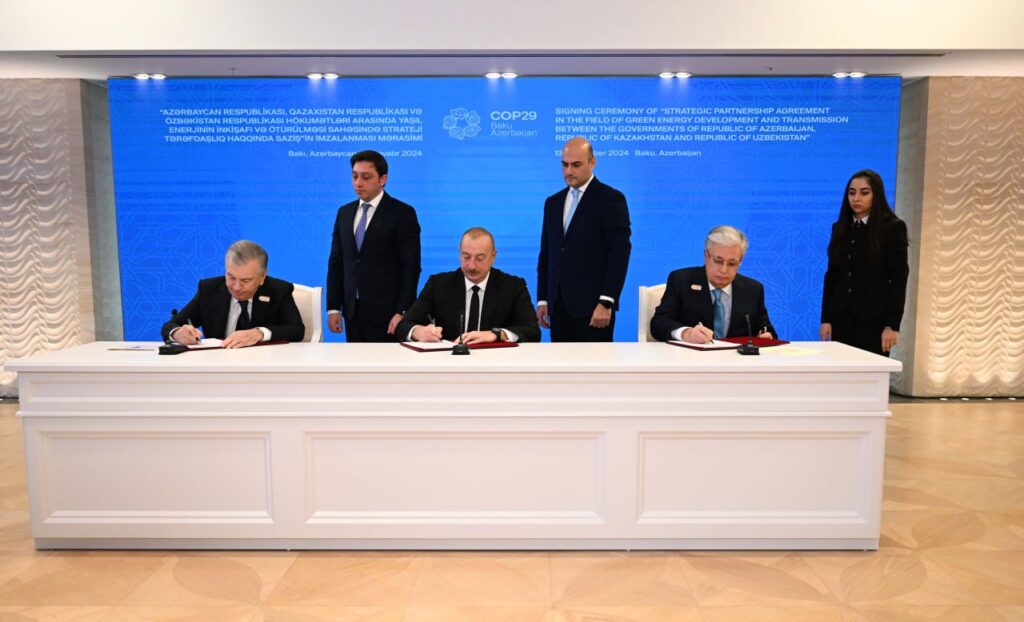
Between 11 and 22 November, the 29th Conference of the Parties (COP29) to the United Nations Framework Convention on Climate Change (UNFCCC) will take place in Baku, Azerbaijan. In the run-up to this global event, Central Asian countries have been continuing their integration into the cooperative implementation of the global energy and environmental agenda. Such measures include, but are not limited to, commitments to reducing methane emissions, contributions to green supply chains, and — for Kazakhstan in particular — its nuclear policy based on multi-vector diplomacy. One may anticipate their especially enhanced presence in view of the fact that several them have strategic-partner relations with Azerbaijan, which is cooperating with them also in the implementation of the Trans-Caspian International Trade Corridor (TITR or "Middle Corridor"). The Central Asian states are using their implementation of global energy and environmental priorities as an instrument to integrate further into the international system. Following their participation at COP28 (30 November – 23 December 2023, in Dubai, United Arab Emirates), all five of them signed the Global Methane Pledge to reduce methane emissions by at least 30% by 2030. They have also stepped up their contributions to green supply chains, signalling their ambitions to become more important players in global geoeconomics. At the same time, these initiatives also seek to promote domestic economic diversification. Kazakhstan, in particular, continues to play a central role with its multi-vector approach, notably in the nuclear energy sector, positioning itself at the intersection of sustainability and global energy security. Kazakhstan holds 12% of global uranium reserves. It became the world’s leading producer in 2009 and in 2022 accounted for 43% of global production. In Central Asia, Uzbekistan has a Rosatom-sponsored NPP project under way, as does Kyrgyzstan. Along with Kazakhstan, Uzbekistan and Turkmenistan in particular actively engaged in discussions on climate policy at COP28, acknowledging the need to balance their resource-rich economies with global sustainability goals. One of the key outcomes was the region's collective involvement in the Global Methane Pledge. Global environmental policy bodies have assessed that methane emissions are a significant concern for global climate policy. The effect of this assessment will be to load still greater financial burdens on oil and gas companies by making development of hydrocarbon deposits, and the transmission of hydrocarbon resources to market, more expensive. Kazakhstan’s commitment to cutting methane emissions by 30% by 2030 exemplifies this shift, signalling a readiness to reform domestic industries in line with global climate targets. Turkmenistan has the highest methane emissions intensity in the region, but challenges remain in terms of monitoring and implementation. Uzbekistan’s leadership was also highlighted at COP28. The country’s ambitious plans to scale up solar and wind energy by 2030 align with broader regional goals of reducing dependence on hydrocarbons. This is Tashkent's (and the region's) way of enhancing their profile as "good global citizens" as policy decisions by political bodies at the international level increasingly emphasize decarbonization. Uzbekistan has made strides in "green supply chains" by focusing on the renewable energy sector...

USAID Launches Green Solutions in Kyrgyzstan

The United States Agency for International Development (USAID) has announced a new U.S. government-sponsored Green Solutions Activity. This five-year initiative backed by a $24 million investment aims to empower small and medium enterprises in Kyrgyzstan to adopt innovative green solutions, enhance energy efficiency, and increase the supply of renewable energy, the U.S. Embassy in Bishkek reported. “This investment marks a pivotal moment in the U.S. government’s commitment to building a greener future in close partnership with the Government of the Kyrgyz Republic. USAID will partner with local businesses and offer grants to adopt green solutions and technologies. Importantly, we will also work with local banks and financial institutions to advance green finance initiatives,” USAID Deputy Assistant Administrator Änjali Kaur stated at the launch event in Bishkek. The launch event occurred at Kyrgyzstan’s first rooftop grid-connected photovoltaic solar plant at the Kyrgyz State Technical University. Developed with USAID support and officially inaugurated in December 2023, the 80-kilowatt solar power installation can generate 143,037 kilowatt hours annually. It not only powers the university but also enables it to sell excess electricity back to the grid, effectively helping to offset operational costs and modeling a more sustainable energy future for the region. USAID is supporting the Kyrgyz government’s green economy initiative to diversify its energy sources into various clean energy forms. The regional Power Central Asia activity focuses on energy sector connectivity and decarbonization, energy security and resilience, and expanded cross-border electricity trade. Additionally, the USAID Future Growth Initiative and USAID Agro Trade Activity promote green production.

Uzbekistan Plans to Increase Share of Green Energy to 40% by 2030

Uzbekistan intends to increase the share of renewable energy sources in the country’s energy consumption structure to 40% by 2030. Energy Minister Zhurabek Mirzamakhmudov announced this at the “Russian Energy Week" forum. According to Mirzamakhmudov, renewable energy, including solar and wind power plants, will become the basis for meeting the growing electricity demand as part of the country's growth strategy. Mirzamakhmudov noted that Uzbekistan's economy is growing by 6% annually, and the population will continue to grow. This causes the demand for electricity to grow by 7-8% per year, and by 2030, this figure may stabilize at 7.5%. Uzbekistan plans to introduce up to 20 gigawatts of solar and wind power plant capacity to meet this demand. It is expected that the share of renewable energy sources in the country's total energy balance will reach 40%. The share of renewable energy is about 10%, but by the end of this year, it should increase to 15%. In the coming years, 2.5 to 3.5 gigawatts of new capacity will be commissioned annually. In addition, considerable attention will be paid to developing thermal and hydroelectric power plants, which are planned to reach 18.5 gigawatts of capacity by 2030. The minister also emphasized the importance of energy storage systems. Uzbekistan plans to install 300 megawatts of storage capacity this year and increase it to 4.2 gigawatts by 2030, mainly using lithium-ion batteries. Along with this, projects to create hydro-battery stations will be implemented. Mirzamakhmudov added that all these projects are financed by foreign direct investment, demonstrating the high interest of international investors in the country's energy sector. The Russian Energy Week 2024 forum is being held in Moscow from September 26 to 28. The event's main theme is “Energy Cooperation in a Multipolar World.” More than 70 speakers from various countries have participated, including from Russia, BRICS countries, and Africa. The forum discussed topics such as sustainable energy development, the role of hydrocarbons in the future, and issues of technological independence. One of the key events was the meeting of BRICS energy ministers. Earlier, The Times of Central Asia wrote about the annual meeting of the Board of Directors of the Asian Infrastructure Investment Bank (AIIB) held in Samarkand on September 25-26, where Uzbek President Shavkat Mirziyoyev proposed a program of green energy development for Central Asia.