• KGS/USD = 0.01144 0%
  • KZT/USD = 0.00206 0%
  • TJS/USD = 0.10760 0%
  • UZS/USD = 0.00008 0%
  • TMT/USD = 0.28571 0%
  • KGS/USD = 0.01144 0%
  • KZT/USD = 0.00206 0%
  • TJS/USD = 0.10760 0%
  • UZS/USD = 0.00008 0%
  • TMT/USD = 0.28571 0%
  • KGS/USD = 0.01144 0%
  • KZT/USD = 0.00206 0%
  • TJS/USD = 0.10760 0%
  • UZS/USD = 0.00008 0%
  • TMT/USD = 0.28571 0%
  • KGS/USD = 0.01144 0%
  • KZT/USD = 0.00206 0%
  • TJS/USD = 0.10760 0%
  • UZS/USD = 0.00008 0%
  • TMT/USD = 0.28571 0%
  • KGS/USD = 0.01144 0%
  • KZT/USD = 0.00206 0%
  • TJS/USD = 0.10760 0%
  • UZS/USD = 0.00008 0%
  • TMT/USD = 0.28571 0%
  • KGS/USD = 0.01144 0%
  • KZT/USD = 0.00206 0%
  • TJS/USD = 0.10760 0%
  • UZS/USD = 0.00008 0%
  • TMT/USD = 0.28571 0%
  • KGS/USD = 0.01144 0%
  • KZT/USD = 0.00206 0%
  • TJS/USD = 0.10760 0%
  • UZS/USD = 0.00008 0%
  • TMT/USD = 0.28571 0%
  • KGS/USD = 0.01144 0%
  • KZT/USD = 0.00206 0%
  • TJS/USD = 0.10760 0%
  • UZS/USD = 0.00008 0%
  • TMT/USD = 0.28571 0%

Viewing results 1 - 6 of 72

Moscow International Relations University Opens Branch in Astana

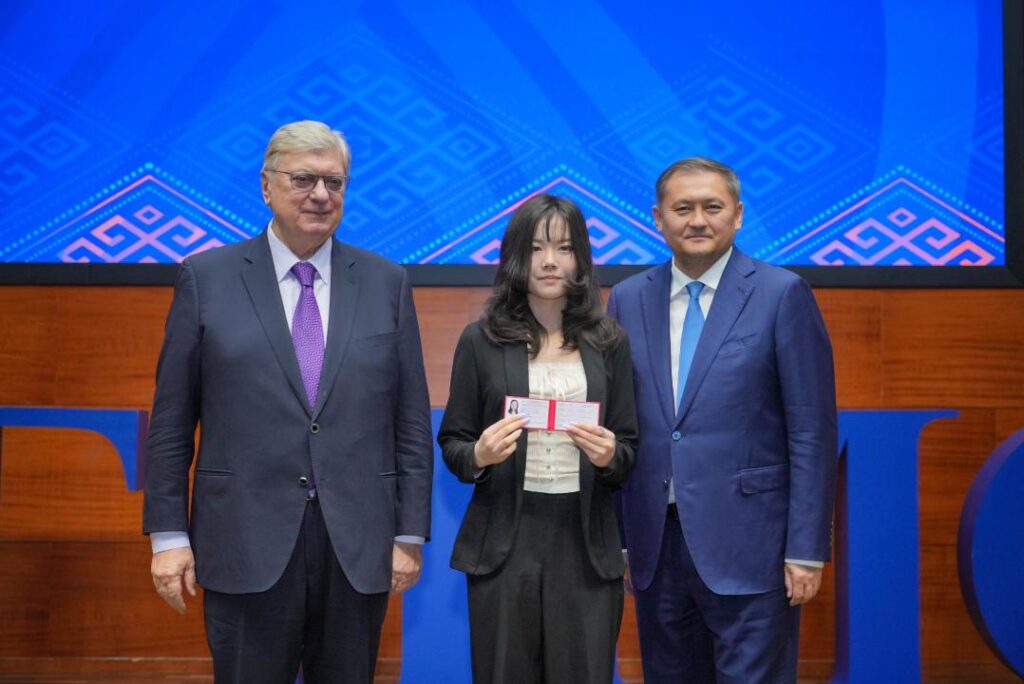
The Moscow State Institute of International Relations (MGIMO), a leading Russian university affiliated to Russia's Ministry of Foreign Affairs, has officially opened a branch at L.N. Gumilyov Eurasian National University in Astana. On November 1, the inaugural class of 103 students at the new MGIMO Astana campus received their student ID cards from Kazakhstan’s Minister of Science and Higher Education, Sayasat Nurbek, and MGIMO Rector Anatoly Torkunov. According to Torkunov, the academic programs at the Astana branch are designed to train specialists for key sectors of Kazakhstan’s economy, business, and international relations. Kazakhstan’s Ministry of Science and Higher Education reported that MGIMO Astana currently offers two undergraduate programs, World Mineral Resources and Energy Markets and Analysis and Modeling of Socioeconomic and Business Processes, as well as two master’s programs: Financial Economics and Financial Technologies and Multilateral Institutions and Management of Global Technological Development. Artem Malgin, director of the MGIMO Astana branch, noted that undergraduate students will spend two semesters studying in Moscow, while master’s students will study there for one semester. Courses at the branch are taught by faculty from both MGIMO and the Eurasian National University. MGIMO Astana is the university’s second international campus. Its first overseas branch, MGIMO Tashkent, opened in Uzbekistan and currently offers six undergraduate and graduate programs tailored to the local academic context and taught by MGIMO faculty.

New Partnerships Aim to Turn Kyrgyz Students into Entrepreneurs

On October 20, the investment fund Central Asia Capital signed strategic cooperation agreements with Jusup Balasagyn Kyrgyz National University (KNU) and the Kyrgyz-Russian Slavic University (KRSU) to promote practice-oriented education, support student startups, and create new employment opportunities. The partnerships aim to bridge the gap between academia and industry by providing students with hands-on business experience, mentorship, and pathways to entrepreneurship. “Our agreements with KNU and KRSU are a major step toward creating conditions where students not only gain knowledge but also apply it in real business settings. This is a strategic investment in the future of Kyrgyzstan’s economy,” said Anton Sobin, Chairman of the Board of Directors at Central Asia Capital. A flagship initiative under the agreements will be the launch of an Acceleration School, where students can develop business projects, receive expert mentorship, and compete for investment grants. “We want young people to see that they can build successful businesses in Kyrgyzstan without going abroad,” Sobin emphasized. Under the agreement with KNU, the fund will support curriculum modernization, scholarship programs, and internship placements within its subsidiaries and partner firms. The KRSU partnership emphasizes innovation and startup support, along with infrastructure development. Planned upgrades include a new innovation lab, enhanced sports facilities, and improvements to the university campus. Central Asia Capital will also assist in the renovation of KRSU’s educational and recreational complex at Lake Issyk-Kul.

TCA Interview: Asia’s First New York Film Academy Campus Opens in Almaty

On 27 September, the New York Film Academy Kazakhstan (NYFA) opened the first branch of the world-renowned American film school in Central Asia. For young Kazakhstani and foreign students, this presents a unique opportunity to gain top-tier knowledge for future careers in the industry. The new campus was established through a partnership between Almaty University of Energy and Communications (Energo University) and the Dala Edge Creative Technology Park, with the opening ceremony attended by Michael Young, President and CEO of the New York Film Academy, and Sayasat Nurbek, Minister of Science and Higher Education of Kazakhstan. Gani Nygymetov, Rector of Energo University, spoke to The Times of Central Asia about the opportunities and prospects of NYFA Kazakhstan. TCA: How did the idea to establish the New York Film Academy Kazakhstan campus in Kazakhstan come about? GN: Energo University has been in existence for over 50 years and is one of the leading technical universities in Central Asia, specializing in engineering and energy. In February this year, we presented a new development strategy that includes a mission to remain a leader in energy education, while also expanding into telecommunications, IT, and techno-creative programmes. To achieve these goals, the 16-hectare Dala Edge Creative Technology Park was created near Almaty. Now, a branch of NYFA has opened there, its first campus in Asia. Previously, NYFA campuses were only located in Florence, New York, and Los Angeles. I am confident that the opening of the campus in Kazakhstan will give an additional impetus to the development of creative industries in the region and enable us to train specialists of international calibre. The Creative Technology Park will become a hub for professional training and innovative projects and will support the integration of students and professionals into the film, animation, and game design industries. TCA: Who teaches at NYFA Kazakhstan, exclusively American specialists, or are local experts also involved in the programme? What subjects are taught? GN: American specialists teach students in film directing, screenwriting, acting, 3D animation, visual effects, and game design. All programmes meet international standards, instruction is in English, and modern tools and methods used in the United States are employed. Inviting NYFA to Kazakhstan is part of a strategy to develop the country's academic potential. The Ministry of Science and Higher Education, led by Minister Sayasat Nurbek, is actively attracting leading international universities. Today, more than 40 renowned foreign universities have opened branches in Kazakhstan. This allows talented students to receive high-quality education at home and also attracts students from other countries in the region. Partnerships with international universities, including Anhalt University (Germany), which has also opened a branch at our university, and NYFA, help set high standards of education and expand opportunities for students. In the coming years, we plan to launch our own digital media faculty. [caption id="attachment_37086" align="aligncenter" width="353"] Gani Nygymetov, Rector of Energo University; image: Energo University[/caption] TCA: How many students are currently studying at NYFA Kazakhstan? Are there plans to expand the number of disciplines?  GN: NYFA...

New York Film Academy Opens First Central Asian Campus in Kazakhstan

The New York Film Academy (NYFA) has opened its first campus in Central Asia, marking a significant milestone for the region’s creative industries. The official launch took place on September 27 in Kaskelen, a town located 20 kilometers from Almaty. Situated within the Creative Industries Park of Energy University, the new campus spans more than 1,000 square meters. It features professional sound stages, editing and recording studios, lecture halls, dressing rooms, and specialized classrooms for acting. According to NYFA, the facilities are designed to support the full cycle of film production from concept development to shooting and post-production. NYFA Kazakhstan will welcome its first cohort in autumn 2025, offering five of its most sought-after programs: filmmaking, screenwriting, acting for film, game design, and 3D animation and visual effects. Courses will be taught by faculty from NYFA’s U.S. campuses, bringing international expertise directly to Kazakhstan. Speaking at the opening ceremony, NYFA President and CEO Michael Young emphasized the broader cultural significance of the project: “We are proud that the New York Film Academy has opened in Kazakhstan. This is not just an educational project, but a platform that brings together the region's talent and introduces them to the global film industry.” Officials stated that the campus is expected to become a regional hub for cultivating creative professionals, providing access to world-class film education without the need to study abroad.

Woosong University Kazakhstan Campus Officially Opens

On September 25, Woosong University launched its new branch, Woosong University Kazakhstan, which will initially offer a program in AI and Big Data, with plans to expand into broader technology and software engineering fields. At the opening ceremony, former Deputy Prime Minister Yermek Kusherbayev, who assumed the post of Minister of Foreign Affairs the following day, highlighted the significance of the event: "To date, 40 strategic partnerships of various formats have been implemented, including 33 branches of foreign universities. Today, we are witnessing a historic event, the opening of a branch of one of the leading universities of the Republic of Korea in the spiritually rich and ancient Turkestan. This university will become not just an educational platform but also a center for international cooperation, innovation, and the training of highly qualified specialists who will shape the intellectual capital of our country." Minister of Science and Higher Education Sayasat Nurbek added that Kazakhstan aspires to become Central Asia’s leading educational hub, with foreign university branches playing a central role in this transformation. Expanding Kazakh-Korean Cooperation Several higher education partnerships are already underway between Kazakhstan and South Korea: Dong-Eui University is collaborating with Akhmet Baitursynov University to train engineers for automobile manufacturing in Kostanay. Korkyt Ata University in Kyzylorda has launched dual-degree programs with the Seoul National University of Science and Technology (SeoulTech). Satbayev University in Almaty is working with the Korea Advanced Institute of Science and Technology (KAIST) to establish a center for rare earth metals processing. Kazakhstan as an International Education Hub As previously reported by The Times of Central Asia, Kazakhstan is attracting an increasing number of prestigious foreign institutions: On September 3, Cardiff University (Wales) opened Cardiff University Kazakhstan in Astana Germany’s Anhalt University of Applied Sciences launched a branch in Almaty Italy’s Marche Polytechnic University, based in Ancona, has opened a branch campus at Zhetysu University in Taldykorgan. Looking ahead, two additional institutions are set to establish campuses in 2026: Grenoble INP-Phelma, UGA, France’s premier engineering school in physics, electronics, and materials science, will open a branch in Almaty. The Colorado School of Mines will open its first international campus in Zhezkazgan, specializing in geology and mining.

From Astana to the World: Kazakhstan Expands Academic Frontier

Kazakhstan is rapidly establishing itself as a regional center for higher education, attracting students from around the world. The number of branches of foreign universities operating in the country is steadily increasing, complemented by a growing domestic academic base, especially in fields such as artificial intelligence. Today, Kazakhstan is viewed as a viable regional alternative to Russia, which has long been considered a destination for affordable, high-quality education. Expanding Options for Students In June, the Ministry of Science and Higher Education of the Republic of Kazakhstan unveiled a map of foreign university branches operating in the country. The government is positioning Kazakhstan as a leading academic hub in Central Asia by enhancing international cooperation and expanding opportunities for students. Partnerships have already been established with 39 foreign universities. Currently, 23 branches of institutions from the UK, Italy, China, Russia, the U.S., France, and South Korea operate in Kazakhstan. [caption id="attachment_36320" align="aligncenter" width="1201"] Map of foreign university partnerships; image: Ministry of Science and Higher Education of Kazakhstan.[/caption] Seven more branches are expected to open in the 2025-2026 academic year, namely Coventry University, the Moscow State Institute of International Relations (MGIMO) in Astana, Gazi University in Shymkent, Woosong University in Turkestan, Anhalt University in Almaty, Politecnico della Marche in Taldykorgan, and Dong Eui University in Kostanay. A standout example of this strategy arrived in early September: Notably, on September 3, Cardiff University opened its first campus outside the UK in Astana. It is also the first member of the prestigious Russell Group to begin operations in Kazakhstan. The Russell Group comprises 24 leading UK universities responsible for two-thirds of all research grants and contract funding in the UK, and 56% of doctoral degrees awarded. Cardiff University Kazakhstan is now accepting students for four-year bachelor’s programs in computer science, business management, civil engineering, and geology and mineral exploration. Kazakhstan has witnessed a surge in the establishment of foreign university branches since 2021. These include the Peking University of Languages and Culture at Astana International University, and the National Research Nuclear University MEPhI (Russia) at Al-Farabi Kazakh National University. Additional branches include the University of Lorraine (France) at the Kazakh National Pedagogical University named after Abai, and the University of Anhalt (Germany) at the Almaty University of Power Engineering and Telecommunications named after Gumarbek Daukeev. Other notable branches include the University of Hong Kong at Satpayev University in Almaty, Berlin Technical University in Aktau, De Montfort University (UK) in Almaty, and Queen’s University Belfast (Ireland) at Narxoz University, among others. These branches offer programs in mining, water resource management, and mineral exploration and extraction, along with biotechnology, electrical engineering, energy, mechatronics, logistics, chemical technology, robotics, and related disciplines. In 2023, Korkyt Ata University in Kyzylorda launched an Institute of Artificial Intelligence, in partnership with Seoul National University of Science and Technology. It currently offers programs in computer science, cybersecurity, software development, and information systems. An Ambitious Vision Observers note that Kazakhstan’s education drive is unfolding amid growing global competition for international students. Neighboring Uzbekistan...