• KGS/USD = 0.01143 0%
  • KZT/USD = 0.00205 0%
  • TJS/USD = 0.10433 0.1%
  • UZS/USD = 0.00008 0%
  • TMT/USD = 0.28577 0%
  • KGS/USD = 0.01143 0%
  • KZT/USD = 0.00205 0%
  • TJS/USD = 0.10433 0.1%
  • UZS/USD = 0.00008 0%
  • TMT/USD = 0.28577 0%
  • KGS/USD = 0.01143 0%
  • KZT/USD = 0.00205 0%
  • TJS/USD = 0.10433 0.1%
  • UZS/USD = 0.00008 0%
  • TMT/USD = 0.28577 0%
  • KGS/USD = 0.01143 0%
  • KZT/USD = 0.00205 0%
  • TJS/USD = 0.10433 0.1%
  • UZS/USD = 0.00008 0%
  • TMT/USD = 0.28577 0%
  • KGS/USD = 0.01143 0%
  • KZT/USD = 0.00205 0%
  • TJS/USD = 0.10433 0.1%
  • UZS/USD = 0.00008 0%
  • TMT/USD = 0.28577 0%
  • KGS/USD = 0.01143 0%
  • KZT/USD = 0.00205 0%
  • TJS/USD = 0.10433 0.1%
  • UZS/USD = 0.00008 0%
  • TMT/USD = 0.28577 0%
  • KGS/USD = 0.01143 0%
  • KZT/USD = 0.00205 0%
  • TJS/USD = 0.10433 0.1%
  • UZS/USD = 0.00008 0%
  • TMT/USD = 0.28577 0%
  • KGS/USD = 0.01143 0%
  • KZT/USD = 0.00205 0%
  • TJS/USD = 0.10433 0.1%
  • UZS/USD = 0.00008 0%
  • TMT/USD = 0.28577 0%

Viewing results 1 - 6 of 117

“A Road Not for the Faint-Hearted”: How Austrian Prisoners of War Built a Tourist Path in East Kazakhstan

A winding mountain road in East Kazakhstan has become a point of fascination not only for tourists but also for historians, filmmakers, and researchers. Known variously as the Old Austrian Road, the Austrian Route, or Irek Zhol (“Winding Road”), this nearly 50-kilometer path connects the Katon-Karagai and Markakol districts, cutting through pristine wilderness in a national park and a state reserve. Today the path is being restored, but the road’s true value lies in a dramatic and little-known past that stretches back over a century. A New Chapter for an Old Road In July 2025, authorities announced the launch of extensive repair work on the Old Austrian Road. With a budget exceeding $1 million from the regional government, the project includes rebuilding a damaged bridge near Katon-Karagai, replacing culverts, reinforcing slopes, and rehabilitating impassable sections. The most challenging terrain lies near Lake Markakol, where the route crosses swampy stretches, sharp switchbacks, and granite outcroppings. Yet these obstacles have not deterred growing numbers of visitors, off-road enthusiasts, cyclists, hikers, and even horse riders, eager to explore the wild beauty of Eastern Kazakhstan. [caption id="attachment_35993" align="aligncenter" width="1280"] Image: TCA/Yulia Chernyavskaya[/caption] The Road’s Origins in War and Captivity Though few know it, this scenic mountain route has deep strategic and historical roots. Long before the 20th century, locals used it as a trail for horses and carts. But by the early 1900s, the Russian Empire decided to formalize the path, partly due to the road’s proximity to the Chinese border. Between 1914 and 1916, the road was reconstructed, largely by Austrian prisoners of war, mainly ethnic Czechs, Slovaks, Hungarians, and Galicians, captured during World War I. According to Vienna-based historian Lana Berndl, who has conducted extensive research on the topic, roughly 800 prisoners were transported from Austria via St. Petersburg and Omsk to the Irtysh River and then forced to march to the village of Altai (now Katon-Karagai). Around 600 reached their destination. Construction began simultaneously from Katon-Karagai and Alekseevka. Despite working only in the warmer months, the prisoners built a road whose difficulty rivals Alpine passes. During the harsh winters, many worked on local farms and integrated into village life. Some even married and remained in Kazakhstan permanently. [caption id="attachment_35994" align="aligncenter" width="1280"] Image: TCA/Yulia Chernyavskaya[/caption] Tragically, several were later repressed during Stalin’s purges. Among them was Ludwig Fritzen, a Hungarian prisoner who stayed, married a local woman, and was executed in 1937 after being accused of espionage. Remnants of this history remain: roughly 30 graves with Gothic-scripted crosses can still be found in old cemeteries throughout the region, silent testimonies to those who built the road under extreme duress. Film Rekindles Forgotten History In 2016, Austrian filmmaker Ruslana Berndl released a documentary titled The Austrian Road, which brought global attention to the forgotten story. She first learned about the road from a brief mention in a German travel guide that described it as “not for the faint-hearted” and built by Austrian POWs. Intrigued, Berndl, then a doctoral student at the University of...

Thousands of Illegal Structures Demolished in Bishkek as City Pushes Urban Renewal

More than 6,300 residential and commercial structures have been demolished in Bishkek during the first half of 2025, as part of an ongoing urban renovation program, according to the city administration. Authorities report that over 80,000 square meters of municipal land have been cleared as a result. The sweeping effort follows a comprehensive review of land use across the Kyrgyz capital. In recent weeks, tensions have flared in the Kok-Zhar residential area, where officials began enforcing demolition orders against homes built on land the government claims was illegally occupied. During one such operation, five individuals were detained and administrative cases were opened against 17 others who protested the demolition of their homes. Approximately 120 residents reportedly blocked roads in an attempt to halt construction equipment and defend their properties. Many disputed homes were built on land formerly designated for agricultural use, which had been sold and developed for residential purposes over the past decade. The area now includes around 1,200 plots, with some 700 single and two-story houses. City officials argue that updated urban planning requires the reclamation of these areas for future public infrastructure projects. A prominent example includes the demolition of private homes and fences along the southern section of Bishkek’s government highway, currently under renovation for official use. This redevelopment, which followed the construction of new government and presidential offices nearby, has resulted in dozens of families losing part or all of their properties. Some residents, however, have managed to successfully challenge the demolitions in court. In response to mounting public criticism, Bishkek Mayor Aibek Dzhunushaliev has proposed a subsidized state mortgage program for families affected by the demolitions. Supported by city council members, the initiative also includes the rapid allocation of municipal land for multi-apartment housing and the creation of a transparent waiting list. “Several dozen families whose homes were removed during the reconstruction of Bishkek’s northern bypass have already received housing under the program,” the city administration stated. Mayor Dzhunushaliev emphasized the administration’s commitment to fulfilling President Sadyr Japarov’s directive that every Kyrgyz family should have a home. At the same time, he stressed the importance of aligning land use with current legislation, especially in areas originally zoned for agriculture. Despite official assurances, many residents remain skeptical. Some insist their homes were built legally and that they possess valid documentation. While a few court decisions have favored homeowners, most have lost their legal challenges against the city.

Outdated Infrastructure Threatens Central Asia’s Energy Security

Central Asia’s natural gas sector is facing mounting pressure as population growth and rising consumption outpace production, SpecialEurasia reports. The region’s population now exceeds 70 million, with annual growth rates surpassing 2% in many republics. Kazakhstan, Uzbekistan, and Turkmenistan together account for more than 95% of Central Asia’s gas reserves. Combined, they hold approximately 3.5 trillion cubic meters (tcm) of proven reserves. Turkmenistan alone possesses an estimated 17 tcm, giving it the world’s fourth-largest proven gas reserves outside the Middle East and Russia. Despite these substantial reserves, aging infrastructure and insufficient investment continue to hamper production capacity. Kazakhstan produces around 59 billion cubic meters (bcm) of gas annually, Uzbekistan 45 bcm, and Turkmenistan 81 bcm. However, surging domestic demand has outstripped supply, compelling Kazakhstan and Uzbekistan to import gas from Russia, a dependency that dates back to the 1990s but is becoming increasingly fraught amid current geopolitical tensions. Much of the region’s pipeline infrastructure remains from the Soviet era and lacks the capacity to meet contemporary needs, according to SpecialEurasia. Turkmenistan remains heavily reliant on a single pipeline route to Russia, while Kazakhstan and Uzbekistan depend on Russian energy giants Gazprom and Rosneft for imports and infrastructure maintenance. Efforts to diversify export routes beyond Russia have encountered difficulties due to limited infrastructure and geopolitical uncertainty. China has emerged as a dominant player in the region, funding pipeline and transportation projects through the Belt and Road Initiative. These investments have enhanced connectivity with Chinese markets but have also increased Central Asia’s economic dependence on Beijing. Meanwhile, the European Union has advocated for green energy and digitization, though its financial commitments remain modest compared to those of Russia and China. Iran is positioning itself as a potential transit corridor, offering Central Asia access to seaports. However, international sanctions and persistent geopolitical tensions continue to limit broader cooperation. Russia’s invasion of Ukraine has further strained Moscow’s regional relationships, diminishing its capacity to provide the kind of support it once did. Central Asian governments now face the challenge of maintaining a strategic balance among Russia, China, and Western powers to ensure both economic resilience and political autonomy. SpecialEurasia concludes that without substantial investment in infrastructure, greater economic diversification, and a more balanced approach to foreign partnerships, Central Asia will remain vulnerable despite its abundant natural gas resources.

Kyrgyzstan Restores Irrigation System Amid Growing Water Demand

In the dry and hot year of 2025, Kyrgyz farmers received one billion cubic meters more water than in 2024, according to the Ministry of Water Resources, Agriculture, and Processing Industry. Despite the challenging weather conditions, 7 billion cubic meters of water were delivered during the growing season, enabling the irrigation of over 1.1 million hectares of agricultural land. Chronic water shortages during the irrigation season have long plagued Kyrgyzstan's agriculture, frequently sparking disputes in rural areas. The primary cause is the aging irrigation infrastructure, much of it dating back to the Soviet era. Many canals are clogged or damaged, leading to significant water losses. In 2025, the ministry reported that 429.5 kilometers of canals were repaired and cleaned, alongside the restoration of 302 hydraulic structures, 123 water gauges, 91 pumping stations, and 156 pumping units. Nine units were fully replaced, and 53.5 kilometers of collector and drainage systems were cleaned. To modernize the network, the government plans to construct 106 daily and ten-day water regulation basins by 2030. These facilities are intended to improve water storage and distribution across farms. Ten basins have already been commissioned this year, with 12 more under construction. Officials are also combining modern and traditional solutions to address irrigation challenges. Sprinkler systems, popular in the 1980s, are being revived due to their efficiency, they require 500 to 1,000 cubic meters of water per hectare, compared to two to three times more with the traditional ary system. However, most farmers continue to rely on the ary method due to the high cost of sprinkler and drip irrigation equipment. According to the ministry, drip and sprinkler systems are now in use on 8,365 hectares: 1,702 hectares on state-owned land and 6,663 hectares on private farms. Restoration of old wells and construction of new canals also continue. This year, work began on a plant to manufacture concrete linings for irrigation canals, with a target of producing 500,000 square meters of concrete canal linings in 2025.

AIIB and Tajikistan Sign First Grant Agreement for Obigarm–Nurobod Road Project

The Asian Infrastructure Investment Bank (AIIB) and Tajikistan have signed a $2.04 million Project-Specific Window (PSW) Grant Agreement to support the Obigarm–Nurobod Road Project – Long Bridge and Approaches. This marks AIIB’s first PSW grant, a significant milestone in its efforts to mobilize blended finance for development impact. The Obigarm–Nurobod Road Project aims to restore critical connectivity along a 75-kilometer section of the M41 Highway in central Tajikistan. This section, located in the mountain range north of the Vahdat River Valley, was disrupted by the reservoir impoundment of the Rogun Hydropower Plant. The project is expected to enhance regional connectivity and improve access for communities in the affected areas. The agreement was signed at AIIB Headquarters in Beijing by Fayziddin Qahhorzoda, Tajikistan’s Minister of Finance, and Konstantin Limitovskiy, AIIB’s Chief Investment Officer. Representatives from the China International Development Cooperation Agency (CIDCA), which funds the grant, also attended the ceremony. “This first PSW grant is an important step in AIIB’s journey to scale impact through blended finance,” said Limitovskiy. “By combining infrastructure investment with local skills development and inclusive programming, we aim to deliver long-term benefits for communities, especially women and youth in project-affected areas. The PSW grant, funded by CIDCA, will focus on strengthening local capacity and promoting inclusive development. Key initiatives include: Technical and Vocational Training: Programs for infrastructure professionals and construction workers. Community Training Centers: Facilities aimed at empowering women through skills development. Entrepreneurship Support: Initiatives to improve livelihoods and promote economic empowerment in affected areas.

South Korea to Support Electric Transport Infrastructure Development in Bishkek

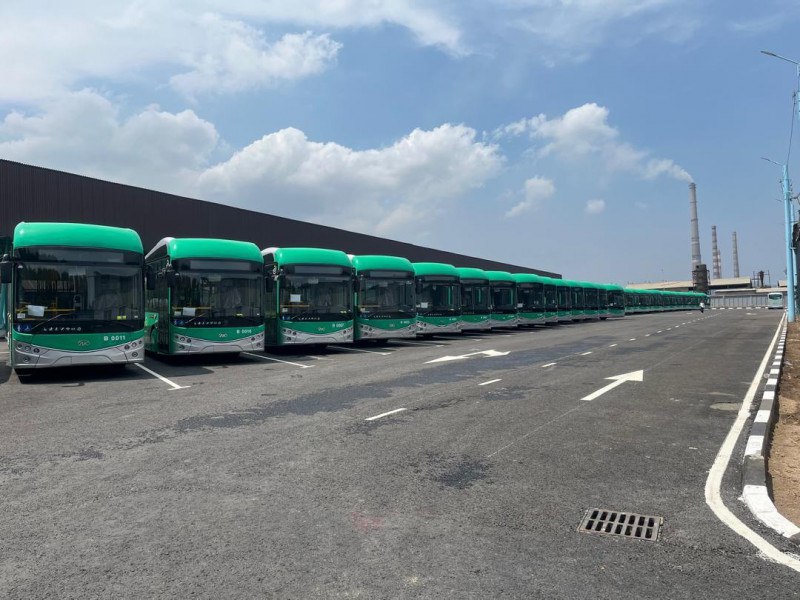
South Korean companies will assist Bishkek in building a modern charging infrastructure for electric public transport, following agreements reached between Kyrgyz Deputy Minister of Economy and Trade Sanzhar Bolotov and representatives of the Korea Environmental Transport Association, along with several private firms. The collaboration aims to jointly develop, implement, and operate a state-of-the-art network of charging stations for electric buses in the Kyrgyz capital. It also includes the introduction of improved environmental practices. “The South Korean side expressed its readiness not only to help with infrastructure, but also to transfer to Bishkek expert knowledge and technology in the field of eco-friendly transport, as well as to conduct extensive information campaigns to promote electric transport among the population,” the Kyrgyz Ministry of Economy and Trade stated. The agreement also encompasses a range of environmental initiatives. South Korean experts will assist Bishkek in improving air quality and reducing carbon emissions, critical objectives for a city frequently plagued by severe air pollution, particularly in the autumn and winter months. An important component of the agreement is the training of young specialists in South Korea. “Particular attention will be paid to the formation of a system of interaction between industry and the academic community, which will ensure the employment of trained specialists and the development of local expertise in the field of charging infrastructure operation,” the ministry added. Bishkek has pursued a consistent strategy of replacing traditional public transport with electric alternatives. Initially, the city phased out route taxis, replacing them with buses powered by gas and petrol. More recently, city authorities purchased 120 electric buses manufactured in China, with some units already delivered, through a project in collaboration with the Asian Development Bank. Concurrently, the city has begun phasing out its aging trolleybus fleet, a move that has sparked public debate. The infrastructure previously used for trolleybuses is being repurposed for the electric bus network. However, the process has faced delays, and several tenders for modifying the existing contact network have been cancelled. Starting in 2025, the popular Ala-Archa Nature Park will ban entry for vehicles with internal combustion engines. Tourists will be transported exclusively by municipal electric buses or allowed to use their own electric vehicles.