• KZT/USD = 0.00211
  • TJS/USD = 0.10810
  • UZS/USD = 0.00008
  • TMT/USD = 0.29760
  • KZT/USD = 0.00211
  • TJS/USD = 0.10810
  • UZS/USD = 0.00008
  • TMT/USD = 0.29760
  • KZT/USD = 0.00211
  • TJS/USD = 0.10810
  • UZS/USD = 0.00008
  • TMT/USD = 0.29760
  • KZT/USD = 0.00211
  • TJS/USD = 0.10810
  • UZS/USD = 0.00008
  • TMT/USD = 0.29760
  • KZT/USD = 0.00211
  • TJS/USD = 0.10810
  • UZS/USD = 0.00008
  • TMT/USD = 0.29760
  • KZT/USD = 0.00211
  • TJS/USD = 0.10810
  • UZS/USD = 0.00008
  • TMT/USD = 0.29760
  • KZT/USD = 0.00211
  • TJS/USD = 0.10810
  • UZS/USD = 0.00008
  • TMT/USD = 0.29760
  • KZT/USD = 0.00211
  • TJS/USD = 0.10810
  • UZS/USD = 0.00008
  • TMT/USD = 0.29760
02 August 2026

Viewing results 1 - 6 of 7

Kazakhstan and China Agree to Expand Scheduled Air Services

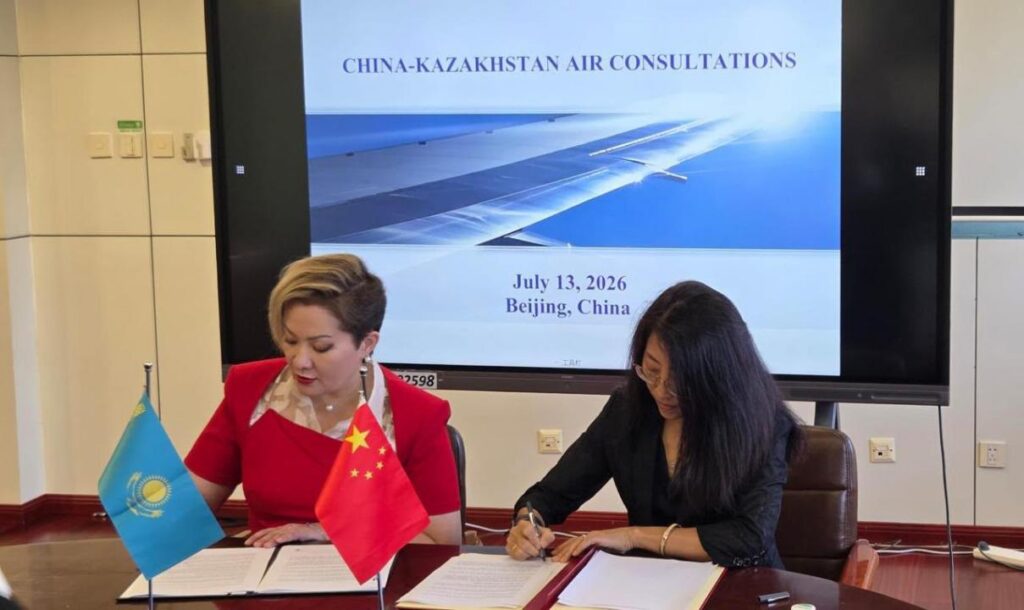
Kazakhstan and China have agreed to significantly expand scheduled air services between the two countries following aviation consultations held in Beijing between Kazakhstan’s Civil Aviation Committee and the Civil Aviation Administration of China. According to Kazakhstan’s Ministry of Transport, the talks focused on bilateral cooperation in civil aviation. The two sides agreed to increase the number of scheduled passenger flights operated by airlines of both countries from 124 to 152 flights per week. They also expanded the list of major Chinese destinations available for air services with Kazakhstan to 11 cities, adding Chongqing, one of southwestern China’s largest industrial, logistics, and transportation hubs, with a population of more than 32 million. The consultations also covered plans to launch direct flights between Astana and Shanghai, with airlines from both countries expected to participate. Another key issue was the creation of a third international air corridor between Kazakhstan and China. The new route is expected to increase the capacity of regional airspace, optimize flight paths, reduce congestion on existing air routes, and support further growth in passenger and cargo traffic between the two countries. The parties also discussed the allocation of airport slots for Kazakh airlines at Chinese airports, expanded access to Chinese airspace for Kazakh carriers operating international transit flights, and the conclusion of an interagency agreement on civil aviation search-and-rescue cooperation. “The two sides confirmed their mutual interest in further developing cooperation in civil aviation and agreed to continue joint efforts aimed at expanding air connectivity, improving transport links, and strengthening the strategic partnership between Kazakhstan and China,” the Ministry of Transport said. The agreement comes as Kazakhstan continues to expand its international aviation network. Earlier this month, Kazakhstan’s low-cost carrier FlyArystan announced the launch of a new Atyrau-Batumi route to Georgia beginning July 14, with weekly flights operated by Airbus A320 aircraft. From August 2026, Turkish carrier AJet will also increase frequencies on both the Astana-Ankara and Almaty-Ankara routes from two to seven weekly flights. As previously reported by The Times of Central Asia, Hong Kong’s flagship carrier Cathay Pacific plans to launch scheduled cargo services to Astana in August 2026, followed by regular passenger flights between Hong Kong and Almaty in January 2027.

Turkmenistan’s Air Connectivity Shows Little Change Despite Expansion Plans

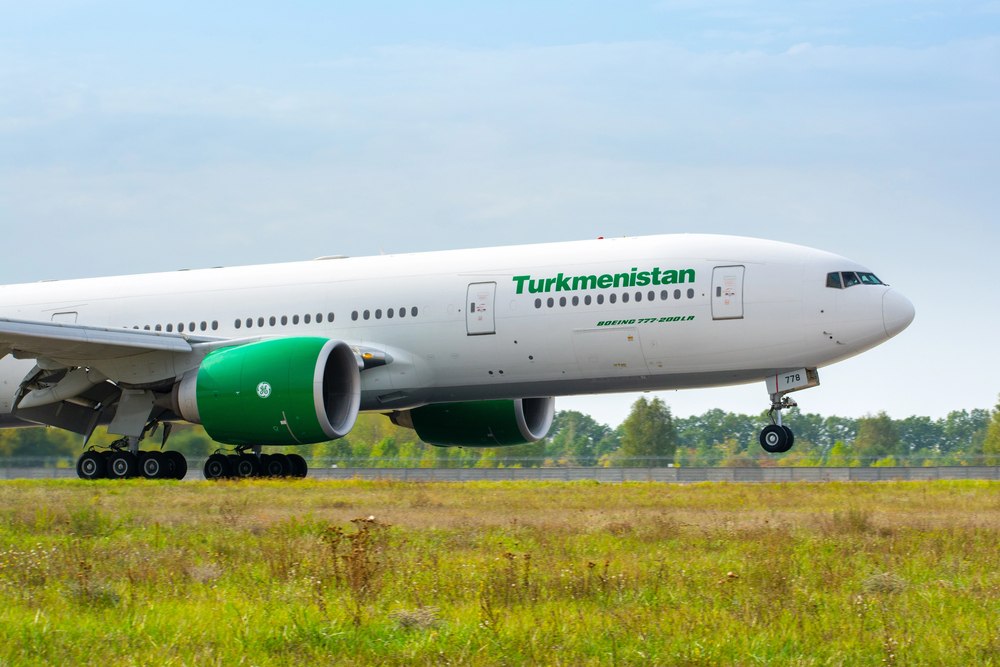
Turkmenistan’s airport schedules remain largely unchanged, with no new destinations added and previously announced flights yet to begin operating. Plans to expand international air links from Turkmenistan have been discussed for years, but little has changed in practice. At the end of last year, Russia’s S7 Airlines announced the launch of the Ashgabat-Novosibirsk route starting March 31. Tickets went on sale at the time, with flights planned once a week. However, as of early April, the flights are absent both from the airline’s schedule and from airport data. Only connecting options remain in booking systems. No official explanation has been provided, despite considerable interest in the route. Flights from Turkmenistan to Russia remain in high demand, significantly exceeding supply. Tickets sell out almost immediately despite high prices, which passengers often associate with monopoly conditions and possible corruption schemes. At present, the choice is limited to two routes: S7 Airlines operates Ashgabat-Moscow flights, while national carrier Turkmenistan Airlines serves only the Ashgabat-Kazan route. The limited number of direct routes forces passengers to seek alternatives. One of the most common is transit through Uzbekistan. The neighboring country can be reached by land, and from there dozens of flights to Russian cities are available. At the same time, there is separate demand for travel to Uzbekistan itself, including for business, education, and tourism. Nevertheless, Turkmenistan has no direct air links with any neighboring country. The restoration of flights with Uzbekistan was discussed in 2025 by presidents Serdar Berdimuhamedov and Shavkat Mirziyoyev, but no specific timelines or routes have been announced since. Some travel takes place via Azerbaijan. In the first two months of this year, more than 4,000 citizens of Turkmenistan entered the country. A significant share of these trips is related not to tourism but to obtaining European visas, as doing so from within Turkmenistan is more difficult. Meanwhile, discussions on transport cooperation between Ashgabat and Baku have focused mainly on cargo transportation. The only notable change has been an increase in the number of flights between Ashgabat and Istanbul, driven by the foreign carrier Turkish Airlines.

Kyrgyzstan and China to Launch Direct Flight Between Osh and Kashgar

A new air route connecting Osh, Kyrgyzstan’s second-largest city, with Kashgar in China’s Xinjiang Uyghur Autonomous Region is expected to launch in April, according to a statement from Airports of Kyrgyzstan JSC. The announcement follows a meeting held on January 30 with the Commercial Aircraft Corporation of China (COMAC). The new flight is intended to enhance transport connectivity between the two neighboring countries, deepen bilateral trade and economic ties, and promote tourism and cultural exchange. The route is expected to be operated by Chengdu Airlines, a COMAC-affiliated carrier, using COMAC’s C919 aircraft, China’s first domestically developed short-to-medium-range turbofan jet, which can accommodate up to 97 passengers. Osh already has an existing air link to Xinjiang. In November 2025, China Southern Airlines resumed flights between Osh and Urumqi, the region's capital. Xinjiang serves as a strategic gateway to China for Kyrgyzstan, and Kashgar is the departure point for the China-Kyrgyzstan-Uzbekistan (CKU) railway, an ambitious regional infrastructure project aimed at connecting China with Central Asia, the Middle East, and Europe. The 523-kilometer railway will run from Kashgar to Andijan, Uzbekistan, passing through Kyrgyzstan via Torugart, Makmal, and Jalal-Abad. Construction on the CKU railway officially began on December 27, 2024, in Kyrgyzstan’s Jalal-Abad region. New transport links by air and rail are expected to further boost trade between Kyrgyzstan and China. According to Chinese Ambassador to Kyrgyzstan Liu Jiangping, bilateral trade reached a record $27.2 billion in 2025, up 20% from the previous year.

ICAO to Develop Master Plan for Kazakhstan’s Civil Aviation

Kazakhstan’s Ministry of Transport and the International Civil Aviation Organization (ICAO) have signed an agreement to develop a strategic Master Plan for the Development of Kazakhstan’s Civil Aviation through 2050. The plan will outline a comprehensive strategy for the country’s civil aviation sector, covering the development of airports, air navigation systems, and airlines. It will also focus on improving flight safety, aviation security, accessibility, and the liberalization of air transport. Kazakhstan is the first country in Central Asia and the Commonwealth of Independent States (CIS) to establish a strategic partnership with ICAO for the sustainable development and modernization of its civil aviation sector. The initiative aligns with national objectives to enhance Kazakhstan’s role as a regional transit and transport hub. According to the Ministry of Transport, domestic airlines carried 14.3 million passengers in 2024, a 9% increase from 2023. Passenger traffic at Kazakhstan’s airports also grew by 14%, reaching 29.7 million people. Kazakhstan currently operates 582 flights per week to 31 countries, including Russia, Kyrgyzstan, Uzbekistan, Tajikistan, Georgia, Belarus, Azerbaijan, the United Arab Emirates, Saudi Arabia, Qatar, South Korea, China, India, and several European nations such as Germany, Italy, and the Netherlands. Additional destinations include countries in Southeast Asia, the Middle East, South Asia, Turkey, and the Maldives.

Uzbekistan Approves Regular Flights from Malaysia, South Korea, and Egypt

Uzbekistan has approved regular flights for airlines from Malaysia, South Korea, and Egypt, the Civil Aviation Agency under the Ministry of Transport of Uzbekistan announced. Under an intergovernmental air services agreement between Uzbekistan and Malaysia, AirAsia X Berhad received approval on February 3, 2025, to operate regular flights between Kuala Lumpur and Tashkent. On the same day, South Korea’s T’way Air was also granted permission to launch regular flights on the Seoul-Tashkent-Seoul route under the Uzbekistan-South Korea air services agreement. Both AirAsia X Berhad and T’way Air will operate these flights using Airbus A330 aircraft. On February 4, Egypt’s Red Sea Airlines received approval to operate regular flights between Sharm el-Sheikh and Tashkent. This decision follows the Uzbekistan-Egypt air services agreement, and the airline will use Boeing 737 aircraft for these flights. Previously, The Times of Central Asia reported that Uzbekistan Airways altered its flight routes to Europe starting in January, bypassing Russian and Belarusian airspace. The airline’s press service stated that the decision was based on recommendations from the European Union Aviation Safety Agency (EASA), and was not related to the recent Azerbaijan Airlines crash.

Uzbekistan Airways Reroutes Flights to Europe, Avoiding Russia and Belarus

Uzbekistan Airways has altered its flight routes to Europe, bypassing Russian and Belarusian airspace. The airline’s chairman, Shukhrat Khudoykulov, announced the decision at a press conference on January 28, according to local media reports. Flights are now taking a more southern route through Azerbaijan and Turkey. The change took effect on January 20, 2025. Reason for the Rerouting The airline’s press service told Kun.uz that the decision was made based on a recommendation from the European Union Aviation Safety Agency (EASA) and was not related to the recent Azerbaijan Airlines crash. “This is a recommendation from the European Aviation Safety Agency since we also serve European passengers,” the airline’s statement said. The change comes in the wake of the Azerbaijan Airlines crash on December 25, 2024. The aircraft, which was flying from Baku to the Russian city of Grozny, crashed near Aktau, Kazakhstan. Of the 67 people on board, 38 died, while 29 survived. Initial reports suggested that a Russian air defense system may have mistakenly shot down the plane during a Ukrainian drone attack on Grozny. A missile reportedly exploded near the aircraft, damaging its fuselage. Kazakhstan, which initially led the investigation, has transferred the case to Brazil’s aviation safety agency (CENIPA). The findings have been sent back to Kazakhstan and are expected to be released soon. Impact on Flight Times and Costs In response to Repost.uz, Uzbekistan Airways clarified that the change was made as a precautionary measure and also to helps optimize flight routes. The rerouting has increased travel distances. For example, the Tashkent-Munich flight, which previously covered 4,849 kilometers when flying through Russia, now spans 5,156 kilometers. This adds 30 to 40 minutes to flight times and raises operational costs for the airline.