• KGS/USD = 0.01144 0%
  • KZT/USD = 0.00201 0%
  • TJS/USD = 0.10527 0%
  • UZS/USD = 0.00008 0%
  • TMT/USD = 0.28571 0%
  • KGS/USD = 0.01144 0%
  • KZT/USD = 0.00201 0%
  • TJS/USD = 0.10527 0%
  • UZS/USD = 0.00008 0%
  • TMT/USD = 0.28571 0%
  • KGS/USD = 0.01144 0%
  • KZT/USD = 0.00201 0%
  • TJS/USD = 0.10527 0%
  • UZS/USD = 0.00008 0%
  • TMT/USD = 0.28571 0%
  • KGS/USD = 0.01144 0%
  • KZT/USD = 0.00201 0%
  • TJS/USD = 0.10527 0%
  • UZS/USD = 0.00008 0%
  • TMT/USD = 0.28571 0%
  • KGS/USD = 0.01144 0%
  • KZT/USD = 0.00201 0%
  • TJS/USD = 0.10527 0%
  • UZS/USD = 0.00008 0%
  • TMT/USD = 0.28571 0%
  • KGS/USD = 0.01144 0%
  • KZT/USD = 0.00201 0%
  • TJS/USD = 0.10527 0%
  • UZS/USD = 0.00008 0%
  • TMT/USD = 0.28571 0%
  • KGS/USD = 0.01144 0%
  • KZT/USD = 0.00201 0%
  • TJS/USD = 0.10527 0%
  • UZS/USD = 0.00008 0%
  • TMT/USD = 0.28571 0%
  • KGS/USD = 0.01144 0%
  • KZT/USD = 0.00201 0%
  • TJS/USD = 0.10527 0%
  • UZS/USD = 0.00008 0%
  • TMT/USD = 0.28571 0%

Viewing results 1 - 6 of 11

Soyuz Crew Lands Safely in Kazakhstan After Space Mission

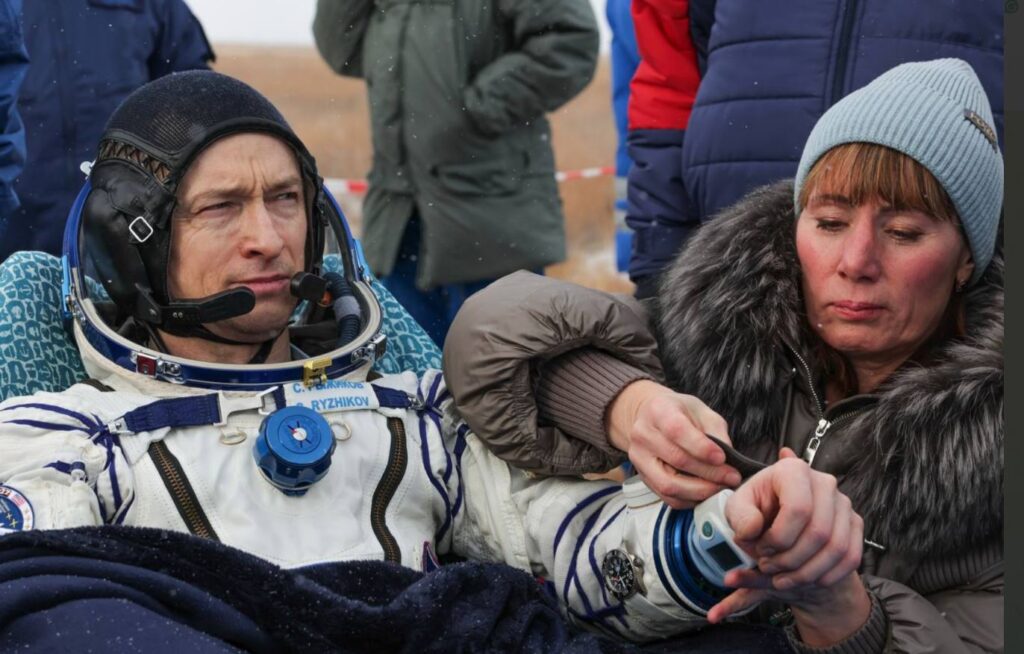
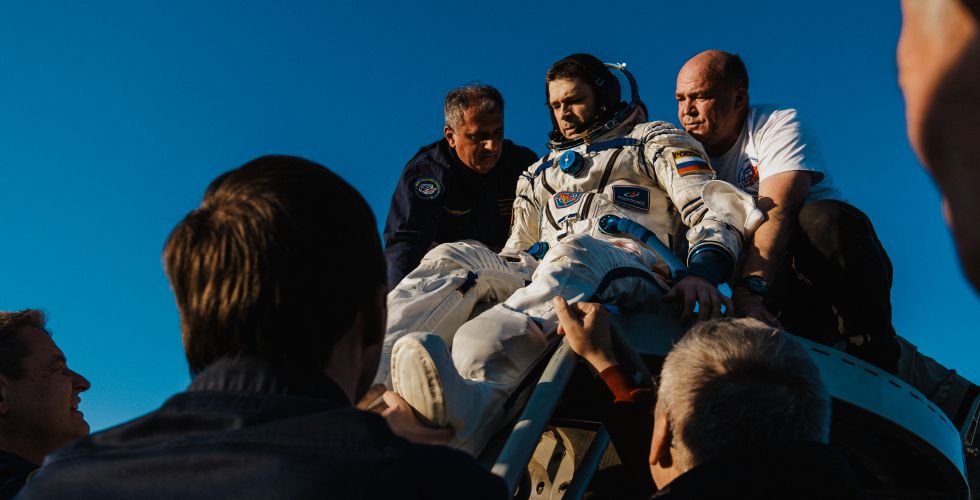
An American astronaut and two Russian cosmonauts landed in Kazakhstan on Tuesday after leaving the International Space Station, or ISS, in a Soyuz MS-27 spacecraft, ending an eight-month stay in space. NASA´s Jonny Kim and Sergey Ryzhikov and Alexey Zubritsky of Roscosmos, the Russian space agency, made the parachute-assisted landing in the steppes southeast of Zhezkazgan, in the central part of the country. “Early in the morning, they were on the ISS, and now they are on Earth,” Roscosmos said on Telegram. “Over the course of 245 days in space, the crew orbited Earth 3,920 times, traveling nearly 104 million miles,” NASA said. “They launched to the space station on April 8. This mission marked the first spaceflight for both Kim and Zubritsky, while Ryzhikov completed his third journey to space, logging a total of 603 days in space.” [caption id="attachment_40649" align="aligncenter" width="1307"] Image: Roscosmos[/caption] Kazakhstan’s Ministry of Foreign Affairs welcomed the safe landing and congratulated the three men on completing their mission aboard the International Space Station. The men conducted a number of scientific experiments on the station. “Kazakhstan remains a trusted partner in international space cooperation, providing essential infrastructure and conditions that support safe and successful human spaceflight,” the ministry said. The Baikonur Cosmodrome in Kazakhstan is a mainstay of the Russian space program.

Critical Baikonur Launch Pad Hit by Damage After Soyuz MS-28 Liftoff

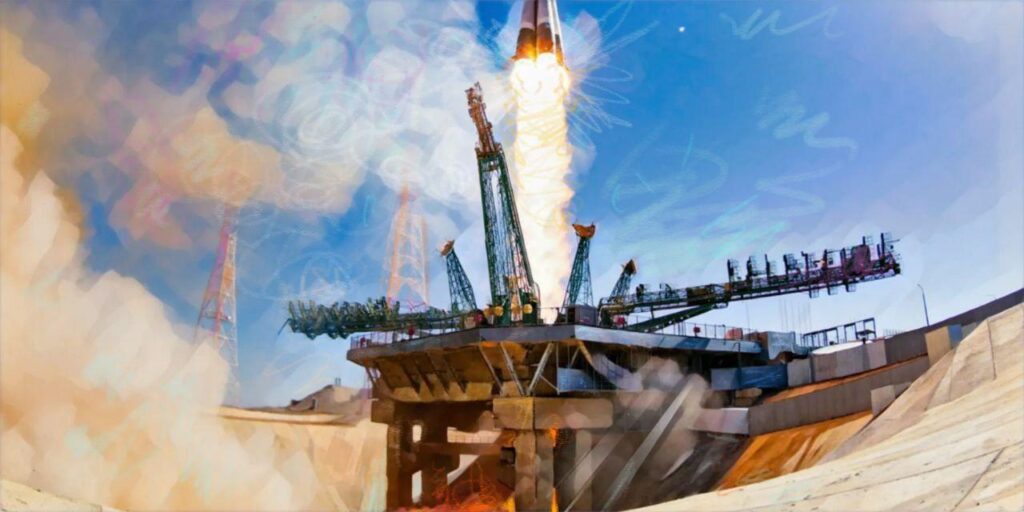
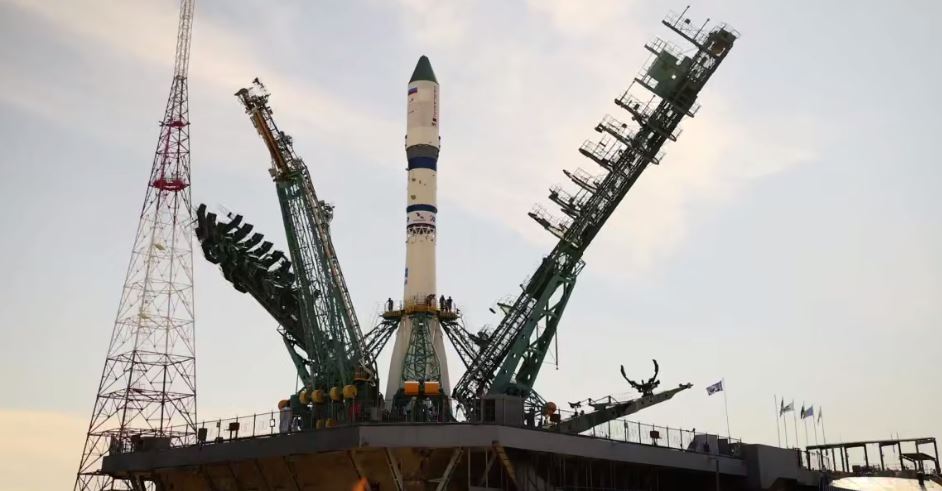
Russia’s space agency has confirmed that a launch pad at the Baikonur Cosmodrome in Kazakhstan was damaged during the liftoff of a Soyuz spacecraft that carried three crew to the International Space Station, raising questions about the near-term launch schedule at the site that Russia has relied on for more than six decades. Roscosmos reported that the Soyuz MS-28 mission lifted off from Baikonur on November 26 and reached orbit without problems. The spacecraft carried Russian cosmonauts Sergey Kud-Sverchkov and Sergey Mikayev, and NASA astronaut Christopher Williams. The crew docked with the station about three hours later. Roscosmos said in a statement on its official Telegram channel that the crew was healthy and the spacecraft worked as planned. Soon after the launch, engineers inspected Launch Pad 31/6, which served as the departure point for the flight. The agency said the inspection found damage to several structural elements on the pad and that repair work would start soon. Roscosmos said all required parts were on hand and the pad would be restored in the near future. Both The Moscow Times and Russian state media, including RIA Novosti, reported that the pad sustained damage but did not identify specific components. Roscosmos confirmed that “damage to several elements of the launch pad was detected.” Independent analysts have stated the damage might be more serious than Roscosmos has suggested, with Anatoly Zak, who publishes technical assessments of Russian space activity at RussiaSpaceWeb, reporting that a mobile service platform may have collapsed into the flame trench below the pad during or shortly after liftoff. Zak noted that the available launch pad for Russian crew missions might be unusable until engineers confirm the structure’s stability, and that it was unclear how soon crews or cargo could fly from Baikonur if the pad requires major work. Roscosmos has not confirmed a collapse of the platform, and it has not provided further details about the condition of the pad. The agency said the accident did not affect the MS-28 mission itself, which it described as nominal. But any impact on the pad is notable because Russia depends on Baikonur for its Soyuz crew launches. Russia leases the site from Kazakhstan through 2050 and continues to use its Soviet-era pads because Vostochny Cosmodrome in Russia’s Far East is not yet certified for crew flights. Russian outlets noted that future launches could face adjustments, but none reported a confirmed delay of a Progress mission. Roscosmos has neither confirmed the schedule nor said whether that mission will move to a later date. NASA has not issued a public statement about the status of joint operations after the incident. Russia and the United States continue to exchange seats on Soyuz and SpaceX vehicles under a 2022 agreement that allows both sides to maintain a sustained presence on the International Space Station. NASA has said the arrangement reduces risk because each side can reach the station even if one spacecraft type is grounded for technical reasons. The new damage at Baikonur highlights the...

Latest Baikonur Launch Pays Tribute to 1975 Apollo-Soyuz Mission

In July 1975, millions of people watched on television as a U.S. Apollo spacecraft docked with a Soviet Soyuz capsule in a crewed mission in orbit that symbolized collaboration between the two superpowers at the height of Cold War enmity. That remarkable moment 50 years ago is being commemorated on a Soyuz rocket carrying a Russian cargo spacecraft that launched from the Baikonur Cosmodrome in Kazakhstan – early on Friday, Baikonur time - and is scheduled to reach the International Space Station after a two-day trip. The spacecraft is loaded with more than 2.5 tons of fuel, drinking water, food, medicine, science equipment, and other supplies for the crew on the station. The Soyuz rocket currently heading to the ISS is painted white and blue and has an emblem marking the anniversary of the Soyuz-Apollo docking, which was the first international space mission. It had begun on July 15, 1975, when two Soviet cosmonauts launched from Baikonur and, hours later, three American astronauts blasted off from Cape Canaveral, Florida. The Russians and the Americans connected in space two days later, shaking hands, exchanging gifts, and sharing a meal. The show of comity in space contrasted with the intense competition between the two global rivals that was known as the “space race,” which included the Soviet launch of the Sputnik satellite into orbit in 1957 and the Apollo 11 landing of American astronauts on the moon in 1969. “I really believe that we were sort of an example … to the countries. We were a little of a spark or a foot in the door that started better communications,” Apollo astronaut Vance Brand had said, according to a NASA account of the Apollo-Soyuz mission. Tensions between Russia and the United States escalated after Moscow launched a large-scale invasion of Ukraine in 2022, though relations improved after U.S. President Donald Trump took office for a second term in January. The U.S. and Russian space agencies have continued to collaborate over the course of the protracted war. Roscosmos, the Russian space agency, refers to the cargo spacecraft currently in orbit as Progress MS-31, while the U.S. agency NASA uses the term Progress 92 because it’s the 92nd Russian resupply craft to launch in support of the International Space Station since its construction began in 1998. The Apollo-Soyuz mission has been described as a precursor of the ISS project.

NASA’s Oldest Active Astronaut, Two Russian Cosmonauts, Land in Kazakhstan

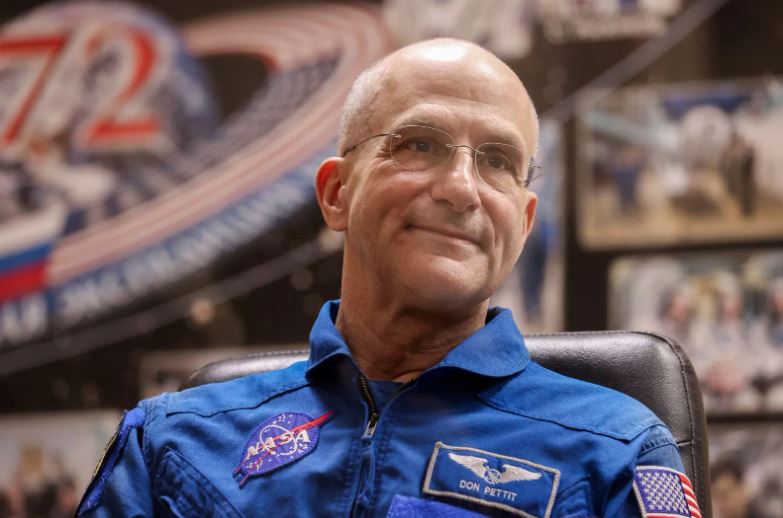
Accompanied by two Russian cosmonauts, NASA astronaut Donald Pettit marked his 70th birthday on Sunday with a parachute-supported landing on the steppes of Kazakhstan after a journey back to Earth from the International Space Station. A Soyuz MS-26 spacecraft carrying Pettit, as well as cosmonauts Alexey Ovchinin and Ivan Vagner, touched down at 6:20 a.m. local time southeast of Zhezkazgan, a city in Kazakhstan’s central Ulytau region. The three men had launched from the Russia-operated Baikonur Cosmodrome in Kazakhstan and docked at the station on Sept. 11 last year, spending a total of 220 days in space. “Rehabilitation and a meeting with loved ones lie ahead!” Roscosmos, the Russian space agency, said on Telegram. Photographs and video of the landing showed Pettit giving a thumbs-up as support team members carried him away from the spacecraft. Ovchinin and Vagner were shown wrapped in blankets and smiling broadly. Pettit, Ovchinin and Vagner orbited the Earth 3,520 times and traveled 93.3 million miles during their mission, according to NASA. It was Pettit’s fourth spaceflight and he has spent a total of 590 days in orbit. Ovchinin, also a four-time spaceflight traveler, has spent just five days longer than Pettit in space. Vagner has logged 416 days in space on his two trips. While American John Glenn became the oldest person to go to space in 1998 at age 77, Pettit is NASA’s oldest active astronaut. During his time on the space station, Pettit researched how to enhance in-orbit metal 3D printing capabilities, advance water sanitization technologies, explore plant growth under varying water conditions, and investigate fire behavior in microgravity, NASA said. His photography also attracted followers back on Earth. “Mother Earth, I am coming home,” Pettit posted on X on Saturday.

Grounding the Stars: Andrew McConnell’s Lens on Space and the Steppe

Award-winning photographer and filmmaker Andrew McConnell has dedicated his career to illuminating the world’s overlooked regions and underreported stories. He has a distinctive ability to examine major global issues and events from fresh, often unexpected perspectives. Ordinary people in extraordinary circumstances are the focus of McConnell’s lens. From conflict zones in the Democratic Republic of the Congo to the hidden lives of the Sahrawi people in Western Sahara, his work frequently highlights human endurance in challenging environments. His new book, Some Worlds Have Two Suns, takes a different direction. It explores the vast, remote Kazakh Steppe, where the sparse local population coexists with the high-tech world of space travel. The project began in 2014 after he filmed his documentary Gaza. While decompressing at home in Ireland, he watched a BBC documentary about a Soyuz spacecraft landing in the Kazakh Steppe. The stark contrast between destruction and human achievement struck him. “I turned to my parents and said, ‘I’m gonna go and see that.’” That moment sparked an eight-year journey documenting the Russian ground crews recovering astronauts and the communities living beneath these celestial homecomings. TCA: You visited the Kazakh Steppe multiple times to document the Soyuz landings. How many trips did you make and what were the challenges of reaching such a remote location? Andrew: I probably made a dozen. I would join the ground crew in Karaganda, which is not far from Astana, and from there they head out to the Steppe, and depending on whether it's winter or summer they have different vehicles for either one. In summer, the Steppe is fine to drive on, so they have four by fours and we head out and set up camp the day before the Soyuz arrives. They know the exact time the Soyuz will land, right down to the second, and it always goes to the same location, which is a group of tombs. You can see those in the book, the two horsemen beside these tombs. These are old nomadic burial tombs, maybe 300 years old, so that, initially, was very interesting to me… you know, what are these? The Steppe is this unending boundless void of nothingness, just flat grassland. At first, as a photographer, it was quite underwhelming because visually, how do you make that interesting? But here were these tombs in the middle of nowhere and it was instantly fascinating. That was always the base camp. I don’t know if that’s where Rocosmos aimed Soyuz, but that’s where it came into the atmosphere every time I saw it. It would enter the atmosphere above these tombs. The parachute deploys and then it depends on the wind because they can drift for 20 kilometers. A couple of times it was a windless day, and the Soyuz dropped within sight of these tombs. I had a fantasy that it would drop in the middle of it. [caption id="attachment_28250" align="aligncenter" width="2000"] Nomadic burial tombs, Soyuz landing zone, Kazakhstan, 2018; image: Andrew McConnell[/caption] TCA: What shifted your focus from the...

Crew of Record-Breaking Cosmonauts Land in Kazakh Steppe

The descent vehicle of the Soyuz MS-25 spacecraft has successfully landed in the steppe of Kazakhstan, near the town of Zhezkazgan. Russian cosmonauts Oleg Kononenko, Nikolai Chub, and NASA astronaut Tracy Dyson were on board. Cosmonauts Kononenko and Chub spent 374 days in space, making their mission one of the longest in International Space Station (ISS) history. This is second only to the flights of Valery Polyakov and Sergey Avdeev, who spent 438 and 380 days in space, respectively, on the Mir station. Tracy Dyson stayed in orbit for 184 days. During their mission, Kononenko and Chub participated in several scientific experiments, took four Progress MS cargo ships, and conducted two spacewalks. The flight was an important contribution to the development of applied and fundamental research on the ISS. The spacecraft landed yesterday at 14:59, Moscow time. Kononenko and Chub's flight was a significant event for the space programs of Roscosmos and NASA. Despite completing their mission, the crew of the 72nd long-duration expedition, including Russian and American cosmonauts and astronauts, continues to work on the ISS. The station crew includes Roscosmos cosmonauts Alexei Ovchinin, Ivan Wagner, and Alexander Grebenkin, and NASA astronauts Donald Pettit, Matthew Dominick, Michael Barratt, Jeanette Epps, Barry Wilmore, and Sunita Williams. The International Space Station (ISS) is one of mankind's most impressive engineering projects. It was launched in 1998, and is the product of 16 countries. The station revolves around the Earth every 90 minutes, allowing the crew to observe 16 sunrises and sunsets daily. In addition, the ISS is the largest object ever built in space, measuring about 109 meters long. The ISS is also considered the most expensive object built by humans, costing an estimated $120 billion by 2014, alone. According to NASA, the ISS "costs about $3 billion a year, roughly a third of NASA’s annual human space flight budget."