• KGS/USD = 0.01143 0%
  • KZT/USD = 0.00216 0%
  • TJS/USD = 0.10633 -0.28%
  • UZS/USD = 0.00008 0%
  • TMT/USD = 0.28571 0%
  • KGS/USD = 0.01143 0%
  • KZT/USD = 0.00216 0%
  • TJS/USD = 0.10633 -0.28%
  • UZS/USD = 0.00008 0%
  • TMT/USD = 0.28571 0%
  • KGS/USD = 0.01143 0%
  • KZT/USD = 0.00216 0%
  • TJS/USD = 0.10633 -0.28%
  • UZS/USD = 0.00008 0%
  • TMT/USD = 0.28571 0%
  • KGS/USD = 0.01143 0%
  • KZT/USD = 0.00216 0%
  • TJS/USD = 0.10633 -0.28%
  • UZS/USD = 0.00008 0%
  • TMT/USD = 0.28571 0%
  • KGS/USD = 0.01143 0%
  • KZT/USD = 0.00216 0%
  • TJS/USD = 0.10633 -0.28%
  • UZS/USD = 0.00008 0%
  • TMT/USD = 0.28571 0%
  • KGS/USD = 0.01143 0%
  • KZT/USD = 0.00216 0%
  • TJS/USD = 0.10633 -0.28%
  • UZS/USD = 0.00008 0%
  • TMT/USD = 0.28571 0%
  • KGS/USD = 0.01143 0%
  • KZT/USD = 0.00216 0%
  • TJS/USD = 0.10633 -0.28%
  • UZS/USD = 0.00008 0%
  • TMT/USD = 0.28571 0%
  • KGS/USD = 0.01143 0%
  • KZT/USD = 0.00216 0%
  • TJS/USD = 0.10633 -0.28%
  • UZS/USD = 0.00008 0%
  • TMT/USD = 0.28571 0%

Viewing results 1 - 6 of 30

Welcome to Turkmenistan? President Says He Wants International Tourists to Visit

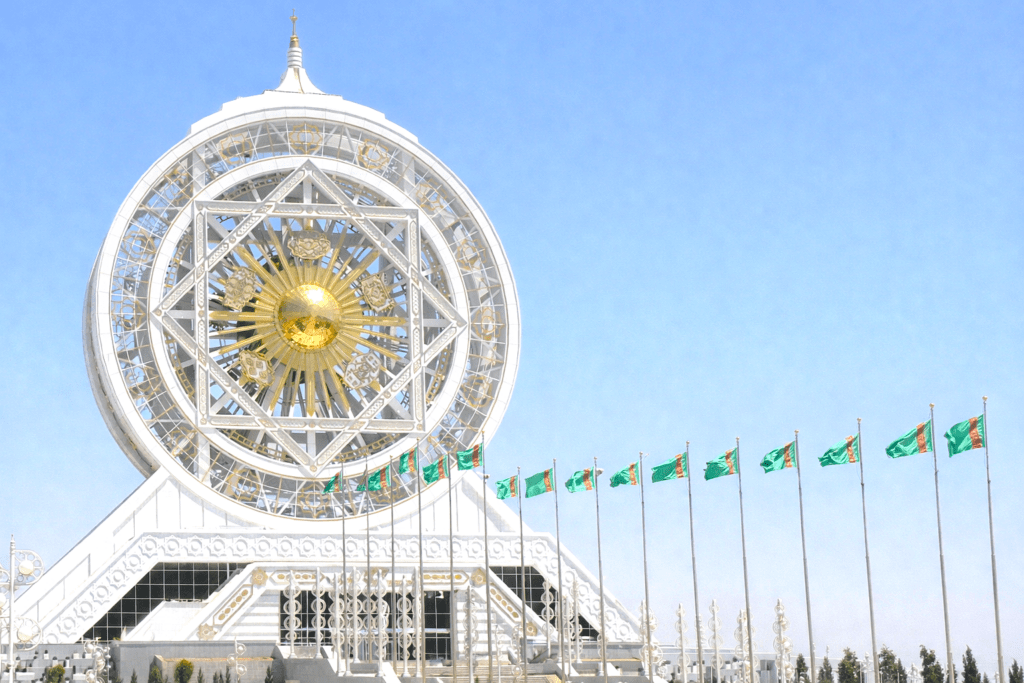
Turkmenistan, one of the world’s most closed countries, is hosting an international tourism conference this week. The “TurkmenTravel – 2026” event in the capital of Ashgabat aims to attract foreign visitors to a country that is generally difficult to visit because of tight controls, including required letters of invitation and the need to have licensed guides. While some travel agencies aim to address those challenges for tourists, Turkmenistan remains a little-understood country and lags far behind regional countries such as neighboring Uzbekistan in terms of infrastructure and accessibility for travelers. But the three-day tourism conference, which ends on Thursday, could be a tentative sign that Turkmenistan wants to open up, selectively, and within the limits of a tightly controlled system that restricts the internet and other sources of information for its citizens. [caption id="attachment_13432" align="aligncenter" width="1920"] Ashgabat Arch of Neutrality; image: Stephen M. Bland[/caption] Across Central Asia, governments increasingly treat tourism as both an economic sector and a tool of international image-building. Turkmenistan now appears to want some of that attention, but on its own carefully managed terms. The event was a priority for Turkmenistan’s government. President Serdar Berdimuhamedov delivered a message of encouragement to the participants and said tourism was growing in the Central Asian country whose stated policy is one of neutrality in international affairs. Statistics on tourism growth and other metrics are hard to come by in Turkmenistan, however. That makes the message from Ashgabat especially striking: a state known less for openness than for control is publicly promoting tourism growth while offering little transparent data to show how far that growth has actually come. [caption id="attachment_47157" align="aligncenter" width="2560"] Kunya-Urgench- The ancient Nejameddin Kubra and Sultan Ali Mausoleums; image: Stephen M. Bland[/caption] “Permanently neutral, Turkmenistan places great importance on expanding international cooperation in this area,” the president said. He noted collaboration with the U.N. World Tourism Organization and other international institutions. For years, Turkmenistan’s image abroad has rested less on mass tourism than on mystery: the white-marble capital, vast desert landscapes, major Silk Road sites, and a political system that has often kept outsiders at a distance. In Ashgabat, that mystery is part of the experience from the start. White marble towers rise in regimented lines, fountains splash into largely empty spaces, and broad avenues can feel strangely still. The city is visually extravagant but tightly controlled, with an atmosphere that can leave visitors unsure whether they are in a showcase capital, a stage set, or both. Berdimuhamedov listed some of Turkmenistan’s attractions: Ancient Merv, Nisa, and Kunya-Urgench, the Bereketli Garagum and Gaplaňgyr nature reserves, desert ecosystems, and the elaborate architecture in Ashgabat. [caption id="attachment_27727" align="aligncenter" width="2560"] Ashgabat - A row of marble towers in the Berzengi district; image: Stephen M. Bland[/caption] Cordula Wohlmuther, regional director for Europe of U.N. Tourism, was one of the listed speakers at the tourism conference. The agenda for the event included a session titled “How to promote Central Asian culture on the world stage.” One company, Asia Odyssey Travel, portrays Turkmenistan...

American Firm to Build Theme Park in Kyrgyzstan

U.S.-based IdeAttack, Inc. is set to build a theme park in Tokmok, a city located approximately 60 kilometers east of Kyrgyzstan’s capital, Bishkek. The Tourism Development Support Fund of the Kyrgyz Republic and the Chui District Administration have signed a memorandum with IdeAttack, allocating a 50-hectare land plot for the park’s development. IdeAttack specializes in the planning and design of large-scale mixed-use developments, theme parks, cultural attractions, and destination resorts. The company has previously delivered projects in the United States, United Arab Emirates, China, and South Korea. The Tokmok park will feature: Architecture inspired by Central Asian fantasy Attractions based on the Kyrgyz Epic of Manas Theme zones centered on the Great Silk Road Live shows with music, dance, and theatrical performances Master classes on yurt-making, felt production, horse riding, and traditional cuisine This marks IdeAttack’s first project in both Kyrgyzstan and Central Asia. The initiative is expected to boost international tourism to the region.

Visits of Chinese Tourists to Kazakhstan Surged in 2024

In 2024, 655,000 Chinese tourists visited Kazakhstan, representing a 78% increase compared to the previous year, Nurtas Karipbayev, chairman of the Tourism Industry Committee at the Ministry of Tourism and Sports of Kazakhstan, announced at a press conference on February 6. The surge in visitors comes as Kazakhstan declared 2024 the "Year of Kazakhstan Tourism in China", an initiative aimed at strengthening cultural and economic ties between the two countries. The program promoted Kazakhstan as a travel destination and facilitated collaborations between tourism industry stakeholders from both nations. As part of the initiative, leading Chinese media and social networks - with a combined audience exceeding 1.3 billion people - broadcast and published content about Kazakhstan, significantly boosting its appeal among Chinese travelers, Karipbayev stated. He noted that Almaty was the most popular destination for Chinese tourists in Kazakhstan. Kazakhstan also participated in four major tourism exhibitions in China: ITB China, ITE Hong Kong, COTTM, and the China International Medical Tourism Fair. These events helped establish new partnerships with leading Chinese tour operators. "Throughout the year, various Kazakh cities and regions hosted 10 major presentation tours. These events further heightened interest in Kazakhstan. Participation in tourism exhibitions and the organization of informational tours remain key priorities in our collaboration," Karipbayev said. The increase in tourist flow was further supported by the mutual visa-free travel regime, which took effect in November 2023. Under this arrangement, Kazakh and Chinese citizens can travel visa-free for up to 30 days per visit, with a maximum stay of 90 calendar days within a 180-day period. The agreement covers tourism, medical treatment, business trips, and transit travel. Following the success of 2024, the governments of Kazakhstan and China have designated 2025 as the "Year of China Tourism in Kazakhstan", aiming to further expand travel and cultural exchanges between the two countries.

Kazakhstan to Provide Tourists with QR-Code Security Cards

Foreign visitors entering Kazakhstan will now receive a special card with a QR code linking to the multilingual portal SafeTravel.kz, a platform designed to enhance tourist safety and provide access to essential services. The Ministry of Internal Affairs has launched this initiative as part of broader efforts to improve security measures for foreign visitors. Cards with QR codes are now being distributed at border checkpoints and airports, with the first set already in use at Kazakhstan’s international airport in Astana. Through SafeTravel.kz, tourists can access: The "102" mobile app for instant contact with police, including an SOS function A memo on migration laws and entry requirements A city map with links to navigation and travel apps A list of official taxi and online transport services Information on telecommunications operators with links to their websites Emergency response guidelines for various incidents Contact details for ambulance, fire, and rescue services Kazakhstan’s introduction of this QR-code security system aims to ensure a safer and more convenient experience for international travelers by providing quick access to emergency services and essential information.

Kyrgyzstan Facilitates Group Travel Tourism from China

On February 4, Kyrgyzstan’s Ministry of Economy and Commerce and China’s Ministry of Culture and Tourism signed a memorandum in Beijing aimed at facilitating organized group travel from China to Kyrgyzstan. The agreement was signed during Kyrgyz President Sadyr Japarov’s state visit to China and is expected to boost Kyrgyzstan’s tourism industry and contribute to economic growth. According to Kyrgyzstan’s Ministry of Economy and Commerce, 127,956 Chinese citizens visited the country in 2024, marking a 56% increase from 70,842 visitors in 2023. China has also included Kyrgyzstan on its list of recommended destinations for individual Chinese travelers. In October 2024, Kyrgyzstan introduced a visa-free regime for organized Chinese tour groups for stays of up to 21 days. The move aims to strengthen Kyrgyz-Chinese public diplomacy and enhance the country’s appeal to one of the world’s largest outbound tourism markets. Kyrgyzstan’s tourism industry has been experiencing steady growth in recent years. The country was expected to welcome more than 10.5 million foreign tourists in 2024, up from 8.5 million in 2023. In the first eight months of 2024, Kyrgyzstan recorded 6.1 million foreign visitors, with the majority coming from Uzbekistan, Kazakhstan, and Russia. Other significant sources of tourists included Turkey, China, India, Germany, Pakistan, the United States, and South Korea.

Kyrgyzstan Simplifies Entry Rules for Foreign Citizens

Kyrgyzstan has introduced significant changes to its visa policy, eliminating several visa categories, including business, tourist, and mountain tourism visas, as part of efforts to improve its investment climate and boost tourism. These visas will now be replaced with a streamlined system centered around a new “Sapar visa”, which can be issued within 24 hours of application. According to the Ministry of Foreign Affairs, the Sapar visa will be available to foreign citizens traveling to Kyrgyzstan for business, tourism, or private purposes, such as visiting friends or undergoing medical examinations. The visa allows stays of up to 90 days and offers both single-entry and multiple-entry options. The changes will take effect on January 22, 2025, with applications submitted through the government’s Electronic Visa portal. The e-visa portal, launched five years ago, was developed to simplify the visa application process, particularly for tourists and investors. The system is user-friendly, requiring only an internet connection, a credit or debit card for payment, and scanned copies of necessary documents. By modernizing its visa policies and making the process faster and more accessible, Kyrgyzstan hopes to attract more foreign investors and tourists, bolstering economic growth. The government’s approach reflects a commitment to removing bureaucratic hurdles and positioning the country as an attractive destination for both business and leisure travel.