• KZT/USD = 0.00221
  • TJS/USD = 0.10830
  • UZS/USD = 0.00008
  • TMT/USD = 0.29760
  • KZT/USD = 0.00221
  • TJS/USD = 0.10830
  • UZS/USD = 0.00008
  • TMT/USD = 0.29760
  • KZT/USD = 0.00221
  • TJS/USD = 0.10830
  • UZS/USD = 0.00008
  • TMT/USD = 0.29760
  • KZT/USD = 0.00221
  • TJS/USD = 0.10830
  • UZS/USD = 0.00008
  • TMT/USD = 0.29760
  • KZT/USD = 0.00221
  • TJS/USD = 0.10830
  • UZS/USD = 0.00008
  • TMT/USD = 0.29760
  • KZT/USD = 0.00221
  • TJS/USD = 0.10830
  • UZS/USD = 0.00008
  • TMT/USD = 0.29760
  • KZT/USD = 0.00221
  • TJS/USD = 0.10830
  • UZS/USD = 0.00008
  • TMT/USD = 0.29760
  • KZT/USD = 0.00221
  • TJS/USD = 0.10830
  • UZS/USD = 0.00008
  • TMT/USD = 0.29760
17 October 2026

Viewing results 1 - 6 of 50

Turkey, Uzbekistan, and Azerbaijan Plan New Trade Route Connecting Asia and Europe

Turkish President Recep Tayyip Erdoğan met with delegations from Uzbekistan and Azerbaijan on January 29 to discuss strengthening regional trade and connectivity. At the meeting, Uzbekistan's Foreign Minister Bakhtiyor Saidov delivered a letter from President Shavkat Mirziyoyev. “We conveyed the warmest greetings and a letter from His Excellency the President of Uzbekistan, Shavkat Mirziyoyev. The strong ties between our leaders form the foundation for close cooperation in all areas. Our peoples, connected by a shared history, traditions, and customs, are working together for a better future,” Saidov wrote on Telegram. Saidov was in Ankara for a trilateral forum with his Turkish and Azerbaijani counterparts. Ahead of the event, he held talks with Turkish Foreign Minister Hakan Fidan and Azerbaijani Foreign Minister Jeyhun Bayramov. During the forum, the three countries discussed expanding trade routes between Asia and Europe, as reported by the Anadolu Agency. Turkish Foreign Minister Hakan Fidan stated that the Middle Corridor — which runs through Central Asia, the Caspian Sea, the Caucasus, and Turkey — has proven to be the most reliable and cost-effective trade route between the two continents. Fidan stressed the importance of regional cooperation in the economic, transport, and energy sectors, particularly in light of recent global disruptions caused by the pandemic and conflicts. He also noted Turkey’s growing role as an energy hub amid ongoing challenges in global energy supply. Beyond trade, the ministers addressed regional security concerns, including the situation in Syria. Fidan described recent developments there as a “new window of opportunity” for reconstruction and stability. He called for joint efforts to support Syria’s rebuilding process, emphasizing that stability in the region would enhance trade, transport, and energy cooperation. During the forum, Turkey, Azerbaijan, and Uzbekistan outlined a joint declaration and road map for future cooperation, covering foreign policy and regional cooperation between the three countries; expanding trade, economic, and investment ties to boost regional commerce; and developing transport routes and enhancing regional connectivity. Transport ministers from all three nations will now work on improving logistics and transit routes to further facilitate trade.
Kazakhstan-China Railway Cargo Transportation Reaches Record High in 2024

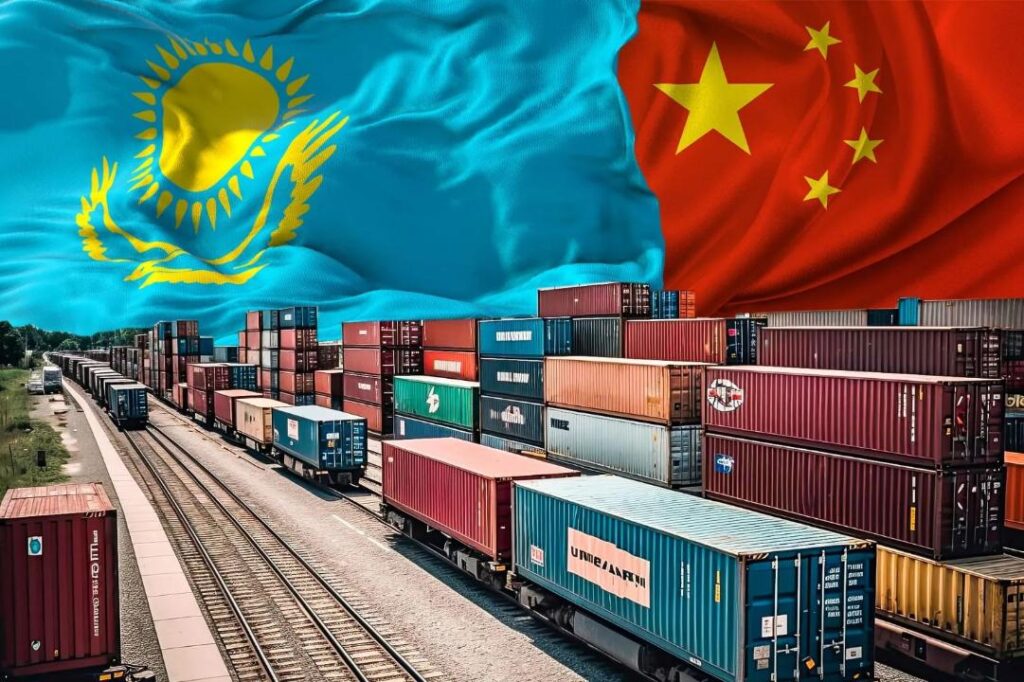
In 2024, railway cargo transportation between Kazakhstan and China exceeded 32 million tons, achieving an all-time high, according to the Kazakh Ministry of Transport. Kazakhstan’s rail exports to China grew by 1 million tons, totaling 13.7 million tons. Key export commodities included iron and non-ferrous ore, ferrous and non-ferrous metals, and grain. Meanwhile, Chinese transit cargo passing through Kazakhstan increased by 19%, reaching 15.3 million tons. Additionally, containerized Chinese cargo transiting to Europe via the Trans-Caspian International Transport Route (TITR) recorded significant growth, rising by 43% compared to 2023. One of the main drivers of this record-breaking performance was the opening of a Kazakh terminal at the dry port in Xi’an, China. In 2024, more than 300 container trains passed through this terminal and the Kazakh Caspian port of Aktau, an astonishing thirtyfold increase from 2023. Kazakhstan Temir Zholy (KTZ), the country’s national railway company, has expanded its terminal network. Currently, Kazakhstan operates five major terminals: The port of Lianyungang (China), The dry port in Xi’an (China), Dostyk railway station (Kazakhstan), The Khorgos Gateway dry port (Kazakhstan), and The ferry complex at the Caspian port of Kuryk (Kazakhstan). Kazakhstan has announced plans to add nine additional terminals over the next two years, reinforcing Kazakhstan’s position as a vital hub for transcontinental trade. Several terminal construction projects began in 2024, including: Almaty, Kazakhstan: A logistics hub aimed at strengthening domestic cargo-handling capacity. Azerbaijani port of Alat: A joint project involving Kazakhstan, Azerbaijan, and China to establish a cargo terminal in Baku. Budapest, Hungary: A terminal in Hungary’s capital designed to expand Kazakhstan’s trade network in Europe. Selyatino, Russia: A facility near Moscow to support rail cargo transportation between Kazakhstan, Russia, and China. Additionally, and in collaboration with China’s port of Lianyungang, Kazakhstan has begun constructing a container hub at the Caspian port of Aktau. Kazakhstan’s expanding railway infrastructure will solidify its role as a key logistics hub connecting China, Central Asia, and Europe. With continued investment in terminal networks and partnerships with regional and global stakeholders, Kazakhstan is well-positioned to further enhance its trade capacity and meet the growing demand for transcontinental cargo transportation.

Long-Awaited Construction of China-Kyrgyzstan-Uzbekistan Railway Officially Launched

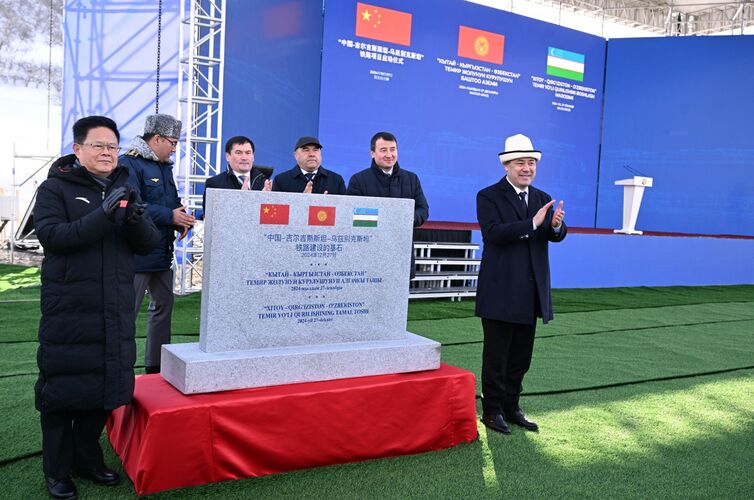
On December 27, Kyrgyzstan's President Sadyr Japarov, the Chairman of the National Development and Reform Commission of the People's Republic of China, Zheng Shanjie, and Uzbekistan’s Deputy Prime Minister Jamshid Khodjayev participated in a ceremony to mark the start of construction on the China-Kyrgyzstan-Uzbekistan railway. The event occurred in the village of Tosh-Kutchu in Kyrgyzstan’s Jalal-Abad region, where they laid the first stone for this significant regional transportation project. Speaking at the ceremony, President Japarov highlighted the importance of the China-Kyrgyzstan-Uzbekistan railway as more than just a transportation route, describing it as a critical strategic bridge linking the East and West. "This route will ensure the delivery of goods from China to Kyrgyzstan, as well as to the countries of Central Asia and the Middle East, including Turkey, and on to the European Union. The project will strengthen interregional ties, help diversify transport routes and increase the competitiveness of the region as an international transport and transit hub, which is in line with the goals of the Central Asian countries," Japarov said. Zheng Shanjie delivered a message from Chinese President Xi Jinping, highlighting that the new land corridor connecting Asia and Europe will significantly increase the flow of people and trade among the three countries. According to the message, the project is expected to drive regional prosperity by fostering industrial and resource development, boosting trade, and attracting investment. Uzbekistan's President Shavkat Mirziyoyev, in an address read by Deputy Prime Minister Khodjayev, called the launch of railway construction a historic milestone that the three nations had been working toward for nearly 30 years. The Uzbek leader noted that the new transportation artery, which will establish the shortest land route connecting Central Asia and China, will strengthen the strategic partnership between the three nations. The 523-kilometer railway will traverse Kashgar (China), Torugart, Makmal, Jalal-Abad (Kyrgyzstan), and Andijan (Uzbekistan). Once completed, the railway is expected to handle up to 15 million tons of cargo annually. Currently, neither Kyrgyzstan nor Uzbekistan has a direct railway connection to China. Central Asia’s rail link to China is limited to a route through Kazakhstan, leaving Kyrgyzstan and Uzbekistan without a direct connection.

Important Deal Signed for China-Kyrgyzstan-Uzbekistan Railway Project

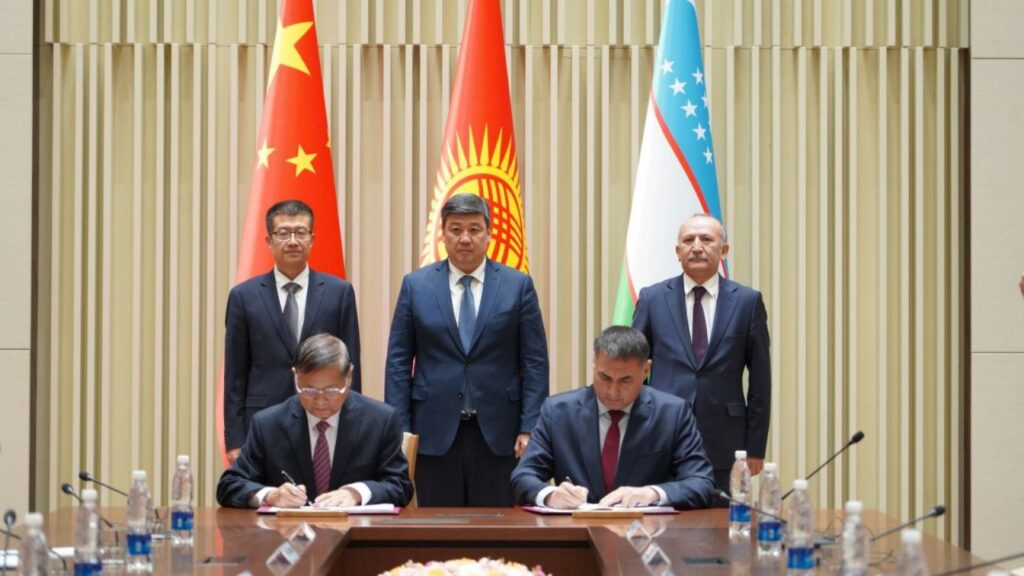
On December 20, Bishkek hosted the signing of an investment agreement between Kyrgyzstan’s Cabinet of Ministers and China-Kyrgyzstan-Uzbekistan Railway Company LLC. The agreement encompasses the design, construction, financing, operation, and maintenance of the China-Kyrgyzstan-Uzbekistan railway. The announcement came shortly after Kyrgyz President Sadyr Japarov revealed that construction on the strategic railway, which will connect the three nations, is set to begin on December 27. The agreement was signed by Kyrgyzstan’s Minister of Transport and Communications, Absattar Syrgabaev, and Zhong Shenggui, Chairman of the Board of Directors of China-Kyrgyzstan-Uzbekistan Railway Company LLC. A Historic Milestone The signing ceremony was attended by Kyrgyz Deputy Chairman of the Cabinet of Ministers and Minister of Water Resources, Agriculture, and Processing Industry Bakyt Torobayev; Li Baojie, Charge d’Affaires of the Chinese Embassy in Kyrgyzstan; and Saidikram Iyazkhodjaev, Uzbekistan’s Ambassador to Kyrgyzstan. In his remarks, Torobayev called the agreement a historic achievement for the three nations, marking the conclusion of a lengthy negotiation process and the start of practical implementation. “This large-scale infrastructure project is of both regional and international significance,” he emphasized. Strategic Importance of the Railway The China-Kyrgyzstan-Uzbekistan railway is a pivotal development for the transport strategies of the participating countries. Currently, neither Kyrgyzstan nor Uzbekistan has a direct railway link with China, while Central Asia’s rail connection to China is limited to a route through Kazakhstan. Furthermore, Kyrgyzstan and Uzbekistan lack a direct railway link between them. The project’s significance was cemented on June 6, 2024, when China, Kyrgyzstan, and Uzbekistan signed an intergovernmental agreement in Beijing. The 523-kilometer railway will traverse Kashgar (China), Torugart, Makmal, Jalal-Abad (Kyrgyzstan), and Andijan (Uzbekistan). Transit and logistics infrastructure will be developed along the route to support its operations. Once completed, the railway is expected to transport up to 15 million tons of cargo annually, significantly enhancing trade and connectivity in the region.

Kazakhstan and China Digitalize Customs Procedures on Middle Corridor

Kazakhstan Temir Zholy (KTZ), Kazakhstan's national railway company, has announced the digitalization of customs declaration procedures for transit cargo along the Trans-Caspian International Transport Route (TITR), also known as the Middle Corridor, at the border between Kazakhstan and China. In collaboration with Global DTC, KTZ Express - a subsidiary of KTZ - has launched the Tez Customs digital platform. This system transitions customs operations to a paperless format, reducing processing time to just 30 minutes after a train's arrival at the border station. The platform enables preliminary preparation of documents, automatic registration, and issuance of transit declarations. These capabilities optimize logistics processes, enhance transparency at all stages of customs clearance, and significantly reduce the time required for customs operations. Since May 2024, Tez Customs has fully automated customs clearance processes for transit cargo along the China–Central Asia route via Kazakhstan, specifically along the Altynkol-Saryagash section. In October 2024, its scope was expanded to include cargo transported along the Middle Corridor. To date, Tez Customs has processed over 54,000 transit declarations on the China to Central Asia route and more than 5,000 declarations on the TITR. The Trans-Caspian International Transport Route serves as a critical link between China and Europe, passing through Kazakhstan and the Caucasus. More than 80% of all land cargo transported from China to Europe travels through Kazakhstan, according to Kazakh statistics. During the first nine months of 2024, the volume of cargo transported along the Middle Corridor increased by 23% compared to the entirety of the previous year, reaching 3.4 million tons. Projections suggest that by 2030, this figure will rise to 10 million tons annually. The digitalization of customs procedures via Tez Customs represents a significant advancement in the efficiency and transparency of transit operations on the TITR. This innovation reinforces Kazakhstan’s position as a vital transit hub for trade between China, Central Asia, and Europe, while also supporting the continued growth of cargo volumes along the Middle Corridor.

China to Transport Lithium-Ion Batteries Along TITR via Kazakhstan

This month marks a significant milestone in Kazakhstan-China transport cooperation with the test shipment of lithium-ion batteries from China via the Trans-Caspian International Transport Route (TITR). This major trade corridor links China to Europe through Kazakhstan and the Caucasus. The decision was announced following a meeting between Kazakhstan’s Minister of Transport Marat Karabayev and China’s Transport Minister Liu Wei in Beijing on December 5. Strengthening TITR Cooperation The two ministers agreed on initiatives to further develop the TITR, including the creation of a permanent working group to facilitate the seamless flow of goods. They also highlighted advancements in the digitization of transport operations. Truckers can now receive permit forms within an hour through a newly implemented digital platform, streamlining international road transportation. The TITR is seeing rapidly growing freight traffic. According to Kazakhstan’s Ministry of Transport, road freight volumes with China have more than doubled annually. Before 2023, Kazakh truckers made approximately 50,000 trips per year. In 2024, this figure is projected to reach 230,000 trips. Expanding Multimodal Transport The meeting also explored the potential for developing cargo transportation via transboundary rivers between the two nations. Both ministers noted a surge in rail and road freight volumes, as well as transit transportation through the Middle Corridor (another name for the TITR). From January to October 2024, rail freight between Kazakhstan and China increased by 13%, reaching 26.6 million tons. Road freight volumes soared by 60% in the third quarter alone, amounting to 1.9 million tons. Meanwhile, cargo transportation from China to Europe via the TITR has experienced explosive growth. In 2024, the volume surpassed 27,000 twenty-foot containers, a 25-fold increase compared to the same period in 2023.