• KGS/USD = 0.01144 0%
  • KZT/USD = 0.00212 0%
  • TJS/USD = 0.10841 -0.46%
  • UZS/USD = 0.00008 0%
  • TMT/USD = 0.28490 0%
  • KGS/USD = 0.01144 0%
  • KZT/USD = 0.00212 0%
  • TJS/USD = 0.10841 -0.46%
  • UZS/USD = 0.00008 0%
  • TMT/USD = 0.28490 0%
  • KGS/USD = 0.01144 0%
  • KZT/USD = 0.00212 0%
  • TJS/USD = 0.10841 -0.46%
  • UZS/USD = 0.00008 0%
  • TMT/USD = 0.28490 0%
  • KGS/USD = 0.01144 0%
  • KZT/USD = 0.00212 0%
  • TJS/USD = 0.10841 -0.46%
  • UZS/USD = 0.00008 0%
  • TMT/USD = 0.28490 0%
  • KGS/USD = 0.01144 0%
  • KZT/USD = 0.00212 0%
  • TJS/USD = 0.10841 -0.46%
  • UZS/USD = 0.00008 0%
  • TMT/USD = 0.28490 0%
  • KGS/USD = 0.01144 0%
  • KZT/USD = 0.00212 0%
  • TJS/USD = 0.10841 -0.46%
  • UZS/USD = 0.00008 0%
  • TMT/USD = 0.28490 0%
  • KGS/USD = 0.01144 0%
  • KZT/USD = 0.00212 0%
  • TJS/USD = 0.10841 -0.46%
  • UZS/USD = 0.00008 0%
  • TMT/USD = 0.28490 0%
  • KGS/USD = 0.01144 0%
  • KZT/USD = 0.00212 0%
  • TJS/USD = 0.10841 -0.46%
  • UZS/USD = 0.00008 0%
  • TMT/USD = 0.28490 0%

Viewing results 1 - 6 of 8

Kazakhstan Invites Islamic Development Bank to Open New Astana Office

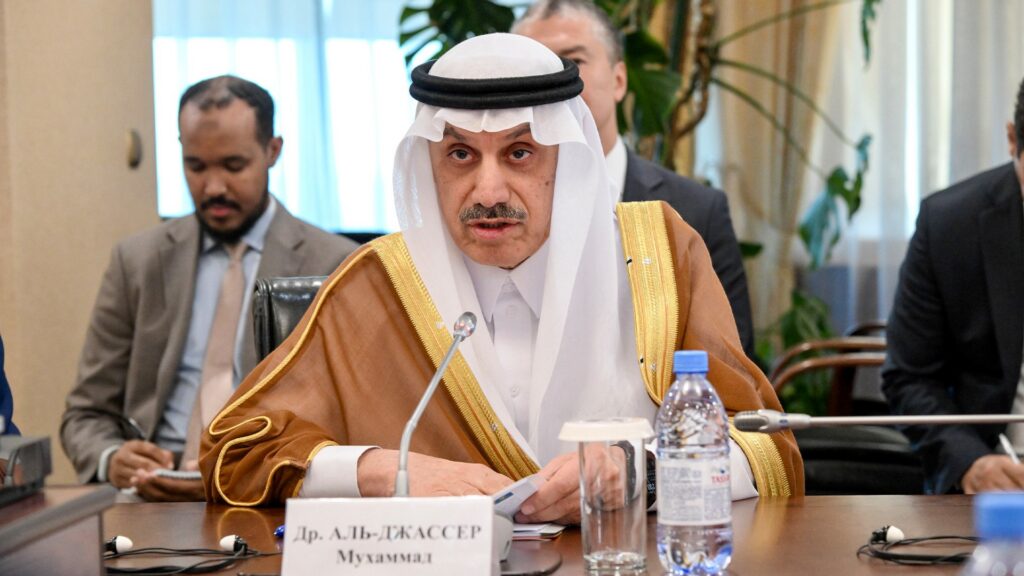
Kazakhstan has proposed that the Islamic Development Bank (IsDB) open an additional office in Astana as the country seeks to deepen cooperation on infrastructure, Islamic finance, and green technologies. Deputy Prime Minister and Minister of National Economy Serik Zhumangarin made the proposal during a meeting with Islamic Development Bank (IsDB) Group Chairman Muhammad Sulaiman Al Jasser ahead of the next meeting of Kazakhstan’s Council of Foreign Investors. According to Kazakhstan’s government, Zhumangarin said the bank’s regional office in Almaty has coordinated operations across Eastern Europe, the CIS, Mongolia, and China since opening in 1997. He said closer engagement with Kazakhstan’s central government institutions is now needed to expand cooperation. Kazakhstan has been a member of the IsDB since 1995. Between 1997 and 2026, total financing and technical assistance provided by the bank to Kazakhstan exceeded $4.2 billion. Current joint projects cover water management, transport infrastructure, and industrial development, while a new partnership strategy between Kazakhstan and the IsDB for 2027-2032 is now being drafted. Zhumangarin said Kazakhstan expects the bank’s expertise to support projects aimed at infrastructure development, food security, natural resource management, and the introduction of modern and green technologies. He noted that cooperation has accelerated significantly over the past three years. In 2024, the two sides launched a large-scale water infrastructure construction and reconstruction program worth $1.1 billion. Since February this year, Kazakhstan has also begun implementing a framework agreement worth $1.3 billion to develop infrastructure in special economic and industrial zones. In addition, the sides are discussing financing for transport projects, including the Kyzylorda-Saksaulsk railway and a bypass road around Kyzylorda. Al Jasser said the potential for cooperation goes beyond the current project portfolio. “Over the years, our specialists have built effective cooperation that allows us to expand the portfolio of projects. The Islamic Development Bank has sufficient flexibility to find solutions for many challenges facing member states,” he said. Al Jasser added that the bank prioritizes building national capacity by relying on domestic systems to prepare and implement projects. Following the meeting, the parties exchanged signed copies of a forward leasing agreement aimed at developing infrastructure in Kazakhstan’s special economic and industrial zones. As previously reported by The Times of Central Asia, the IsDB is also active elsewhere in the region. In February last year, Uzbekistan signed two agreements with the bank worth a combined $299 million to improve its education system and modernize road infrastructure.

Uzbekistan Targets $50 Billion in Investment with Financial Reforms

Uzbekistan is preparing to introduce Islamic finance services nationwide, with the first offerings expected in 2027. Under the country’s updated “Uzbekistan 2030” development strategy, at least three commercial banks are expected to provide Sharia-compliant financial services by the end of the decade, marking a significant shift in the structure of the banking sector. Against this backdrop, President Shavkat Mirziyoyev was briefed on March 25 on a broader set of initiatives aimed at strengthening the country’s investment climate. These include plans to establish the Tashkent International Financial Center, launch an International Center for Digital Technologies, and gradually introduce Islamic finance mechanisms. The presentation comes as Uzbekistan seeks to position itself more competitively in the global economy amid rising geopolitical uncertainty and intensifying competition for foreign investment. Officials said the country’s natural resources, economic potential, and ongoing reforms create favorable conditions for attracting international companies exploring new markets. Mirziyoyev stressed the need to act swiftly to capitalize on emerging opportunities, noting that attracting foreign investors requires modern infrastructure, a transparent business environment, and legal systems aligned with international standards. Uzbekistan aims to attract more than $50 billion in investment this year. A central component of the strategy is the Tashkent International Financial Center, which is expected to serve as a platform for new investment flows and long-term economic growth. By 2030, it is projected to attract an additional $20-25 billion, contribute up to 1% of annual GDP growth, and create as many as 15,000 highly skilled jobs. The center will operate under a special legal regime incorporating elements of the common law system of England and Wales, while allowing its governing bodies to adopt independent regulations. Plans include the establishment of a Tashkent International Commercial Court and an International Arbitration Center to handle disputes. Investors are expected to benefit from tax incentives, simplified visa procedures, and the ability to freely move and repatriate capital, alongside access to modern financial instruments, including digital assets. In parallel, Uzbekistan is developing the International Center for Digital Technologies under the Enterprise Uzbekistan brand. The center will function under a special legal framework expected to remain in place until 2100. Within a regulatory sandbox, companies will be able to test new technologies, pay salaries in foreign currency, and operate under international labor and data standards. The digital center will focus on artificial intelligence, data processing, research and development, and startup support. By 2030, it is expected to attract up to 1,000 companies, create more than 300,000 jobs, and generate export revenues of up to $5 billion. Several major international technology firms have already expressed interest in the initiative. The introduction of Islamic finance is another key pillar of the reform agenda. The proposed system includes instruments such as murabaha, mudarabah, musharakah, and Islamic leasing, all designed to comply with national legislation. Tax measures are also under consideration, including exemptions on certain transactions and investment income. To oversee the sector, an Islamic Finance Council will be established under the Central Bank, with similar bodies to be created within...

Kazakhstan to Launch AI-Powered Imam App

Kazakhstan’s Spiritual Administration of Muslims (DUMK) is set to integrate artificial intelligence into religious practice with the launch of Imam AI, a mobile application designed to provide believers with instant, Sharia-compliant answers to religious questions. The initiative aims to ease the burden on clergy and offer verified religious guidance in a digital format. According to DUMK, the adoption of AI reflects growing public demand for fast and reliable religious information. “In line with modern requirements, we need to systematically introduce the capabilities of artificial intelligence into the religious sphere,” the organization stated in a post on the muftyatkz Instagram page. The Imam AI app will be built on AI technology and will draw from authenticated sources of Islamic knowledge. Supreme Mufti Nauryzbay Kazhy Taganuly stated that the platform would comply fully with Sharia law while providing accessible, on-demand religious consultations. This development is part of a broader effort to digitally transform religious institutions in Kazakhstan. The country has already begun incorporating AI into public administration, notably with the introduction of SKAI, a neural network based on a national language model used in state and quasi-state management. As a further step, DUMK plans to draft a Digital Development Concept for 2026-2028, which will set priorities for the digitalization of religious activities. The Supreme Mufti stressed that failing to adapt to technological change means falling behind the needs of contemporary society. “We are living in an era of technology and digital opportunity. Our responsibility is the systematic and widespread use of digital solutions and artificial intelligence in religious practice, in full accordance with Sharia law,” Taganuly noted. Another key initiative involves the creation of an Islamic finance sector under DUMK. The Mufti stated that growing religious awareness and a desire for ethical earnings have fueled demand for financial products that align with Islamic principles. The new sector will offer Sharia reviews of financial instruments and issue fatwas related to leasing, insurance, investments, bonds, digital assets, and electronic payment systems. Together, the launch of Imam AI and the institutionalization of Islamic finance mark a broader convergence of religion, technology, and economics in Kazakhstan. A recent joint report by the Eurasian Development Bank, the Islamic Development Bank Institute, and the London Stock Exchange forecasts steady growth in Islamic finance across Central Asia. For Kazakhstan, the digitalization of the religious sphere is becoming a key component of its broader modernization agenda, positioning AI not as a novelty but as a practical tool for improving access and meeting evolving societal expectations.

Uzbekistan to Launch Islamic Finance Services in 2027

Uzbekistan plans to introduce Islamic finance services at a national level, with the first offerings set to launch in 2027. According to the updated draft of the Uzbekistan 2030 development strategy, at least three commercial banks are expected to provide Sharia-compliant financial services by the end of the decade. The strategy outlines the creation of a legal and institutional framework to support Islamic finance, beginning with one commercial bank in 2027 and expanding to three banks by 2029-2030. The initiative will be financed through the banks’ own resources, with the Central Bank designated as the lead regulatory authority. This initiative follows earlier legislative steps aimed at diversifying Uzbekistan’s financial system. In September 2023, the Legislative Chamber of the country's parliament, the Oliy Majlis, passed a draft law on Islamic banking in its first reading, a milestone in the country’s push toward financial innovation and inclusion. As previously reported by The Times of Central Asia, the draft legislation includes amendments to the Tax Code, Civil Code, and other legal statutes. It introduces formal definitions for Islamic banks, Sharia-compliant operations, investment deposits, and relevant regulatory standards. Central Bank Deputy Chairman Abrorkhuja Turdaliev has emphasized that the reforms go beyond removing legal obstacles. In comments to local media, he highlighted the need to establish institutional mechanisms, including specialized Sharia councils, audit and accounting frameworks, and a dedicated tax regime, to ensure the system functions in accordance with Islamic financial principles. In an interview with Spot, Turdaliev stated that the Central Bank expects up to ten Islamic banks to be operating in Uzbekistan by 2030. In addition, several traditional banks, including three state-owned institutions, are expected to launch Islamic “windows” to provide Sharia-compliant services alongside conventional products.

Opinion: Multi-Vectorism 2.0 – Kazakhstan Seeks Balance in a Shifting Geopolitical Landscape

The world is reverting to the logic of bloc confrontation. Sanctions regimes, technological barriers, and deepening mistrust between major powers are compelling medium-sized states to chart independent courses. Kazakhstan stands at the center of this evolving geopolitical matrix. While Moscow remains a vital partner in defense and energy, Astana is simultaneously cultivating strong ties with other global power centers, including China, the U.S., Turkey, the European Union, and the Gulf states. Yet Kazakhstan refuses to align with any single bloc, adhering instead to a strategy of "flexible autonomy", cooperating broadly while preserving its sovereignty. Russia: Alliance with Strategic Boundaries On November 11-12, 2025, President Kassym-Jomart Tokayev met with Russian President Vladimir Putin in Moscow. The two leaders signed a declaration on a comprehensive strategic partnership and alliance, reaffirming cooperation on security, energy, and logistics projects. Key discussions included the gasification of border regions, the modernization of energy infrastructure, and the transit of Russian energy via Kazakhstan. Tokayev emphasized Kazakhstan’s interest in a stable and prosperous Russia, calling Putin a “statesman of global stature.” Still, this alignment does not supplant Kazakhstan’s multi-vector policy. The Moscow visit directly followed Tokayev’s talks in Washington, underscoring that Astana views relations with Russia as one of several strategic pillars. The U.S.: Investment and Critical Minerals Diplomacy During Tokayev’s visit to the U.S. in early November 2025, he and President Donald Trump oversaw the signing of 29 agreements totaling approximately $17 billion. The deals spanned industry, energy, digitalization, education, and innovation. Highlights in recent collaboration between Kazakhstan and the U.S. include a $2.5 billion John Deere production facility in Kostanay and Turkestan, a $1.1 billion development of tungsten deposits, and over $1 billion in digital infrastructure cooperation with companies such as Hewlett Packard Enterprise, Oracle, and Starlink. Leading global funds also pledged roughly $1 billion in new investments. These agreements reflect growing trust and a shared commitment to investment-driven, high-tech cooperation. China: Strategic Synergy and Technological Convergence China remains Kazakhstan’s largest trading partner and a cornerstone of its eastern vector. During Tokayev’s October 17, 2023 visit to Beijing, he and President Xi Jinping reaffirmed a “comprehensive strategic partnership” built on political trust and economic cooperation. In June 2025, Xi Jinping visited Astana for the second China-Central Asia Summit, where he and Kassym‑Jomart Tokayev reinforced their countries’ “comprehensive strategic partnership”, oversaw deals spanning energy, infrastructure, agriculture, and digital technology. Later that year, at the Shanghai Cooperation Organisation summit in Tianjin, the two leaders used the platform to deepen cooperation within a multilateral framework, promoting connectivity and regional trade under the Belt and Road Initiative. Turkey: Civilizational Ties and Strategic Growth Ties between Kazakhstan and Turkey are underpinned by shared cultural and historical foundations. At the fifth High-Level Strategic Cooperation Council meeting in Ankara on July 29, 2025, President Recep Tayyip Erdoğan welcomed Tokayev, reaffirming Turkey’s role as a major investor and educational partner. More than 12,000 Kazakh students are enrolled in Turkish universities. Defense cooperation is expanding under the Organization of Turkic States (OTS), and tourism and...

Uzbekistan Advances Draft Law to Introduce Islamic Banking System

Uzbekistan has taken a major step toward diversifying its financial sector with the approval of a draft law on Islamic banking in its first reading. Lawmakers in the legislative chamber of the parliament, the Oliy Majlis, debated the bill during a session held on September 16. The initiative is part of the government's broader effort to expand access to financial services for citizens and businesses, attract foreign investment, and create new mechanisms for economic support. To this end, the draft proposes amendments to the Tax Code, Civil Code, and eight other laws. The bill formally introduces into legislation the concepts of Islamic banks, financial operations, standards, and investment deposits. It also outlines a licensing regime allowing for the establishment of either fully-fledged Islamic banks or Islamic “windows” within existing conventional banks. Permitted financial instruments will include murabaha, mudaraba, musharaka, wakala, and salam, contracts widely used in Islamic finance. Abrorkhoja Turdaliev, Deputy Chairman of the Central Bank, stated that the reforms go beyond removing legal barriers and are aimed at building the institutional foundations of Islamic finance. He highlighted the need to establish dedicated councils, audit bodies, and accounting systems to ensure compliance with Islamic financial principles. The bill also includes provisions for a special tax regime tailored to Islamic finance operations. Turdaliev noted that Islamic banking prohibits the charging of interest, the financing of activities forbidden under Islamic law, and excessive uncertainty in contracts. Instead, it emphasizes partnership and risk-sharing. To support this model, the draft law would eliminate restrictions that currently prevent banks from directly participating in trade or acquiring equity stakes in companies. Drawing on international experience from Malaysia, Turkey, the UAE, and neighboring countries, the proposed legal framework seeks to build a modern infrastructure for Islamic finance in Uzbekistan. “This law will provide legal grounds for establishing Islamic banks, Islamic windows, and microfinance institutions, thereby expanding access to alternative financial services and introducing new tools to support business,” Turdaliev said.