• KGS/USD = 0.01144 0%
  • KZT/USD = 0.00193 -0%
  • TJS/USD = 0.10811 -0.28%
  • UZS/USD = 0.00008 0%
  • TMT/USD = 0.28490 0%
  • KGS/USD = 0.01144 0%
  • KZT/USD = 0.00193 -0%
  • TJS/USD = 0.10811 -0.28%
  • UZS/USD = 0.00008 0%
  • TMT/USD = 0.28490 0%
  • KGS/USD = 0.01144 0%
  • KZT/USD = 0.00193 -0%
  • TJS/USD = 0.10811 -0.28%
  • UZS/USD = 0.00008 0%
  • TMT/USD = 0.28490 0%
  • KGS/USD = 0.01144 0%
  • KZT/USD = 0.00193 -0%
  • TJS/USD = 0.10811 -0.28%
  • UZS/USD = 0.00008 0%
  • TMT/USD = 0.28490 0%
  • KGS/USD = 0.01144 0%
  • KZT/USD = 0.00193 -0%
  • TJS/USD = 0.10811 -0.28%
  • UZS/USD = 0.00008 0%
  • TMT/USD = 0.28490 0%
  • KGS/USD = 0.01144 0%
  • KZT/USD = 0.00193 -0%
  • TJS/USD = 0.10811 -0.28%
  • UZS/USD = 0.00008 0%
  • TMT/USD = 0.28490 0%
  • KGS/USD = 0.01144 0%
  • KZT/USD = 0.00193 -0%
  • TJS/USD = 0.10811 -0.28%
  • UZS/USD = 0.00008 0%
  • TMT/USD = 0.28490 0%
  • KGS/USD = 0.01144 0%
  • KZT/USD = 0.00193 -0%
  • TJS/USD = 0.10811 -0.28%
  • UZS/USD = 0.00008 0%
  • TMT/USD = 0.28490 0%
10 December 2025

Viewing results 1 - 6 of 16

Kyrgyzstan Seeks German Investment in Green Energy, Logistics, and Tourism

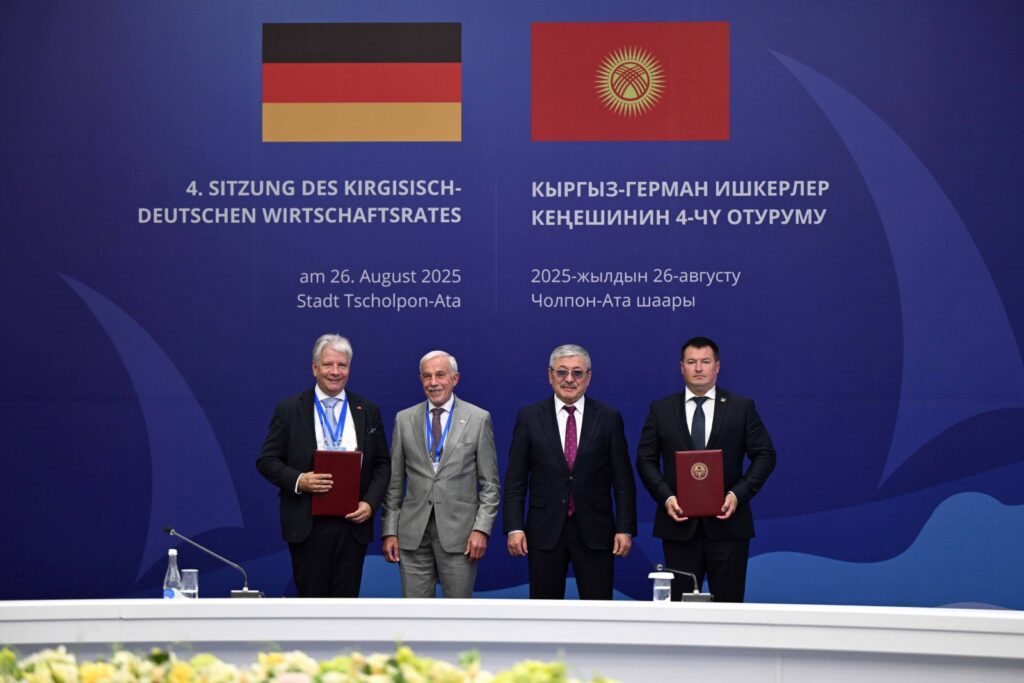
On August 26, the resort city of Cholpon-Ata on Lake Issyk-Kul hosted the Day of German Economy in Kyrgyzstan, alongside the 4th meeting of the Kyrgyz-German Business Council. Opening remarks were delivered by Adylbek Kasymaliyev, Chairman of the Cabinet of Ministers of Kyrgyzstan, and Professor Reinhold Krämmel, Honorary Consul of Kyrgyzstan in Bavaria and Thuringia and Deputy Co-Chairman of the Business Council. Calls for Green Investment and Innovation Kasymaliyev highlighted Kyrgyzstan’s interest in attracting German investment and advanced technologies to modernize its industries, create jobs, and strengthen export potential. He identified key areas for cooperation, including renewable energy, green technologies, transport and logistics infrastructure, and the financial sector. Environmental issues featured prominently in the discussions. Kasymaliyev further emphasized the threat of rapidly melting glaciers, which he said "requires the consolidation of efforts and joint initiatives." “We know Germany as one of the most active defenders of nature. Unfortunately, environmental problems are worsening each year. Glaciers in our mountains are melting and shrinking drastically. Addressing such critical issues requires joint efforts,” he said. Youth and Education as Bridges of Cooperation Kasymaliyev also underlined the importance of youth in Kyrgyzstan’s development and in strengthening bilateral ties. He noted a growing interest among young Kyrgyz citizens in the German language, culture, and vocational education, elements he described as forming the foundation for long-term partnership. While acknowledging current progress, Kasymaliyev stressed that Kyrgyz-German economic relations have significant untapped potential. New Agreements and Sectoral Priorities Following the meeting, a memorandum of cooperation was signed between Kyrgyz Temir Jolu, the national railway company, and Rhenus SE & Co. KG to jointly explore logistics and transit infrastructure opportunities. Kasymaliyev also held bilateral talks with Michael Harms, Executive Director of the Eastern Committee of the German Economy. He underscored Germany’s growing importance as a trade partner, noting that bilateral trade had nearly quadrupled between 2020 and 2024. The Kyrgyz side presented several promising areas for German investment, including the IT sector, data center and logistics hub development, renewable energy and green hydrogen production, and mining. “Kyrgyzstan is fully committed to supporting German companies interested in launching investment projects in our country,” Kasymaliyev stated. Tourism Growth Highlighted Tourism was also spotlighted as a rising sector of bilateral engagement. Germany is now among Kyrgyzstan’s top tourism partners, with more than 23,000 German visitors recorded in 2024, and over 10,000 arriving in the first half of 2025 alone.

Uzbekistan Deploys Space Technology to Combat Environmental Violations

Uzbekistan’s Prosecutor General’s Office and the national space agency, Uzbekkosmos, have signed a memorandum of cooperation aimed at strengthening environmental protection through the use of space-based technologies. According to Uzbekkosmos, the agreement facilitates the exchange of information and the use of satellite tools to monitor environmental conditions and investigate violations. The initiative will integrate aerospace technologies into environmental inspections, preliminary investigations, and monitoring activities, leveraging the State Space Monitoring System to provide more accurate and transparent data. The partnership outlines joint actions to detect and prevent a range of ecological infractions, including the reduction of green spaces, illegal tree felling, unauthorized use of forest lands, and illicit construction activities. The agreement also targets illegal excavation, particularly in riverbeds and protected water zones. The authorities will monitor compliance with regulations on riverbed cleaning and bank reinforcement, identifying any unauthorized digging operations. Satellite data will further be used to assess the volume of materials extracted from mines, monitor compliance with waste storage regulations, and detect illegal dumping sites. The initiative also addresses post-harvest practices, such as the burning of crop residue, which negatively affects air quality and soil health. Officials believe the partnership will enhance environmental oversight, promote public awareness, and improve the efficiency of ecological inspections. It is also expected to foster a stronger culture of environmental responsibility across the country. This initiative follows President Shavkat Mirziyoyev’s 2024 ratification of Uzbekistan’s accession to the Outer Space Treaty, which governs the peaceful exploration and use of outer space, including the Moon and other celestial bodies. Originally signed in 1967 by the United Kingdom, Russia, and the United States, the treaty now includes 115 ratifying countries, with 22 additional signatories yet to ratify.

Binance Founder to Advise Kyrgyzstan President on Digital Assets

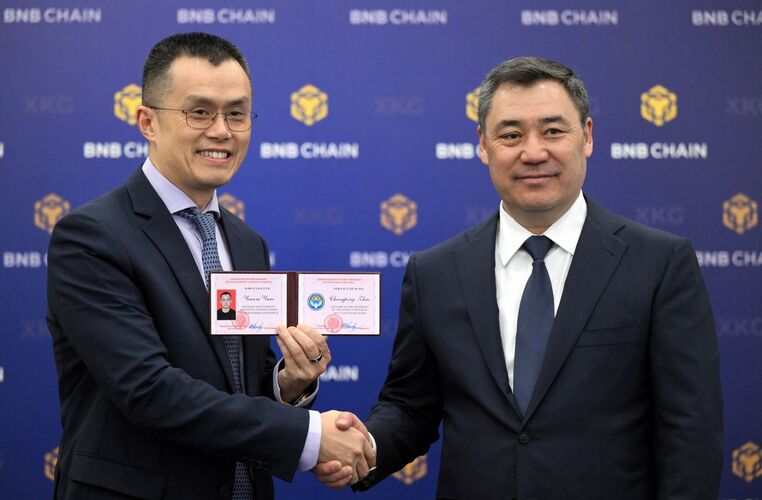
On May 3 in Cholpon-Ata, President Sadyr Japarov met with Changpeng Zhao, founder of Binance, the world’s largest cryptocurrency exchange, to discuss the future of digital assets and blockchain technologies in Kyrgyzstan. The meeting focused on the development of the country’s digital asset ecosystem, the introduction of blockchain technology into public administration, and measures to bolster cybersecurity. Japarov emphasized that Kyrgyzstan is actively promoting digital assets, particularly through the planned introduction of a national digital currency, the digital som. Changpeng Zhao expressed his readiness to support Kyrgyzstan’s digital transition by consulting and training local specialists involved in developing and implementing the digital som. During the meeting, Japarov presented Zhao with a certificate appointing him as a public adviser to the President of Kyrgyzstan on the development of digital assets. The following day, May 4, Japarov chaired the inaugural session of the National Council for the Development of Virtual Assets and Blockchain Technologies in Cholpon-Ata. Zhao was officially accepted as a member of the Council, which was established to formulate a unified state policy on virtual assets and promote their use in governance and key economic sectors. Japarov outlined the Council's main areas of focus: Enhancing financial literacy and supporting educational programs Strengthening cybersecurity and protecting users from digital fraud Integrating blockchain technologies into public administration systems “Interest in cryptocurrency is growing every year in Kyrgyzstan, and blockchain technologies and digital assets are becoming the basis of a new financial system,” Japarov stated. Earlier, the National Investment Agency of Kyrgyzstan signed a Memorandum of Cooperation with Zhao. Under the agreement, Binance will assist in developing blockchain infrastructure, creating a national cryptocurrency reserve, and training professionals in blockchain technology, virtual asset management, and cybersecurity.

Binance to Assist Kyrgyzstan in Developing Blockchain Infrastructure and Crypto Assets

Kyrgyzstan’s National Investment Agency has signed a Memorandum of Cooperation with Changpeng Zhao, founder of Binance, the world’s largest cryptocurrency exchange by trading volume. According to the agency, Binance will assist Kyrgyzstan in several key areas, including the development of blockchain infrastructure and the creation of a national cryptocurrency reserve. The partnership will also focus on training young professionals, government employees, and specialists in blockchain technologies, virtual asset management, and cybersecurity. In addition, Binance will provide support in establishing a management system for virtual assets and blockchain technology in Kyrgyzstan source. While public interest in cryptocurrencies continues to grow in Kyrgyzstan, the market remains poorly regulated. Earlier this year, the Ministry of Economy and Commerce proposed legislation to create licensed crypto banks that would offer regulated banking services related to digital assets. The ministry stressed the need to integrate crypto assets into the national financial system, citing the rapid advancement of digital technology and the economic potential of legalizing cryptocurrency transactions. The introduction of crypto banks is expected to increase transaction volumes, boost tax revenues, and create new jobs in the fintech sector, positioning Kyrgyzstan as a regional hub for financial innovation. In a separate move to stabilize the sector, Kyrgyzstan’s Cabinet of Ministers significantly raised the minimum authorized capital required for crypto exchanges, from 100 million KGS to 10 billion KGS, a hundredfold increase. The Ministry of Economy and Commerce, which initiated the reform, stated that the measure is designed to ensure the financial stability of crypto platforms, safeguard user interests, and foster a transparent and secure virtual assets market. Existing exchanges have until January 1, 2026, to comply with the new capital requirements.