


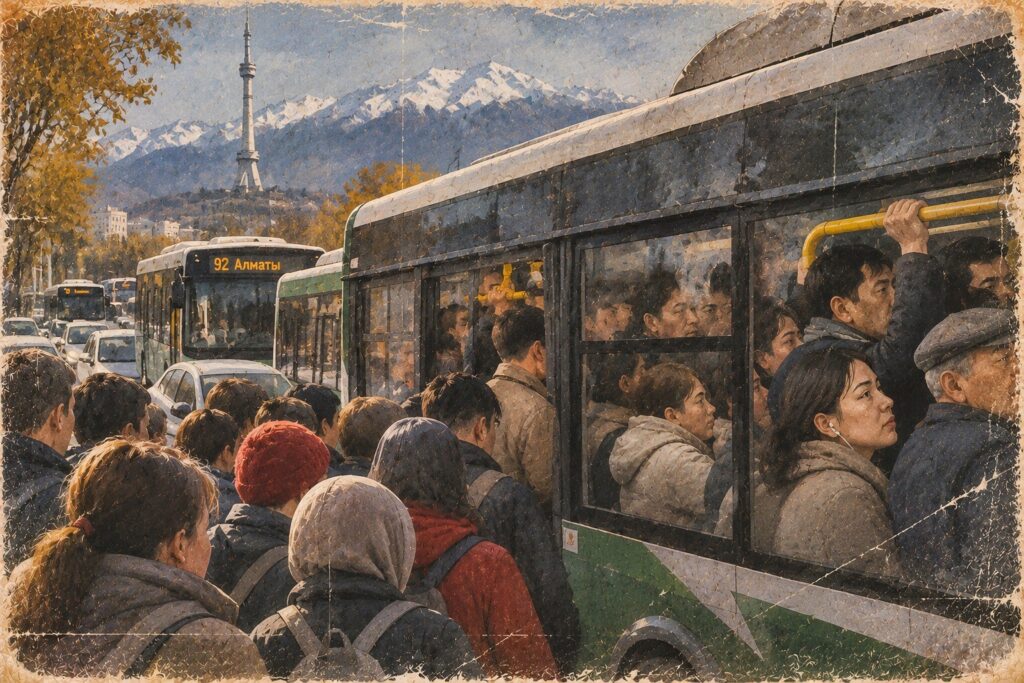
Opinion: Overcrowding on Almaty Buses – A Man-Made Transit Crisis
The Kazakh authorities' grand plans to turn Almaty and its picturesque surroundings into Central Asia's next tourist mecca have run headlong into a public transportation crisis this fall. Almaty residents have been flooding social media with photos and videos of overcrowded buses and trolleybuses, saying they have not seen anything like this since the 1990s. But a closer look at the problem suggests that the current chaos is largely man-made. Almaty is a university city, so residents have long been accustomed to several months of crowded conditions each year. Public spaces, inexpensive cafés, and public transportation all become noticeably busier. For years, however, people in Almaty have generally avoided blaming newcomers for the city's infrastructure problems, preferring to put up with the inconvenience. This year, though, that tolerance has been put to a serious test. By October, residents had realized that ignoring the elephant in the room was becoming increasingly absurd. Journalists began picking up complaints from social media and amplifying residents' grievances. One of the most widely circulated images in mid-October showed a young woman's leg trapped in a bus door as she tried to squeeze aboard. City officials responded like firefighters trying to contain a blaze of public outrage. They blamed traffic congestion for throwing buses off schedule and acted as though the problem was limited to just one or two routes. Roadwork commissioned by the Almaty authorities themselves has added to the disruption. Officials have also pointed to fare evasion, claiming that more than 30% of passengers during rush hour were not paying their fares. [caption id="attachment_60039" align="aligncenter" width="1816"] Buses are often full to capacity.[/caption] "Fare payments are also used to calculate how many buses are needed on a route. Currently, 3,238 public transportation vehicles operate in Almaty every day," Almaty's Department of Road Traffic and Public Transport Management explained. On November 5, officials insisted that the number of buses in service had not fallen, although they acknowledged cutting the number of journeys by 20–30% during off-peak hours. They again blamed traffic congestion and claimed that more than 40% of passengers were not paying their fares. These explanations failed to satisfy Almaty residents who regularly pay their fares. They had already uncovered a document that had previously escaped public attention. It turned out to be the city's public transportation tariff commission minutes, published on the department's website. They record meetings through August 7, 2026, and the commission's approval of reductions in planned bus deployments and journeys across city routes "in accordance with consultants' recommendations." "The reductions were made in accordance with international practices. The number of vehicles deployed on city routes was reduced by up to 20% on weekdays, 10% on Saturdays, 25% on Sundays, and 35% on public holidays. The number of round trips on city routes was reduced by 10–20% on weekdays, 5–10% on Saturdays, 12.5–25% on Sundays, and 17.5–35% on public holidays," the document states. As if that were not enough, another revealing document surfaced: an October 22, 2026, publication by the Committee of...
