• KZT/USD = 0.00225
  • TJS/USD = 0.10860
  • UZS/USD = 0.00008
  • TMT/USD = 0.29850
  • KZT/USD = 0.00225
  • TJS/USD = 0.10860
  • UZS/USD = 0.00008
  • TMT/USD = 0.29850
  • KZT/USD = 0.00225
  • TJS/USD = 0.10860
  • UZS/USD = 0.00008
  • TMT/USD = 0.29850
  • KZT/USD = 0.00225
  • TJS/USD = 0.10860
  • UZS/USD = 0.00008
  • TMT/USD = 0.29850
  • KZT/USD = 0.00225
  • TJS/USD = 0.10860
  • UZS/USD = 0.00008
  • TMT/USD = 0.29850
  • KZT/USD = 0.00225
  • TJS/USD = 0.10860
  • UZS/USD = 0.00008
  • TMT/USD = 0.29850
  • KZT/USD = 0.00225
  • TJS/USD = 0.10860
  • UZS/USD = 0.00008
  • TMT/USD = 0.29850
  • KZT/USD = 0.00225
  • TJS/USD = 0.10860
  • UZS/USD = 0.00008
  • TMT/USD = 0.29850
12 November 2026

Viewing results 1 - 6 of 3

Kazakhstan Science Funding Audit Finds 103 of 141 Projects Missed Sales Targets

Kazakhstan’s science ministry plans to revise how it measures the commercial success of publicly funded research. The Supreme Audit Chamber found that only 38 of 141 completed projects generated steady sales over the past three years. The other 103, worth a combined 22 billion tenge (about USD 49 million), missed their production and sales targets. Alikhan Smailov, the chamber’s chairman, presented the findings at a November 11 session of the Kurultai, Kazakhstan’s unicameral parliament. He said research institutions often cite publications, patents, and reports that a technology has been put to use as evidence of success. Auditors found no record of an agreement to use any of the 60 patents they examined. Kazakhstan, Central Asia’s largest economy, is seeking to reduce its dependence on exports of oil, uranium, and metals by developing its own technologies and expanding manufacturing. Between 2022 and 2025, annual spending on research and development (R&D) more than doubled, from 122 billion tenge (about $273 million) to 262 billion tenge ($585 million). Even so, R&D spending in 2025 accounted for just 0.16% of gross domestic product, against a target of 1%. The government’s share of funding rose from 55% to 82%, which auditors attributed in part to weak business demand for domestic research. One effort to bring research into industry is a rare metals research center in Almaty that opened in October with South Korean support. Backed by a five-year funding program worth about $15 million, the center plans to develop mineral processing technologies and test them with Kazakh mining and metallurgical companies. Auditors also found problems with how the government selects and funds research. Of 393 scientific and technical assignments approved for 2023–2025, 149 worth 67 billion tenge (about $150 million) were never carried out. In 2025, calls for funding applications went out up to 208 days late, delaying research. The national scientific councils that review those applications also faced potential conflicts of interest. Of their 225 members, 84 belonged to research teams working on 127 projects, and 27 council members were principal investigators. Seventy-nine projects received 62 billion tenge (about $139 million) without detailed spending plans. Researchers could receive 96% to 98% of a project’s funding before its final evaluation and keep that money even if the final report was rejected. Mining companies are required to set aside 1% of the previous year’s extraction costs for R&D. Smailov said weak oversight had allowed some of the money intended for industrial research to go into bank deposits, securities, and repurchase agreements, in which an asset is sold with a commitment to buy it back. Overall, the chamber identified 51 billion tenge (about USD 114 million) in financial irregularities and another 47 billion tenge (about USD 105 million) in inefficient planning and spending. Smailov said 13 billion tenge had to be repaid. The remaining 38 billion tenge could be accounted for by correcting records, delivering goods, or completing outstanding work. The chamber referred 36 cases to the authorities for possible administrative penalties and decided to refer three...
Tokayev Unveils $14 Billion Construction Plan in Kazakhstan State of the Nation Address

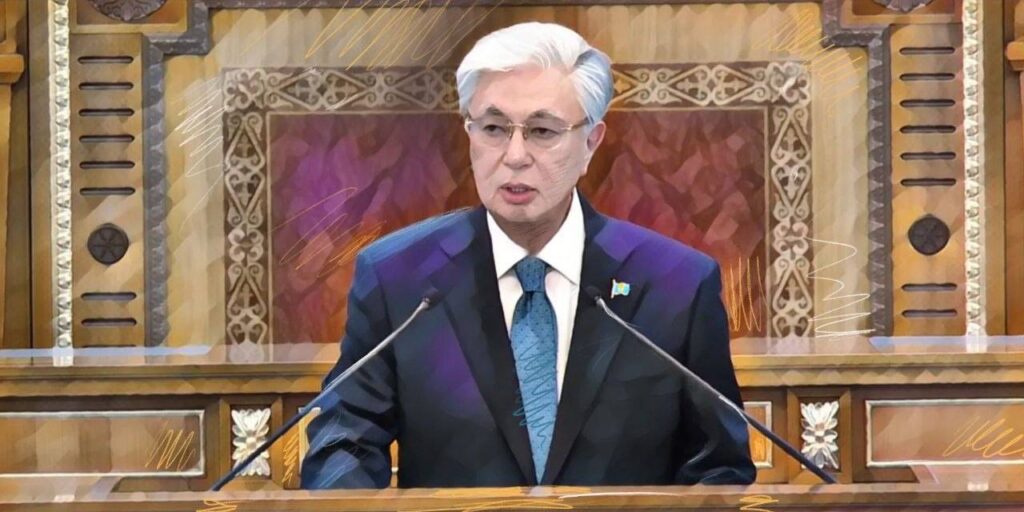
Kazakhstan plans to spend 6.5 trillion tenge (about $14.3 billion) from its National Fund on infrastructure projects by 2029 and eliminate its electricity shortage in the same period, President Kassym-Jomart Tokayev announced in his annual State of the Nation Address on October 28. The president also outlined plans to accelerate nuclear power plant construction, expand transport routes between China and Europe, and establish a separate court for investors in the new city of Alatau. $14 Billion for Infrastructure Tokayev proposed declaring 2027 a year of large-scale construction and launching a nationwide program covering roads, airports, railway stations, and public facilities. The government is expected to allocate approximately 6.5 trillion tenge from the National Fund by the end of 2029, including 1.5 trillion tenge ($3.3 billion) for social projects in the remaining months of 2026 and the first two months of 2027. The program envisages building around 70 healthcare facilities and approximately 50 education, sports, and cultural facilities. Plans also include extending gas supplies and clean drinking water to underserved communities. Tokayev said public funding should help attract private investment rather than finance the entire program. The spending plans raise questions about the use of Kazakhstan's accumulated oil revenues. The National Fund was established in part to protect the economy from fluctuations in commodity prices, but its resources are regularly used to meet budgetary needs. Tokayev said Kazakhstan must balance preserving financial reserves for future generations with investing in modern infrastructure. He argued that public spending should deliver economic and social returns. Kazakhstan Aims to Eliminate Electricity Deficit Tokayev acknowledged that Kazakhstan's electricity production is insufficient to meet the needs of its growing economy, particularly as the country seeks to expand industry and build data centers. According to the national grid operator KEGOC, Kazakhstan generated 123.1 billion kilowatt-hours of electricity in 2025, while consuming 124.6 billion. The shortfall of approximately 1.5 billion kilowatt-hours was covered by net imports. The president set a target of achieving a sustained surplus of electricity production over domestic consumption by 2029. Tokayev criticized the longstanding practice of purchasing expensive electricity from neighboring countries during winter peaks in demand and subsequently returning electricity in summer at substantially lower prices. "That's quite a simple little 'business,' and it's been going on for decades," Tokayev remarked. He also pointed to delays in bringing new generating capacity online in Turkestan, Kyzylorda, Almaty, and Ekibastuz, as well as a shortage of qualified energy specialists. To meet the 2029 target, Kazakhstan will need to build new power stations and modernize existing facilities. Tokayev called for further development of coal-fired generation alongside renewable energy, particularly solar power. Nuclear Power Plans Tokayev said construction of the Balkhash nuclear power plant could begin in 2027. He also proposed accelerating preparations for an agreement on the Moyynkum nuclear power plant. Russia's state nuclear corporation Rosatom is leading the Balkhash project, while China National Nuclear Corporation has been selected as the main contractor for the second plant. However, the first reactor at Balkhash is not expected to...

Uzbekistan Introduces Anti-Corruption Reviews for $50 Million Investment Projects

Uzbekistan has introduced mandatory anti-corruption reviews for major investment projects worth at least $50 million, as the government intensifies efforts to strengthen oversight of public spending and large-scale development initiatives. The new procedure was approved through an official instruction registered by the Ministry of Justice on May 8, according to the ministry’s Legal Information channel. Under the new rules, large investment projects involving at least $50 million in financing will be subject to anti-corruption examinations and assessments of their impact on market competition before they can move forward. The regulation applies to projects aimed at creating, expanding, or modernizing socially and economically significant infrastructure, services, and facilities. The reviews will be conducted by internal anti-corruption control units within state bodies and organizations. Officials said projects identified as carrying a high risk of corruption could receive a negative assessment regarding their feasibility and implementation. Authorities also stressed that projects will not be approved until all shortcomings identified during the examination process are fully addressed. The Times of Central Asia previously reported that Uzbekistan had opened criminal proceedings against senior officials in the Ministry of Internal Affairs following investigations into large-scale financial violations. At a government meeting on January 27, President Shavkat Mirziyoyev said investigators had uncovered 53 trillion Uzbekistani som (UZS), approximately $4.38 billion, in financial irregularities and misused funds nationwide. According to the president’s press secretary, 4.2 trillion som ($347.3 million) of the total was directly linked to corruption schemes.  Authorities reported that 1.3 trillion som ($107.5 million) had already been recovered, while 55 individuals were arrested across the country in connection with corruption-related cases.
