

• KGS/USD = 0.01144 0%
  • KZT/USD = 0.00208 0%
  • TJS/USD = 0.10407 -0.29%
  • UZS/USD = 0.00008 0%
  • TMT/USD = 0.28571 0%
  • KGS/USD = 0.01144 0%
  • KZT/USD = 0.00208 0%
  • TJS/USD = 0.10407 -0.29%
  • UZS/USD = 0.00008 0%
  • TMT/USD = 0.28571 0%
  • KGS/USD = 0.01144 0%
  • KZT/USD = 0.00208 0%
  • TJS/USD = 0.10407 -0.29%
  • UZS/USD = 0.00008 0%
  • TMT/USD = 0.28571 0%
  • KGS/USD = 0.01144 0%
  • KZT/USD = 0.00208 0%
  • TJS/USD = 0.10407 -0.29%
  • UZS/USD = 0.00008 0%
  • TMT/USD = 0.28571 0%
  • KGS/USD = 0.01144 0%
  • KZT/USD = 0.00208 0%
  • TJS/USD = 0.10407 -0.29%
  • UZS/USD = 0.00008 0%
  • TMT/USD = 0.28571 0%
  • KGS/USD = 0.01144 0%
  • KZT/USD = 0.00208 0%
  • TJS/USD = 0.10407 -0.29%
  • UZS/USD = 0.00008 0%
  • TMT/USD = 0.28571 0%
  • KGS/USD = 0.01144 0%
  • KZT/USD = 0.00208 0%
  • TJS/USD = 0.10407 -0.29%
  • UZS/USD = 0.00008 0%
  • TMT/USD = 0.28571 0%
  • KGS/USD = 0.01144 0%
  • KZT/USD = 0.00208 0%
  • TJS/USD = 0.10407 -0.29%
  • UZS/USD = 0.00008 0%
  • TMT/USD = 0.28571 0%

Viewing results 1 - 6 of 6

Kazakh Food Exports to China Grow After CIIE 2025 Deal

At the China International Import Expo (CIIE 2025) in Shanghai, Kazakhstan’s Trade Policy Development Center, QazTrade, signed a partnership agreement with Optimize Integration Group (OIG), one of China’s leading food importers responsible for 18% of all frozen meat imports into the country. The agreement aims to promote digital trade and create online platforms that will facilitate the entry of Kazakhstani food products into the Chinese market. Under the terms of the agreement, both sides will jointly promote Kazakh agricultural and food products, improve logistics infrastructure, and develop digital trade technologies and payment systems. “This partnership with OIG, one of the most technologically advanced and influential trading platforms in China, opens up significant opportunities,” said QazTrade CEO Aitmukhamed Aldazharov. “Kazakhstani producers will not only increase their exports to China but will also integrate into advanced digital supply chains. This is a major step forward for e-commerce and mutual trust between our countries.” At CIIE 2025, QazTrade also showcased the growing potential of Kazakhstan’s agricultural cooperatives. In collaboration with the National Association of Cooperatives of Kazakhstan and China Coop, China’s largest cooperative retail network, Kazakh products such as honey, kumis, and confectionery are set to enter the Chinese retail market. China Coop encompasses over 340,000 retail outlets with annual turnover exceeding 7 trillion yuan. Aldazharov expressed confidence in the cooperatives' prospects, noting that joint market research has been conducted, trial shipments arranged, and priority export categories identified. These include vegetable oil, meat, honey, dairy beverages, and confectionery. In parallel, QazTrade is launching an acceleration and training program aimed at Chinese companies seeking to expand their operations in Kazakhstan and across Central Asia.
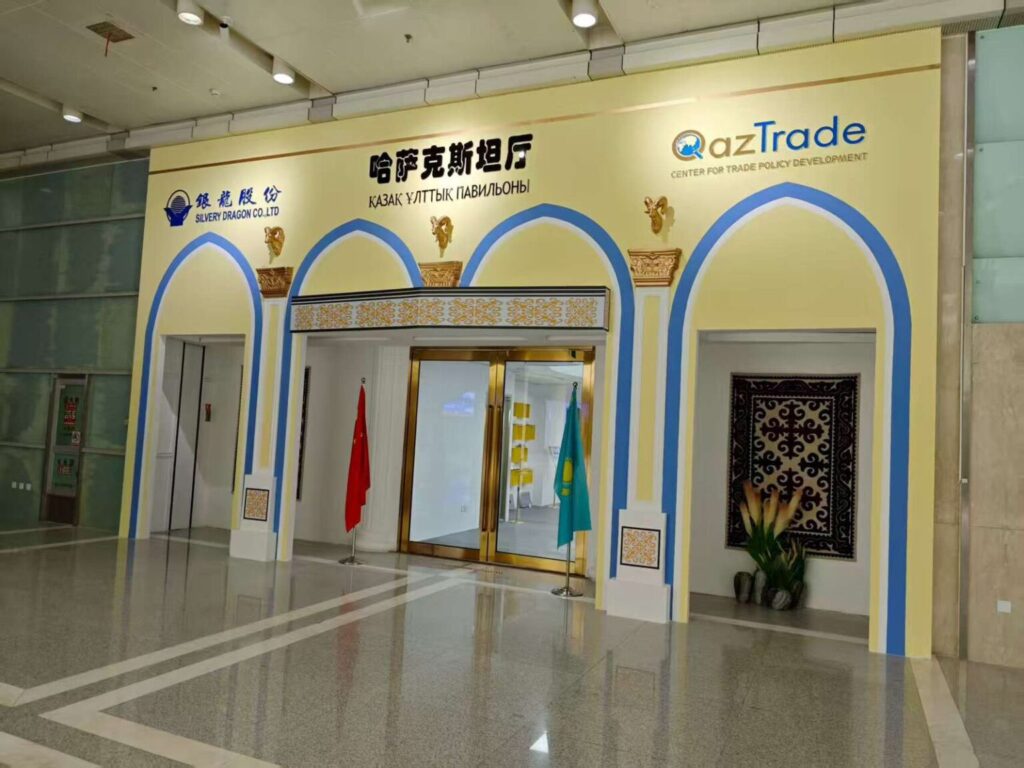

QazTrade Opens Office in Tianjin to Strengthen Kazakhstan-China Trade Ties

Kazakhstan’s QazTrade Center for Trade Policy Development has opened a new office, Kazakhstan Hall, at the International Trade and Shipping Service Center in Tianjin, one of northern China’s leading industrial and port cities. Spanning 100 square meters, the office is designed primarily to showcase Kazakhstani food products and facilitate trade promotion in the Chinese market. It is currently operating in pilot mode, with an expanding exhibition area and ongoing preparations to formally register QazTrade’s representative office. The official opening ceremony is expected later this autumn. According to QazTrade, trade turnover between Kazakhstan and Tianjin reached $347.9 million in 2023 and rose to $474 million in 2024, a sign of steady growth in bilateral commerce. Tianjin serves as a key logistics and trade hub for Shanghai Cooperation Organization (SCO) member states. It offers Kazakhstan access to a “green-light corridor” for SCO countries, multimodal transport links between Asia and Europe, and a variety of investment and financial services. “The opening of the QazTrade office in Tianjin is an important step for us,” said QazTrade Director General Aitmukhammed Aldazharov. “Through the Tianjin port, we will be able to deliver Kazakhstani goods to any country in the world faster and more efficiently.” Growing Bilateral Trade Kazakhstan-China trade continues to gain momentum. During a meeting with Kazakh Minister of Trade and Integration Arman Shakkaliyev on August 20 in Beijing, Chinese Minister of Commerce Wang Wentao stated that bilateral trade reached $43.8 billion in 2024, a 9.2% increase compared to the previous year. In the first half of 2025 alone, trade turnover totaled $21.8 billion. Kazakhstan and China have set a joint target to double bilateral trade by 2030, with expanded cooperation in logistics, agriculture, energy, and manufacturing forming the core of future initiatives.

What Drives Kazakhstan’s Threefold Growth in High-Tech Exports

Kazakhstan has sharply increased its presence in the global market for high-tech goods in recent years. According to analysts at Finprom.kz, the country’s high-tech exports nearly tripled, rising from $2.5 billion in 2021 to $7.3 billion in 2024. Geography and Growth Dynamics This surge was driven less by a physical increase in exports, up 9.7%, and more by rising global prices and the growth of re-exports. Since 2022, amid shifting geopolitical dynamics, Kazakhstan has emerged as a key player in re-export chains for complex technical equipment. The Bureau of National Statistics reports that nearly 77% of high-tech export value in 2024 ($5.6 billion) was attributed to companies registered in Astana and Almaty. However, this reflects business registration patterns rather than actual production. For example, a Kazakh-Chinese joint venture in Ust-Kamenogorsk manufactures fuel assemblies for nuclear reactors, yet its exports are registered as originating from Almaty. Uranium: The Strategic Core Uranium and its compounds remain Kazakhstan’s dominant high-tech export, comprising 62.7% of the total in 2024, or $4.6 billion. Over the past three years, the value of uranium exports rose 2.6 times, while the physical volume increased by just 16.7%. The key driver was a sharp spike in global uranium prices: in the first half of 2024 alone, the spot price rose by 73%, while long-term contract prices also trended upward. Aviation and Leasing Structures Aircraft ranked second in terms of profitability. In 2024, exports of airplanes and helicopters exceeded $940 million, 30 times higher than in 2021. Ireland was the largest reported buyer. However, this spike reflects aviation leasing arrangements rather than direct aircraft sales. As noted in a document submitted by Prime Minister Olzhas Bektenov to the Mazhilis, Kazakhstan's parliament, Kazakhstan’s national carrier Air Astana operates aircraft registered in Ireland, leading to leasing-related flows being counted as exports. Smartphones, Electronics, and Digital Equipment Smartphones emerged as a fast-growing category, with exports increasing 54-fold to $433 million. Key markets included Central Asian neighbors, Mongolia, and the Czech Republic. Much of the growth occurred in 2022, driven by shifting supply chains amid international sanctions. While the volume of exported computers and digital equipment rose, their total value declined. Notably, exports of digital data processing units fell from $136.6 million in 2021 to $11.6 million in 2024. This discrepancy highlights the predominance of re-exports. In 2024, Kazakhstan produced just 33,000 computing units but exported 744,100. Similarly, it manufactured 7,500 electromechanical devices while exporting nearly 200,000. Broader Export Structure According to QazTrade, the share of high value-added products in Kazakhstan’s exports reached 13.5% or $11.1 billion in 2024, marking a 16.1% year-on-year increase. However, the country’s export structure remains resource-heavy: raw materials account for 63.3% of total exports, followed by low value-added goods at 15.5%, with high-tech processed goods in third place.

Potential Impact of EU Carbon Tax on Kazakhstan’s Industries

From 2026, transboundary carbon regulations will be imposed on European Union countries. The introduction of a new EU carbon tax will also affect export of products from Kazakhstan . After the transition period, which began on January 1st 2024 and will run until the end of 2026, payment will be increased on emissions. Following discussions at a seminar for Kazakhstan’s industrial exporters on March 15th, the Kazakh Ministry of Trade and Integration reported that the new legislation will affect six industrial sectors including the production of ferrous metals and aluminum, cement, fertilizers, hydrogen, and electricity. Nurlan Kulbatyrov, Deputy Director General of QazTrade JSC stated that since Kazakhstan has an Enhanced Partnership and Cooperation Agreement with the EU, the country will be impacted by both the EU Green Deal and carbon border adjustment tax. To prepare for the changes, he reported that since last year, QazTrade, in collaboration with the Ministry of Trade and Integration, has been conducting awareness-raising activities on carbon taxation for export-oriented companies. An expert from the European Commission explained that cross-border regulation will mainly affect sectors associated with iron, steel and aluminum, which accounted for between 0.8 - 0.9% of Kazakhstan's total exports to the EU in 2022. EU countries currently account for 39% of Kazakhstan's exports, including oil, petroleum products, ferroalloys, coal, uranium and wheat. In 2023, Kazakhstan exported goods valued at $41.4 billion to the EU, including $388 million worth of carbon-intensive products. In the first phase, industrial enterprises will be required to submit quarterly reports to the European Commission comprising data on export volumes, greenhouse gas emissions connected to production and quotas used. After 2025, carbon regulation will come into force, and free quotas gradually levelled out. Charges will initially target direct emissions, but could later be extended to other sectors with risks of carbon leakage, such as oil refineries and chemical plants. Ainur Amirbekova, Director of the International Integration Department of QazTrade JSC, added that the introduction of a carbon tax by EU countries will inevitably affect the cost of Kazakhstan’s exports, and thus heighten competition. Since rising prices could potentially close markets for particular goods, Kazakh enterprises have been forewarned to address both decarbonization and the transition to alternative technologies as soon as possible.
