• KGS/USD = 0.01143 0%
  • KZT/USD = 0.00205 0%
  • TJS/USD = 0.10724 0.09%
  • UZS/USD = 0.00008 0%
  • TMT/USD = 0.28571 0%
  • KGS/USD = 0.01143 0%
  • KZT/USD = 0.00205 0%
  • TJS/USD = 0.10724 0.09%
  • UZS/USD = 0.00008 0%
  • TMT/USD = 0.28571 0%
  • KGS/USD = 0.01143 0%
  • KZT/USD = 0.00205 0%
  • TJS/USD = 0.10724 0.09%
  • UZS/USD = 0.00008 0%
  • TMT/USD = 0.28571 0%
  • KGS/USD = 0.01143 0%
  • KZT/USD = 0.00205 0%
  • TJS/USD = 0.10724 0.09%
  • UZS/USD = 0.00008 0%
  • TMT/USD = 0.28571 0%
  • KGS/USD = 0.01143 0%
  • KZT/USD = 0.00205 0%
  • TJS/USD = 0.10724 0.09%
  • UZS/USD = 0.00008 0%
  • TMT/USD = 0.28571 0%
  • KGS/USD = 0.01143 0%
  • KZT/USD = 0.00205 0%
  • TJS/USD = 0.10724 0.09%
  • UZS/USD = 0.00008 0%
  • TMT/USD = 0.28571 0%
  • KGS/USD = 0.01143 0%
  • KZT/USD = 0.00205 0%
  • TJS/USD = 0.10724 0.09%
  • UZS/USD = 0.00008 0%
  • TMT/USD = 0.28571 0%
  • KGS/USD = 0.01143 0%
  • KZT/USD = 0.00205 0%
  • TJS/USD = 0.10724 0.09%
  • UZS/USD = 0.00008 0%
  • TMT/USD = 0.28571 0%

Viewing results 1 - 6 of 31

Central Asia Faces Growing Water Risks as Qosh Tepa Canal Nears Completion

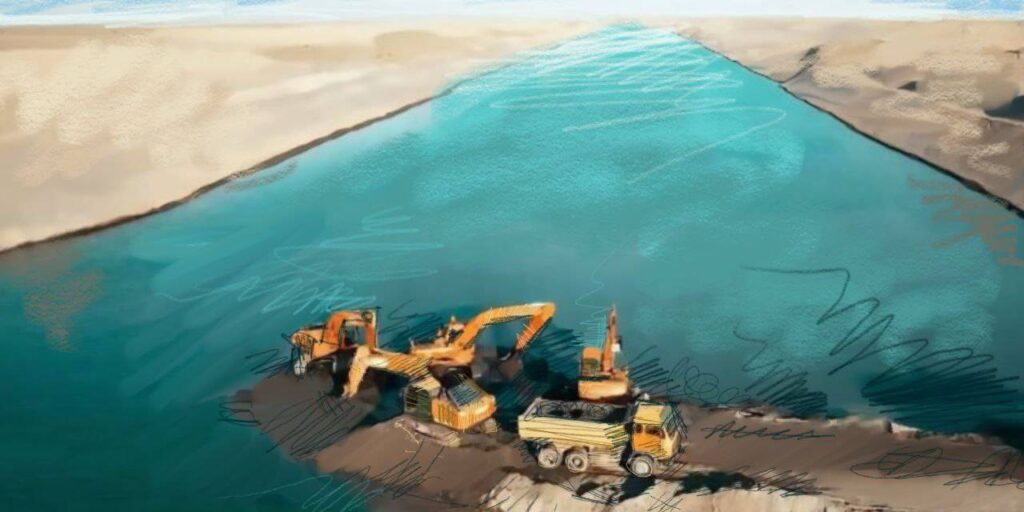
Kazakh media, Inbusiness.kz, reports that discussions within the Russian Academy of Sciences have revived a decadesold idea to redirect Siberian rivers toward Central Asia. Researchers have proposed that Russia’s Ministry of Science and Higher Education include a study of the project in its state research plan, arguing that the region is entering a critical phase of water scarcity. This renewed debate comes as Afghanistan advances construction of the Qosh Tepa Canal, a massive irrigation project in the country’s north. The first 108 kilometer section began operating in 2023, and work on the second phase is nearing completion. Once fully operational, the 285 kilometer canal is expected to divert more than 15% of the Amu Darya river’s flow to irrigate around 550,000 hectares of farmland in Afghanistan’s drought-prone regions. Construction began in March 2022 and its impact is already being felt across Central Asia. Experts warn the canal could reduce Uzbekistan’s water supply by around 15% and Turkmenistan’s by up to 80%, which may lead to lower crop yields, job losses, rising poverty and even potential migration or tensions. Scholars in Kazakhstan note rising alarm. Ravshan Nazarov, an associate professor based in Tashkent, said that failure to address water shortages could trigger mass population movements. He argued that redirecting Siberian rivers, though technically complex and costly, may become unavoidable. He warned that if Russia does not share its water resources, it might eventually face “an influx of 100 million refugees.” Data from the Food and Agriculture Organization (FAO) show that Turkmenistan is the region’s largest water consumer, using 53 cubic kilometres annually despite a population of just about 7 million. Experts attribute this to ageing infrastructure, high evaporation losses and a lack of concrete-lined canals. Meanwhile, Kyrgyzstan has faced water shortages since 2020.

Afghanistan’s Qosh Tepa Canal Raises Water Security Fears

Water has long been one of Central Asia’s most contested resources, shaping agriculture, energy policy, and diplomacy across the region. Recently, Afghanistan’s Qosh Tepa Canal project has emerged as a central point in this debate. Promoted by the Taliban as a vital step toward achieving food security and economic growth, the canal also raises alarm bells among downstream neighbors who heavily depend on the Amu Darya River. Now, according to Islamic Emirate spokesman Zabihullah Mujahid, the second phase of the project is expected to be completed within five months, raising further concerns among downstream countries about its potential impact on regional water security. Progress on the Ground In August, the Afghan authorities stated that 93% of the second phase had been completed. Videos show the canal lined with concrete and stone in some sections, alongside the construction of large and medium-sized bridges to link surrounding settlements. The project spans 128 kilometers from Dawlatabad district in Balkh province to Andkhoy district in Faryab province and involves over 60 contractors, making it one of Afghanistan’s largest infrastructure projects. Origins and International Support The canal’s roots trace back to earlier international efforts. While some sources attribute its conceptual origins to Soviet or British engineers in the 1960s, significant development began in 2018 under President Ashraf Ghani. The project was supported by the U.S. Agency for International Development (USAID) and Indian engineering firms. According to the Scientific-Information Center of the Interstate Commission for Water Coordination (SIC ICWC), a $3.6 million feasibility study was launched in Kabul in December 2018, funded by USAID and conducted by AACS Consulting and BETS Consulting Services Ltd. The study was coordinated with several Afghan ministries, but has not been published. Following the Taliban’s takeover, the Islamic Emirate held an official inauguration ceremony on March 30, 2022. The full canal is designed to stretch 285 kilometers, measuring 100 meters wide and 8.5 meters deep, and is expected to divert an estimated six to ten cubic kilometers of water annually from the Amu Darya. Afghan media have quoted water management expert Najibullah Sadid, who projected the canal could generate between $470 million and $550 million in annual revenue. Regional Concerns and Environmental Risks The project has raised alarm in Uzbekistan, Turkmenistan, and Tajikistan, countries that depend heavily on the Amu Darya for irrigation. Experts at SIC ICWC point out that no environmental impact assessment was conducted for downstream states, nor were they formally notified of the construction, as required by international water conventions. In December 2022, Uzbek President Shavkat Mirziyoyev called for practical dialogue with Afghanistan and the international community to strengthen regional water security. Adroit Associates estimates that the canal could eventually divert up to 13 billion cubic meters annually, nearly one-quarter of the Amu Darya’s average flow. Environmental risks are also mounting. Analysts warn that Uzbekistan, which relies heavily on the river for agriculture, could face soil degradation and declining crop yields. Turkmenistan, where agriculture accounts for 12% of GDP, may also suffer severe disruptions. Some studies suggest Uzbekistan and...

Rail, Water, and Helicopters – Uzbekistan’s “Limited Recognition” of the Taliban

Uzbekistan has spent the middle of September embroiled in an increasingly tetchy press battle over an unusual topic: helicopters. The Taliban, who run the de facto government in Kabul, have long claimed that several dozen military aircraft and helicopters currently residing in Uzbekistan are rightfully theirs. On September 11, a Taliban official announced publicly that Uzbekistan had agreed to hand them back. This was reported widely in the regional media, with the Uzbek foreign ministry slow off the mark in denying these claims. The dispute goes back to the fall of Kabul in August 2021, when a total of 57 aircraft were flown from Afghanistan to Uzbekistan and Tajikistan as Ashraf Ghani’s government collapsed. “The helicopters came from the Afghan territory to Uzbek territory illegally, so actually we had the right to confiscate them,” Islomkhon Gafarov, an Afghanistan expert at the Center for Progressive Reform, a Tashkent think tank, told the Times of Central Asia. However, Gafarov adds that the aircraft were the property of the U.S. military loaned to the previous government of Afghanistan, and therefore, Washington will have a say in their return. This has not stopped the Taliban from continuing to demand the helicopters back for use in “humanitarian operations,” in the words of Foreign Minister Amir Khan Muttaqi. Such wrangling is part of the daily diplomatic in-tray for Tashkent when dealing with a neighbor whose government has not been recognized by almost the entire world. “Afghanistan is our neighbor,” said Gafarov. “According to the geopolitical situation, we have to conduct a dialogue with this government. It’s true, Uzbekistan hasn’t recognized the Taliban government, but de facto, we work with them; we’ve had diplomatic relations with them since 2018.” Tashkent certainly has reasons to work with the Taliban. Helicopters are a mere sideshow compared to two far larger issues that will define their relations for years to come: rail and water. Railway On the positive side of the ledger, the Taliban have brought to Afghanistan a reasonable degree of stability - enough to start contemplating large-scale infrastructure projects. In July, an agreement was struck between Pakistan, Afghanistan, and Uzbekistan to conduct a feasibility study for a trans-Afghanistan railway, with 647 kilometers of new track being laid to link Uzbekistan with Pakistan’s Indian Ocean ports. This railway could bring significant benefits to Uzbekistan, one of only two double-landlocked countries in the world. Currently, sea-bound exports must travel via Turkmenistan to Iran. Other routes almost all rely on going via Kazakhstan. The China-Kyrgyzstan-Uzbekistan railway, currently being constructed, should remove some of the need for sea-bound routes, but the Pakistan route would be faster. “The trans-Afghan route is the shortest way to the seaports of Karachi and Gwadar,” Gafarov told TCA. With a line from Termez, Uzbekistan, to Mazar-i-Sharif in Northern Afghanistan already operational, this only leaves two sections unbuilt - from Mazar to Kabul, and then from Kabul to Peshawar in Pakistan. The teams are still only at the feasibility stage right now, and have, with some chutzpah, predicted...

Qosh Tepa Canal Sparks Concerns in Central Asia

Afghanistan is rapidly advancing construction of the Qosh Tepa Canal, a large-scale water infrastructure project in the north of the country that could have far-reaching consequences for its Central Asian neighbors, according to Euronews. The 285-kilometer canal aims to divert an estimated 25-30% of the Amu Darya River’s flow to irrigate more than 500,000 hectares of farmland. The Amu Darya is one of Central Asia’s principal water sources, flowing through Tajikistan, Uzbekistan, and Turkmenistan. Uzbekistan and Turkmenistan, both downstream countries, depend heavily on the river for agriculture and hydroelectric power. Experts warn the canal could reduce Uzbekistan’s water intake by 15% and Turkmenistan’s by as much as 80%, with potential consequences including reduced crop yields, job losses, deepened poverty, and even cross-border tensions or migration. Although Kazakhstan and Kyrgyzstan are not directly linked to the Amu Darya, the ripple effects could still reach them. Azamatkhan Amirtayev, leader of Kazakhstan’s Baytaq party, cautioned that Uzbekistan may compensate by drawing more water from the Syr Darya River, thereby reducing Kazakhstan’s water supply by up to 40%. Environmental concerns are also mounting. The Aral Sea, already severely degraded by decades of mismanagement, may face further deterioration. “This project could be the last nail in the coffin for the Aral Sea,” said regional water expert Bulat Yessekin. He urged Central Asian countries to engage Afghanistan through offers of shared energy and food in exchange for coordinated water management. The canal’s implications were a key topic at the recent Water Security and Transboundary Water Use conference, where participants warned that it threatens to reverse years of regional cooperation aimed at restoring the Aral Sea. While Central Asian countries participate in international water-sharing frameworks, Afghanistan does not. Its Taliban-led government remains unrecognized internationally and is not bound by existing treaties. However, diplomatic ties are evolving. Uzbekistan has opened channels of cooperation with Kabul, and both Kazakhstan and Kyrgyzstan have removed the Taliban from their lists of banned organizations. Afghanistan’s Deputy Foreign Minister Mohammad Naeem Wardak expressed openness to dialogue. “The Qosh Tepa canal will not be to the detriment of anyone,” he stated. Kazakhstan, which chairs the International Fund for Saving the Aral Sea in 2025, has proposed using the platform to initiate talks. The country’s Ministry of Water Resources emphasized that any solution must involve regional cooperation and the adoption of water-saving technologies to reduce wastage.

Afghanistan’s Qosh-Tepa Canal Could Impact Kazakhstan’s Water Security

The construction of the Qosh-Tepa Canal in Afghanistan and its potential implications for Central Asia’s water security were central topics at the recent international conference, Water Security and Transboundary Water Use: Challenges and Solutions, held in Astana. Delegates from Turkey, Israel, Tajikistan, Kyrgyzstan, Afghanistan, and Turkmenistan convened to address the canal’s possible repercussions and broader issues of regional water distribution. Potential Threats to the Syr Darya Kazakhstan’s Deputy Minister of Water Resources and Irrigation, Aslan Abdraimov, warned that the Qosh-Tepa Canal could significantly reduce the flow of the Syr Darya River, with direct consequences for the already depleted Aral Sea. While Kazakhstan does not share a border with Afghanistan, the canal's impact is expected to ripple across the region. “No sharp fluctuations in water resources are expected in the near term, but in the long term, a reduction in the Syr Darya’s flow is inevitable,” Abdraimov stated. He emphasized that this would further strain the fragile water balance in the Aral Sea basin. The Aral Sea’s degradation has been ongoing for decades, largely due to the diversion of the Amu Darya and Syr Darya rivers for agricultural use, primarily for irrigating cotton and wheat fields. These diversions have contributed heavily to the sea’s dramatic shrinkage. Azamatkhan Amirtayev, chairman of Kazakhstan’s Baytak Party, expressed concern that the Qosh-Tepa Canal could divert 25-30% of the Amu Darya’s flow. “This means that Uzbekistan and Turkmenistan will receive less water. Consequently, Uzbekistan may draw more from the Syr Darya, leading to reduced water availability for Kazakhstan, potentially by 30-40%,” Amirtayev said. He urged for regional cooperation and scientifically informed policymaking to mitigate water losses. The Qosh-Tepa Canal and Its Regional Consequences The Qosh-Tepa Canal, under construction in northern Afghanistan, is designed to stretch 285 kilometers and span approximately 100 meters in width. Once operational, it is expected to irrigate over 500,000 hectares of farmland by diverting up to 10 cubic kilometers of water annually from the Amu Darya, roughly a quarter of the river’s average flow. Such a significant withdrawal could disrupt the hydrological balance across Central Asia. Reduced flows in the Syr Darya may accelerate the desiccation of the Aral Sea and exacerbate ecological degradation in Kazakhstan’s downstream regions. Experts at the conference underscored the urgency of strengthening regional water diplomacy and establishing new cooperative frameworks to ensure sustainable water usage and prevent environmental disasters. Hope for Dialogue Afghan representatives have previously signaled a willingness to engage in dialogue on water resource management. Observers suggest that joint initiatives in water management could play a key role in easing regional tensions and improving environmental outcomes. As the region faces mounting water stress due to climate change, population growth, and infrastructure development, coordinated action among Central Asian states and Afghanistan is increasingly seen as essential for long-term water security.

Uzbekistan Sees Opportunities in Afghanistan

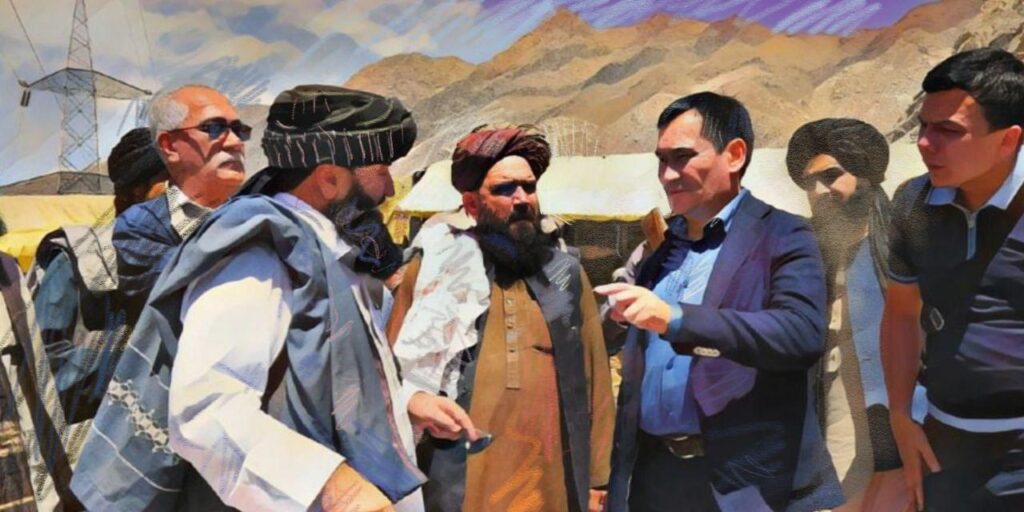
Uzbekistan’s business relations with neighboring Afghanistan are booming. In 2024, Uzbek-Afghan trade came to some $1.1 billion, and more than $1 billion of that was Uzbek exports to Afghanistan. It seems after the February 22-23 visit of Taliban acting Deputy Prime Minister for Economic Affairs Abdul Ghani Baradar to Uzbekistan, that figure is likely to continue climbing. Baradar met with Uzbek Prime Minister Abdullo Aripov and Deputy Prime Minister Jamshid Khojayev to discuss trade and investment, which is essentially the basis of Uzbekistan’s relations with Taliban-ruled Afghanistan. The immediate results of these talks were modest, but projects due to start in the near future offer substantial profits for both Uzbekistan and Afghanistan. Uzbekistan agreed to lift restrictions on imports of Afghan agricultural goods, which facilitated another agreement establishing a free economic zone in Uzbekistan’s border area that would have factories for processing pine nuts and cotton from Afghanistan. Agricultural goods are the bulk of Afghanistan’s exports to Uzbekistan, which is not surprising since more than 40 years of war have prevented Afghanistan from building many plants and factories for producing finished goods. A report from November 2024 said in the first ten months of the year, Uzbekistan’s exports to Afghanistan came to some $855.9 million, while Afghan exports to Uzbekistan amounted to only some $28.3 million. Power On Uzbekistan is the leading exporter of electricity to Afghanistan, supplying nearly 60% of Afghanistan’s electricity imports, and that amount could increase soon. Baradar’s delegation discussed progress on the 500 kV transmission line from Uzbekistan’s Surkhan region to Dashti-Alvan, near the Baghlan provincial capital Pul-e-Khumri, which will increase Uzbekistan’s electricity exports to Afghanistan by some 70%. Construction of the 260-kilometer transmission line started in 2018 and has been repeatedly delayed. Baradar said Uzbek officials agreed to cut the cost of building the transmission line from $252 million to $222 million. Turkmenistan is also considering building a 500 kV transmission line to Dashti-Alvan. Uzbek Deputy Prime Minister Khojayev and Baradar reviewed progress at Afghanistan’s Toti-Mardan gas field, just south of the border with Turkmenistan, which is believed to contain vast reserves of natural gas. In November 2024, Uzbekistan signed a ten-year contract to develop the gas field, pledging to invest $100 million in the project each year. According to reports about Baradar’s recent visit, drilling at the site is expected to begin soon. Prime Minister Aripov said Uzbek investors were already preparing to start construction of a cement plant in Afghanistan’s Samangan Province. Taliban officials have been offering Uzbek companies opportunities in Afghanistan’s mining sector for months. The Taliban acting minister of mines and petroleum, Hidayatullah Badri, was part of Baradar’s delegation and he met with Uzbek officials to discuss cooperation in developing Afghanistan’s mineral resources. The Afghan delegation again proposed Uzbek participation in developing mining sites, but there was no word in reports on any agreements. Aripov mentioned Uzbekistan was interested in the exploration and extraction of oil and gas, both of which Uzbekistan needs for domestic consumption, but did not mention mining....