• KGS/USD = 0.01144 0%
  • KZT/USD = 0.00204 0%
  • TJS/USD = 0.10835 0%
  • UZS/USD = 0.00008 0%
  • TMT/USD = 0.28490 -0.28%
  • KGS/USD = 0.01144 0%
  • KZT/USD = 0.00204 0%
  • TJS/USD = 0.10835 0%
  • UZS/USD = 0.00008 0%
  • TMT/USD = 0.28490 -0.28%
  • KGS/USD = 0.01144 0%
  • KZT/USD = 0.00204 0%
  • TJS/USD = 0.10835 0%
  • UZS/USD = 0.00008 0%
  • TMT/USD = 0.28490 -0.28%
  • KGS/USD = 0.01144 0%
  • KZT/USD = 0.00204 0%
  • TJS/USD = 0.10835 0%
  • UZS/USD = 0.00008 0%
  • TMT/USD = 0.28490 -0.28%
  • KGS/USD = 0.01144 0%
  • KZT/USD = 0.00204 0%
  • TJS/USD = 0.10835 0%
  • UZS/USD = 0.00008 0%
  • TMT/USD = 0.28490 -0.28%
  • KGS/USD = 0.01144 0%
  • KZT/USD = 0.00204 0%
  • TJS/USD = 0.10835 0%
  • UZS/USD = 0.00008 0%
  • TMT/USD = 0.28490 -0.28%
  • KGS/USD = 0.01144 0%
  • KZT/USD = 0.00204 0%
  • TJS/USD = 0.10835 0%
  • UZS/USD = 0.00008 0%
  • TMT/USD = 0.28490 -0.28%
  • KGS/USD = 0.01144 0%
  • KZT/USD = 0.00204 0%
  • TJS/USD = 0.10835 0%
  • UZS/USD = 0.00008 0%
  • TMT/USD = 0.28490 -0.28%

Viewing results 1 - 6 of 53

Building Bridges Across Eurasia: Kazakhstan’s Strategic Push for Transport Integration

The development of the economic systems of Europe and Asia is outpacing the level and pace of integration in the transportation systems of the countries located between them. This problem can be solved by creating an overland chain across the entire Eurasian space. As part of the development of its transit potential, Kazakhstan has started to form the backbone of such a terminal network. All work on creating transport networks has been entrusted to the national company, Kazakhstan Temir Zholy (KTZ), which plans to integrate all modes of transport to offer a comprehensive range of client services under a 'one-stop-shop' principle and enhance international operations. Establishing a terminal network outside of the republic will improve freight logistics and help build efficient supply chains. This decision is driven by market demands for cargo delivery, which go beyond mere transportation needs and require the provision of a comprehensive transportation product by a single logistics operator. Where Cargo Flows Begin Developing cooperation with China plays a crucial role in integrating Eurasian transport space. In 2023 alone, transit freight traffic between Kazakhstan and China reached a record 28.3 million tons. This success was partially due to the development of a terminal network in China - the Kazakhstan-China logistics terminal in the Pacific port of Lianyungang has been operating for ten years, and the largest dry port in Central Asia, Khorgos – Eastern Gate, operates on the border. The transport system between these two ports facilitates the delivery of goods from China's eastern coast to Europe via the Caspian Sea, ensuring the shortest delivery times. Adding the new Kazakh terminal in Xi'an to this transport chain has optimized logistics processes and boosted transportation performance. In the first eight months of 2024, container transit from China along the Trans-Caspian International Transport Route (TITR) increased 20-fold thanks to the freight terminal in Xi'an, a project was implemented in partnership with the Chinese company, Xi'an Free Trade Port Construction and Operation. Focusing on EAEU Transport Potential Significant steps have been taken to harness the transport potential of the Eurasian Economic Union (EAEU) countries. In April, construction began on a new terminal at the Selyatino station near Moscow. A trilateral Kazakhstan-Russia-China agreement on creating the CRK Terminal transport and logistics center has been signed by KTZ, SlavtransService, and Xi'an Free Trade Port Construction and Operation. This logistics hub, based in one of the largest dry ports in Selyatino, will develop direct transport links between Xi'an, Russia, and other countries. Its launch is expected this year. Additionally, in the fall of 2024, KTZ signed a Memorandum of Understanding with Chinese and Belarusian partners to build a new logistics terminal in the Belarusian city of Svisloch. Caspian Priority To further integrate Kazakhstan into the key Trans-Caspian International Transport Route (TITR) plans are underway to create an inter-modal freight terminal in Azerbaijan's Alyat port. An agreement for the project's implementation has been signed between SK-AIH Investment Fund Ltd, KTZ, Baku International Sea Trade Port CJSC, and Xi'an Free Trade Port Construction and...

Long-Awaited Construction of China-Kyrgyzstan-Uzbekistan Railway Officially Launched

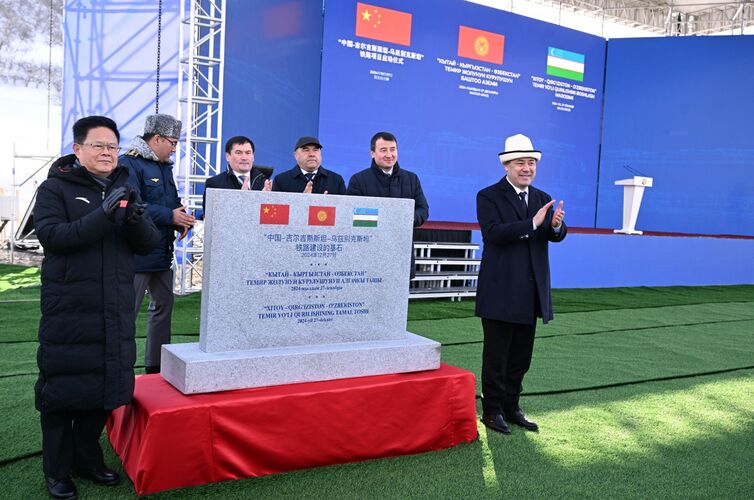
On December 27, Kyrgyzstan's President Sadyr Japarov, the Chairman of the National Development and Reform Commission of the People's Republic of China, Zheng Shanjie, and Uzbekistan’s Deputy Prime Minister Jamshid Khodjayev participated in a ceremony to mark the start of construction on the China-Kyrgyzstan-Uzbekistan railway. The event occurred in the village of Tosh-Kutchu in Kyrgyzstan’s Jalal-Abad region, where they laid the first stone for this significant regional transportation project. Speaking at the ceremony, President Japarov highlighted the importance of the China-Kyrgyzstan-Uzbekistan railway as more than just a transportation route, describing it as a critical strategic bridge linking the East and West. "This route will ensure the delivery of goods from China to Kyrgyzstan, as well as to the countries of Central Asia and the Middle East, including Turkey, and on to the European Union. The project will strengthen interregional ties, help diversify transport routes and increase the competitiveness of the region as an international transport and transit hub, which is in line with the goals of the Central Asian countries," Japarov said. Zheng Shanjie delivered a message from Chinese President Xi Jinping, highlighting that the new land corridor connecting Asia and Europe will significantly increase the flow of people and trade among the three countries. According to the message, the project is expected to drive regional prosperity by fostering industrial and resource development, boosting trade, and attracting investment. Uzbekistan's President Shavkat Mirziyoyev, in an address read by Deputy Prime Minister Khodjayev, called the launch of railway construction a historic milestone that the three nations had been working toward for nearly 30 years. The Uzbek leader noted that the new transportation artery, which will establish the shortest land route connecting Central Asia and China, will strengthen the strategic partnership between the three nations. The 523-kilometer railway will traverse Kashgar (China), Torugart, Makmal, Jalal-Abad (Kyrgyzstan), and Andijan (Uzbekistan). Once completed, the railway is expected to handle up to 15 million tons of cargo annually. Currently, neither Kyrgyzstan nor Uzbekistan has a direct railway connection to China. Central Asia’s rail link to China is limited to a route through Kazakhstan, leaving Kyrgyzstan and Uzbekistan without a direct connection.

Beijing Meeting Charts Future of China-Kazakhstan-Turkmenistan-Iran Rail Corridor

On December 25, experts convened in Beijing to evaluate the performance and future potential of the China-Kazakhstan-Turkmenistan-Iran railway route. The meeting reviewed the route’s operational results for 2024 and explored opportunities for further development. Kazakhstan was represented by KTZ Express, a subsidiary of Kazakhstan Temir Zholy (KTZ), the national railway company. According to KTZ Express, cargo transportation volume along the route increased by 31% during the first 11 months of 2024 compared to the same period in 2023. This growth underscores the rising interest of market participants in the route and highlights Kazakhstan’s critical role as a transit hub in the global supply chain. Key Discussion Points Participants focused on several areas to enhance the route’s efficiency: Increasing cargo delivery speeds to further reduce transit times. Optimizing customs procedures to streamline cross-border operations. Implementing modern digital solutions to simplify logistics processes and improve transparency. Strategic Importance of the Route The China-Kazakhstan-Turkmenistan-Iran railway corridor is a vital link in Eurasian trade, facilitating the rapid movement of goods from China’s eastern coast to the Persian Gulf and Middle Eastern markets. This corridor has already achieved significant milestones, reducing delivery times between China and Iran to just 15 days. With its growing cargo volumes and strategic positioning, the China-Kazakhstan-Turkmenistan-Iran railway route is poised to become an even more significant player in Eurasian trade. Continued efforts to optimize its operations and infrastructure will further solidify its role in connecting key global markets.

Transforming Kazakhstan’s Railways: Strategic Infrastructure for Regional and Global Connectivity

Kazakhstan’s rail network is a strategic national asset, vital for a country of its vast size and landlocked geography. Without direct access to the world’s oceans, railways serve as critical arteries for trade and transit. Under new geopolitical and logistical conditions, the importance of modernizing and expanding this network has become increasingly urgent. Spanning 21,000 kilometers, Kazakhstan’s railroads form the backbone of its transportation infrastructure. By 2030, the country plans to modernize 11,000 kilometers of highways and construct over 5,000 kilometers of new railways. Among these ambitious projects are the construction of second tracks on the Dostyk-Moyinty railway section, a bypass railway line around Almaty, and two new lines: Darbaza-Maktaaral and Bakhty-Ayagoz. Expanding Trade with China: Increased Cargo Traffic The Dostyk border station has become a key hub for exports to China and a vital transit point for East-West trade. In recent years, growing cargo volumes and limited capacity have placed immense pressure on its infrastructure. The Dostyk-Alashankou junction point, with a current capacity of 20 million tons annually, handled 15.2 million tons in the first 10 months of this year alone - a 15% increase compared to the same period last year. To address these challenges, construction of second railroad tracks on the Dostyk-Moyinty section began in November 2022. Part of the National Project: Strong Regions - Driver of the Country's Development, this project aims to increase the section’s capacity fivefold, from 12 to 60 train pairs per day. Transportation speeds between China and Europe are also set to improve significantly, from the current 800 kilometers per day to 1,500 kilometers per day. Official data indicates that 635 kilometers of the planned 836 kilometers have already been completed. The project involves 62 bridges, 242 pipelines, and a workforce of 24 construction companies and over 440 units of equipment. Completion is expected by late 2025. Private Investments Driving New Railway Lines Kazakhstan’s second major rail crossing with China, Altynkol station, has also reached its maximum capacity. Together with Dostyk, the two stations handle 28 million tons annually. This makes the development of the new 272-kilometer Bakhty-Ayagoz railway line essential. Connecting the border to the Semey-Aktogay section and the China-Europe corridor, the new line is expected to boost goods transportation to and from China by an additional 20 million tons. This project, realized under a public-private partnership model, will feature the construction of 11 stations, 47 bridges, 23 railroad overpasses, and eight highway overpasses. It will also include five pedestrian bridges and 16 observation structures, utilizing over 500,000 locally manufactured sleepers and 36,000 rails. Approximately 1,700 jobs will be created during the construction phase, with priority given to local residents. Alleviating Traffic in Almaty: A New Bypass Line The 73-kilometer bypass railway line around Almaty is set to increase cargo capacity by 17 million tons annually. By redirecting traffic to the Zhetygen-Kazybek Bey line, this project will reduce congestion at the Almaty junction by 40%. Faster delivery times for goods and passengers - up to 24 hours shorter - are among...

Uzbekistan Targets $200 Billion GDP by 2030 with Transport Reforms

On November 26, President Shavkat Mirziyoyev outlined transformative plans for Uzbekistan’s state-owned railway and aviation sectors, setting an ambitious goal to increase the country’s GDP to $200 billion by 2030. Significant changes are already being implemented to enhance efficiency and convenience. In the railway sector, six independent enterprises have been created under “Uzbekistan Railways.” The company added 1,200 new freight cars, halving domestic freight transportation times. The digitalization of operations has streamlined processes, cutting the ordering stage for freight cars from seven days to three and reducing processing time from 72 hours to just 12 hours. Around Tashkent, train traffic has increased by 30%, and for the first time, the previously unprofitable enterprise posted a profit of 30 billion UZS ($2.3 million) this year. In the aviation sector, Uzbekistan Airways has seen flights increase by 25%, with domestic flights surging 2.5 times. The airline now holds a 20% share of international transport in Central Asia, and annual passenger traffic is projected to exceed 6 million. “Uzbekistan Airports” has also expanded services for planes, cargo, and passengers. Greater private sector involvement in airport management has yielded notable results, with 44 airlines currently operating in Uzbekistan. Cargo transportation through airports is expected to grow by 22% this year. “The economy and trade relations in our country are developing year after year. The population’s income and the tourism potential of the regions are also increasing. By 2030, we have set a goal to increase the volume of our gross domestic product to $200 billion. Therefore, we should pay special attention to the transport arteries,” Mirziyoyev said. To support these developments, a new version of the Law “On Railway Transport” has been signed, replacing the 25-year-old legislation. The updated law aims to attract private companies and investments to further develop infrastructure and accelerate industry growth.

Kazakhstan, Hungary, and China Establish Cargo Terminal in Budapest

Kazakhstan Temir Zholy (KTZ, Kazakhstan’s national railway company), L.A.C. Holding (Hungary), and Xi'an Free Trade Port Construction and Operation Co., Ltd (China) have signed a memorandum to establish a joint inter-modal cargo terminal in Budapest. The document was signed on November 20 as part of the state visit of Kazakhstan's President Kassym-Jomart Tokayev to Hungary. The planned terminal will leverage the strategic location of the Hungarian capital in the heart of Europe and its developed transport network for multimodal transportation across the continent. The terminal will have a capacity of 230,000 TEU annually and will increase the number of container trains between China and Europe, including transit along the Trans-Caspian International Transport Route (TITR). The new terminal is expected to reduce delivery times and transportation costs. KTZ continues to expand its terminal network along key transport corridors to strengthen Kazakhstan's position as a key transit hub in Eurasia. On November 12, Kazakhstan, Azerbaijan, and China signed an agreement to establish an inter-modal cargo terminal in the Port of Alat in Baku, Azerbaijan. Commenting on the signed Memorandum at a press briefing in Budapest, Tokayev said this initiative will strengthen trade and transport ties between the participating countries. “New opportunities are opening up for the development of infrastructure, logistics, and international trade. Eighty-five percent of land transit shipments between Asia and Europe pass through Kazakhstan. In the near future, the volume of cargo transportation along this route will reach 10 million tons,” Tokayev said.