• KGS/USD = 0.01144 0%
  • KZT/USD = 0.00214 0%
  • TJS/USD = 0.10697 0%
  • UZS/USD = 0.00008 0%
  • TMT/USD = 0.28490 0%
  • KGS/USD = 0.01144 0%
  • KZT/USD = 0.00214 0%
  • TJS/USD = 0.10697 0%
  • UZS/USD = 0.00008 0%
  • TMT/USD = 0.28490 0%
  • KGS/USD = 0.01144 0%
  • KZT/USD = 0.00214 0%
  • TJS/USD = 0.10697 0%
  • UZS/USD = 0.00008 0%
  • TMT/USD = 0.28490 0%
  • KGS/USD = 0.01144 0%
  • KZT/USD = 0.00214 0%
  • TJS/USD = 0.10697 0%
  • UZS/USD = 0.00008 0%
  • TMT/USD = 0.28490 0%
  • KGS/USD = 0.01144 0%
  • KZT/USD = 0.00214 0%
  • TJS/USD = 0.10697 0%
  • UZS/USD = 0.00008 0%
  • TMT/USD = 0.28490 0%
  • KGS/USD = 0.01144 0%
  • KZT/USD = 0.00214 0%
  • TJS/USD = 0.10697 0%
  • UZS/USD = 0.00008 0%
  • TMT/USD = 0.28490 0%
  • KGS/USD = 0.01144 0%
  • KZT/USD = 0.00214 0%
  • TJS/USD = 0.10697 0%
  • UZS/USD = 0.00008 0%
  • TMT/USD = 0.28490 0%
  • KGS/USD = 0.01144 0%
  • KZT/USD = 0.00214 0%
  • TJS/USD = 0.10697 0%
  • UZS/USD = 0.00008 0%
  • TMT/USD = 0.28490 0%

Viewing results 1 - 6 of 42

Opinion: The Regional Ecological Summit and the Making of a Central Asian Voice

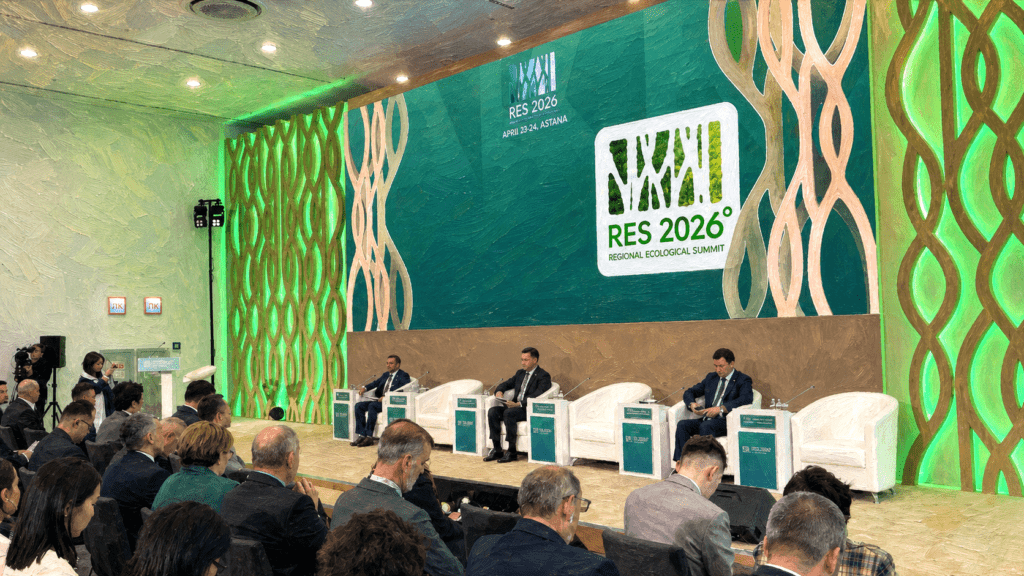
On 22–24 April, Astana hosted the Regional Ecological Summit—a gathering of governments, international organizations, financial institutions, and civil society that marked a new level of ambition in Central Asia’s environmental diplomacy. Fifty-eight sessions were held across three days at a moment when Central Asia’s ecological agenda is becoming inseparable from its political and economic future. The opening ceremony was attended by the presidents of all five Central Asian states. The summit adopted the Astana Declaration on Ecological Solidarity in Central Asia and brought renewed attention to the need to reform the International Fund for Saving the Aral Sea (IFAS). Taken together, these developments signal more than procedural diplomacy. They point to growing political momentum. The region has never lacked shared history or channels of communication. Russian remains a practical language of intergovernmental exchange, and borders, economies, rivers, energy systems, and labor markets have tied these countries together long before contemporary climate diplomacy gave this interdependence a new vocabulary. For decades, much external analysis of Central Asia expected this interdependence to produce confrontation, particularly around water and energy. Those risks remain real. Yet the Astana summit showed a more complex trajectory. Climate change, biodiversity loss, water insecurity, land degradation, and food security are not separate national problems neatly contained within borders. Addressing them is becoming one of the fields through which regional coherence is being built. The significance of the Summit lies less in ceremonial language than in the consolidation of multiple ecological agendas into a visible diplomatic architecture. Through its panels and high-level discussions, the Summit placed Central Asia’s natural heritage not at the margins of development but at its center. Ecosystems, rivers, glaciers, mountains, and landscapes are not only environmental assets. They are conditions for prosperity, stability, and resilience. Kazakhstan’s chairmanship of IFAS reopened the question of whether the Fund, long criticized for its limitations, can be reworked rather than left as a symbol of failed regional environmental governance. Kazakhstan’s proposal for an International Water Organization should be read in the same frame: it is not merely a technical proposal about water governance but an attempt to move a Central Asian concern into the language of global institutional reform. Kyrgyzstan’s mountain agenda and Tajikistan’s glacier diplomacy also belong to this broader pattern. They are not just isolated national branding exercises. Together with Uzbekistan’s increasingly active regional posture, they form a wider mosaic: each country brings a distinct ecological priority, but these priorities are becoming legible as parts of one regional perspective, and its voice carries more weight when presented as such. This is particularly important in the current geopolitical moment. As larger powers turn inward, compete over corridors, or speak about Central Asia through the old grammar of influence, the region is attempting to define itself not as terrain for another “Great Game" but as a pole of its own. This does not mean distance from external partners. On the contrary, the United Nations was a strategic partner of the Summit, and many formats involved major international organizations, European...

Central Asia Seeks Solutions to Water Scarcity Amid Climate Risks

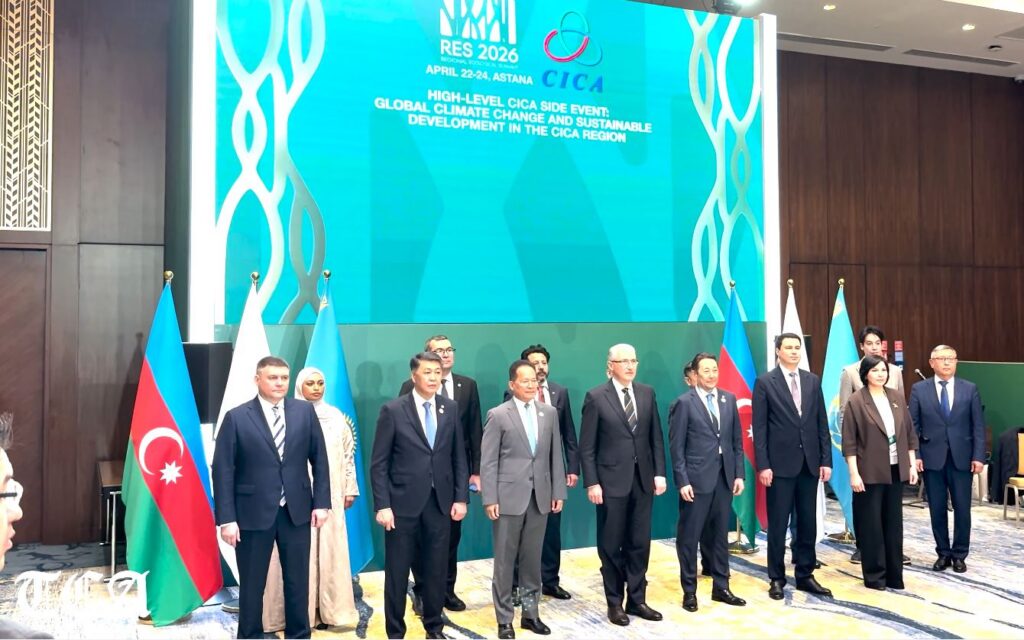
Central Asian countries must accelerate the transition from discussing climate goals to implementing them in practice, as water scarcity intensifies and the impacts of climate change deepen, participants at a regional conference said on Friday. A key event on the final day of the Regional Ecological Summit (RES 2026) in Astana was the Central Asian Climate Change Conference (CACCC), where government officials, international organizations, and experts discussed risks to the region’s water, energy, and food security. Participants noted that declining water availability requires a fundamental shift in resource management approaches. [caption id="attachment_47800" align="aligncenter" width="1280"] Image: TCA[/caption] “In conditions of reduced water availability, the priority is no longer increasing water intake but improving efficiency in water use. Today, government support for water-saving technologies covers up to 80% of costs. This represents a fundamental shift toward rational and economically sound water management,” said Kazakhstan’s Vice Minister of Water Resources and Irrigation, Talgat Momyshev. According to him, by 2030, the use of such technologies is expected to expand to more than 1.3 million hectares, potentially reducing agricultural water consumption by approximately 30%. “This is not just about saving resources, but about forming a new management model where data, forecasting, and cross-sectoral coordination play a central role,” he added. Kazakhstan is also developing a national water information system that will integrate data on surface and groundwater resources. More than 6,000 canals are expected to be digitized by the end of the year, enabling a shift toward predictive water management. Participants placed particular emphasis on the transboundary nature of water resources in the region. [caption id="attachment_47801" align="aligncenter" width="1280"] Image: TCA[/caption] “The development of joint monitoring systems and data exchange, the creation of resilient infrastructure, and the coordination of water and energy policies are becoming increasingly important. We believe that data, trust, and joint planning must form the foundation of effective climate adaptation,” Momyshev said. International partners confirmed their readiness to expand support for the region. “Our current efforts in the water sector are reflected in the Swiss Cooperation Programme for Central Asia for 2026-2029," said Tobias Werder, a representative of the Swiss government. "More than half of its $200 million budget is allocated to water-related projects. Since 2017, we have also actively promoted the Blue Peace Central Asia initiative, which helps strengthen regional coordination and move from dialogue to practical solutions.” Kazakhstan’s Minister of Ecology and Natural Resources, Yerlan Nyssanbayev, noted that the climate agenda in the region extends far beyond environmental issues. “For Central Asia, climate change is no longer a distant projection. It is a factor directly affecting water, energy, agriculture, infrastructure, and public health. Under these conditions, the climate agenda becomes a matter of economic resilience, regional security, and the quality of public governance,” he said. [caption id="attachment_47799" align="aligncenter" width="1280"] Image: TCA[/caption] According to Nyssanbayev, the region must accelerate the implementation of concrete projects. “It is now clear that we must focus on improving project preparation, expanding access to climate finance, and strengthening coordination. Without this, achieving our stated goals will be...

Central Asian Countries to Jointly Address Cryosphere Threats

As part of the Regional Ecological Summit (RES 2026) in Astana, the UNESCO Regional Office in Almaty organised a session titled “The Cryosphere of Central Asia: From Scientific Assessment to Joint Climate Adaptation Action,” in cooperation with Kazakhstan’s Ministry of Ecology and Natural Resources and Ministry of Science and Higher Education. The event was held under the GEF-UNDP-UNESCO Cryosphere project and in collaboration with Central Asian countries. The session focused on discussing the Joint Subregional Action Programme (JSAP) on the cryosphere, a framework document developed by Central Asian countries with UNESCO’s support. The programme is aimed at strengthening regional cooperation in monitoring and research on glaciers, snow cover, and permafrost, as well as aligning approaches to climate change adaptation, according to Kazakhstan’s Ministry of Ecology and Natural Resources. Central Asia is experiencing accelerated glacier melt. Under a high-emissions scenario, the region could lose up to 85% of its glacier volume by 2100 compared to 2020 levels. This would increase pressure on water resources, infrastructure, and communities, while also heightening the risk of natural hazards, including glacial lake outburst floods. As these processes are regional in nature, they require coordinated responses across Central Asian countries. “UNESCO has been actively supporting Central Asian countries in strengthening the scientific basis and advancing regional cooperation on the cryosphere. Today, the key priority is to move from scientific assessment to concrete action. The Joint Subregional Action Programme provides a practical framework for this transition and enhances coordination of adaptation efforts across the region,” said Amir Piric, Director of the UNESCO Regional Office in Almaty. As a key outcome of the session, heads of relevant government authorities from Kazakhstan, Tajikistan, Turkmenistan, and Uzbekistan responsible for environmental protection issued a joint statement supporting JSAP implementation, reaffirming their commitment to strengthened regional cooperation. “Today it is clear that no country can effectively address climate change challenges alone. Regional cooperation is therefore essential. The Joint Statement reflects the readiness of Central Asian countries to join efforts and develop coordinated approaches to climate change adaptation,” said Nurlan Kurmalayev, Deputy Minister of Ecology and Natural Resources of Kazakhstan. The JSAP provides a foundation for coordinated action among countries and partners, defines cooperation priorities, and supports the advancement of climate adaptation measures in the region. The joint statement also opens opportunities to mobilise funding from various sources, including donors, international financial institutions, and the private sector.

Regional Ecological Summit in Astana Produces Ecology Declaration and Broader Regional Agenda

Central Asian leaders have adopted the Astana declaration on ecology and sustainable development, giving the Regional Ecological Summit in Astana a formal political outcome while a wider package of biodiversity, climate, and pollution initiatives takes shape around it. Kazakhstan’s environment ministry says the five heads of state adopted the document, titled “Ecological Solidarity of Central Asia,” during the April 22 to 24 Summit. The declaration sets out a common regional position on several of Central Asia’s biggest environmental pressures. According to the ministry summary, the text calls for closer coordination in climate negotiations, glacier preservation, the mountain agenda, biodiversity, chemical and waste management, plastic pollution, air quality, land degradation, and desertification. It also presents the declaration as a contribution to ecological sustainability, inclusive economic growth, and a sustainable future for the region. Water runs through the document, but the language is careful. The declaration welcomes work on an interstate program to conserve the Caspian Sea and expresses concern about declining water levels and the shallowing of lakes in Central Asia. It also notes Kazakhstan’s proposal for a possible International Water Organization within the United Nations system, but stops short of endorsing its creation. The summit’s outcome does not rest on a single document. On April 24, the United Nations Environment Programme said the Astana meeting had launched new regional partnerships on circular economy and glaciers, while countries established common approaches on biodiversity, climate action, and air pollution. UNEP also said a regional climate and ecology investment portfolio was set up to widen access to international finance for environmental projects. A separate biodiversity track had already produced its own result earlier in the week. On April 22, UNDP in Kazakhstan said Central Asian countries had signed a regional declaration on biodiversity conservation during a high-level plenary session in Astana. According to UNDP, the document envisages an umbrella programme and action plan, as well as a regional resource mobilization plan to be presented at COP17 in Armenia. Outside confirmation of the main declaration has also become clearer. EFE reported on April 22 that the five Central Asian republics had approved the Astana Declaration of Ecological Solidarity, linking it to Tokayev’s focus on water security, the Aral Sea, and the Caspian. Put together, the Astana summit now looks like a broader regional attempt to turn shared ecological pressure into a workable political agenda. The summit’s next test will be whether these declarations and partnerships are followed by funding, coordination, and cross-border implementation.

Video: Regional Ecological Summit Moves Into Day Two in Astana

The Regional Ecological Summit in Astana moved into its second day on Thursday with panel discussions, technical sessions, and further exchanges among regional officials, as the event built toward the expected adoption of a joint declaration on its closing day on Friday. [video width="3840" height="2160" mp4="https://timesca.com/wp-content/uploads/2026/04/no-comments-4-1.mp4"][/video]

Mirziyoyev Calls for Central Asian Environmental Solidarity at Astana Summit

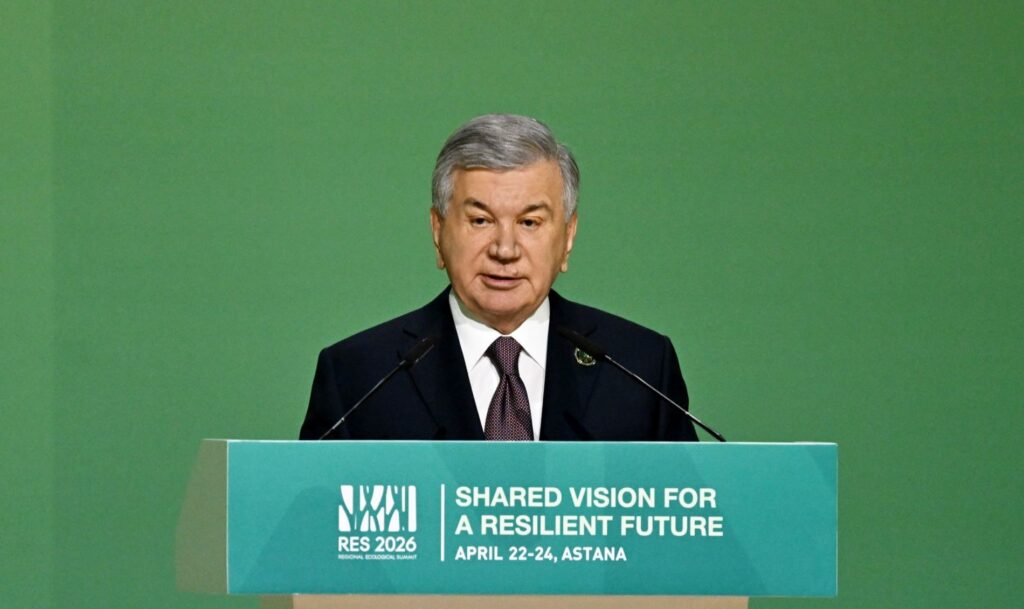
Uzbek President Shavkat Mirziyoyev used the opening of the Regional Ecological Summit in Astana on April 22 to argue that Central Asia must treat climate and environmental pressure as a shared regional challenge rather than a set of national problems. The meeting comes as Kazakhstan tries to turn ecology into a broader platform for regional coordination, investment, and policy action, Addressing fellow leaders and delegates, Mirziyoyev backed the summit’s theme, “Shared Vision for a Sustainable Future,” and said the meeting built on the regional dialogue launched at last year’s Samarkand Climate Forum. He said environmental diplomacy in Central Asia was becoming more systematic and consistent at a time when warming in the region was moving at twice the global rate. Mirziyoyev pointed to the loss of nearly one-third of Central Asia’s glaciers, unstable rainfall, growing water shortages, and land degradation affecting 80 million hectares. His remarks landed as water security has become one of the most urgent regional concerns ahead of the 2026 growing season, as recently reported by The Times of Central Asia. He also criticized what he described as weakening global environmental solidarity and called for fairer access for developing countries to climate finance, advanced technologies, and innovation. While welcoming regional efforts to put environmental protection at the center of cooperation, Mirziyoyev stated that, “Countries that have contributed least to global climate change are once again being left alone to deal with its consequences.” Mirziyoyev also highlighted Uzbekistan’s domestic record, including tree planting under the Yashil Makon program and afforestation on the dried bed of the Aral Sea. He also proposed new regional initiatives, including a Clean Air consortium, a Green Trade Corridor, a shared climate investment portfolio, and a Central Asian Red Book for biodiversity protection.