• KGS/USD = 0.01143 0%
  • KZT/USD = 0.00205 0%
  • TJS/USD = 0.10433 0.1%
  • UZS/USD = 0.00008 0%
  • TMT/USD = 0.28577 0%
  • KGS/USD = 0.01143 0%
  • KZT/USD = 0.00205 0%
  • TJS/USD = 0.10433 0.1%
  • UZS/USD = 0.00008 0%
  • TMT/USD = 0.28577 0%
  • KGS/USD = 0.01143 0%
  • KZT/USD = 0.00205 0%
  • TJS/USD = 0.10433 0.1%
  • UZS/USD = 0.00008 0%
  • TMT/USD = 0.28577 0%
  • KGS/USD = 0.01143 0%
  • KZT/USD = 0.00205 0%
  • TJS/USD = 0.10433 0.1%
  • UZS/USD = 0.00008 0%
  • TMT/USD = 0.28577 0%
  • KGS/USD = 0.01143 0%
  • KZT/USD = 0.00205 0%
  • TJS/USD = 0.10433 0.1%
  • UZS/USD = 0.00008 0%
  • TMT/USD = 0.28577 0%
  • KGS/USD = 0.01143 0%
  • KZT/USD = 0.00205 0%
  • TJS/USD = 0.10433 0.1%
  • UZS/USD = 0.00008 0%
  • TMT/USD = 0.28577 0%
  • KGS/USD = 0.01143 0%
  • KZT/USD = 0.00205 0%
  • TJS/USD = 0.10433 0.1%
  • UZS/USD = 0.00008 0%
  • TMT/USD = 0.28577 0%
  • KGS/USD = 0.01143 0%
  • KZT/USD = 0.00205 0%
  • TJS/USD = 0.10433 0.1%
  • UZS/USD = 0.00008 0%
  • TMT/USD = 0.28577 0%

Viewing results 1 - 6 of 71

Beneath the Silk Road: China’s Archaeological Diplomacy in Uzbekistan

As China’s economic footprint expands across Central Asia, Beijing is quietly pursuing another, subtler form of influence - one that reaches beneath the soil rather than above it. Alongside highways, pipelines, and industrial parks, China is investing in archaeological diplomacy that uses shared history and cultural discovery to deepen ties with its neighbors. Uzbekistan has emerged as a key partner in this effort. Beyond trade and infrastructure, the two countries are now working hand in hand to uncover the remnants of ancient civilizations that once thrived along the Silk Road. This collaboration combines science and strategy, offering a soft power approach that complements China’s growing hard power presence in the region. Across Uzbekistan’s Surkhandarya, Samarkand, Ferghana, and Khorezm regions, joint Chinese-Uzbek teams are making discoveries. One notable example is the joint Chinese-Uzbek team working at the Chinar-Tepa site in the upper Surkhandarya River valley, where researchers have uncovered more than 30 ancient house foundations along with a rich collection of cultural artifacts. Another major project has revealed the remains of an Iron Age city-state in the Surkhandarya River basin in southern Uzbekistan. These findings are the result of three excavation seasons conducted between 2024 and 2025, during which the joint team surveyed 47 sites across the basin and identified the area as a major center of ancient Bactria. This cooperation is not just confined to the field. In October 2023, Ferghana State University and Chinese partners launched a joint archaeology department. Their subsequent joint studies of the ancient city of Kuva have revealed key insights into urban planning, including city walls, moats, and roads dating back centuries. Meanwhile, China’s funding for the restoration of the ancient city of Khiva highlights another layer of cultural collaboration on the preservation of shared heritage. For both countries, archaeology is more than an academic pursuit; it's a bridge between culture, economy, and future cooperation. For Uzbekistan, cities like Samarkand, Bukhara, and Khiva are already world-renowned tourist destinations. The government’s ambition to attract up to 15 million foreign visitors underscores tourism’s growing role in national development. Unearthing new historical sites expands this potential, offering travelers a richer experience that spans both the pre-Islamic and Islamic eras. Each discovery deepens the cultural map of Uzbekistan, and each new site means more visitors, more investment, and greater economic diversification for the state. Beyond the economic dimension, the partnership with China is also cultivating a new generation of experts in archaeology and heritage preservation. Many members of these joint excavation teams belong to the post-2000 generation, young professionals who are gaining firsthand experience through collaboration. With access to cutting-edge technologies such as drone-based aerial photography, geomagnetic surveying, and 3D modeling, Uzbek archaeologists and students are learning to combine traditional excavation with modern science. Over time, this knowledge transfer strengthens the country’s human capital base, empowering Uzbekistan to pursue its own archaeological research and heritage conservation independently on a larger scale. For China, promoting joint archaeological exploration aligns closely with the Belt and Road Initiative’s vision of soft connectivity....

Silk Road Shipwrecks: Virtual Museum Opens Maritime Section

One of Central Asia’s most engaging new cultural projects took on a new dimension last month. The Silk Road Virtual Museum, an online collection of over 20 exhibitions of pre-16th-century Eurasian life and art, has recently opened a section for the ancient trade route’s maritime history. An initiative by the Institute of Asian Studies at Leiden University in the Netherlands, the site allows visitors to move through themed rooms, just as they would wander through a physical museum. Beginning on a map of the world on the museum’s homepage, visitors click on the Silk Road locations that they wish to discover. Each pin on the map takes them to a video replicating a guided tour of art and artefacts from that place at a certain historical era. Just as in a real museum, each exhibit has an information panel explaining what the object is. Life on the Central Asian parts of the Silk Road is shown in exhibitions to Sogdian traders in Samarkand (6th-8th centuries), with camels often featuring in their ceramic art, and a room dedicated to ancient caravanserais (inns that provided lodging for travellers), including at Tash Rabat in Kyrgyzstan. Launched in 2024, the Silk Road Virtual Museum already displays over 1,300 objects in total. Their geographical reach mainly stretches from Venice to China, as the Silk Road is often imagined today – but there are collections from places as unexpected as Sweden and Indonesia.  With the launch of the maritime section on 16 September, their scope now spans seas as well as deserts. Virtual visitors can travel along the coasts of the Indian Ocean, where there are already seven shipwreck exhibitions, each with its own unique story. The project is managed by VirtualMuseum360 and supported by an international network of scholars, who aim to make the Silk Road’s many eras and strands accessible to people wherever they are in the world. The web pages have two advantages over traditional museums, in that they are free to access and open 24/7.  Leading the Silk Road Virtual Museum (SRVM) is Professor Richard Griffiths, the director of Leiden University’s ‘New Silk Roads’ programme. A distinguished economic historian who has specialised in the history of trade, during a spell teaching in the Chinese city of Chengdu, Griffiths took an interest in China’s Belt and Road Initiative. When he began to trace the policy’s history, he realised that the origins of China’s modern trade with the West can be found in the myths and realities of the ancient Silk Roads. The key to making SRVM work, he says, is collaboration. Griffiths tells The Times of Central Asia: “We’re not replacing real museums – we’re working alongside them. Everything we do depends on the knowledge of academics, archaeologists, and conservators. Together we can make heritage accessible to anyone, anywhere, without losing its depth or integrity.” “Our visitors are a real mix,” he adds. “Often people tell me they use SRVM before a trip, so that when they see objects in a real museum,...

“Recipes for Broken Hearts”: Bukhara Launches First Art Biennale

This autumn, the ancient Silk Road city of Bukhara is poised to reemerge as a global cultural destination, hosting its first-ever international art biennale, Recipes for Broken Hearts. Running from September 5 to November 20, the ten-week festival will transform Bukhara, a UNESCO Creative City, into a vibrant arena for contemporary art, community rituals, and culinary experiences. The initiative is spearheaded by Gayane Umerova, chair of the Uzbekistan Arts and Culture Development Foundation (ACDF), with renowned curator Diana Campbell at the helm. More than 70 new works, created in Uzbekistan, will be displayed in historic madrasas and caravanserais, reimagined as immersive exhibition spaces. The event promises to be among the region’s largest cultural gatherings, aiming to reclaim Bukhara’s place on the global cultural map. Not Just an Exhibition, A Sensory Ritual Recipes for Broken Hearts is not a traditional exhibition. Designed as a “ritual for the senses,” it invites audiences to engage with art not just visually but through touch, scent, sound, and taste. Sculptures, textiles, music, and food converge into an experimental space for “emotional healing.” Visitors become participants rather than spectators. At the opening ceremony, instead of a red carpet, guests will be welcomed by the scent of fermentation. Korean Buddhist nun and chef Jeon Kwan will prepare kimchi, place it in a clay pot, and bury it. Ten weeks later, the fermented dish will be unearthed and shared with the public, symbolizing transformation and healing through time. A Dialogue Between Cultures The biennale’s installations span a wide geographic and cultural range. Egyptian-American artist Laila Gohar will craft navata, a crystal made from grape juice and saffron. Colombian artist Delcy Morelos will construct a dome of clay, sand, and spices to symbolize human connection to the earth. Uzbek artist Oizhon Khairullaeva and ceramist Abdurauf Tahirov will create “organs of the city,” including a beating ceramic heart and a “stomach” integrated into historic architecture. Indian sculptor Subodh Gupta will build a giant dome from enamel teapots and bowls, shaped like a yurt, where guests will be served fusion cuisine. Central to the project is the in situ approach: every piece is created in Bukhara with the support of local artisans, potters, weavers, and carpet makers, infusing contemporary works with traditional skills. “This isn’t an art fair,” explained the curators. “Each piece speaks from this land, even if the whole world sees it.” [caption id="attachment_21936" align="aligncenter" width="2560"] The Kalon Mosque, Bukhara; image: TCA, Stephen M. Bland[/caption] Bukhara as a Living Gallery Festival venues are dispersed throughout Bukhara’s historic core, effectively turning the city into an open-air gallery. Four restored caravanserais symbolize the emotional journey from grief to hope. The 16th-century Gavkushon madrasa, repurposed as the “House of Softness,” will host workshops, public readings, and a symposium titled The Craft of Mending. There, artists and scholars will explore the “culture of repair”, from object restoration to the preservation of historical memory. “Erasing history is also a form of pain. Restoration is resistance to oblivion,” notes Harvard-based art historian Aziza Izamova. Concurrently,...

Kyrgyzstan and China Launch Joint Project to Preserve Ancient Silk Road City

Kyrgyzstan and China have launched a joint initiative to conserve the Ak-Beshim archaeological site, the ruins of the ancient city of Suyab, a major Silk Road settlement in the Chui Valley in northern Kyrgyzstan. This project marks a significant step in cultural cooperation between the two countries, focused on preserving shared heritage along one of history’s most storied trade routes. The Ministry of Culture, Information and Youth Policy of Kyrgyzstan and China’s Dunhuang Research Academy have established a joint laboratory for cultural heritage preservation, which will lead conservation efforts at Ak-Beshim. Located 7 kilometers southwest of Tokmok, the site of Suyab was a prominent cultural and commercial center from the 5th to 8th centuries. It served as the capital of the Western Turkic Kaganate and a key hub for Sogdian merchants along the Chang’an-Tian Shan Corridor, an ancient Silk Road route currently nominated for UNESCO World Heritage status. Chinese sources suggest that Tang dynasty poet Li Bo (701-762/763) may have been born in Suyab. Archaeologists have also uncovered what is believed to be the oldest Christian structure found in Kyrgyzstan: a Nestorian church dating to the 7th or 8th century. Preliminary fieldwork has already been conducted, and a conservation plan for Ak-Beshim has been drafted. The new lab is expected to serve as a regional center for cultural heritage protection, promoting research and conservation at other Silk Road sites across Belt and Road Initiative (BRI) countries. Suyab declined in the 11th century with the rise of Balasagun, another historic city in the Chui Valley near the famed Burana Tower. Nevertheless, its historical significance continues to attract scholarly and public interest as Kyrgyzstan deepens its commitment to preserving regional cultural landmarks. Officials from both countries emphasized that the project supports broader goals of cultural diplomacy and historical preservation, creating a bridge between ancient civilizations and contemporary international collaboration.

Silk Roads Exhibition: Beating Heart of the Ancient World

On a gloomy winter’s day, The Times of Central Asia visited the Silk Roads Exhibition at the British Museum. The sight of a significant queue wrapped around the museum for entry was startling. Once inside, the exhibit thronged with visitors snaking their way to peruse artifacts arranged by region and era. Concerned about blocking display views as you read descriptions? No need to worry — thick guidebooks with full narratives greeted you at the entrance to borrow during your visit. The exhibition envisions the Silk Road as the beating heart of the ancient world, with arteries stretching across seas, mountains, and deserts. With over 300 artifacts spread across five geographical zones, it can be hard to know where to start. I observed a nearby gentleman in tweed who offered a simple tip: start with a place that interests you and go from there. Then I overheard that he was going to Cairo. New partnerships with Uzbekistan’s Art and Culture Development Foundation (ACDF) and Tajikistan’s museums had seen fresh items loaned to the exhibit. These collaborations highlight Central Asia's important role in this sweeping narrative, helping to connect the dots in this continent-spanning story. Immersed in the culture and history, I couldn’t help but wonder — what did the audience think? After a few unsuccessful attempts, I spoke with an English visitor named Georgie Bennett. [caption id="attachment_27908" align="aligncenter" width="2029"] Georgie Bennett visiting the Silk Roads Exhibition; image: TCA, Stephen M. Bland[/caption] TCA: What drew you here today? I think the thing for me is I have a really poor knowledge and understanding of this bit of history. So, I heard the exhibition was on and some of my friends already booked tickets, I said yes, I’ll absolutely come along because… I wanted to learn more. TCA: What’s the one item that’s caught your eye the most? I really like the story of the silk princess; it was a very humanizing story about this lady who’s newly married and brings the knowledge of how to make silk to her husband’s kingdom… I feel like I've learned so much. I’m enjoying it, though I almost wish I had a notebook and pen because I'm getting a general impression without knowing any of the details. [caption id="attachment_27909" align="aligncenter" width="2560"] Charred wooden door panel from Kafir Kala, near Samarkand, Uzbekistan, circa AD 500, on loan from the State Museum reserve[/caption] The Times of Central Asia also spoke to one of the curators, Luk Yu-Ping to delve deeper into the Silk Road experience. TCA: Globalism is considered a modern concept of interconnectivity, but looking at the vast connections and influence within the Silk Road Exhibition it’s implied that this concept may have been prevalent in the past along these trade routes. Could you expand on this? This exhibition highlights the movement of people, objects, and ideas across Asia, Africa, and Europe during the period 500 to 1000 CE. The focus is not only on trade but also other ways of contact and exchange. Audiences might be...

Central Asia and South Korea Seek to Expand Cooperation

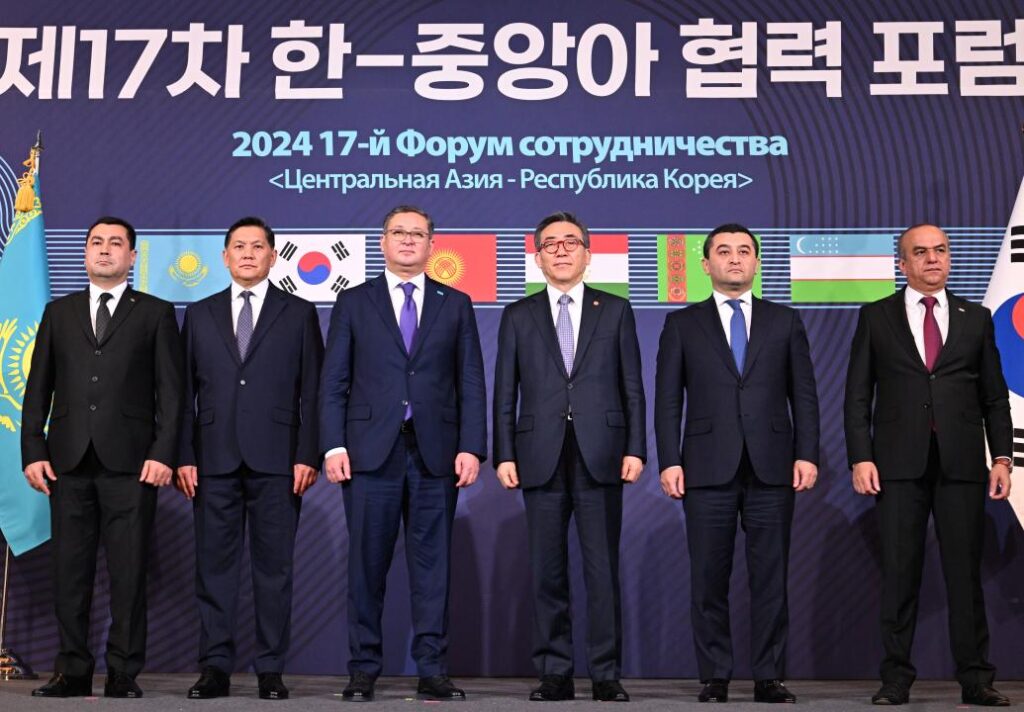
The 17th Central Asia–Republic of Korea Cooperation Forum, which took place in Seoul on November 4, addressed key areas of partnership between Central Asian countries and South Korea in sectors such as transport and logistics, energy, critical minerals, digital transformation, environmental issues, and tourism. Speaking at the forum, Kazakhstan’s Minister of Foreign Affairs, Murat Nurtleu, emphasized the importance of transport connectivity for the region’s sustainable economic growth. Kazakhstan is developing the Trans-Caspian International Transport Route to ensure safe and efficient cargo transportation from Asia to Europe. The Kazakh minister invited Korean companies to participate in major projects to expand the route’s capacity to 10 million tons of cargo annually. Addressing energy cooperation, Nurtleu highlighted Kazakhstan’s abundant natural resources, including rare earth metals and uranium. The Kazakh Foreign Minister expressed hope that Korean companies would join projects for resource extraction and processing and participate in a consortium to construct a nuclear power plant in Kazakhstan. Nurtleu stated, "Central Asian countries and the Republic of Korea are natural partners connected by a shared history, Altai heritage, and traditional trade relations dating back to the Silk Road era. The Republic of Korea is increasingly vital in the economic and technological development of the entire Central Asian region.” At the forum, Kyrgyzstan’s First Deputy Minister of Foreign Affairs, Asein Isaev, highlighted the growing role of South Korea as a high-tech nation interested in strengthening supply chains for energy resources and rare earth metals and developing transport and logistics routes with Kyrgyzstan and other Central Asian countries. As part of the forum, South Korea's President Yoon Suk Yeol met with the heads of Central Asian delegations and pointed out Korea’s interest in strengthening relations with Central Asian countries through the K-Silk Road initiative. This strategic program supports Korean infrastructure development in Central Asia in exchange for improved access to the region’s raw materials and critical minerals. During his visit to Kazakhstan in June, Yoon Suk Yeol emphasized the importance of strengthening the strategic partnership between Kazakhstan and South Korea to supply critical minerals.