• KZT/USD = 0.00211
  • TJS/USD = 0.10810
  • UZS/USD = 0.00008
  • TMT/USD = 0.29760
  • KZT/USD = 0.00211
  • TJS/USD = 0.10810
  • UZS/USD = 0.00008
  • TMT/USD = 0.29760
  • KZT/USD = 0.00211
  • TJS/USD = 0.10810
  • UZS/USD = 0.00008
  • TMT/USD = 0.29760
  • KZT/USD = 0.00211
  • TJS/USD = 0.10810
  • UZS/USD = 0.00008
  • TMT/USD = 0.29760
  • KZT/USD = 0.00211
  • TJS/USD = 0.10810
  • UZS/USD = 0.00008
  • TMT/USD = 0.29760
  • KZT/USD = 0.00211
  • TJS/USD = 0.10810
  • UZS/USD = 0.00008
  • TMT/USD = 0.29760
  • KZT/USD = 0.00211
  • TJS/USD = 0.10810
  • UZS/USD = 0.00008
  • TMT/USD = 0.29760
  • KZT/USD = 0.00211
  • TJS/USD = 0.10810
  • UZS/USD = 0.00008
  • TMT/USD = 0.29760
02 August 2026

Viewing results 1 - 6 of 5

Why Global Universities Are Expanding into Kazakhstan

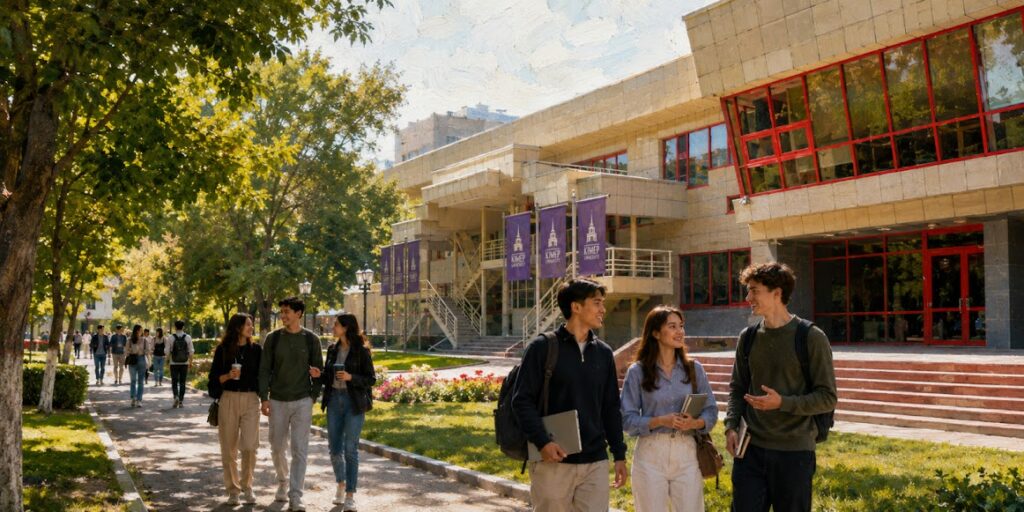
Kazakhstan's campaign to bring foreign universities into the country has moved far beyond a small pilot. By July 2026, the government said it had established partnerships with 40 foreign institutions and had 32 foreign university branches in operation. A separate government summary said those institutions enrolled about 12,000 students and employed 1,500 teachers, including 500 foreign professors. The expansion has accelerated since 2021. Universities from Europe, North America, Russia, China, and South Korea now operate campuses, joint institutes, or degree partnerships across Kazakhstan. The projects range from branded campuses in Astana and Almaty to specialist programs in Petropavl, Aktobe, Turkestan, and Taldykorgan. The figures describe more than a higher education reform. Kazakhstan is importing degrees, teaching methods, and university brands while trying to retain local students and attract more from abroad. The country's international student population reached 35,075 from 88 states in 2025, an increase of 11% from the previous year. These are related but distinct trends. Most international students attend Kazakh institutions, while foreign branches serve both domestic and overseas applicants. Kazakhstan wants to turn both flows into a regional education industry. The result will depend less on the number of openings than on degree quality, graduate employment, research, and regional demand. Universities Are Following the Students International education was long built around students moving to a small group of destination countries. That model remains powerful, but universities are increasingly taking their programs to the markets where students already live. UNESCO says 7.3 million of the world's 269 million higher education students now study outside their home countries, up from about two million in 2000. This has created a large mobile market, but it has also increased pressure on housing, immigration systems, and university capacity in popular destinations. The OECD noted in April 2026 that leading host countries were reassessing how international enrollment fits with housing supply, public services, and institutional capacity. Australia, Canada, the United Kingdom, and several European countries have reviewed visa or admissions policies in recent years. For universities, an overseas campus or joint degree offers another route to growth. It can bring in students who cannot afford several years of housing and travel abroad. It also gives an institution a presence in a new market without relying entirely on migration. Coventry University made the logic unusually clear when it announced a second Kazakhstan campus in June. "It is harder for students to come to the UK, so we are taking quality UK higher education to them," vice-chancellor John Latham said. Foreign operations are not always replicas of the home campus. They differ in ownership, staffing, admissions, language, and the qualification awarded. Some universities manage a branded campus. Others deliver programs through a Kazakh partner's buildings and staff. This makes expansion faster and cheaper, but it also makes quality assurance more important. Why Kazakhstan? Kazakhstan offers universities a sizeable domestic market and access to a much larger region. The country enrolled 678,100 higher education students at the start of the 2025-2026 academic year, including more than...


Indian Students Involved in New Year’s Eve Brawl Deported from Kazakhstan

Six Indian students have been deported from Kazakhstan following their involvement in a mass brawl in Almaty on New Year’s Eve​. The students, enrolled at a university in Almaty, were the only individuals implicated in the altercation, with no Kazakh citizens involved. "This was an internal conflict among the students," Kazakhstan’s Minister of Science and Higher Education, Sayasat Nurbek commented. "The Almaty Police Department is conducting an investigation. We have discussed the matter with the Indian Embassy and reached a joint decision to deport the students." The altercation occurred at a café on Kok-Tobe, a popular mountain destination in Almaty​. What began as a quarrel between the students escalated into a violent mass brawl, with video footage showing participants wielding chairs, tables, and batons. The footage quickly circulated online, drawing public attention to the incident​​. According to the Almaty Police Department, all individuals involved in the fight were identified and taken to the Medeusky District Police Department for questioning.

Uzbek Teachers Highlight Rising Interest in English and Other Foreign Languages

Interest in learning foreign languages in Uzbekistan is growing year by year, with English proving by far, the most popular. The English language is taught in Uzbekistan's schools from the 1st to the 11th grade. More advanced classes are offered by colleges or universities and in an ever- increasing number of  educational centers specializing in teaching English. Regarding young people's interest in the language,  Abbas Khan Mekhmonaliev, a teacher at the “English Team” language learning center, told The Times of Central Asia: “There is much to admire when it comes to the new generation in Uzbekistan, especially their passion for learning English. In the past, many young people studied English primarily to meet university entrance requirements. However, times have changed. Today, young people are thinking more broadly: learning English is no longer just a stepping stone to an education that opens the door to a future career. Young Uzbeks dream of going abroad to visit and succeed, and English is key to opening up global opportunities. This focus is about more than just language proficiency; it is about a distant future in which their lives will be more prosperous, fulfilling, and globally connected." According to Mekhmonaliev, English dominates other languages, especially amongst ambitious young people who see their peers succeed abroad by mastering English. In addition, they see it as an essential step towards promoting and achieving international recognition for Uzbekistan. “Several factors are responsible for the growing interest in learning English among the youth of Uzbekistan," explained Mekhmonaliev."First, English is the key to good career opportunities at home and abroad, as many employers require English. Second, access to global information, culture, and education, mostly in English, encourages young people to learn languages. Finally, studying or working abroad has become more attractive, and English is an important tool for achieving these ambitions and broadening their horizons.” Reiterating this stance, Rano Jurakulova, with over ten years of teaching English, commented, “Due to international education opportunities, better job prospects, and the influence of globalization, more and more young people are eager to learn English.” According to UNESCO data, Uzbekistan ranked fifth globally in terms of the number of students studying abroad in 2021. In recent years, the number of people wishing to study and work in Turkey has risen significantly and as of September 2024, over 55 thousand citizens of Uzbekistan received a residence permit for the country. As a result, the demand for studying the Turkish language has also increased.  Turkish language teacher, Mohinur Qurbonmuradova, connects the increase in the number of language learners with the requirement of a language certificate for enrolment in master’s and doctoral studies : “90% of students study the Turkish language for this purpose. It is easy and a language close to Uzbek. Learning English takes a little longer." However, aside from attaining the certificate, she adds that very few are interested in learning Turkish. For many, English is no longer just an academic requirement but a powerful tool that opens doors to global educational opportunities, employment,...

Turkmen Student Wins UNESCO Prize in AI Competition

Abdyleziz Saryev, a student from Turkmenistan's International University of Humanities and Development, has won the award for "Best Idea and Approach" at the third UNESCO International Model competiton on the ethics of using artificial intelligence in education. The event's final stage was held from August 12-14 in Almaty, and Saryev won the jury's recognition against stiff competition from students from 52 countries. In addition to Saryev, awards were given to representatives of Egypt and Hong Kong. Students from these countries were recognized for "Best Paper" and "Best Presentation", respectively. The Third UNESCO International Model is an educational event in which students try on the role of representatives of UNESCO member states by simulating official UNESCO meetings. Participants get an opportunity to study in-depth the international problems related to the use of AI, and propose solutions for their implementation in the education system.

International Development Association Allocates $25 million to Kyrgyz Universities.

The International Development Association (IDA) has announced it will  provide Kyrgyzstan with a $25 million interest-free loan over 50 years, with a ten-year grace period. The loan includes an allocation of $19.7 million to be divided between  five of the country's universities. The Academy of Medicine will receive $4 million, $1.3 million of which will be invested in laboratories for biochemical research, genetics, and molecular biology; $900,000 on equipment for pathomorphological research, and $800,000 on equipment for a laboratory for pharmaceutical bioequivalence studies. The remaining $1 million will be spent on laboratories, IT equipment, and software for new and expanded educational programs. Kyrgyz State Technical University will be allocated $3.2 million,  $2.2 million of which will be used for equipment and software for three laboratories, IT equipment, and software. The Kyrgyz National University (KNU) will also receive $3.2 million with $1.7 million allocated for scientific and IT equipment and software for teaching laboratories. The remaining $1.5 million will be spent on laboratories, IT equipment, and software for educational programs. Osh State University (OSU) will receive $2.8 million, with $300,000 reserved for the purchase of an ultrasound machine for breast examination, $1.5 million for an MRI machine, and $1 million for laboratory and IT equipment and software programs. The University of Agriculture has been allocated  $3.75 million, with $800,000 to be used to purchase equipment for an infectious animal disease diagnostic laboratory, $1.2 million for molecular genetic equipment, $550,000 for equipment for a histology and immunohistochemistry laboratory, $400,000 for equipment for the Department of Veterinary Medicine and Food Safety, and $800,000 for laboratory and IT equipment and software. The national budget will cover $5.3 million of the loan funds whilst the universities will pay off the remaining amount through revenue provided by laboratory services.