• KZT/USD = 0.00223
  • TJS/USD = 0.10810
  • UZS/USD = 0.00009
  • TMT/USD = 0.29850
  • KZT/USD = 0.00223
  • TJS/USD = 0.10810
  • UZS/USD = 0.00009
  • TMT/USD = 0.29850
  • KZT/USD = 0.00223
  • TJS/USD = 0.10810
  • UZS/USD = 0.00009
  • TMT/USD = 0.29850
  • KZT/USD = 0.00223
  • TJS/USD = 0.10810
  • UZS/USD = 0.00009
  • TMT/USD = 0.29850
  • KZT/USD = 0.00223
  • TJS/USD = 0.10810
  • UZS/USD = 0.00009
  • TMT/USD = 0.29850
  • KZT/USD = 0.00223
  • TJS/USD = 0.10810
  • UZS/USD = 0.00009
  • TMT/USD = 0.29850
  • KZT/USD = 0.00223
  • TJS/USD = 0.10810
  • UZS/USD = 0.00009
  • TMT/USD = 0.29850
  • KZT/USD = 0.00223
  • TJS/USD = 0.10810
  • UZS/USD = 0.00009
  • TMT/USD = 0.29850
23 September 2026

Viewing results 1 - 6 of 2

Kazakhstan Prepares for China Investment Forum While Pursuing U.S. AI Ties

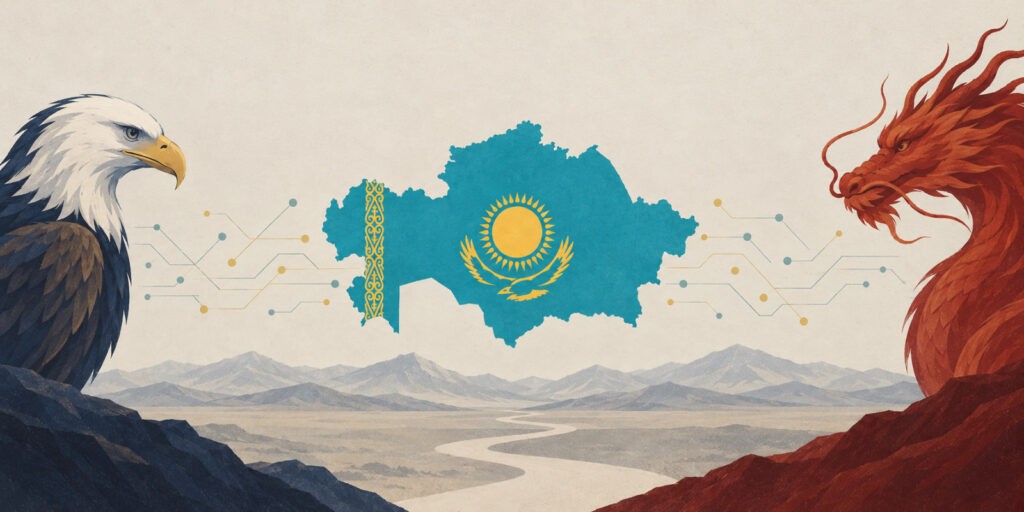
Kazakhstan will host a major investment forum with China in Almaty on September 25, with artificial intelligence expected to feature prominently among potential new agreements. The meeting comes as Astana deepens technology cooperation with Beijing while remaining part of the U.S.-backed Pax Silica initiative. Tokayev confirmed his participation in the forum in an interview with China’s Xinhua News Agency. “This forum is intended to serve as a platform for launching new concrete economic and investment cooperation projects,” the president said. In the same interview, Tokayev outlined potential cooperation with China in AI and digital technologies, ranging from industry, mining, and energy to transport, healthcare, satellite technology, and data centers. Some projects in these areas are already being discussed with Chinese businesses. During Tokayev’s July visit to Shanghai, Kazakhstan and Chinese companies signed more than 70 commercial agreements with a stated value exceeding $15 billion. They included projects involving Huawei, robotics development, AI in the automotive industry, and the Data Center Valley in Ekibastuz, where a complex with capacity of up to 1 GW is planned. Two International Initiatives in Three Weeks On June 25, Kazakhstan became the first country in Central Asia to join Pax Silica, a U.S.-backed initiative aimed at developing trusted supply chains for the AI economy. It covers areas including semiconductors, critical minerals, computing infrastructure, energy, and advanced manufacturing. Kazakhstan also signed a joint statement with the United States on an AI Opportunity Partnership. On July 16, Kazakhstan joined 28 other countries in Shanghai in signing an agreement to establish the World Artificial Intelligence Cooperation Organization (WAICO). The organization, headquartered in Shanghai, says its goals include expanding international cooperation and developing approaches to global AI governance. Its other founding participants include Brazil, China, Indonesia, Russia, and the four other Central Asian states: Kyrgyzstan, Tajikistan, Turkmenistan, and Uzbekistan. Beijing is promoting wider access to AI technologies and open models, workforce development, and greater participation by developing countries in setting international rules. China is also seeking to reduce its technology sector’s dependence on U.S. components. Kazakhstan, meanwhile, has remained part of Pax Silica. Washington Raises the Question of Choosing Sides On August 14, Reuters reported that the U.S. State Department had drafted a letter for countries partnering with Washington on AI. Countries participating in both Pax Silica and the China-backed initiative could be asked to choose between the two frameworks. A U.S. official told Reuters that Washington wanted a clearer separation between the American and Chinese technology ecosystems. The report specifically identified Kazakhstan as a participant in both initiatives and said its dual participation had raised concerns in Washington. At the time, the document remained a draft. There is no public evidence that Kazakhstan has received such a demand or that Washington has formally required Astana to choose between the two initiatives. Several weeks later, Tokayev argued in his Xinhua interview against dividing technology along geopolitical lines. “AI should not become the privilege of a narrow circle of the most technologically advanced states, much less turn into a new...

How a New Generation of Startups From Kazakhstan Attracted International Investors

A software engineering team writes code in Almaty for a parent company incorporated in Delaware. Most of its revenue comes from customers in the United States and Singapore, with the United Kingdom another important market. Until recently, this business model was unusual in Kazakhstan. It is now becoming more common as entrepreneurs launch international companies from the outset rather than focus solely on the domestic market. Rather than adapt foreign products for Kazakhstan’s population of about 20 million, these founders are developing technology for customers abroad. Their success is drawing interest from international venture capital firms and raising Kazakhstan’s profile as a source of high-growth technology companies. Growth Measured in Numbers The latest Startups and Venture Capital in Central Asia 2026 report by RISE Research shows how quickly Kazakhstan’s venture sector is growing. Venture investment reached $209 million in 2025, nearly three times the $71 million raised a year earlier. The figure also exceeded the combined total elsewhere in Central Asia. The aggregate valuation of funded startups in Kazakhstan rose to $2.16 billion. RISE Research also found that U.S.-oriented startups with roots in Kazakhstan raised more than $214 million in 2025. This helps explain the rise in international interest. Venture funds are backing companies built for global markets rather than businesses dependent on a relatively small domestic customer base. Among the best-known examples is Higgsfield AI, which develops software for creating and editing AI-generated video. The company raised $50 million in Series A financing in September 2025. An $80 million extension in January 2026 brought the round to more than $130 million and valued the company at over $1.3 billion, confirming its status as Kazakhstan’s first unicorn. Cerebra AI develops software that analyzes CT scans to help clinicians detect ischemic and hemorrhagic strokes. The platform uses the ASPECTS scale and can return an analysis within minutes. Codiplay supplies educational software and Internet of Things kits used to teach programming and hands-on electronics in 13 countries, including South Korea and the UK. The company raised $9 million in Series A financing in January 2025. Parqour develops parking management software with automated license plate recognition. Its systems operate in 22 countries and cover more than 300 parking areas. These companies work in different fields, but their businesses are built mainly around software and intellectual property, even where hardware is part of the product. That makes expansion abroad less capital-intensive and helps explain their appeal to foreign investors. Why Investors Are Paying Attention Now Kazakhstan’s emergence as Central Asia’s leading venture capital market did not happen overnight. The record investment figures of 2025 followed several years of work in the startup sector, including Astana Hub’s accelerator programs and tax incentives. More founders also began developing products for international markets. One clear sign was international recognition. Three startups with founders from Kazakhstan were accepted into Y Combinator in 2025, matching the total accepted in all previous years combined, according to RISE Research. For international investors, acceptance into the Silicon Valley accelerator provides external validation as...