• KZT/USD = 0.00223
  • TJS/USD = 0.10820
  • UZS/USD = 0.00009
  • TMT/USD = 0.29850
  • KZT/USD = 0.00223
  • TJS/USD = 0.10820
  • UZS/USD = 0.00009
  • TMT/USD = 0.29850
  • KZT/USD = 0.00223
  • TJS/USD = 0.10820
  • UZS/USD = 0.00009
  • TMT/USD = 0.29850
  • KZT/USD = 0.00223
  • TJS/USD = 0.10820
  • UZS/USD = 0.00009
  • TMT/USD = 0.29850
  • KZT/USD = 0.00223
  • TJS/USD = 0.10820
  • UZS/USD = 0.00009
  • TMT/USD = 0.29850
  • KZT/USD = 0.00223
  • TJS/USD = 0.10820
  • UZS/USD = 0.00009
  • TMT/USD = 0.29850
  • KZT/USD = 0.00223
  • TJS/USD = 0.10820
  • UZS/USD = 0.00009
  • TMT/USD = 0.29850
  • KZT/USD = 0.00223
  • TJS/USD = 0.10820
  • UZS/USD = 0.00009
  • TMT/USD = 0.29850
16 September 2026

Viewing results 1 - 6 of 303

Tajikistan Warns Against “Unverified” Reports About Moscow Attack

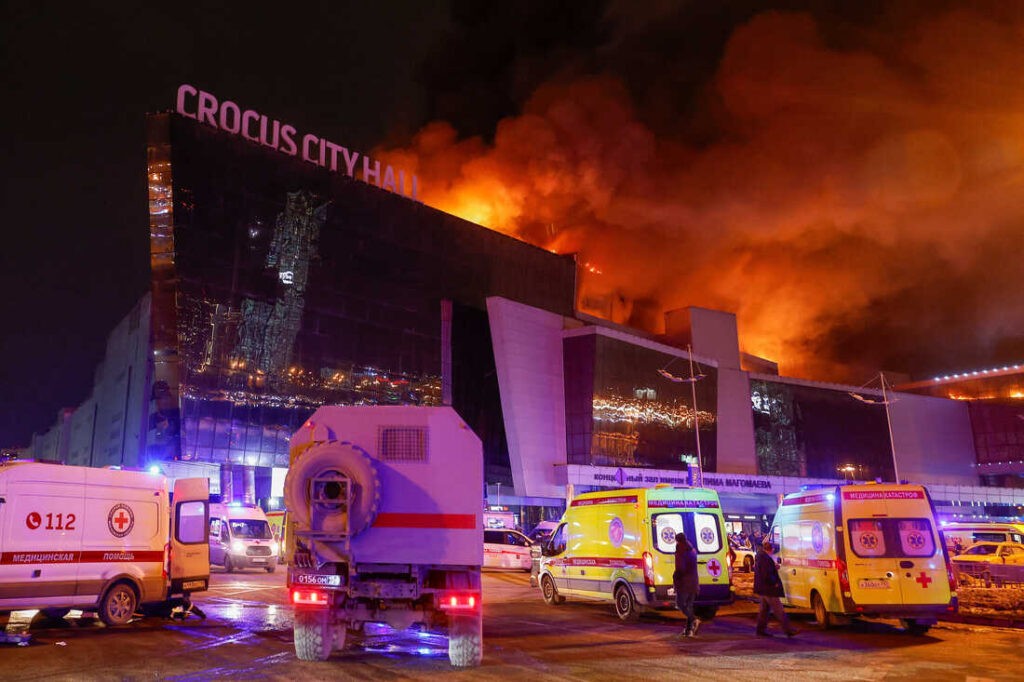
Tajikistan is warning against “fake information” about the alleged role of Tajik citizens in the attack that killed more than 100 people at a concert venue in Moscow. Tajikistan’s foreign ministry said on Saturday that it had not received confirmation from Russian authorities about any involvement of Tajiks in the attack at the Crocus City complex. The ministry asked media to rely on “official information” distributed by Russian authorities. The Afghanistan branch of the Islamic State group (ISKP) claimed responsibility for the mass shooting on Friday night. Telegram and other social media platforms are swirling with allegations that Tajik citizens were involved. Large numbers of Tajik migrants live in Russia, many enduring difficult conditions in hostels while struggling to find work. “We emphasize that the Tajik side has not received any confirmation from the Russian authorities regarding the currently circulating fake information about the involvement of citizens of Tajikistan,” the ministry said in a statement. “Keep in mind that the dissemination of unverified and unreliable information could harm the citizens of Tajikistan currently abroad,” the ministry said. Russia said it has arrested 11 suspects and that an investigation is ongoing. Tajikistan was among several Central Asian states that condemned the attack and sent condolences to relatives and friends of the dead. President Kassym-Jomart Tokayev of Kazakhstan spoke by telephone to Russian President Vladimir Putin on Saturday, Kazakhstan’s presidential press office said. “The head of our state strongly condemned the brutal act of violence against civilians and reaffirmed solidarity with Russia in the fight against terrorism,” the press office said. Kazakhstan has offered the help of its law enforcement agencies to Russia if needed and Uzbekistan’s presidential office said those responsible for the attack “will be assured of the inevitability of punishment.” Several bouquets of flowers were laid outside the Russian embassy in Astana, Kazakhstan. Video recorded by witnesses at the Moscow venue showed several gunmen roaming the atrium and other parts of the entertainment complex, opening fire on civilians. A large blaze also broke out at the building during the attack and was later extinguished. On Feb. 27, Russian Defense Minister Sergei Shoigu spoke of threats coming from extremists in Afghanistan and prioritized “ensuring military security in the Central Asian strategic area.” Shoigu said the number of ISKP militants in Afghanistan had increased by 15% in the past year. He said their key objectives were to spread radical ideology and to conduct subversive activities on the southern borders of the Collective Security Treaty Organization. The organization, CSTO, is a Russian-led security alliance that includes Belarus, Kazakhstan, Kyrgyzstan, and Tajikistan. “Radicals from Central Asia have accounted for a notable share of recent Islamic State-inspired or -directed plots and attacks in the United States, Europe, Turkey, and Iran,” Lucas Webber and Riccardo Valle wrote in a Hudson Institute analysis last year. In September 2022, ISKP – which vehemently opposes Russia’s support for the regime of Bashar al-Assad in Syria - claimed responsibility for a suicide bombing at the Russian embassy in Kabul...
Russia Detains Suspects with Tajik Passports – Death Toll Rises to 133

Russia has announced the arrest of eleven individuals, including four who are suspected of carrying out a deadly shooting at a concert hall near Moscow, marking the most lethal incident of its kind in the country in two decades. The attack, which resulted in the death of 143 people and counting, according to state TV, was claimed by the Islamic State militant group. However, Russian authorities are trying to forge a potential connection to Ukraine, despite strong denials from Ukrainian officials regarding any involvement. The death toll was later revised to 133. The Federal Security Service (FSB) of Russia has reported the apprehension of the "four terrorists" as they were allegedly attempting to cross into Ukraine, repeatedly mentioning that the suspects had connections within Ukraine. They are currently being transported to Moscow for further investigation. Maria Zakharova, a spokeswoman for the Russian Foreign Ministry, expressed on Telegram that the suspects had intended to flee to Ukraine to evade capture, stating, “Now we know in which country these bloody bastards planned to hide from pursuit.” In response to Moscow’s attempts to pin the atrocity on Ukraine and bolster waning support for Putin’s war, Andriy Yusov, a spokesman for Ukrainian military intelligence, refuted the claims of Ukraine's involvement, emphasizing his nation’s focus on defending its sovereignty and targeting military objectives, not civilians. He dismissed the FSB's assertion regarding the suspects' intended escape to Ukraine as another fabrication by Russian intelligence services. No evidence has been presented to support the theory of a Ukrainian link. Russian lawmaker Alexander Khinshtein revealed that the assailants had escaped in a Renault vehicle, which was later identified by police in the Bryansk region, approximately 210 miles southwest of Moscow. Upon refusal to comply with police instructions to stop, the vehicle was searched, uncovering a pistol, an assault rifle magazine, and passports from Tajikistan. In a video shown on state TV, a suspect stated that he had been paid 500,000 roubles ($5,425) by unknown people via Telegram to carry out the atrocity.

Central Asian States Respond to Moscow Attacks

ALMATY, Kazakhstan – Central Asian countries have denounced the attack on a Moscow concert hall that killed more than 60 people, with Kazakhstan offering the help of its law enforcement agencies to Russia if needed. The Islamic State group claimed responsibility for the mass shooting on Friday night. “Kazakhstan strongly condemns the terrorist act against civilians in Moscow," Kazakh President Kassym-Jomart Tokayev said in a statement. He expressed condolences in a message to Russian President Vladimir Putin and urged United Nations member states to unanimously condemn the attack. Uzbek President Shavkat Mirziyoyev also sent condolencesto relatives of the dead and wishes for the quick recovery of the injured. More than 140 people were injured, according to Russian authorities. Video recorded by witnesses showed several gunmen roaming the concert hall, opening fire on civilians. A large blaze also broke out at the building during the attack. Uzbekistan “firmly condemns this act of terrorism directed against civilians, and the organizers and executors of this crime will be assured of the inevitability of punishment,” the president’s press service said. The claim of responsibility could not be immediately confirmed, and it was unclear whether there was a link to Islamic State extremists in Afghanistan. On Feb. 27, Russian Defense Minister Sergei Shoigu spoke of threats coming from extremists in Afghanistan and prioritized “ensuring military security in the Central Asian strategic area.” Shoigu said the number of Islamic State militants in Afghanistan had increased by 15% in the past year. He said their key objectives were to spread radical ideology and to conduct subversive activities on the southern borders of the Collective Security Treaty Organization. The organization, CSTO, is a Russian-led security alliance that includes Belarus, Kazakhstan, Kyrgyzstan, and Tajikistan. Image above credit: Reuters

Over 100 Cases of Terrorism and Extremism Addressed by Kazakh Courts

According to statistics for 2023, 122 individuals were sent to Kazakhstan courts for crimes related to extremism and terrorism, slightly less than 2022's figure of 124. The most common offenses - 24 in total - included participating in and organising activities related to religion, followed closely by 23 cases of inciting social, national, tribal, racial, class or religious discord. Ninety nine detainees had secondary or specialized secondary education, and only 19, higher education. Forty one had either disseminated propaganda supporting terrorism or publicly called for an act of terrorism. The offenders' ages were widespread with 44 offenders aged 30-39, 38 aged 40- 49, 15 over 50, and 6 over 60. Younger Kazakhs accused of extremism and terrorism included three minors under 18, 4 aged 18-20, and 12 aged 21-29. The highest number of cases took place in Astana where the total of 50 showed an increase of 28.2% compared to 2022. Almaty saw 21 cases; North Kazakhstan, 16; Atyrau 14, and Zhambyl 13. During the year, police seized 153 pieces of extremist material comprising 96 books and 42 leaflets. Elected representatives of Kazakhstan's Mazhilis (Parliament) are currently implementing a bill to prohibit entry to the country by foreigners involved in terrorist organizations and with prior convictions of sex crimes against minors.

It Has Been 25 years Since the Terrorist Attack in Tashkent

TASHKENT, Uzbekistan - A lot of people in Uzbekistan remember where they were on that traumatic day 25 years ago. There are no public commemorations on the Feb. 16 anniversary. But every year, Uzbek media publish details about the 1999 bombings in Tashkent, the capital. School teachers briefly tell students about it. The Uzbek government blamed Islamic militants for the coordinated bombings that killed at least 16 people and injured about 100. Islam Karimov, president at the time, said extremists had intended to kill him. Abduvali Soyibnazarov, a political commentator in Uzbekistan, spoke about the attacks in a conversation with The Times of Central Asia. He said since his office – the Broadcasting Center of Uzbekistan is located in the central part of the city, the sounds of explosions were clearly heard by him. It was 10:40 a.m., Soyibnazarov recalled. “There was supposed to be a meeting of the government of Uzbekistan dedicated to the results of the economic development of the republic in the past year. Shortly before the start of the meeting, a shootout took place between the president’s guards and militants in the main square of Tashkent - in front of the government building,” he said. International news organizations scrambled to figure out what was happening. There was a false rumor that the Cabinet of Ministers building had been attacked with grenades. “The first explosion occurred shortly after the start of the shooting, on Yusuf Khos Khajib street of the capital, near the building of the Ministry of Internal Affairs. A ZAZ-968M car exploded,” Soyibnazarov said. The second explosion, the most powerful of the day, occurred at 10:55 a.m., 15 minutes after the first blast. “The explosion was in a car parked near Independence Square. Some residents, whose houses are two to three kilometers away from the place of the explosion, believed that an earthquake had started. Our Uzbek radio broadcasting center is also located in the central part of the city, so the explosion was very loud. Even the windows of our office almost broke,” he said. A third car blew up near the entrance of the Cabinet of Ministers building, during a meeting that Karimov was scheduled to attend. Karimov, however, had not yet arrived. After being informed about the attacks, he went to the scene and was addressing the nation on live television when – at 11:20 a.m. - a fourth bomb exploded a few kilometers away, near the National Bank of Uzbekistan. “As a result, the windows of the bank and surrounding buildings were shattered. People injured by broken glass were shown on TV. We heard explosions going off at different intervals in other parts of the city. The fifth and last explosion took place at 12 p.m. in the garage of a private house,” Soyibnazarov said. The casualties included three internal affairs officers, one of whom later died. Several days after the attacks, Karimov said he had narrowly escaped death. “I usually arrive at meetings 10-15 minutes early. But I was a...

Unplanned vacations: 50,000 Aktobe Schoolchildren Missed Classes Because of Fake Terrorist Threat

In Aktobe, an attacker spread a terrorist threat to schools, after which parents did not let their children attend classes. On January 25th, an unknown culprit left a threatening message in a Telegram channel, where they spoke about plans to organize a mass shooting in schools in the city of Aktobe. The message quickly spread through social networks and parental chats, after which many parents did not let their children to go to school: out of 57924 students, only 8558 attended classes. The police immediately found the author of the threatening messages and asked the parents of schoolchildren not to sow panic. The city administration also assured citizens that there was no threat to children, and that schools would be reinforced with security guards. The attacker turned out to be an 18-year-old young man, who is a citizen of another country from the near abroad. A case has already been opened against him for knowingly spreading false information about an act of terrorism. Regional authorities in Aktobe say the situation is now under the control of specialized law enforcement agencies, and there is no cause for concern. Additionally, the city administration asked parents not to unnecessarily disrupt the educational process.