• KGS/USD = 0.01144 0%
  • KZT/USD = 0.00216 0%
  • TJS/USD = 0.10718 0.28%
  • UZS/USD = 0.00008 0%
  • TMT/USD = 0.28530 0%
  • KGS/USD = 0.01144 0%
  • KZT/USD = 0.00216 0%
  • TJS/USD = 0.10718 0.28%
  • UZS/USD = 0.00008 0%
  • TMT/USD = 0.28530 0%
  • KGS/USD = 0.01144 0%
  • KZT/USD = 0.00216 0%
  • TJS/USD = 0.10718 0.28%
  • UZS/USD = 0.00008 0%
  • TMT/USD = 0.28530 0%
  • KGS/USD = 0.01144 0%
  • KZT/USD = 0.00216 0%
  • TJS/USD = 0.10718 0.28%
  • UZS/USD = 0.00008 0%
  • TMT/USD = 0.28530 0%
  • KGS/USD = 0.01144 0%
  • KZT/USD = 0.00216 0%
  • TJS/USD = 0.10718 0.28%
  • UZS/USD = 0.00008 0%
  • TMT/USD = 0.28530 0%
  • KGS/USD = 0.01144 0%
  • KZT/USD = 0.00216 0%
  • TJS/USD = 0.10718 0.28%
  • UZS/USD = 0.00008 0%
  • TMT/USD = 0.28530 0%
  • KGS/USD = 0.01144 0%
  • KZT/USD = 0.00216 0%
  • TJS/USD = 0.10718 0.28%
  • UZS/USD = 0.00008 0%
  • TMT/USD = 0.28530 0%
  • KGS/USD = 0.01144 0%
  • KZT/USD = 0.00216 0%
  • TJS/USD = 0.10718 0.28%
  • UZS/USD = 0.00008 0%
  • TMT/USD = 0.28530 0%

Viewing results 1 - 6 of 32

China’s Zhongyun to Partner on $300M Seaport Project in Aktau

A new $300 million seaport is set to be built in Aktau, with China’s Zhongyun International confirmed as the strategic partner. The announcement was made by Nurdaulet Kilybay, Akim (Governor) of the Mangistau region, during a government meeting on November 25. Located on the Caspian Sea in western Kazakhstan, the port of Aktau connects to Azerbaijani ports Baku and Alyat to the west, and to the Iranian port of Bandar-e Anzali to the south. The Aktau-Alyat ferry crossing plays a key role in the Trans-Caspian International Transport Route, part of the larger Belt and Road Initiative linking China to Europe via Kazakhstan, Azerbaijan, Georgia, and Turkey. The route significantly shortens delivery times to the European Union. Aktau’s current cargo port has a capacity of 3.2 million tons of dry goods and 12.5 million tons of crude oil annually. In June 2025, the first phase of a $38 million container hub was launched in Aktau, expanding the port’s capacity from 140,000 to 240,000 twenty-foot equivalent units (TEU). Over the summer, Mangistau authorities held talks with several Chinese firms about building a modern seaport and logistics center in Aktau. Zhongyun International has since registered a local subsidiary and is preparing documentation for an investment agreement. “This project will contribute to the formation of a new international transport corridor: China-Kazakhstan-Aktau-Baku-Poti-Europe. Its implementation will cut delivery times by 7-15 days, reduce transport costs by 18-25%, and create new jobs,” Kilybay said. Additional Infrastructure at Kuryk Port At the same meeting, Minister of Trade and Integration Arman Shakkaliev reported on progress at the Sarzha multifunctional marine terminal in the port of Kuryk, located on the eastern Caspian coast near Aktau. The $189 million project is being developed with private investment. “The general cargo terminal and temporary storage facility are now operational, and cargo transshipment has already begun,” Shakkaliev said. Terminals for grain, bulk, chemical, and universal cargo, as well as a transport and logistics center, are currently under construction. The port of Kuryk now handles up to 6 million tons of cargo per year, 4.1 million tons via the railway terminal and 1.9 million tons via the road terminal. In 2024, dredging works in the port’s waters were completed ahead of schedule, enabling deeper drafts and the full loading of vessels.

Kazakhstan, Azerbaijan, Georgia, and China Deepen Cooperation on Trans-Caspian Transport Corridor

Railway companies from Kazakhstan, Azerbaijan, and Georgia have signed a cooperation agreement with China Railway Container Transport Corp., Ltd. (CRCT) to jointly develop the Trans-Caspian International Transport Route (TITR), also known as the Middle Corridor – a strategic link connecting China and Europe via Central Asia and the South Caucasus. The agreement was signed during the Second China Railway Express Cooperation Forum, held on 18 November in Xi’an, under the theme “Connecting Asia and Europe for a Shared Future.” According to Kazakhstan Temir Zholy (KTZ), the country’s national railway operator, the agreement establishes formal cooperation between Chinese railways, through CRCT, and MIDDLE CORRIDOR MULTIMODAL Ltd., a joint venture created in 2023 by the railway companies of Kazakhstan, Azerbaijan, and Georgia. The initiative aims to enhance the efficiency, safety, digitalization, and sustainability of China-Europe rail container transport services along the trans-Caspian route. Kazakhstan, Azerbaijan, and Georgia play key roles along the TITR, which offers a vital alternative trade corridor between China and Europe that bypasses Russia. In recent years, Kazakhstan has strengthened its position as a regional transit hub. KTZ reports that freight transportation between Kazakhstan and China has increased more than 4.5-fold over the past decade. For 2025, total freight volume is projected to reach 35 million tons, with over 29 million tons transported in the first ten months, an 11% year-on-year increase. Joint infrastructure projects in China and Kazakhstan, including hubs in Lianyungang, Khorgos, and Xi’an, continue to demonstrate strong growth. Container shipments have more than quintupled in the past ten years, exceeding 1.4 million twenty-foot equivalent units (TEUs). Momentum along the Trans-Caspian route also remains strong: the number of container trains increased by 12% in the first ten months of this year. To capitalise on this growth, Kazakhstan is investing in railway infrastructure. Modernization and construction of 5,000 kilometers of railway track is underway, which will raise the country’s annual cross-border freight capacity with China to 100 million tons in the coming years.

Official Meetings in Almaty Boost Efficiency of Trans-Caspian Transport Route

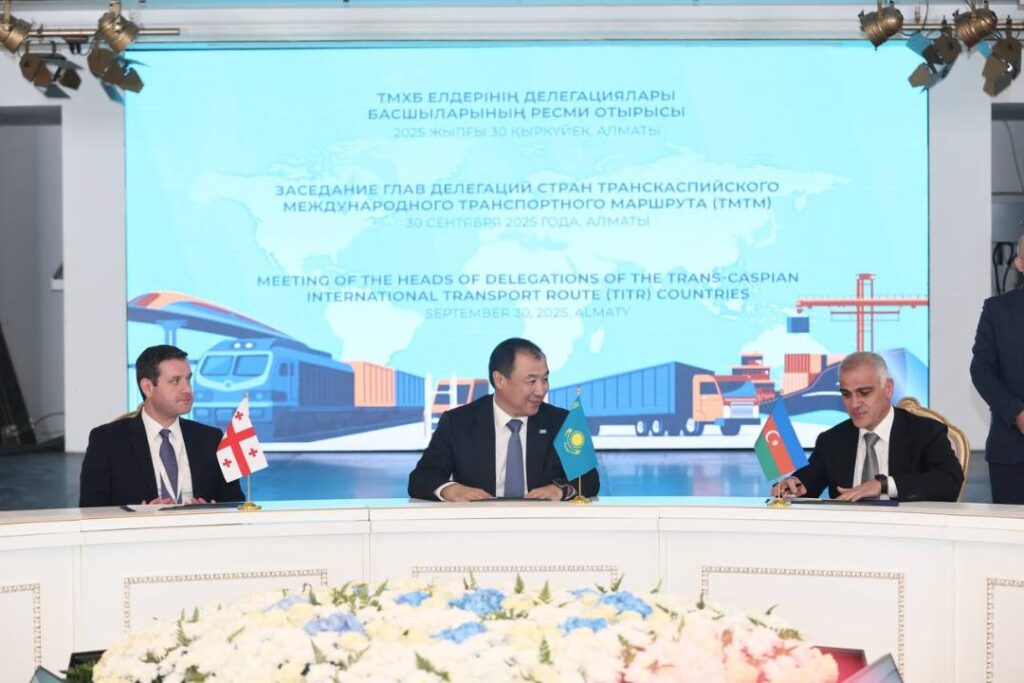
Almaty hosted a high-level meeting on October 1 of delegations from countries participating in the Trans-Caspian International Transport Route (TITR). The TITR is also known as the Middle Corridor, a strategic Eurasian trade link connecting China, Central Asia, and Europe. Senior officials from Azerbaijan, Georgia, Kazakhstan, and Turkey convened to discuss ways to enhance the corridor’s efficiency and competitiveness. Key Agreements Signed Among the main outcomes was the signing of an action plan aimed at removing bottlenecks along the TITR. The document outlines coordinated measures by the railway companies of Kazakhstan, Azerbaijan, and Georgia to streamline cargo transportation. The plan includes the introduction of a unified long-term tariff across the corridor and strategies to expand its overall capacity. Another major development was an agreement between the European Bank for Reconstruction and Development (EBRD) and JSC Aktau International Sea Trade Port to modernize port infrastructure and acquire new ship-to-shore cranes. The initiative, supported by up to €45 million in financing from the EBRD and the European Union, aims to significantly boost container-handling capabilities at Aktau, Kazakhstan’s principal maritime hub on the Caspian Sea. The project includes the extension of two berths and the acquisition of weather-resistant cranes, enabling the port to operate two fully dedicated container berths. By the end of 2026, Aktau is expected to host the largest container terminal in the Caspian region, with an annual handling capacity of up to 240,000 twenty-foot equivalent units (TEUs). Regional Cooperation Under the OTS Also on October 1, Almaty hosted the 8th meeting of transport ministers of the Organization of Turkic States (OTS), which includes Azerbaijan, Kazakhstan, Kyrgyzstan, Turkey, and Uzbekistan. The ministers focused on accelerating the development of the TITR through greater adoption of digital technologies and electronic transit systems. Participants endorsed initiatives to enhance maritime transport, including expanded Caspian shipping, the construction of new transshipment facilities, and the launch of additional ferry services. The meeting also backed efforts to establish regular block train operations, particularly along the Baku-Tbilisi-Kars railway corridor.

Kazakhstan and Turkey to Jointly Develop Trans-Caspian Transport Route

Kazakhstan’s national railway operator, Kazakhstan Temir Zholy (KTZ), and Turkey’s TCDD Taşimacilik A.Ş. have signed a cooperation agreement to enhance railway freight transportation along the Trans-Caspian International Transport Route (TITR), also known as the Middle Corridor. Bypassing Russia, the TITR links China and Europe via Central Asia and the Caspian Sea. Freight volumes along the corridor surged by 60% in 2024, reaching 4.5 million tons. Projections suggest that figure could surpass 10 million tons by 2030. According to KTZ, the agreement outlines several joint initiatives aimed at improving the route’s efficiency and competitiveness. Key measures include: Launching regular rail services between Kazakhstan and Turkey; Increasing freight volumes on the Baku-Tbilisi-Kars railway line; Expanding two-way cargo flows between China and Europe/Africa; Streamlining transit procedures and logistics coordination; Simplifying customs and administrative processes to speed up cross-border cargo movement. The partnership will also focus on implementing digital solutions such as paperless documentation and real-time tracking of containers and rolling stock. These initiatives are expected to enhance Kazakhstan’s transit and logistics capacity and reinforce its strategic role in global supply chains. The agreement was signed during President Kassym-Jomart Tokayev’s official visit to Turkey. During the visit, Tokayev reiterated Kazakhstan’s commitment to developing the Trans-Caspian route and highlighted interest in attracting Turkish investment in key infrastructure sectors, including railways, dry ports, cargo terminals, and shipbuilding. As part of the visit, KTZ also held talks with Mersin International Port, part of the PSA International Group, on expanding cooperation to develop the Middle Corridor and establish more efficient multimodal logistics links between Asia and Europe. KTZ Chairman Talgat Aldybergenov affirmed both sides’ commitment to ensuring stable freight volumes and underscored Mersin’s role as a strategic transshipment hub for the Middle Corridor. To further strengthen the logistics chain, Kazakhstan proposed leveraging the potential of KPMC, a joint venture between KTZ and PSA International, which is already involved in developing multimodal services along the Xi’an-Istanbul route.

KTZ Secures $540 Million Loan to Upgrade Trans-Kazakhstan Railway Corridor

Kazakhstan Temir Zholy (KTZ), the national railway operator, has secured a syndicated loan of up to 480 million Swiss francs (approximately $540 million) for a three-year term. Arranged through Abu Dhabi Commercial Bank and Deutsche Bank, the financing will support key infrastructure projects along the Trans-Kazakhstan Railway Corridor. According to KTZ, the loan will fund construction of the Moiynty-Kyzylzhar section, upgrades to congested segments of the national rail network, and the refinancing of existing debt. The Trans-Kazakhstan Railway Corridor is central to Kazakhstan’s strategy to solidify its role as a major overland transit hub connecting China and Europe. Infrastructure improvements are expected to reduce delivery times, lower logistics costs, create jobs, and diversify international trade routes, enhancing both the resilience of Kazakhstan’s economy and the competitiveness of its transport sector. Currently, more than 80% of overland freight from China to Europe passes through Kazakhstan via the Trans-Caspian International Transport Route (TITR), also known as the Middle Corridor. This route circumvents Russia and connects China to Europe through Central Asia and the Caspian Sea. In 2024, freight volumes along the TITR surged by 60%, reaching 4.5 million tons. Kazakhstan aims to more than double that volume to 10 million tons by 2030, as part of its broader ambition to expand its footprint in global supply chains.

Kazakhstan Emphasizes Strategic Role of Trans-Caspian Route at Astana Forum

Kazakhstan is positioning the Trans-Caspian International Transport Route (TITR), also known as the Middle Corridor, as a cornerstone of sustainable logistics across Eurasia. Speaking at a panel session on May 29 during the Astana International Forum, Deputy Minister of Foreign Affairs, Alibek Kuantyrov outlined the country's ambitions to transform the route into a vital artery for regional connectivity. The session, co-organized with the Boao Forum for Asia, featured high-profile participants, including Boao Forum Chairman and former UN Secretary-General Ban Ki-moon. Kuantyrov highlighted that Kazakhstan boasts over 3,500 kilometers of strategic railway infrastructure linking China to Caspian Sea ports. In the coming years, annual cargo volumes along the TITR are projected to reach 10 million tons. “The TITR is not just a logistics route; it is an infrastructure of trust, efficiency, and growth,” Kuantyrov said. “Kazakhstan is committed to both physical and digital integration. We are already seeing tangible outcomes: in March 2024, a container train from Xi’an [China] reached Azerbaijan in just 11 days, including only three days traversing Kazakhstan.” This efficiency, Kuantyrov explained, was enabled by key infrastructure improvements such as the upgrade of the Dostyk-Moiynty railway section, development of the Khorgos logistics hub on the Kazakh-Chinese border, and the implementation of digital customs technologies. Kazakhstan is investing over $35 billion in infrastructure development, including new railways, the expansion of the Aktau and Kuryk ports, and the creation of a container hub in partnership with international investors. “Our objective is not merely transit,” Kuantyrov added. “Kazakhstan views the TITR as a foundation for industrial development and sustainable integration into global supply chains.” To further enhance east-west cargo flow, the country is constructing second tracks along the 836-kilometer Dostyk-Moiynty section. According to Kazakhstan Temir Zholy, the national railway operator, the additional tracks are set to open in June. These upgrades are expected to increase the line’s capacity fivefold from 12 to 60 train pairs per day.