• KGS/USD = 0.01144 0%
  • KZT/USD = 0.00202 0%
  • TJS/USD = 0.10448 -0.19%
  • UZS/USD = 0.00008 0%
  • TMT/USD = 0.28490 0%
  • KGS/USD = 0.01144 0%
  • KZT/USD = 0.00202 0%
  • TJS/USD = 0.10448 -0.19%
  • UZS/USD = 0.00008 0%
  • TMT/USD = 0.28490 0%
  • KGS/USD = 0.01144 0%
  • KZT/USD = 0.00202 0%
  • TJS/USD = 0.10448 -0.19%
  • UZS/USD = 0.00008 0%
  • TMT/USD = 0.28490 0%
  • KGS/USD = 0.01144 0%
  • KZT/USD = 0.00202 0%
  • TJS/USD = 0.10448 -0.19%
  • UZS/USD = 0.00008 0%
  • TMT/USD = 0.28490 0%
  • KGS/USD = 0.01144 0%
  • KZT/USD = 0.00202 0%
  • TJS/USD = 0.10448 -0.19%
  • UZS/USD = 0.00008 0%
  • TMT/USD = 0.28490 0%
  • KGS/USD = 0.01144 0%
  • KZT/USD = 0.00202 0%
  • TJS/USD = 0.10448 -0.19%
  • UZS/USD = 0.00008 0%
  • TMT/USD = 0.28490 0%
  • KGS/USD = 0.01144 0%
  • KZT/USD = 0.00202 0%
  • TJS/USD = 0.10448 -0.19%
  • UZS/USD = 0.00008 0%
  • TMT/USD = 0.28490 0%
  • KGS/USD = 0.01144 0%
  • KZT/USD = 0.00202 0%
  • TJS/USD = 0.10448 -0.19%
  • UZS/USD = 0.00008 0%
  • TMT/USD = 0.28490 0%

Viewing results 1 - 6 of 9

Uzbekistan Begins Construction of New International Airport Near Tashkent

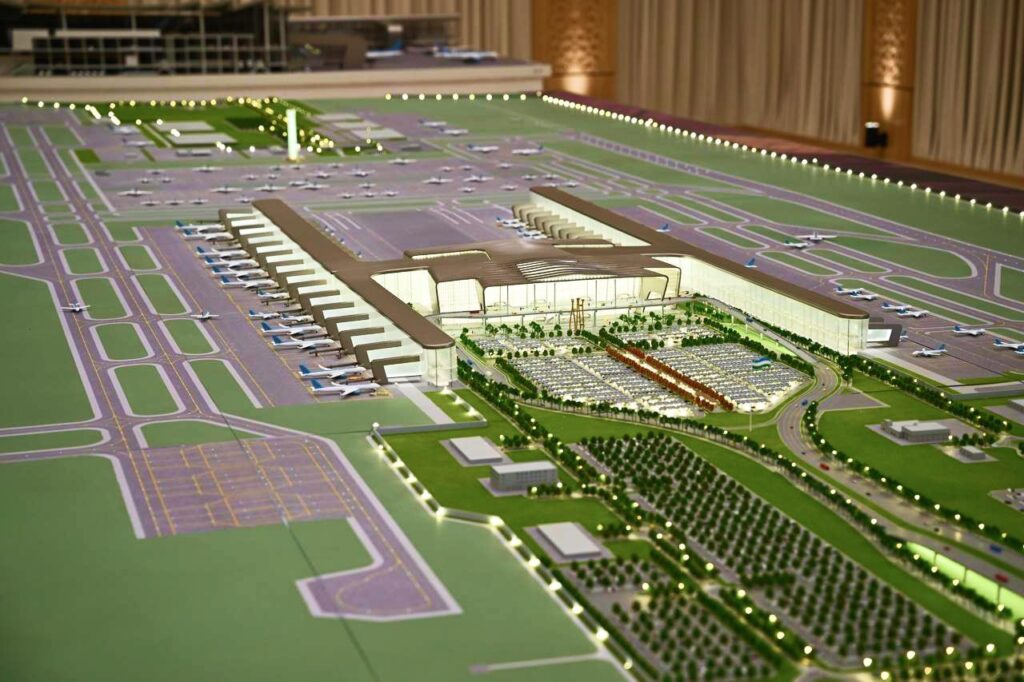
Uzbekistan has launched one of its largest infrastructure initiatives to date, the construction of a new international airport in the Tashkent region. President Shavkat Mirziyoyev inaugurated the project, which is being implemented by an international consortium of investors. A National-Scale Project The new airport is intended to strengthen Uzbekistan’s aviation sector and establish the country as a key transit hub between East and West. “Ultimately, our goal is to turn Uzbekistan into a major aviation hub connecting East and West, North and South,” Mirziyoyev stated. He underscored that developing transport infrastructure and modernizing air traffic management remain strategic priorities. The project is being led by a consortium comprising Vision Invest (Saudi Arabia, 45%), Sojitz (Japan, 30%), Incheon International Airport Corporation (South Korea, 15%), and Uzbekistan Airports (10%). Construction will unfold in four phases. The first stage, with an estimated cost of $2.5 billion, includes building the terminal complex and airfield. Once completed, the airport will have the capacity to handle up to 20 million passengers annually, process 129,000 tons of cargo, and support up to 30 take-offs and landings per hour. It will feature 14 telescopic ramps and parking for 62 aircraft across a 1,300-hectare site in the Urtachirchik and Kuyichirchik districts of the Tashkent region. Technology, Sustainability, and Connectivity Designed to fully comply with International Civil Aviation Organization (ICAO) standards, the airport will incorporate state-of-the-art air navigation and meteorological systems to ensure operational reliability in all weather conditions. Environmental sustainability is a key focus. It will be the first airport in Central Asia constructed in line with “green” building principles. The passenger terminal will house a 46,000 square meter duty-free zone. The facility will serve as part of a broader multimodal transport hub. It will connect directly to major regional highways, Tashkent-Samarkand, Tashkent-Andijan, and Tashkent-Bostanlyk and will feature a dedicated high-speed rail station and a shuttle service linking Tashkent and the planned city of New Tashkent. Officials project that the new airport could generate more than $27 billion in revenue and create thousands of jobs across sectors including construction, tourism, and logistics. Strengthening Uzbekistan’s Regional Aviation Role Passenger traffic in Tashkent has tripled over the past eight years, reaching 9 million annually. By 2040, it is expected to rise to 24 million. The current airport, limited to 11 million passengers and constrained by its urban location, cannot be expanded, prompting the decision to pursue the new megaproject. Nationwide, Uzbekistan is upgrading seven international airports and has built new terminals in Muynak, Kokand, Zaamin, Shakhrisabz, Saryasyk, and Sohe. The aviation sector has also seen increased competition: the number of airlines has grown to 15, and the aircraft fleet has expanded from 26 to 105 units. Within five years, officials aim to boost the fleet to 180 aircraft, expand routes to 230 destinations, and increase annual flights to 200,000.

Afghanistan Offered Opportunity to Regain Role as Central Asian Transit Hub

Erkin Tukumov, Special Representative of the President of Kazakhstan for Afghanistan, has called on Central Asian nations to intensify efforts to develop new transport corridors linking the region with Afghanistan and further to South Asia, including Pakistan and India. He made the remarks during the 2025 Astana Think Tank Forum at a session titled “Vision for Central Asia.” “Afghanistan has historically served as a transit hub, with the Great Silk Road and other trade corridors passing through its territory,” Tukumov stated. “Today, like the countries of Central Asia, Afghanistan is interested in developing stable and reliable transport routes that facilitate the movement of goods and provide access to South Asian markets. In the past, the region was primarily oriented toward the West, and later toward the East, particularly China. The southern direction remained largely overlooked for an obvious reason: Afghanistan endured nearly half a century of war.” Tukumov noted that the security situation is evolving, and although complete safety cannot yet be guaranteed, the level of risk has notably decreased. He emphasized that the Taliban now exercises effective control over the entirety of Afghan territory, which has contributed to an overall sense of stability. Trade and economic cooperation between Central Asian countries and Kabul, grounded in bilateral agreements, is also growing. “The next logical step is the establishment of new transport corridors connecting Central Asia with Afghanistan and South Asia. This objective can only be achieved through a coordinated regional effort,” he said. Javlon Vakhabov, Director of the International Institute for Central Asia (Uzbekistan), supported this view. He advocated for a unified regional approach to infrastructure development, including a strategic focus on the Afghan direction, and called for the creation of a sustainable coordination mechanism. “It is also necessary to convene an international forum titled ‘Central Asia - Afghanistan’ to foster expert dialogue, align policy efforts, share research, and develop joint strategies,” Vakhabov added. He further proposed involving Afghanistan in the regional water dialogue, particularly regarding the joint management of the Amu Darya, and establishing a multilateral framework to ensure equitable water use. Younes Zangyabadi, Executive Director of the Institute for Peace and Diplomacy (Canada-USA), referred to the “Group of Neighbors and Friends of Afghanistan” (6+2 format), a diplomatic initiative established in the late 20th century under UN auspices. The group included Iran, Pakistan, Tajikistan, Uzbekistan, Turkmenistan, China, Russia, and the US. Zangyabadi suggested that this format could be revived with Central Asian countries taking a leading role. “Central Asia is well-positioned to take the initiative in reviving this platform, which once brought together regional and global powers to discuss the future of Afghanistan in an inclusive manner,” he said. Valiullah Shahin, Director of the Center for Strategic Studies at the Afghan Ministry of Foreign Affairs, expressed Kabul’s readiness to participate in water negotiations and emphasized Afghanistan’s interest in boosting trade, economic ties, and regional security. He also voiced support for collaborative efforts focused on development and stability in Central Asia. Previously The Times of Central Asia reported that Kazakhstan...

Kazakhstan Inaugurates Major Container Hub at Aktau Port

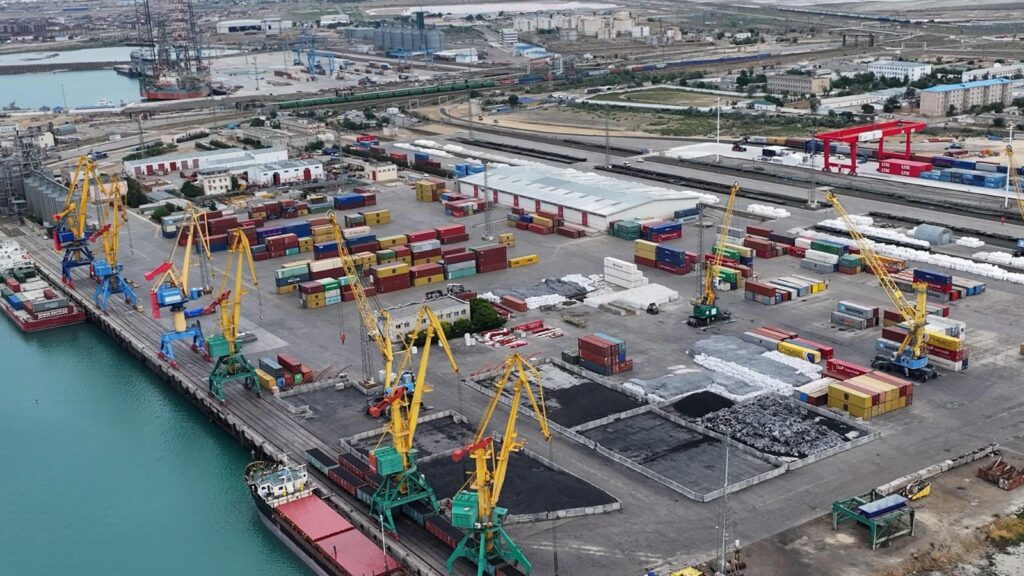
On June 9, Kazakhstan officially launched the largest container hub on the Caspian Sea, situated within its Aktau port.  The project, spearheaded by Kazakhstan’s national railway company, Kazakhstan Temir Zholy (KTZ), was implemented in collaboration with China's Lianyungang port and the Aktau International Sea Trade Port. China Communications Construction Company, a prominent Chinese state corporation specializing in transport infrastructure, served as the general contractor. During the opening ceremony, Nurlan Zhakupov, Chairman of the Board of the National Welfare Fund Samruk-Kazyna, highlighted the joint efforts of Samruk-Kazyna and KTZ in advancing Kazakhstan’s transit and transport potential, a key strategic objective for the nation. "Over the 10 years of KTZ's partnership with the port of Lianyungang, the Kazakh-Chinese terminal in Lianyungang, the Khorgos Gateway Dry Port, and now the container hub in Aktau have been opened. This project is an important step in the development of transport and logistics in Kazakhstan," he stated. The newly inaugurated hub is expected to significantly accelerate the processing of containerized cargo, enhance transit capabilities, and reinforce Kazakhstan's pivotal role as a strategic link on both the East-West and North-South transport routes. The operational launch of the hub was marked by the arrival of the 100,000th container from China, transported via the Trans-Caspian International Transport Route (TITR), a rapidly expanding trade corridor connecting China and Europe through Kazakhstan.

Kazakhstan Expands Role as Key Transit Hub for Chinese Exports to Europe

The inaugural Kazakhstan-China Transport Forum, held in Astana on May 15, unveiled a series of initiatives aimed at solidifying Kazakhstan’s position as a major transport and logistics hub for Chinese exports to Russia and Europe. At the forum, Kazakhstan’s Minister of Transport Marat Karabayev and China’s Minister of Transport Liu Wei discussed the development of a new multimodal transit corridor linking Russia, Kazakhstan, and China. The route will utilize the transboundary Irtysh River, as well as the Ili River, establishing a navigable link from the Kazakh city of Kunayev to Yining in China’s Xinjiang region. Key infrastructure plans include the construction of a new cross-border bridge at the Maykapshagay-Zimunay checkpoint to accommodate heavy trucks and the opening of a third international air corridor between the two countries. The ministers also discussed establishing two new road checkpoints to better connect East Kazakhstan and the Almaty regions with China. By the end of 2025, Kazakhstan aims to complete two major rail infrastructure projects: the second track on the Dostyk-Moiynty railway and a bypass line around Almaty station. These upgrades are expected to significantly boost freight capacity and cut cargo transit times between China and Europe via Kazakhstan. Additional developments include the launch of a direct passenger train between Almaty and Xi'an and an expansion of flight services between the two nations to 65 per week. Meanwhile, construction is underway on a new container hub at the Caspian Sea port of Aktau, a joint venture with a Chinese company. Scheduled for completion by year’s end, the facility will expand the port’s annual capacity from 140,000 to 240,000 TEUs. Kazakhstan’s Ministry of Transport reports that in the first quarter of 2025, road freight volumes between Kazakhstan and China surged by 82%, reaching 822,000 tons. Rail freight volumes grew by 13% over the first four months of the year, totaling 11.4 million tons. These developments highlight Kazakhstan’s growing strategic importance in transcontinental logistics, as China continues to diversify its export routes westward.

Transit Ambitions: Kazakhstan Emerges as Key Link Between East and West

Kazakhstan is poised to enhance its role as a pivotal transit hub between China and Europe amid evolving global logistics dynamics, according to a recent analysis by Energyprom.kz. China’s Role in Global Logistics China remains the world’s largest exporter, shipping approximately 4.5 billion tons of goods annually, with 60-70% transported via maritime routes. More than one-third of global container traffic passes through Chinese ports and transit centers. However, rising geopolitical tensions and sanctions have prompted Beijing to diversify its logistics options and reduce reliance on sea routes. The Belt and Road Initiative (BRI), which primarily traverses Kazakhstan, Russia, and Belarus, plays a crucial role in this strategy. Land routes offer shorter delivery times, typically 10-12 days compared to 30 days by sea. Alternatives bypassing Russia, such as the corridor through Kazakhstan, Iran, and Turkey, are also gaining prominence. Kazakhstan’s Transit Potential Kazakhstan’s strategic location enables it to serve as a vital conduit in global transport flows. The modern incarnation of the Silk Road has transformed the country into a linchpin for trade between East and West. Developing transit corridors not only boosts the national economy but also improves socio-economic conditions in border and underdeveloped regions by creating jobs and attracting investment. Over the past 15 years, Kazakhstan has invested more than 10 trillion tenge in transit infrastructure, generating approximately 600,000 jobs. In 2023, transit cargo volumes reached 30 million tons, exceeding the target of 27.7 million tons set in the national development strategy, “Concept for the Development of the Transport and Logistics Potential of the Republic of Kazakhstan until 2030.” The strategy aims to increase total transit volume to 35 million tons by 2030, including 2 million TEU in container traffic. Growth in Transport Service Exports Kazakhstan’s expanding logistics capabilities are translating into increased exports of transport services. In 2024, rail freight exports totaled US$1.3 billion, up 2.1% from the previous year. Road freight exports surged by 19.6% to US$665.7 million, while sea freight rose by 47.2% to US$64.7 million. Pipeline service exports also grew by 7.1%, despite a 1.6% decline compared to 2019 levels. Innovation and Digitalization in Logistics To cement its global position, Kazakhstan is investing in a smart economy by incorporating innovation and digital solutions into its logistics framework. This includes automation, artificial intelligence, blockchain technology, and the creation of integrated digital logistics hubs. One such initiative is the Alatau Special Economic Zone (SEZ), an innovation center designed to enhance the country’s transit ecosystem. According to the Astana International Financial Center (AIFC), the transport and logistics sector’s contribution to GDP could rise from 6.2% in 2022 to 9% by 2025. Link to AIFC report This digital transformation promises not only to reduce operational costs but also to generate thousands of high-skilled jobs, an essential component of Kazakhstan’s path to sustainable economic growth.