• KGS/USD = 0.01144 0%
  • KZT/USD = 0.00215 0%
  • TJS/USD = 0.10639 0.76%
  • UZS/USD = 0.00008 0%
  • TMT/USD = 0.28530 0%
  • KGS/USD = 0.01144 0%
  • KZT/USD = 0.00215 0%
  • TJS/USD = 0.10639 0.76%
  • UZS/USD = 0.00008 0%
  • TMT/USD = 0.28530 0%
  • KGS/USD = 0.01144 0%
  • KZT/USD = 0.00215 0%
  • TJS/USD = 0.10639 0.76%
  • UZS/USD = 0.00008 0%
  • TMT/USD = 0.28530 0%
  • KGS/USD = 0.01144 0%
  • KZT/USD = 0.00215 0%
  • TJS/USD = 0.10639 0.76%
  • UZS/USD = 0.00008 0%
  • TMT/USD = 0.28530 0%
  • KGS/USD = 0.01144 0%
  • KZT/USD = 0.00215 0%
  • TJS/USD = 0.10639 0.76%
  • UZS/USD = 0.00008 0%
  • TMT/USD = 0.28530 0%
  • KGS/USD = 0.01144 0%
  • KZT/USD = 0.00215 0%
  • TJS/USD = 0.10639 0.76%
  • UZS/USD = 0.00008 0%
  • TMT/USD = 0.28530 0%
  • KGS/USD = 0.01144 0%
  • KZT/USD = 0.00215 0%
  • TJS/USD = 0.10639 0.76%
  • UZS/USD = 0.00008 0%
  • TMT/USD = 0.28530 0%
  • KGS/USD = 0.01144 0%
  • KZT/USD = 0.00215 0%
  • TJS/USD = 0.10639 0.76%
  • UZS/USD = 0.00008 0%
  • TMT/USD = 0.28530 0%

Viewing results 1 - 6 of 21

Cardiff University Opens Campus in Astana

On September 3, Cardiff University in Wales officially inaugurated Cardiff University Kazakhstan in Astana, its first overseas branch campus and the only campus of a Russell Group research university in Central Asia. The event marked a milestone in the growing educational partnership between Kazakhstan and the United Kingdom. At the opening ceremony, Kazakh Minister of Science and Higher Education Sayasat Nurbek emphasized the country’s ambitions: “Kazakhstan is developing as a regional academic hub. This year, more than 31,000 foreign students came to our country. At the initiative of the head of state, a large-scale strategy is being implemented in higher education and science. One of its areas is the opening of branches of leading foreign research universities in our country. Over the past three and a half years, about 40 foreign universities have come to Kazakhstan, five of them have decided to open their campuses.” Cardiff University’s Vice-Chancellor, Professor Wendy Larner, described the launch as a pivotal step in the institution’s global ambitions: “I was delighted to officially open our branch campus in Astana our first international branch campus of Cardiff University. We look forward to welcoming our first cohort of academically excellent students later this month. We are the UK’s first Russell Group university to open a campus in Kazakhstan, marking an important step in our future global ambition.” Beginning in late September, the campus will enroll students in four-year undergraduate programs in computer science, business management, civil engineering, and exploration geology. Courses will be taught in English by faculty from both Cardiff University and its Astana campus, with the branch operating under Cardiff’s direct academic governance to ensure international standards are upheld. The newly appointed British Ambassador to Kazakhstan, Sally Axworthy, also attended the ceremony and welcomed the development: “It is a great honour to be participating in the grand opening of Cardiff University here in Astana as one of my first engagements as British Ambassador to Kazakhstan. The opening marks a new chapter in UK-Kazakhstan educational collaboration, bringing more world-class British academic excellence to Kazakh students and further strengthening the ties between our countries.” The arrival of Cardiff University reflects a broader national initiative to attract world-class institutions. As previously reported by The Times of Central Asia, several other prominent universities are also expanding into Kazakhstan. Russia’s prestigious Moscow State Institute of International Relations (MGIMO) is planning to open a branch in Astana in September 2025. South Korea’s Woosong University is preparing to launch its campus in the Turkestan region this year. Meanwhile, Germany’s Anhalt University of Applied Sciences has already opened a branch in Almaty, and Italy’s Marche Polytechnic University of Ancona has inaugurated its campus at Zhetysu University in Taldykorgan. Looking ahead, France’s Grenoble INP - Phelma, UGA, an elite engineering school, plans to open a branch in Almaty in 2026. In the same year, the United States' Colorado School of Mines is scheduled to launch its first international campus in Zhezkazgan, a key center for Kazakhstan’s geological industry.

Kazakhstan’s Higher Education Transformation – Minister Sayasat Nurbek on Attracting Global Talent and Driving Innovation

Kazakhstan is moving quickly to reposition its universities for a more competitive, tech-driven future and to become Central Asia’s study destination of choice. In an interview with The Times of Central Asia, Minister of Science and Higher Education of Kazakhstan, Sayasat Nurbek, explained that a flagship target captures this ambition: to attract 150,000 international students by 2029, nearly five times today’s level, while deepening partnerships with global universities, expanding research in critical minerals, and backing student entrepreneurship and AI talent pipelines. Kazakhstan as an Emerging Education Hub in Eurasia Government strategies and institutional partnerships frame Kazakhstan not only as Central Asia’s study destination of choice, but as a new nexus for education in Eurasia. The country’s location at the crossroads of Europe and Asia positions it to serve diverse regional markets, while rapidly multiplying branch campuses and partnerships with leading universities demonstrate how this ambition is taking shape. Inside the system, the reform agenda is anchored in greater university autonomy, modular and English-medium programs, stronger international accreditation, and a shift from rote learning to research-led, industry-connected education. As Sayasat Nurbek, Kazakhstan’s Minister of Science and Higher Education, told The Times of Central Asia: “Kazakhstan is not only Central Asia’s education leader - we are becoming a new Eurasian hub. Our partnerships with global universities and the growth of world-class campuses show that students no longer need to leave the region to access international-quality education.” Capturing Demographic Shifts and International Demand Demographics are one reason why this might work. Central Asia and the broader Eurasian neighborhood together have over a billion people under the age of 25 - a cohort that will strain capacity in nearby systems as the demand for higher education surges. Kazakhstan’s bet is to meet that need locally, in English, at global standards, and at a cost point that undercuts Western destinations. In this sense, the country is explicitly targeting an opportunity to capture demographic shifts and attract students from abroad, while positioning itself as a credible, accessible alternative to saturated or costly Western markets. Minister Nurbek emphasized this point: “With more than a billion young people across Central Asia and our neighboring regions, the demand for higher education is exploding. Kazakhstan is seizing this demographic opportunity by offering English-medium programs at global standards, and at a cost that is far more accessible than traditional destinations.” This change is visible on the ground through a rapid expansion of foreign branch campuses and deep partnerships. In September 2025, Cardiff University officially opened in Astana - the first Russell Group presence in the country. Branches of the British De Montfort and Coventry universities have already opened their doors in Almaty and Astana, whilst a campus of the South Korean university, Woosong, is set to launch in Turkestan this month. Ministerial briefings and project sheets describe a broader pipeline that includes operating collaborations as well as branches at varying stages - from Penn State and the University of Arizona to SeoulTech, TU Berlin, Queen’s University Belfast, New York Film Academy,...

Kazakh and Chinese Universities Sign Over 20 New Cooperation Agreements

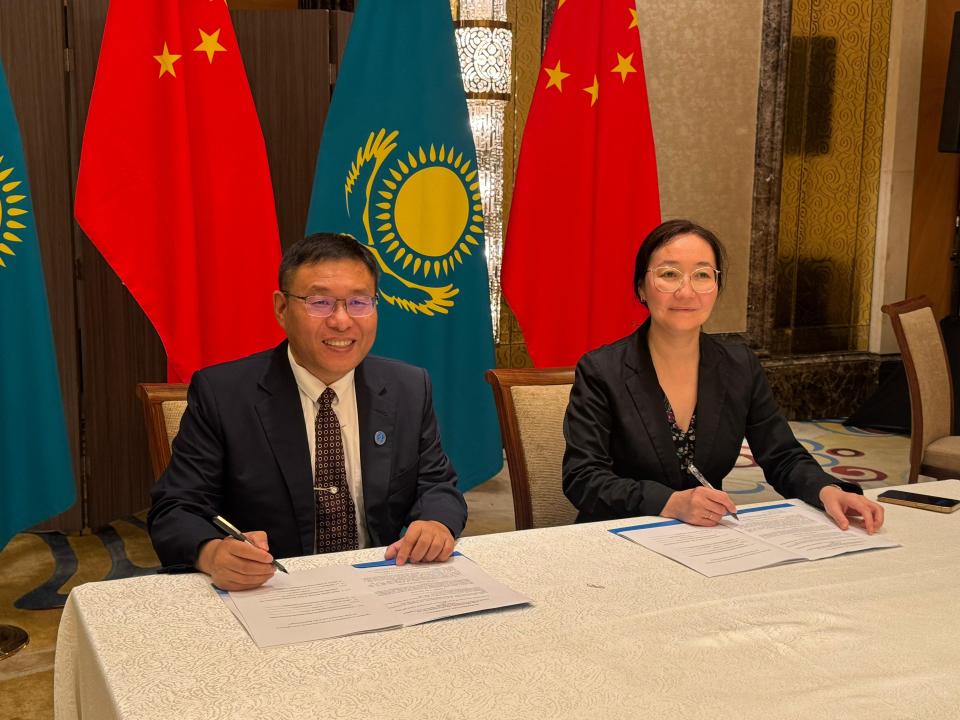
At the Kazakhstan-China Business Council meeting held in Beijing on September 2, leading universities from both countries signed more than 20 new agreements aimed at deepening cooperation in education, science, and innovation, according to the Kazakh Ministry of Science and Higher Education. The wide-ranging agreements span areas such as artificial intelligence, robotics, water resource management, and dual degree programs, highlighting the growing strategic role of academic and research collaboration in the Kazakhstan-China partnership. Among the most significant developments was the establishment of the Kazakh-Chinese Scientific and Technological Alliance on Spatio-Temporal Artificial Intelligence. The alliance includes the National Academy of Sciences of Kazakhstan, the Kazakh National Agrarian Research University, Zhejiang University of Technology, and Zhejiang Zhonghe Technology Co., Ltd. A joint laboratory will also be launched as part of the Belt and Road Initiative. Al-Farabi Kazakh National University (KazNU) signed an agreement with Chinese investment and development firm Yuan Zhen to jointly design and produce unmanned aerial vehicles. KazNU also partnered with Jiangsu Huibo Robotics Technology Co., Ltd. to inaugurate the International Institute of Digital Technologies and Robotics, along with a Robotics Center dedicated to training the next generation of engineers. In Almaty, the Technological University signed an agreement with Beijing Technology and Business University to create the Kazakhstan-China Center for Technology and Innovation Development. Meanwhile, the Kazakh National University of Water Resources and Irrigation and the North China University of Water Resources and Electric Power (NCWU) agreed to collaborate on sustainable water management. In the digital sphere, Astana IT University signed a memorandum of cooperation with Tus-Holdings, a science park affiliated with Tsinghua University, focusing on information technology, artificial intelligence, and startup incubation. Multiple institutions expanded joint academic offerings. Gumilyov Eurasian National University, Abylkas Saginov Karaganda Technical University, ALT University, and Uzbekali Zhanibekov South Kazakhstan Pedagogical University all signed agreements with top Chinese universities to launch dual bachelor’s and master’s degree programs. In the energy sector, the Atyrau University of Oil and Gas and Liaoning Petrochemical University will establish the Kazakhstan-China International Engineering School and a joint international laboratory. Additionally, Astana International University and Beijing Language and Culture University agreed to open a branch campus of the Chinese university in Kazakhstan. These agreements underscore the strategic role of higher education and scientific cooperation in advancing Kazakhstan-China relations, particularly within the framework of the Belt and Road Initiative.