
• KZT/USD = 0.00214
  • TJS/USD = 0.10810
  • UZS/USD = 0.00008
  • TMT/USD = 0.29760
  • KZT/USD = 0.00214
  • TJS/USD = 0.10810
  • UZS/USD = 0.00008
  • TMT/USD = 0.29760
  • KZT/USD = 0.00214
  • TJS/USD = 0.10810
  • UZS/USD = 0.00008
  • TMT/USD = 0.29760
  • KZT/USD = 0.00214
  • TJS/USD = 0.10810
  • UZS/USD = 0.00008
  • TMT/USD = 0.29760
  • KZT/USD = 0.00214
  • TJS/USD = 0.10810
  • UZS/USD = 0.00008
  • TMT/USD = 0.29760
  • KZT/USD = 0.00214
  • TJS/USD = 0.10810
  • UZS/USD = 0.00008
  • TMT/USD = 0.29760
  • KZT/USD = 0.00214
  • TJS/USD = 0.10810
  • UZS/USD = 0.00008
  • TMT/USD = 0.29760
  • KZT/USD = 0.00214
  • TJS/USD = 0.10810
  • UZS/USD = 0.00008
  • TMT/USD = 0.29760

Viewing results 1 - 6 of 30

AI in Kazakh Universities: Institutions Are Not Ready for the ChatGPT Era

AI in Kazakh universities is rapidly transforming higher education, but many institutions appear unprepared for how quickly such tools are becoming normalized in the academic process. While authorities increasingly urge educators to treat AI as a professional tool for the future workforce, universities continue spending tens of thousands of dollars on systems designed to detect texts generated by ChatGPT and similar AI models. By the spring of 2026, the use of generative AI in Kazakh universities had effectively become a new academic norm. Students now routinely use AI systems to write coursework, dissertations, and analytical papers. However, instead of fundamentally reconsidering how knowledge and competencies are assessed, universities are attempting to fit new technologies into an outdated, control-based educational model. Kazakhstan’s Ministry of Science and Higher Education has officially rejected the idea of banning generative AI outright. The ministry states that AI usage is acceptable as long as students adhere to principles of academic integrity and transparency. “Conceptually, the Ministry does not advocate for a complete ban on generative neural networks,” the Committee for Higher and Postgraduate Education said in its official position. This approach was formalized through the “Inter-University Standard for the Use of AI,” adopted in 2024. In 2025, authorities further reaffirmed their commitment to integrating AI into the education system, emphasizing that AI tools should be viewed primarily as instruments rather than threats. Universities Spend Tens of Thousands of Dollars on AI Detectors Despite the ministry’s position, universities across Kazakhstan have begun purchasing AI-detection systems. In the spring of 2025, the company Antiplagiat.Kazakhstan introduced an algorithm designed to detect AI-generated text, which state and national universities have subsequently begun to acquire on a large scale. According to Kazakhstan’s public procurement portal, Kazakh National Medical University signed a contract worth approximately $27,000, while Toraighyrov University conducted several procurements totaling around $19,000. Most contracts were awarded through single-source procurement procedures, strengthening the market position of one dominant supplier in the field of academic verification systems. At the same time, AI detectors do not produce definitive results and instead operate on probabilistic models. Kazakhstan’s Ministry of Education has separately stated that such tools cannot serve as indisputable proof of academic misconduct. “The development of artificial intelligence requires not a mechanical prohibition of AI, but an improvement of assessment systems,” the ministry noted. [caption id="attachment_49352" align="aligncenter" width="1024"] A talk on AI at Al-Farabi University. Image: Joe Luc Barnes[/caption] University Regulations Lag Behind Technological Reality The problem is compounded by outdated university regulations. Many rules and academic policies were written before the mass adoption of generative AI. Documents from Yessenov University and Narxoz University, for example, contain no references to terms such as “AI,” “neural networks,” or “text generation.” Even recently updated regulations often preserve the old logic of evaluation through text originality percentages. In the “Academic Policy of Al-Farabi Kazakh National University for 2025-2026”, AI usage is now formally regulated, yet the university simultaneously retains a requirement that diploma theses maintain a minimum originality level of 75%. This creates a legal contradiction:...
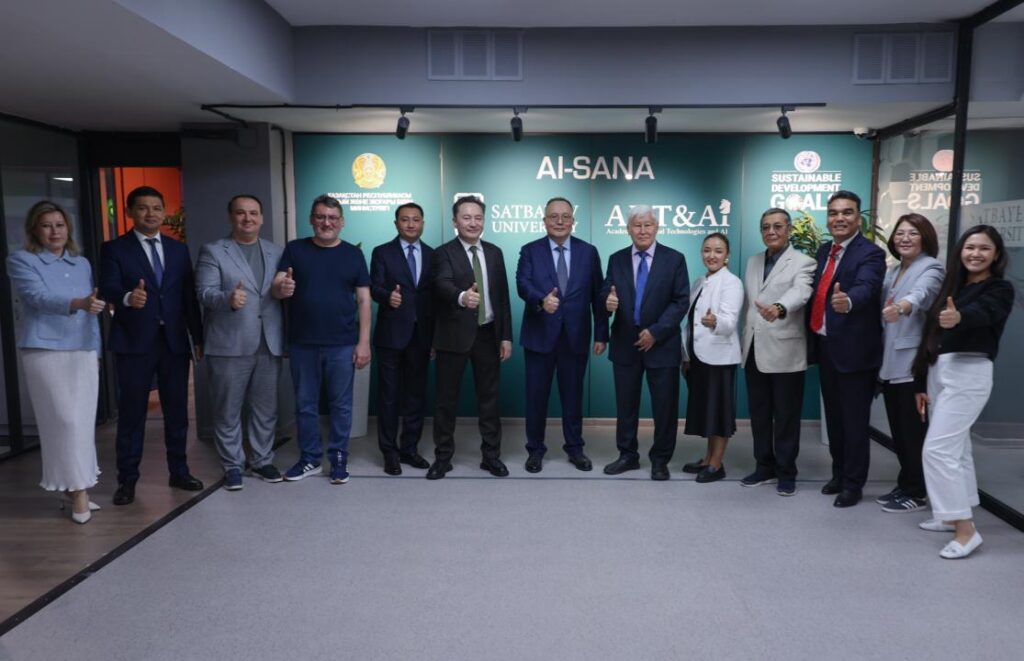

Academy of Digital Technologies & Artificial Intelligence Inaugurated in Kazakhstan

The Academy of Digital Technologies & Artificial Intelligence (ADT&AI) has opened at Satbayev University in Almaty. The new institution will focus on developing digital solutions and artificial intelligence technologies for training next-generation specialists, as well as creating solutions for the corporate sector. The opening ceremony on May 5 was attended by Presidential Aide Kuanyshbek Yessekeyev, Deputy Minister of Science and Higher Education Dinara Shcheglova, and Vice President of the National Academy of Sciences Askar Dzhumadildayev. According to the Ministry of Science and Higher Education, the new academy will offer online courses, making technical education accessible regardless of students’ location. The academy has also launched professional development programs for employees of Kazakhstani enterprises and supports businesses in implementing digital transformation tools in their operations. Through its own data center, the academy will develop digital services and artificial intelligence-based solutions. The AI Lab will play a central role in the academy’s work by integrating AI algorithms into educational and corporate products. “We are creating not just an educational platform, but a fully-fledged technological environment where education, infrastructure, and artificial intelligence work together. Our goal is to provide students and partners with real tools for working and developing in the digital economy,” said Natalia Kudryavtseva, project manager and business analyst at the AI Lab. ADT&AI was created as part of the AI-Sana national program for the development of artificial intelligence in Kazakhstan. The large-scale government initiative aims to develop AI competencies among students, support startups, and create a next-generation technological environment. The program is being implemented with the support of the Ministry of Science and Higher Education and leading universities, including Satbayev University.

Russia to Build University Campus in Bishkek

The Cabinet of Ministers of Kyrgyzstan has approved the reclassification of land in southern Bishkek for the construction of a new campus for the Kyrgyz-Russian Slavic University, the government said. The decree, signed on April 24 by Prime Minister Adylbek Kasymaliev, transfers the land from agricultural use to settlement status. The project is being implemented under an intergovernmental agreement between Kyrgyzstan and Russia following the state visit of Vladimir Putin to Bishkek in November 2025. It involves the construction of a university campus spanning approximately 30 hectares. Officials say the campus will form part of a long-term strategy to develop educational infrastructure and deepen humanitarian cooperation between the two countries. The new complex is designed to accommodate up to 15,000 students and will include academic, research, and social facilities in line with international higher education standards. Construction is expected to be completed by 2030, with funding to be provided jointly by both sides. It is part of a wider educational push by Russia to bolster the influence of Russian language in the region. Russian cultural organisation Evrasiya, a non-profit organisation linked to the Kremlin, has invested heavily in Kyrgyzstan since 2024. President Sadyr Japarov has instructed that the campus be equipped with modern facilities, while the Finance Ministry has been tasked with allocating funds for the necessary engineering infrastructure. Once the decree comes into force, local authorities will be required to terminate third-party rights to the land allocated for the project. Most of the site is currently state-owned, though part remains in private hands. Authorities also noted the need to comply with environmental, sanitary, and urban planning standards, including measures to improve seismic resilience – a perennial fear for Central Asian cities. The agreement on the campus construction was previously ratified by the parliaments of both countries, including Russia’s State Duma and the Federation Council.

Why More Students in Kazakhstan Choose to Study Abroad

An increasing number of students in Kazakhstan are considering education abroad. For some, it offers access to high-quality academic programs; for others, it provides opportunities to gain international experience, learn new languages, and improve career prospects. Interest in foreign universities is growing among school graduates and their parents, who increasingly view overseas education as an investment in their children’s future. According to the Bureau of National Statistics, 678,100 students were enrolled in higher education institutions in Kazakhstan at the start of the 2025-2026 academic year. At the same time, data from the International Trade Administration indicate that more than 90,000 Kazakhstani citizens are currently studying abroad.  Sanzhar Uvashev, an employee of InterPress Abroad, a company that assists applicants seeking admission to foreign universities, spoke about the factors influencing students’ choices and the opportunities offered by international education. TCA: Tell us about your work. What does your organization do? Uvashev: Our company helps students apply to universities abroad. We support applicants in selecting academic programs, preparing documents, and navigating the entire admissions process. One of our distinguishing features is that we are not limited to a specific list of partner institutions or countries. We can assist students in applying to a wide range of universities, depending on their individual preferences. TCA: Which countries are currently the most popular destinations? Uvashev: We work with a broad range of destinations, particularly the United Kingdom, the United States, and Canada, as well as countries across Europe and Asia. Recently, students have shown greater interest in exploring multiple options rather than focusing on a single country. Some prioritize studying in an English-speaking environment, others seek more affordable tuition, while some focus on scholarship opportunities and employment prospects after graduation. TCA: What opportunities exist today for students from Central Asia to study abroad? Uvashev: Opportunities are expanding. Many universities are paying closer attention to applicants from Central Asia, as international students contribute to a more diverse academic environment. As a result, institutions are offering scholarships, tuition discounts, and preparatory programs. Awareness of the region is growing, and with it the range of options available to students. TCA: Why do students continue to choose the U.S. and other destinations? Uvashev: The U.S. remains one of the most popular destinations because of its strong universities and perceived career opportunities. At the same time, countries such as Italy, Austria, and China are also attracting interest. Italy and Austria appeal to students because public universities there can offer relatively affordable, and in some cases almost free, education. China has gained popularity due to the quality of its universities, their rising positions in global rankings, and the availability of scholarships for international students. TCA: Are there programs that allow students to study free of charge? Uvashev: Yes. Students often inquire about scholarship schemes that significantly reduce tuition fees or cover them entirely. Examples include the Bolashak international scholarship program, Stipendium Hungaricum, and Erasmus Mundus. These initiatives provide talented applicants with real opportunities to obtain an education abroad, provided they are well...

Air Pollution Research Center Opens at Osh State University with Japanese Support

A new Inter-Institutional Research Center for Air Pollution Studies (IRCAPS) has been inaugurated at Osh State University in southern Kyrgyzstan. The center is part of a five-year joint project between Osh State University and the Tokyo University of Science. Funded by the Japan International Cooperation Agency (JICA) and the Japan Science and Technology Agency (JST), the $5 million initiative includes full provision of technical equipment for the facility. The opening ceremony, held on November 18, was attended by Professor Nobutoshi Nawa, a leading scientist from the Tokyo University of Science, and Nishigato Kotaro, JICA’s representative in Kyrgyzstan. Osh State University Rector Kudaiberdi Kojobekov stated that the center's establishment represents a new phase in scientific and educational collaboration between Kyrgyzstan and Japan. The center will focus on studying the health impacts of air pollution. Monitoring equipment will be installed both indoors and outdoors in residential areas to assess air quality in Osh, Bishkek, and other regions. Japanese scientists will collaborate directly with Kyrgyz researchers, and the resulting data will be used to formulate policy recommendations for relevant institutions and stakeholders. The project is being carried out in coordination with the Ministry of Health, the Ministry of Natural Resources, Ecology, and Technical Supervision, the Hydrometeorological Service, the International Higher Medical School, the Osh City Administration, and various international partners. Air pollution remains a critical issue in Kyrgyzstan, particularly in its largest urban centers, Bishkek and Osh. Key sources include the widespread use of coal for heating and vehicle exhaust emissions.

Central Asian Countries Agree to Recognize Each Other’s University Degrees

The governments of Kazakhstan, Kyrgyzstan, Tajikistan, Turkmenistan, and Uzbekistan have officially agreed to mutually recognize higher education diplomas issued within the region. Kazakhstan approved the relevant draft on November 12, as documented in an intergovernmental agreement. The initiative aims to create a unified educational space in Central Asia and eliminate barriers related to qualification recognition. Under the agreement, all five countries will automatically recognize university diplomas that are legally valid, officially accredited, and issued by state higher education institutions in any of the participating countries. Recognition will apply in three key areas: Employment in another Central Asian country Internships Continuing education at the next academic level However, qualifications must meet common higher education standards. Recognition may be denied only if substantial differences in the educational systems are identified. The agreement outlines a clear implementation mechanism: each country will appoint a designated authority responsible for diploma recognition and notify the depositary, which will in turn inform the other signatories. If the structure or authority of the appointed body changes, the state is required to issue an immediate notification through diplomatic channels. Despite agreeing on a shared framework, the countries still maintain varying standards for recognizing foreign university degrees. Uzbekistan, Kyrgyzstan, Turkmenistan, and Tajikistan have agreed to recognize diplomas from universities in any participating country, provided those institutions are legally operating and issue officially recognized state diplomas. Kazakhstan, however, has adopted stricter criteria. It will only recognize diplomas from regional universities that appear in the top 1,000 of the following international rankings: Quacquarelli Symonds World University Rankings (QS) Times Higher Education (THE) Academic Ranking of World Universities (ARWU) Diplomas from these universities will allow holders from participating countries to work, intern, or pursue further studies in Kazakhstan, subject to an application process. The agreement is expected to ease the movement of skilled professionals within Central Asia and reduce bureaucratic barriers to regional academic and professional mobility.