• KZT/USD = 0.00219
  • TJS/USD = 0.10810
  • UZS/USD = 0.00009
  • TMT/USD = 0.29850
  • KZT/USD = 0.00219
  • TJS/USD = 0.10810
  • UZS/USD = 0.00009
  • TMT/USD = 0.29850
  • KZT/USD = 0.00219
  • TJS/USD = 0.10810
  • UZS/USD = 0.00009
  • TMT/USD = 0.29850
  • KZT/USD = 0.00219
  • TJS/USD = 0.10810
  • UZS/USD = 0.00009
  • TMT/USD = 0.29850
  • KZT/USD = 0.00219
  • TJS/USD = 0.10810
  • UZS/USD = 0.00009
  • TMT/USD = 0.29850
  • KZT/USD = 0.00219
  • TJS/USD = 0.10810
  • UZS/USD = 0.00009
  • TMT/USD = 0.29850
  • KZT/USD = 0.00219
  • TJS/USD = 0.10810
  • UZS/USD = 0.00009
  • TMT/USD = 0.29850
  • KZT/USD = 0.00219
  • TJS/USD = 0.10810
  • UZS/USD = 0.00009
  • TMT/USD = 0.29850
05 September 2026

Viewing results 1 - 6 of 78

What Drives Kazakhstan’s Threefold Growth in High-Tech Exports

Kazakhstan has sharply increased its presence in the global market for high-tech goods in recent years. According to analysts at Finprom.kz, the country’s high-tech exports nearly tripled, rising from $2.5 billion in 2021 to $7.3 billion in 2024. Geography and Growth Dynamics This surge was driven less by a physical increase in exports, up 9.7%, and more by rising global prices and the growth of re-exports. Since 2022, amid shifting geopolitical dynamics, Kazakhstan has emerged as a key player in re-export chains for complex technical equipment. The Bureau of National Statistics reports that nearly 77% of high-tech export value in 2024 ($5.6 billion) was attributed to companies registered in Astana and Almaty. However, this reflects business registration patterns rather than actual production. For example, a Kazakh-Chinese joint venture in Ust-Kamenogorsk manufactures fuel assemblies for nuclear reactors, yet its exports are registered as originating from Almaty. Uranium: The Strategic Core Uranium and its compounds remain Kazakhstan’s dominant high-tech export, comprising 62.7% of the total in 2024, or $4.6 billion. Over the past three years, the value of uranium exports rose 2.6 times, while the physical volume increased by just 16.7%. The key driver was a sharp spike in global uranium prices: in the first half of 2024 alone, the spot price rose by 73%, while long-term contract prices also trended upward. Aviation and Leasing Structures Aircraft ranked second in terms of profitability. In 2024, exports of airplanes and helicopters exceeded $940 million, 30 times higher than in 2021. Ireland was the largest reported buyer. However, this spike reflects aviation leasing arrangements rather than direct aircraft sales. As noted in a document submitted by Prime Minister Olzhas Bektenov to the Mazhilis, Kazakhstan's parliament, Kazakhstan’s national carrier Air Astana operates aircraft registered in Ireland, leading to leasing-related flows being counted as exports. Smartphones, Electronics, and Digital Equipment Smartphones emerged as a fast-growing category, with exports increasing 54-fold to $433 million. Key markets included Central Asian neighbors, Mongolia, and the Czech Republic. Much of the growth occurred in 2022, driven by shifting supply chains amid international sanctions. While the volume of exported computers and digital equipment rose, their total value declined. Notably, exports of digital data processing units fell from $136.6 million in 2021 to $11.6 million in 2024. This discrepancy highlights the predominance of re-exports. In 2024, Kazakhstan produced just 33,000 computing units but exported 744,100. Similarly, it manufactured 7,500 electromechanical devices while exporting nearly 200,000. Broader Export Structure According to QazTrade, the share of high value-added products in Kazakhstan’s exports reached 13.5% or $11.1 billion in 2024, marking a 16.1% year-on-year increase. However, the country’s export structure remains resource-heavy: raw materials account for 63.3% of total exports, followed by low value-added goods at 15.5%, with high-tech processed goods in third place.

Kazakhstan to Supply Uranium to Slovakia Under New Memorandum

Kazakhstan’s national nuclear company, Kazatomprom, has signed a memorandum of understanding with Slovenské elektrárne a.s. (SEAS), Slovakia’s largest electricity producer, paving the way for future uranium exports to the Central European country. According to a company statement, the memorandum outlines the potential supply of natural uranium concentrate and, eventually, uranium dioxide (UO₂), to fuel Slovakia’s nuclear reactors. The agreement also sets the stage for identifying additional areas of long-term cooperation between the two energy firms. SEAS operates Slovakia’s two nuclear power plants, Bohunice and Mochovce, which collectively run five VVER-440 reactors. The company generates over 70% of Slovakia’s electricity. A controlling 66% stake in SEAS is held by Slovak Power Holding, with the remaining 34% owned by the Slovak government. “With the signing of this memorandum, we are taking an important step towards strengthening cooperation with our European partners,” said Meirzhan Yusupov, Chairman of the Board of Kazatomprom. “Slovakia is one of the countries where nuclear energy plays a key role in ensuring a sustainable energy supply. We hope this agreement lays the foundation for strong and mutually beneficial relations.” Branislav Stricek, CEO and Chairman of SEAS, emphasized the importance of diversifying nuclear fuel sources and expressed confidence in the long-term potential of partnering with the world’s largest uranium producer. Kazatomprom maintained its position as the leading global producer of natural uranium in 2024, accounting for 21% of total output, up from 20% in 2023. The company’s net profit reached $2.1 billion in 2024, marking a 95% increase year-on-year. Kazakh uranium is currently exported to markets across China, Southeast Asia, Europe, and the Americas. This new agreement with SEAS follows several recent deals with European energy providers. In February 2025, Kazatomprom signed its first uranium supply contract with Swiss firms Axpo Power AG and Kernkraftwerk Leibstadt AG to fuel the Beznau and Leibstadt nuclear power plants. In April, The Times of Central Asia, reported that the company had also entered into a similar agreement with Czech energy giant ČEZ.

Kazakhstan Prioritizes Nuclear Energy in Long-Term Development Strategy

Kazakhstan has identified the development of nuclear energy as a strategic priority for the country's economic future, President Kassym-Jomart Tokayev announced at the Astana International Forum (AIF). “Kazakhstan, which possesses 40% of the world's uranium reserves, views nuclear energy as a key pillar of its national development strategy,” Tokayev stated. “However, sustainable development is impossible without addressing the climate crisis, particularly as Central Asia is among the region’s most vulnerable to climate change. Global warming is occurring here at twice the global average rate.” To address this, Tokayev outlined Kazakhstan’s commitment to a pragmatic and regionally coordinated climate agenda. He noted the country’s participation in various international organizations and agreements focused on environmental sustainability. In 2026, Kazakhstan, in partnership with the United Nations, will host a Regional Climate Summit, aimed at aligning Central Asian strategies with global environmental ambitions. Tokayev also highlighted the recent establishment of the UN Regional Center for Sustainable Development Goals for Central Asia and Afghanistan in Almaty. “This marks a significant step in our multilateral cooperation. The center will facilitate joint projects, provide technical support, and coordinate international efforts,” he said. At the same time, Kazakhstan continues to promote nuclear non-proliferation. “Today, nine countries possess more than 13,000 nuclear warheads. Experts warn that the risk of their use is rising, whether through miscalculation, accident, or escalation,” Tokayev cautioned. He emphasized the lasting impact of 450 nuclear tests conducted on Kazakh territory during the Soviet era. Public support for nuclear energy has been growing. In a referendum held last fall, over 70% of Kazakh citizens voted in favor of developing the country’s nuclear energy capacity. In January 2025, the government finalized a shortlist of potential technology suppliers for Kazakhstan’s first nuclear power plant. The contenders include Russia’s Rosatom, South Korea’s KHNP, China’s CNNC, and France’s EDF. The inaugural plant is expected to be built in the Almaty region and operational by 2035. Authorities are also evaluating sites for two additional facilities, with possible locations in Balkhash (southeastern Kazakhstan), Kurchatov (in the Abai region, near the former Semipalatinsk nuclear test site), and Aktau (Mangistau region, home to a Soviet-era experimental reactor). To oversee the development and regulation of the sector, Kazakhstan established the Atomic Energy Agency in March. Reporting directly to the president, the agency is responsible for uranium mining, atomic energy use, radiation safety, and management of the Semipalatinsk Nuclear Safety Zone.

Kazakh Uranium to Power Czech Nuclear Plants

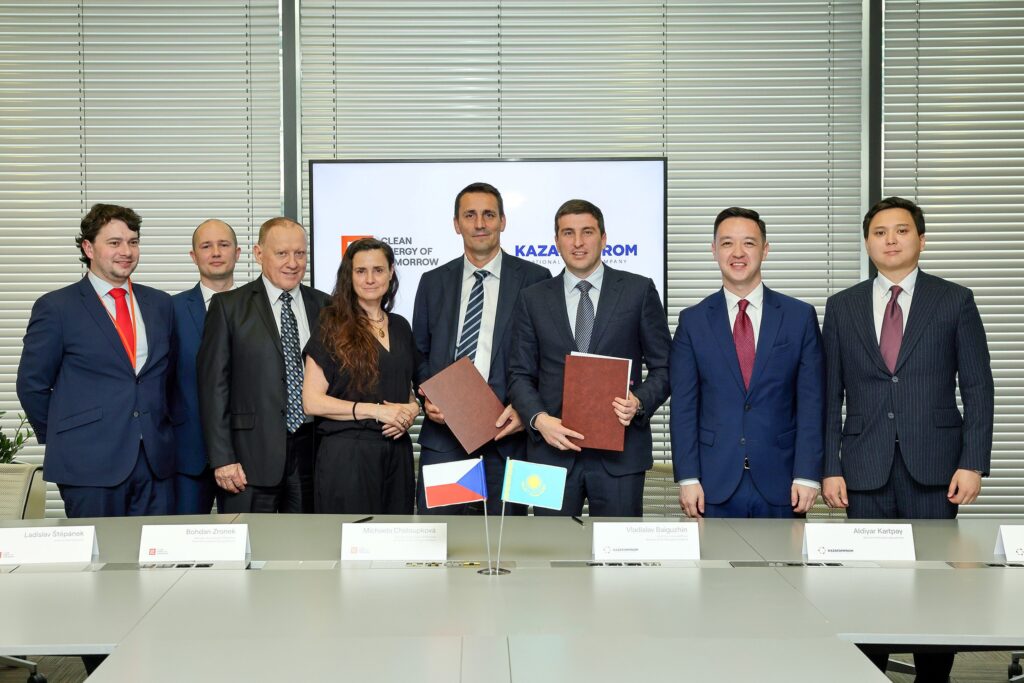
Kazakhstan’s National Atomic Company Kazatomprom has signed a contract with Czech energy giant ČEZ a.s. to supply natural uranium for the country’s nuclear power plants. The agreement marks a significant step in strengthening energy cooperation between Kazakhstan and the European Union. Expanding European Reach The contract, signed at ČEZ’s headquarters in Prague, represents a key milestone in the expansion of Kazatomprom’s uranium supply footprint in Europe. Under the seven-year deal, Kazakhstan will provide approximately one-third of the uranium needed for Westinghouse fuel assemblies used at the Temelín Nuclear Power Plant. Both parties emphasized the agreement’s importance for regional energy security and environmental sustainability. “With the signing of this agreement, Kazatomprom continues to expand its presence in Europe and strengthen its strategy to diversify its sales portfolio. This is another important milestone on our way to becoming the preferred partner for the global nuclear power industry,” said Vladislav Baiguzhin, Kazatomprom’s Chief Commercial Officer. Bogdan Zronek, head of ČEZ’s nuclear division, highlighted the strategic value of the partnership: “The partnership with Kazatomprom diversifies our supplier portfolio and is of strategic importance for ČEZ and the Czech Republic. It provides a stable and reliable source of fuel for our nuclear power plants.” ČEZ and the Czech Nuclear Sector ČEZ is Central Europe’s leading energy company, operating six nuclear reactors at the Temelín and Dukovany sites. Together, these facilities supply roughly 36% of the Czech Republic’s electricity. The company is actively advancing its VIZE 2030 decarbonization strategy, aiming to secure a stable, environmentally friendly energy future. Kazatomprom’s Global Standing Kazatomprom remains the world’s largest producer of natural uranium, accounting for about 21% of global primary production in 2024. All production is carried out in Kazakhstan using in-situ leaching, an environmentally safer extraction method. The company is certified under ISO 45001 and ISO 14001 standards. Kazatomprom exports uranium globally, with key markets in China, Southeast Asia, Europe, and North America. Deliveries are made via long-term contracts and the spot market, including through its Swiss-based subsidiary, Trading House KazakAtom. Ongoing International Partnerships The agreement with ČEZ builds on a strategic relationship initiated in 2016, when the two sides signed a memorandum to cooperate on nuclear fuel cycle projects, including exploration, mining, processing, reclamation, marketing, and technological innovation. In February 2025, Kazatomprom also signed its first-ever uranium supply contract with Switzerland’s Axpo Power AG and Kernkraftwerk Leibstadt AG for the Beznau and Leibstadt nuclear power plants. The latest deal further solidifies Kazatomprom’s position in Europe’s energy market and underscores the growing role of nuclear power in the region’s shift toward clean, sustainable energy sources.

Kazakhstan to Help Jordan Assess Uranium Reserves

During Kazakh President Kassym-Jomart Tokayev’s official visit to Jordan, a memorandum of understanding was signed between Kazakhstan’s Kazatomprom National Atomic Company JSC and the Jordan Uranium Mining Company (JUMCO). The agreement outlines plans for cooperation in uranium exploration and mining in Jordan. Kazatomprom CEO Meirzhan Yusupov emphasized that the partnership with JUMCO presents new opportunities to strengthen Kazakhstan’s position in the global uranium industry. “This memorandum aligns with our strategic goals of efficiently utilizing our resource base. Additionally, studying foreign projects will provide valuable international experience and contribute to the sustainable development of both countries,” he said. Assessing Uranium Potential in Jordan The primary goal of the agreement is to evaluate the potential for uranium exploration and development in Jordan. This includes assessing reserves and analyzing the feasibility of using heap leaching technologies for extraction. Special attention will be given to environmental safety and economic viability. Based on the study results, both parties will decide on the next steps for project development. JUMCO CEO Mohammad Al-Shannagh stated that partnering with the world’s largest uranium producer could accelerate Jordan’s commercial uranium production. “Cooperation with Kazatomprom will open new horizons for us in uranium mining, allowing us to share knowledge, use advanced technologies, and jointly develop marketing strategies,” he said. Joint projects are expected to give new impetus to Jordan’s nuclear industry, creating jobs, attracting local contractors, and improving infrastructure. Kazakhstan’s Expanding Uranium Industry Kazakhstan’s collaboration with JUMCO provides an opportunity to expand its international reach, strengthen economic ties with Jordan, and enhance its influence in the global uranium sector. Kazatomprom is the world’s largest producer of natural uranium, with priority access to one of the world’s most significant resource bases. Since November 2018, Kazatomprom’s shares have been traded on the Astana International Financial Center Exchange and the London Stock Exchange.

Kazakhstan’s Nuclear Power Move and Implications for the West

Kazakhstan’s recent referendum approving the construction of its first nuclear power plant (NPP) is a watershed moment. More than a domestic policy decision, this move puts into relief Kazakhstan's strategy for positioning itself as a linchpin in the diversification of global energy supply chains, with the world's largest uranium reserves accounting for nearly 40% of the global supply and a key geographic location. The country's ambitions align with the broader resurgence of nuclear power as an indispensable component of a sustainable energy future, countering decades of stagnation in the West and challenging the dominance of Russia and China. The renewed attention on nuclear energy arises from a convergence of systemic and technological factors. Environmental pressures to reduce reliance on fossil fuels such as gas and coal have left energy producers searching for scalable, reliable alternatives. Renewable energy sources like wind and solar, while important, remain limited by intermittency and storage challenges. At the same time, safety concerns rooted in historical disasters — Chernobyl, Three Mile Island, and Fukushima — have been mitigated by advances in reactor technology. A growing public recognition of nuclear power's viability has resulted. In this context, Kazakhstan's entry into the nuclear power arena is logical. Enhancing its ability to integrate uranium extraction with downstream nuclear fuel production would underscore its potential to play a central role in addressing global energy needs. By fostering international partnerships, Kazakhstan can leverage its resource wealth to become a critical supplier for advanced economies looking to diversify their energy mix. Kazakhstan's move comes at a time of shifting geoeconomic dynamics in the nuclear energy sector. Over the past three decades, Russia and China have consolidated their dominance, exploiting the West’s inertia. Russia has used NPP construction as a geoeconomic tool, creating dependence in such countries as Turkey and Uzbekistan. China, meanwhile, has aggressively developed its domestic nuclear infrastructure while securing global uranium supplies, particularly through investments in Africa and Central Asia. By contrast, Western nations have lagged behind, plagued by fragmented project management, skilled labor shortages, and political resistance. Anti-nuclear movements, many of which gained momentum during the Cold War with Soviet backing, have continued to stymie development in Europe and North America. The resulting industrial inertia has left Western economies vulnerable, with insufficient capacity to meet rising energy demands or counterbalance Russian and Chinese influence. Kazakhstan's emergence offers the West a rare opportunity to reverse this trend. The country’s multi-vector diplomatic strategy, emphasizing balanced relations with global powers, makes it an ideal partner for rebalancing energy supply chains. Kazakhstan’s role in global energy extends beyond uranium. The country’s geological resources overlap with deposits of rare-earth elements (REEs), which are vital for advanced defense technologies, renewable energy systems, and high-tech manufacturing. The shared extraction technologies and logistical infrastructure for uranium and REEs present opportunities for integrated resource development. NATO’s Partnership for Peace (PfP) program could play a pivotal role in this regard. By incorporating rare-earth mining and supply chain security into NATO’s Critical Energy Infrastructure Protection (CEIP) framework, member states could...