• KGS/USD = 0.01144 0%
  • KZT/USD = 0.00206 0%
  • TJS/USD = 0.10771 0%
  • UZS/USD = 0.00008 0%
  • TMT/USD = 0.28571 0%
  • KGS/USD = 0.01144 0%
  • KZT/USD = 0.00206 0%
  • TJS/USD = 0.10771 0%
  • UZS/USD = 0.00008 0%
  • TMT/USD = 0.28571 0%
  • KGS/USD = 0.01144 0%
  • KZT/USD = 0.00206 0%
  • TJS/USD = 0.10771 0%
  • UZS/USD = 0.00008 0%
  • TMT/USD = 0.28571 0%
  • KGS/USD = 0.01144 0%
  • KZT/USD = 0.00206 0%
  • TJS/USD = 0.10771 0%
  • UZS/USD = 0.00008 0%
  • TMT/USD = 0.28571 0%
  • KGS/USD = 0.01144 0%
  • KZT/USD = 0.00206 0%
  • TJS/USD = 0.10771 0%
  • UZS/USD = 0.00008 0%
  • TMT/USD = 0.28571 0%
  • KGS/USD = 0.01144 0%
  • KZT/USD = 0.00206 0%
  • TJS/USD = 0.10771 0%
  • UZS/USD = 0.00008 0%
  • TMT/USD = 0.28571 0%
  • KGS/USD = 0.01144 0%
  • KZT/USD = 0.00206 0%
  • TJS/USD = 0.10771 0%
  • UZS/USD = 0.00008 0%
  • TMT/USD = 0.28571 0%
  • KGS/USD = 0.01144 0%
  • KZT/USD = 0.00206 0%
  • TJS/USD = 0.10771 0%
  • UZS/USD = 0.00008 0%
  • TMT/USD = 0.28571 0%

Viewing results 1 - 6 of 9

Uzbekistan Begins Construction of First Nuclear Power Plant

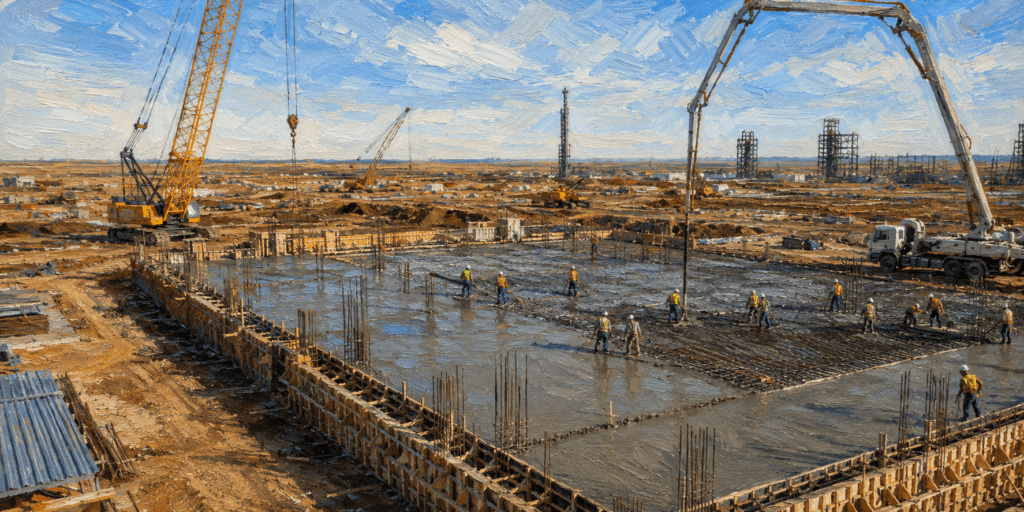
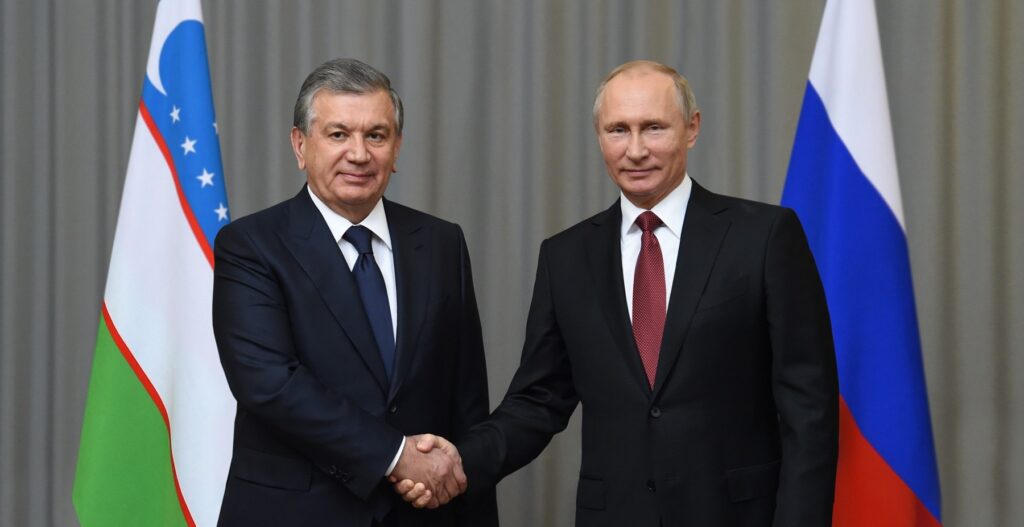
Uzbekistan has started building its first nuclear power plant, turning a project discussed for nearly a decade into one of the largest energy commitments in the country's post-Soviet history. President Shavkat Mirziyoyev and Russian President Vladimir Putin launched construction on June 4 by video link from Saint Petersburg. The plant site in the Forish district of the Jizzakh region was connected to the ceremony. Rafael Mariano Grossi, director general of the International Atomic Energy Agency, also took part. The first concrete pour began overnight from June 4 to June 5 for the foundation slab of the plant's first small modular unit. The first stage used 133 cubic meters of concrete. The full pour is expected to exceed 10,000 cubic meters. Uzatom gave the site the official status of a nuclear power plant under construction under IAEA standards. The plan is no longer the modest small-reactor scheme agreed in 2024. The current design combines two large VVER-1000 reactors with two smaller RITM-200N units. Together, they would give the Jizzakh plant more than 2.1 GW of installed capacity. The small and large units will share one site and supporting infrastructure. That shift raised both the scale and the financial and regulatory stakes. This design is the latest version of a plan that has changed several times. Uzbekistan and Russia signed an intergovernmental agreement on peaceful nuclear cooperation in 2017. In 2018, Rosatom was expected to build two VVER-1200 reactors. The focus later shifted to Jizzakh. In May 2024, Uzbekistan and Rosatom signed a contract for a 330 MW small nuclear plant with six RITM-200N reactors. The plan changed again in 2025, when Tashkent and Moscow settled on the larger mixed-reactor format now under construction. The timetable shows how long the project will take before Uzbekistan gets power from it. The first RITM-200N unit is listed for criticality in late 2029, with the two larger VVER-1000 reactors expected in 2033 and 2035. The push reflects Uzbekistan's fast-rising demand for power. The International Energy Agency says the country's 2020-2030 electricity concept aims to lift generation from 63.6 billion kWh to 120.8 billion kWh by 2030, while cutting gas use in power generation. Uzbekistan produced 86.7 billion kWh in 2025. Renewable power is growing, but officials want a steady baseload supply for industry and cities. Uzbek and Russian estimates put full annual output at about 17 billion kWh. Putin put the future share at up to 15% of Uzbekistan's electricity use, with Reuters also placing the expected contribution at around 15% of demand. Those figures depend on the timing of each unit and on future consumption, which is still rising. Financing is now one of the central questions. Uzatom director Azim Akhmedkhadjaev put the project's base price at $9.5 billion and described that figure as the maximum contract amount. The estimate does not include planned localization, which Uzbekistan wants to raise to 30%. Tashkent wants loans to cover 85-90% of the project and may discuss funding with the New Development Bank and other partners. Russia...

Mirziyoyev, Putin to Mark Launch of Uzbekistan Nuclear Plant Project

Uzbek President Shavkat Mirziyoyev will travel to St. Petersburg on June 4-5 for talks with Russian President Vladimir Putin and a ceremony marking the launch of Uzbekistan’s first integrated nuclear power plant project. Mirziyoyev is also due to address the 29th St. Petersburg International Economic Forum, according to the Uzbek president’s press service. Russian presidential aide Yuri Ushakov said the two leaders would join the launch ceremony by video link before holding talks at the Konstantinovsky Palace on the evening of June 4. The project has become one of the main energy initiatives in Uzbek-Russian cooperation. According to Russian officials, the planned facility in the Jizzakh region will include two large-capacity power units as well as two smaller units with a capacity of 55 megawatts each. The launch ceremony is expected to involve senior international and industry officials. Ushakov said that Rafael Grossi, director general of the International Atomic Energy Agency, Alexey Likhachev, director general of Rosatom, and Azim Akhmedkhadzhaev, head of Uzbekistan’s Uzatom agency, will participate from the construction site. Following remarks by the two presidents and Grossi, Russian and Uzbek nuclear officials are expected to report on technical readiness for the first concrete pouring at the site, formally launching construction work. The Times of Central Asia previously reported that initial concrete works began at the Jizzakh site in March, when Uzatom and Rosatom signed documents moving the project into practical implementation.

Uzbekistan Nuclear Project Could Bring Russia Orders Worth $22 Billion

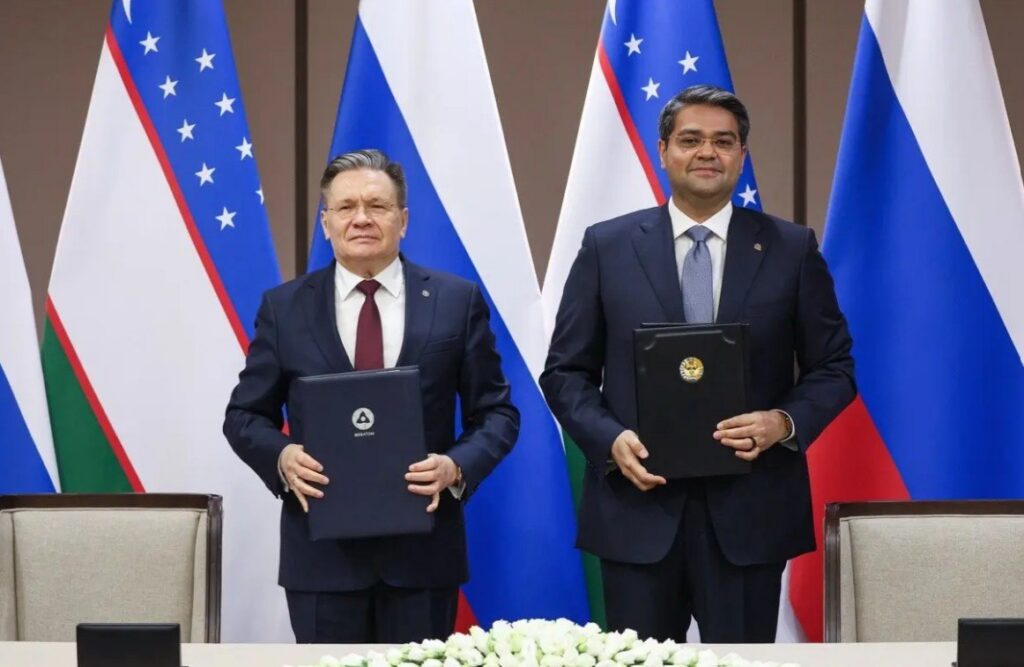
Uzbekistan’s first nuclear power plant, based on small modular reactor (SMR) technology, has entered a new phase, with initial construction, including concrete works, beginning at the site in the Farish district of the Jizzakh region on March 24. The project is part of Uzbekistan’s long-running plan to diversify its energy mix and reduce reliance on gas-fired power generation. The milestone was marked by parallel ceremonies held in Tashkent and at the construction site. During the events, Uzbekistan’s nuclear energy agency Uzatom and Russia’s state nuclear corporation Rosatom signed several key documents, formally advancing the project to the implementation stage. These included a cooperation roadmap covering nuclear and related sectors, as well as an addendum to the contract for building an integrated nuclear power facility in Uzbekistan. The documents were signed by Uzatom Director Azim Akhmedkhadjaev and Rosatom Director General Alexey Likhachev. Speaking to reporters, Likhachev said the project could also have significant economic benefits for Russia. According to the Russian news agency TASS, he stated that construction of even a small reactor unit at the Uzbek site could generate orders worth up to $22 billion for Russian companies. He added that the project could create around 1,000 jobs in Russia. Likhachev also outlined broader potential economic returns, saying that for every ruble invested during construction, up to 1.5 rubles could be returned to the Russian economy, rising to as much as two rubles during the plant’s operational phase.

Uzbekistan Launches First Concrete Works at Planned Nuclear Power Plant

Construction of Uzbekistan’s first nuclear power plant has entered a new phase, with initial concrete works officially launched at the project site in the Farish district of the Jizzakh Region, according to the country’s Atomic Energy Agency, Uzatom. The milestone was marked on March 24 during simultaneous ceremonies held in Tashkent and at the construction site. During the events, Uzatom and Russia’s state nuclear corporation Rosatom signed a number of strategic documents, formally advancing the project to the stage of practical implementation. Among the agreements were a cooperation roadmap covering nuclear and related sectors, as well as an addendum to the contract for the construction of an integrated nuclear power facility in Uzbekistan. The documents were signed by Uzatom Director Azim Akhmedkhadjaev and Rosatom Director General Alexey Likhachev. According to Uzatom, the roadmap outlines cooperation in areas such as project implementation phases, workforce training, public engagement on nuclear energy, and the development of infrastructure for a future town for plant personnel. Uzbek officials said the agreement establishes a comprehensive partnership expected to contribute to both economic and social development. At the construction site, work has begun on laying the concrete foundation beneath the reactor building for a small modular unit using the RITM-200N design. Approximately 900 cubic meters of concrete are scheduled to be poured, with this stage expected to be completed by April 2026. The foundation will incorporate the waterproofing and grounding systems required for the reactor structure. The updated configuration of the plant involves two large power units equipped with Generation III+ VVER-1000 reactors, as well as two smaller units using RITM-200N reactors, each with a capacity of 55 MW. Once fully operational, the facility is expected to generate around 15.4 billion kilowatt-hours of electricity annually, more than 15% of Uzbekistan’s current power consumption. Uzatom stated that regulatory approval for use of the site has already been granted following safety assessments that identified no significant risks related to seismic activity, tectonic faults, or karst formations. The agency said the location meets nuclear, environmental, and technical safety requirements. “The start of concrete works marks an important step in implementing Uzbekistan’s national nuclear energy program,” Akhmedkhadjaev said, adding that the project is proceeding in line with established timelines and safety standards. Separately, Uzatom confirmed that a mission from the International Atomic Energy Agency is expected to visit Uzbekistan in the second half of 2026 to assess progress on the project.

IAEA to Review Uzbekistan Nuclear Power Project in 2026

A mission from the International Atomic Energy Agency (IAEA) is expected to visit Uzbekistan in the second half of 2026 to assess progress on the country’s nuclear power plant project, according to Uzbekistan’s Atomic Energy Agency (Uzatom). Preparations for the visit were discussed during a meeting between Uzatom Director Azim Akhmedkhadjaev and IAEA Director General Rafael Grossi. Uzbek officials said the talks focused on expanding cooperation in nuclear energy and reviewing progress under a joint roadmap aimed at deepening collaboration. According to Uzatom, Grossi noted Uzbekistan’s efforts to develop nuclear energy in line with international standards and IAEA recommendations. He also referred to reforms carried out under President Shavkat Mirziyoyev that, in his view, have helped create the institutional conditions necessary for implementing the nuclear program. The planned follow-up Integrated Nuclear Infrastructure Review (INIR) mission is expected to evaluate preparations for the construction of Uzbekistan’s first nuclear power plant. The facility is planned to be built in the Farish district of Jizzakh Region. Uzbek officials said IAEA specialists will assess progress on key aspects of the project during the visit. Grossi reportedly described the mission as an important stage in the implementation of Uzbekistan’s nuclear energy plans. Discussions also addressed the next practical phase of the project, including the start of initial construction works at the site. According to Uzatom, the planned nuclear power complex is expected to combine both large and small reactor units. At the conclusion of the meeting, Grossi confirmed the IAEA’s readiness to continue supporting Uzbekistan’s nuclear energy program and accepted an invitation to attend events marking the launch of construction. The sides also discussed increasing the number of Uzbek specialists working in the IAEA Secretariat, which officials say could strengthen national expertise in the nuclear sector and expand participation in international projects. The Times of Central Asia previously reported that Belarus has expressed readiness to assist Uzbekistan in developing nuclear power capacity and training specialists, offering to share experience gained through cooperation with Russia.

Uzbekistan and Russia to Develop Nuclear Medicine Strategy Ahead of 2026 Center Opening

Uzbekistan will develop a roadmap and long-term strategy for the advancement of nuclear medicine, according to the press service of the Atomic Energy Agency under the Cabinet of Ministers, Uzatom. The announcement followed a working meeting held on February 10 at Uzatom to discuss prospects for expanding nuclear medicine in the country. The meeting brought together representatives of the Ministry of Health, the Healthcare Projects Center, the Committee for Industrial, Radiation and Nuclear Safety, the Institute of Nuclear Physics of the Academy of Sciences, the state enterprise Radiopreparat, leading medical centers, and experts from Rosatom’s engineering division, underscoring growing cooperation between Uzbekistan and Russia in the sector. During the discussions, the Russian side presented its experience in building modern nuclear medicine infrastructure, including cyclotron complexes, radiopharmaceutical production facilities, and PET/CT diagnostic centers, as well as implementing turnkey international projects. Following the talks, the parties agreed to jointly draft a roadmap and strategy that will provide a framework for technology transfer, specialist training, and improvements in healthcare services. The initiative is intended to strengthen early cancer diagnosis and expand access to advanced treatment methods based on nuclear technologies. The construction of a Nuclear Medicine Center in Tashkent has begun. The center is scheduled to be equipped in 2026 with PET/CT scanners, a cyclotron, a radiopharmaceutical laboratory, as well as Gamma Knife and CyberKnife systems. The broader program also involves upgrading oncology services, promoting early cancer detection, training medical personnel to international standards, and deepening cooperation with Russia and Rosatom. Uzatom stated that it will continue to support the introduction of advanced technologies aimed at improving access to modern cancer diagnostics and treatment. As previously reported by The Times of Central Asia, citing IQVIA data, Uzbekistan’s pharmaceutical market reached $2.14 billion in the twelve months to September 2025, reflecting continued expansion and rising demand for medical services.