
• KGS/USD = 0.01144 0%
  • KZT/USD = 0.00204 0%
  • TJS/USD = 0.10435 0%
  • UZS/USD = 0.00008 0%
  • TMT/USD = 0.28571 0%
  • KGS/USD = 0.01144 0%
  • KZT/USD = 0.00204 0%
  • TJS/USD = 0.10435 0%
  • UZS/USD = 0.00008 0%
  • TMT/USD = 0.28571 0%
  • KGS/USD = 0.01144 0%
  • KZT/USD = 0.00204 0%
  • TJS/USD = 0.10435 0%
  • UZS/USD = 0.00008 0%
  • TMT/USD = 0.28571 0%
  • KGS/USD = 0.01144 0%
  • KZT/USD = 0.00204 0%
  • TJS/USD = 0.10435 0%
  • UZS/USD = 0.00008 0%
  • TMT/USD = 0.28571 0%
  • KGS/USD = 0.01144 0%
  • KZT/USD = 0.00204 0%
  • TJS/USD = 0.10435 0%
  • UZS/USD = 0.00008 0%
  • TMT/USD = 0.28571 0%
  • KGS/USD = 0.01144 0%
  • KZT/USD = 0.00204 0%
  • TJS/USD = 0.10435 0%
  • UZS/USD = 0.00008 0%
  • TMT/USD = 0.28571 0%
  • KGS/USD = 0.01144 0%
  • KZT/USD = 0.00204 0%
  • TJS/USD = 0.10435 0%
  • UZS/USD = 0.00008 0%
  • TMT/USD = 0.28571 0%
  • KGS/USD = 0.01144 0%
  • KZT/USD = 0.00204 0%
  • TJS/USD = 0.10435 0%
  • UZS/USD = 0.00008 0%
  • TMT/USD = 0.28571 0%

Viewing results 1 - 6 of 10

Uzbek Citizen Evacuation Flights Continue from Middle East

More than 9,300 citizens of Uzbekistan had been evacuated from countries in the Middle East as of March 5. According to the press service of Uzbekistan’s Ministry of Foreign Affairs, between March 1 and 10:00 a.m. local time on March 5, a total of 9,361 Uzbek citizens safely returned home from several countries in the region. Officials said the largest number of evacuees arrived from Saudi Arabia, where 8,114 people were transported to Uzbekistan on both regular and specially arranged charter flights. Another 1,192 citizens have so far been repatriated from the United Arab Emirates. Smaller groups were also evacuated from other countries in the region, including 23 citizens from Iran, 25 from Bahrain, and seven from Oman. The ministry said the return of Uzbek nationals is being organized in a structured and phased manner. Officials added that evacuation operations are currently focused on countries whose airspace remains open to civilian flights, with additional flights to be arranged once airspace restrictions are lifted elsewhere in the region. Separately, Uzbekistan’s Ministry of Transport reported that by March 5 a total of 41 special flights had been carried out to bring citizens home from the Middle East. According to the ministry, several Uzbekistan-based airlines, including Uzbekistan Airways, Centrum Air, Qanot Sharq, Fly One Asia, Fly Khiva, and Air Samarkand, have been operating evacuation flights. These included routes from Jeddah and Medina in Saudi Arabia to Tashkent, Andijan, Namangan, Urgench, Qarshi, and Samarkand, as well as flights from Dubai to Tashkent. Transport officials said that 36 flights departing from Jeddah and Medina transported 7,988 passengers to Uzbekistan. An additional five flights from Dubai carried 838 people. Several flights were still operating at the time of the ministry’s latest update, including routes from Dubai and Jeddah to Tashkent and Samarkand. Authorities stated that the evacuation process is continuing step by step and urged Uzbek citizens abroad to remain calm, follow local laws, and rely only on official information issued by Uzbekistan’s diplomatic missions and government agencies.
Uzbekistan Airways Boeing 767 Makes Emergency Landing in Krasnoyarsk

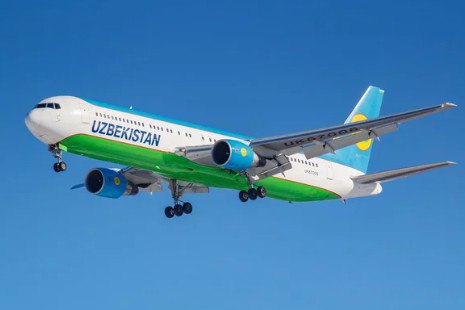
An Uzbekistan Airways Boeing 767 made an emergency landing at Russia’s Krasnoyarsk airport on January 21 while en route from Tashkent to Vladivostok, according to a statement published by Krasnoyarsk airport on its Telegram channel. The aircraft, a Boeing 767-300, was carrying 101 passengers, five flight crew members, and 16 cabin crew at the time of the incident. Airport authorities confirmed the plane landed safely. Passengers subsequently underwent border and customs procedures and were relocated to the airport’s general terminal area. The aircraft was temporarily taken out of service pending a technical inspection. Uzbekistan Airways was expected to dispatch a reserve aircraft to complete the journey to Vladivostok. Later that day, airport officials reported that the stranded passengers were transferred to local hotels and provided with meals. As of 17:45 local time, the reserve aircraft was expected to arrive early on January 22, with a scheduled departure shortly thereafter. A follow-up update confirmed that the replacement aircraft departed Krasnoyarsk at 7:11 a.m. on January 22. Uzbekistan Airways has not yet disclosed the technical issue that led to the emergency landing. This incident follows another serious aviation event earlier this month involving aircraft from Russia’s Pobeda Airlines and Uzbekistan Airways. On January 10, in the Shymkent regional airspace over southern Kazakhstan, Pobeda flight PBD997 from Moscow to Samarkand and Uzbekistan Airways flight UZB9609 from Termez to Moscow came into potential conflict. The incident was classified as serious under Kazakhstan’s aviation safety regulations and prompted a formal investigation, Kazinform reported.

Uzbekistan Airways Refutes Near-Collision Reports in Russian Airspace

Uzbekistan Airways has denied claims that one of its aircraft was involved in a near-collision with a private jet in Russian airspace, describing the reports inaccurate and misleading. The airline issued a statement in response to tabloid coverage in Russia alleging a serious aviation incident near Moscow’s Vnukovo International Airport. As previously reported by The Times of Central Asia, the incident allegedly occurred shortly after midnight on September 29 near Serpukhov, south of Moscow. Early accounts indicated that an Uzbekistan Airways Airbus A320 en route from Samarkand and an Embraer Legacy 650 business jet flying from Bodrum came within three kilometers horizontally and 700 feet vertically of each other—below international safety thresholds—due to a miscommunication over altitude clearance. Uzbekistan Airways has firmly rejected this version of events. In a statement from its press service, the airline stressed that its crew fully complied with all instructions from Moscow air traffic control and did not breach any flight regulations. “All altitude levels were maintained in accordance with the established rules and procedures, and the required separation between aircraft was preserved,” the statement read. The airline also clarified that the flight in question occurred on September 28, not September 29 as initially reported. It added that the aircraft’s onboard safety systems did not issue any alerts, and Moscow’s air traffic controllers made no objections or complaints about the crew’s actions. Uzbekistan Airways criticized several Russian media outlets for publishing what it described as unverified information, which was later reprinted by some Uzbek outlets without proper verification. “This created a misleading impression among readers,” the airline said. Reaffirming its commitment to international aviation standards, the company stated that flight safety remains its highest priority and that all crews operate in strict compliance with air traffic control instructions.

Billion-Dollar Agreements and a Boeing Deal: Inside Mirziyoyev’s Visit to New York

On September 20, President of Uzbekistan Shavkat Mirziyoyev arrived in New York to participate in events marking the 80th session of the UN General Assembly. At John F. Kennedy Airport, he was welcomed by Paolo Zampolli, Special Envoy of the U.S. President for Global Partnerships, Carolyn Lamm, Chair of the American-Uzbekistan Chamber of Commerce, and other officials. Finance and Critical Minerals Cooperation On September 22, Mirziyoyev held a series of high-level meetings with executives from leading corporations and international institutions. Uzbekistan is seeking to position itself as a reliable supplier in the global critical minerals chain. With reserves of copper, gold, uranium, and rare earths, officials have prioritized foreign partnerships to accelerate exploration and processing capacity, while also ensuring environmental and governance standards are met. In talks with IMF Managing Director Kristalina Georgieva, the two sides discussed expanding cooperation on monetary policy, statistical reform, and educational programs. Georgieva commended Uzbekistan’s economic reforms and reaffirmed the Fund’s support. A $1 billion package of initiatives was finalized with Traxys, the Colorado School of Mines, FLSmidth, McKinsey, and Go Green Partners. These projects focus on critical minerals mining and processing, alongside the creation of a Competence Center in Uzbekistan. Discussions with BlackRock board member Adebayo Ogunlesi centered on establishing a joint infrastructure fund. With Citigroup Chairman John Dugan, the president addressed IPOs of state-owned enterprises, Eurobond issuance, and trade finance mechanisms. Franklin Templeton CEO Jenny Johnson confirmed agreements related to the transformation of state-owned companies and the development of the Tashkent Stock Exchange. President Brian Friedman of the New York-based global investment banking and capital markets firm, Jefferies, meanwhile, expressed interest in helping attract strategic investors to Uzbekistan’s National Investment Fund. Franklin Templeton’s management of Uzbekistan’s $1.7 billion National Investment Fund signals growing trust in U.S. asset managers. Meanwhile, Jefferies’ potential involvement in attracting strategic investors highlights the rising role of global capital markets in Uzbekistan’s privatization and modernization agenda. NASDAQ CEO Adena Friedman discussed the modernization of the Tashkent Stock Exchange and the introduction of a government bond trading platform. Oppenheimer Holdings CEO Robert Lowenthal pledged support for Uzbekistan’s private sector and participation in Eurobond issuance. [caption id="attachment_36462" align="aligncenter" width="1280"] Image: president.uz[/caption] Strategic Agreements Signed A signing ceremony was held in the presence of President Mirziyoyev and U.S. Presidential Special Envoy Sergio Gor. Agreements were exchanged with Boeing, FLSmidth, Cleveland Clinic, Citigroup, Cargill, Pangea Filtration Technology, SLB, Biologic International, and others. During a meeting with WTO Director-General Ngozi Okonjo-Iweala, Mirziyoyev reaffirmed Uzbekistan’s commitment to aligning its legislation with international standards, with the goal of completing WTO accession by 2026. Uzbekistan’s WTO accession is being closely watched in Central Asia, as its success could set a precedent for other countries still outside the organization. For investors, WTO membership would mean greater legal predictability and integration into global trade frameworks. The president also met with Air Products CEO Eduardo Menezes. The company has already invested over $1 billion in Uzbekistan, with projects at the GTL plant, Ferghana Refinery, and “Navoiazot.” Both parties agreed to...
