

• KGS/USD = 0.01144 0%
  • KZT/USD = 0.00205 0%
  • TJS/USD = 0.10771 0%
  • UZS/USD = 0.00009 0%
  • TMT/USD = 0.28571 0.28%
  • KGS/USD = 0.01144 0%
  • KZT/USD = 0.00205 0%
  • TJS/USD = 0.10771 0%
  • UZS/USD = 0.00009 0%
  • TMT/USD = 0.28571 0.28%
  • KGS/USD = 0.01144 0%
  • KZT/USD = 0.00205 0%
  • TJS/USD = 0.10771 0%
  • UZS/USD = 0.00009 0%
  • TMT/USD = 0.28571 0.28%
  • KGS/USD = 0.01144 0%
  • KZT/USD = 0.00205 0%
  • TJS/USD = 0.10771 0%
  • UZS/USD = 0.00009 0%
  • TMT/USD = 0.28571 0.28%
  • KGS/USD = 0.01144 0%
  • KZT/USD = 0.00205 0%
  • TJS/USD = 0.10771 0%
  • UZS/USD = 0.00009 0%
  • TMT/USD = 0.28571 0.28%
  • KGS/USD = 0.01144 0%
  • KZT/USD = 0.00205 0%
  • TJS/USD = 0.10771 0%
  • UZS/USD = 0.00009 0%
  • TMT/USD = 0.28571 0.28%
  • KGS/USD = 0.01144 0%
  • KZT/USD = 0.00205 0%
  • TJS/USD = 0.10771 0%
  • UZS/USD = 0.00009 0%
  • TMT/USD = 0.28571 0.28%
  • KGS/USD = 0.01144 0%
  • KZT/USD = 0.00205 0%
  • TJS/USD = 0.10771 0%
  • UZS/USD = 0.00009 0%
  • TMT/USD = 0.28571 0.28%

Viewing results 1 - 6 of 2

Uzbekistan Moves Toward Investment Destination Status at Tashkent International Investment Forum

Uzbekistan’s capital markets are moving from promise to execution, and the National Investment Fund of the Republic of Uzbekistan (UzNIF) has become the clearest deal to show that shift. At the 5th Tashkent International Investment Forum, global investors, bankers, development finance institutions, and export credit agencies gathered gathered around one recurring message: Uzbekistan is no longer trying to convince the world that it is open for business. The challenge now is ensuring that investment momentum becomes sustainable and led by the private sector. During a panel discussion on political risk and blended finance, government officials and international investors debated how frontier markets can attract larger volumes of private capital while reducing reliance on public financing and multilateral support mechanisms. While the discussion focused on frontier markets, Uzbekistan was at the center of nearly every exchange. Jasur Karshibaev, advisor to the Minister of Economy and Finance of Uzbekistan, opened the session by outlining the government’s long-term ambitions. According to Karshibaev, Uzbekistan aims to double the size of its economy and reach upper-middle-income status by 2030. He argued that recent economic indicators suggest the country is moving in that direction despite a difficult global environment. [caption id="attachment_50612" align="aligncenter" width="1024"] Image: TCA[/caption] “The reforms under the leadership of the President of Uzbekistan are already bearing results,” he said, pointing to strong first-quarter economic growth and declining inflation. Karshibaev highlighted recent developments in the country’s sovereign credit profile. In June, Fitch Ratings affirmed Uzbekistan’s sovereign rating at BB and revised the outlook to positive. Yet despite this progress, he stressed that the government’s focus is shifting from public investment toward private capital mobilization. “We cannot base our success on fiscal intervention,” Karshibaev said. “It should be private-sector-led growth.” For Uzbekistan, attracting private investment is becoming more important as the economy expands faster than domestic savings can support. The country continues to seek foreign capital, but officials are increasingly focused on reducing the cost of accessing it. Karshibaev argued that one of the main challenges lies in the gap between perceptions of risk and economic realities. He noted that sovereign bond spreads have narrowed significantly and are approaching levels typically associated with investment-grade economies. However, some institutional risk assessments and country-risk classifications continue to reflect older perceptions. “International investors who vote with their cash are expecting a very positive credit trajectory,” he said. According to Karshibaev, risk assessments need to reflect economic fundamentals more accurately because inflated risk perceptions can raise financing costs and make blended finance instruments less competitive than commercial funding alternatives. He said the government is working closely with international financial institutions, including the Asian Development Bank and the World Bank, while pursuing reforms aimed at achieving investment-grade status before the end of the decade. [caption id="attachment_50614" align="aligncenter" width="1774"] Image: TCA[/caption] Investors also examined how frontier markets are evaluated in practice. Francis Malige, managing director and head of the Financial Institutions Business Group at the European Bank for Reconstruction and Development, argued that one of the biggest misconceptions about frontier markets stems...
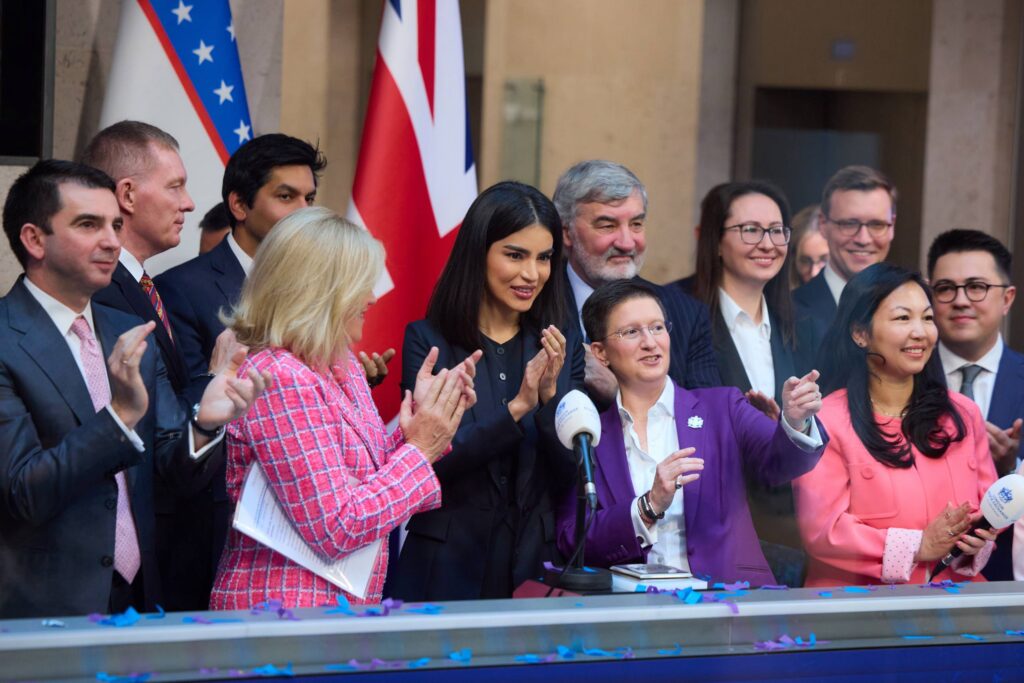

Uzbekistan Conducts First Dual IPO in London and Tashkent

Uzbekistan has completed its first international equity offering, as the state-backed National Investment Fund of Uzbekistan (UzNIF) began trading through a dual listing on the London Stock Exchange and the Tashkent Stock Exchange. UzNIF raised $603.6 million by selling a 31% stake to international and domestic investors. The proceeds could rise to about $692 million if an overallotment option is exercised in full, bringing the total stake sold to 35%. At the offer price, the fund was valued at about $1.95 billion. The offering was managed by Franklin Templeton, while cornerstone investors included funds and accounts managed by BlackRock, Franklin Resources, and Redwheel. The shares were sold by Uzbekistan’s Ministry of Economy and Finance, so the proceeds will go to the state rather than directly to the fund. The listing attracted more than $2.8 billion in investor demand. Julia Hoggett, chief executive of the London Stock Exchange, described UzNIF as the first international IPO from Uzbekistan and the largest IPO on the exchange’s markets so far this year. Saida Mirziyoyeva, head of Uzbekistan’s presidential administration, framed the transaction as part of the country’s effort to deepen capital-market reforms and draw long-term foreign investment. Speaking at the London Stock Exchange, she said the IPO was not only about raising capital, but also about building trust in a new generation of Uzbek institutions. “Uzbekistan has become a more open and reliable partner for the global capital market,” Mirziyoyeva wrote on Telegram. Uzbek officials say the country’s economy has nearly tripled in size in recent years, while investor protections and corporate governance standards have been strengthened. The listing comes as Uzbekistan intensifies efforts to position itself as a new investment destination in Central Asia. During a visit to London, Mirziyoyeva held talks with British officials, financial executives, and investors as Tashkent seeks to expand private-sector participation and develop plans linked to a proposed Tashkent International Financial Centre. Official figures show that British businesses have already invested more than $1 billion in Uzbekistan’s economy. Trading in London opened at $25 per global depositary receipt, with shares rising roughly 12% to $28 within the first hours of trading. On the domestic market, a separate tranche was made available through the Tashkent Stock Exchange, giving Uzbek investors access to a vehicle that had primarily been aimed at international institutions. UzNIF holds stakes in 13 state-linked companies in sectors including transport, energy, banking, telecommunications, utilities, and aviation. Its major holdings include Uzbekistan Airways, Uzbektelecom, Uzbekhydroenergo, and other infrastructure and energy operators. The fund was established in 2024 as part of Uzbekistan’s broader privatization and capital-market reform program. By grouping stakes in strategic state-owned enterprises into a single listed vehicle, the government is offering investors exposure to several parts of the Uzbek economy while retaining state control over the underlying assets. For Uzbekistan, the successful dual listing is a significant market-opening moment. It gives the government a benchmark for future privatizations, broadens access to Uzbek equities, and tests whether investor interest in the country’s reform story can be...