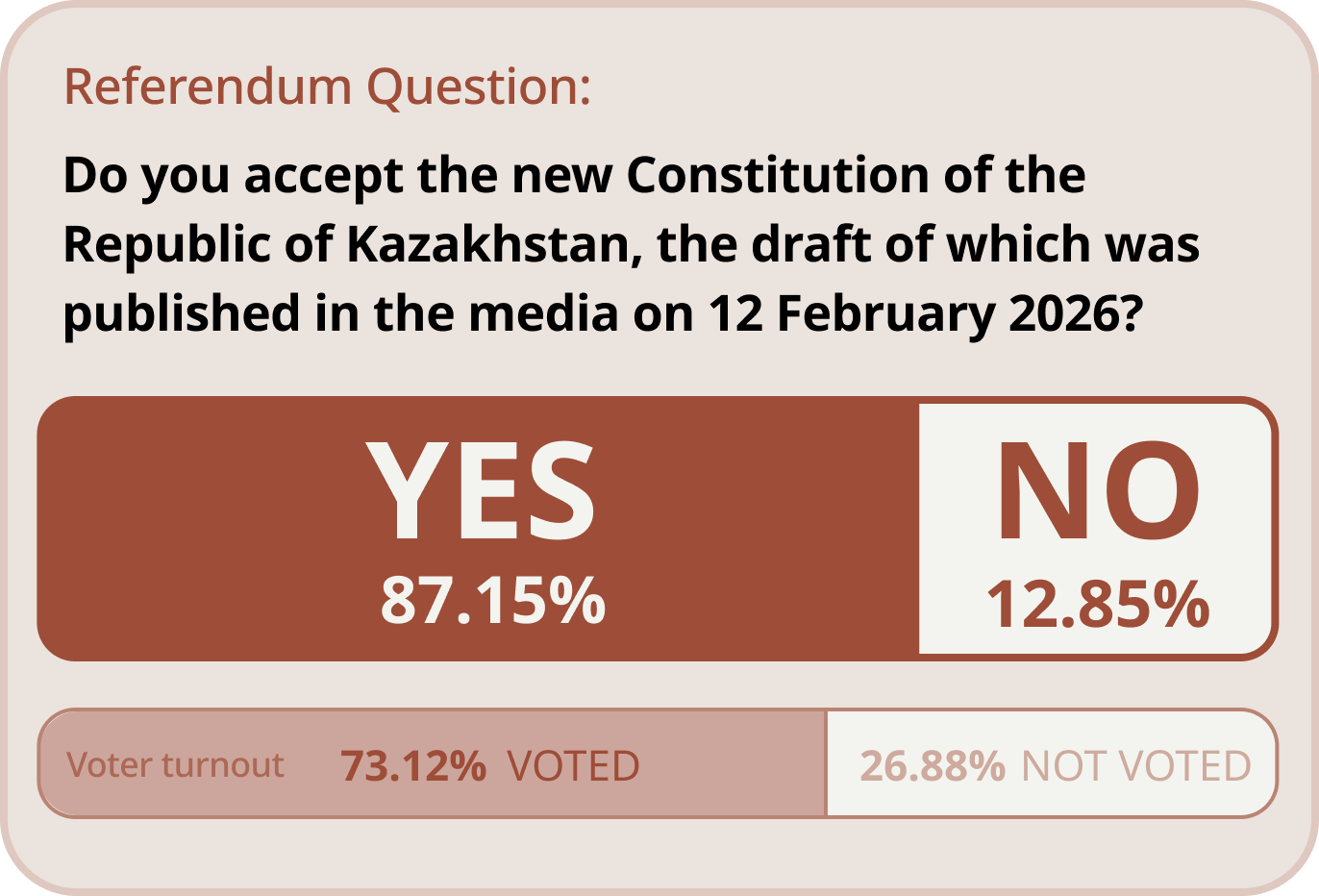
With three years remaining in his presidential term, President Kassym-Jomart Tokayev is leading the overhaul of a new constitution, with a nationwide referendum planned for 15 March. The draft is presented not as incremental reform but as a foundational recalibration of Kazakhstan’s political architecture—rebalancing state institutions, codifying a clear succession framework, and redefining the relationship between the state and society. If approved by referendum, the constitution would likely constitute Tokayev’s principal political legacy, embedding a more institutionalized, rules-based model of governance designed to endure beyond his presidency and shape Kazakhstan’s political trajectory for decades ahead.
Constitutional Evolution 1995 - Present
-
December 16
Independence and Statehood Declared
1991 -
January 28
First Constitution Post-Independence
1993 -
August 30
Second Constitution by Referendum
1995 -
2007 - 2017
Constitutional Amendments
2017 -
March 20
Leadership Transition
2019 -
September 01
Presidential Call for Political Modernization
2020 -
January 2
Nationwide Unrest
2022 -
March 16
“New Kazakhstan” Reform Agenda
2022 -
June 05
Constitutional Referendum
2022 -
September 20
Snap Presidential Election
2022 -
November 20
Tokayev Elected – 7 Year Term Begins
2022 -
2023 - 2024
Reform Implementation Phase
2024 -
Mid - Late
Drafting a New Constitution
2025 -
Jan - Feb
Public Debate on Draft Constitution
2026 -
March 15
Referendum on a New Constitutional Order
2026
Kazakhstan declares independence from the Soviet Union, formally establishing itself as a sovereign state and beginning the process of building its own political, legal, and economic institutions. This declaration ended Kazakhstan’s status as a Soviet republic and led to internationally recognized statehood with diplomatic relations and membership in global organizations.
The country adopts its first post‑independence Constitution, introducing a semi‑presidential framework and laying the initial foundations for governance in the new republic. This Constitution also established the legal basis for civil liberties and state structures in the early years of independence.
A new Constitution is approved through a nationwide referendum, consolidating executive authority and entrenching a super‑presidential system that defines the political order for decades. It also created a bicameral Parliament with the Mäjilis and Senate and enshrined core state principles.
A series of amendments strengthens presidential dominance while formally redistributing certain powers among parliament and government institutions, reshaping but not fundamentally altering the system. These revisions adjusted election terms, strengthened state administration, and aligned state bodies with evolving governance needs.
Following Nursultan Nazarbayev’s resignation, Kassym‑Jomart Tokayev assumes the presidency, marking the first transfer of power in independent Kazakhstan’s history. This transition initiated a new phase of policy emphasis and governance discourse after nearly three decades under one leader.
In his State of the Nation address, Presidient Tokayev outlines an agenda for political reform and institutional modernization, signaling a shift toward gradual systemic transformation that would later lead to substantive constitutional change.
Widespread protests and unrest expose deep governance challenges and legitimacy concerns, accelerating the urgency for structural political reforms. The unrest highlighted socio‑economic grievances and prompted government commitments to reform and dialogue.
President Tokayev announces a comprehensive democratic reform package aimed at redistributing powers, strengthening parliament, and reducing presidential authority as part of his “New Kazakhstan” initiative addressing calls for change after unrest.
Voters approve major constitutional amendments that limit presidential powers, enhance parliamentary roles, abolish special presidential privileges, and initiate a reconfiguration of the political system under the rubric of a “New Kazakhstan.”
An early presidential election is called under revised constitutional rules, reinforcing the transition toward a new institutional framework and giving President Tokayev a renewed public mandate for ongoing reforms.
Tokayev is re‑elected under new constitutional provisions establishing a single, non‑renewable seven‑year presidential term, aimed at providing stability while limiting extended personal rule.
Legislative and institutional changes are implemented, including electoral reforms, the registration of new political parties, and the restoration of the Constitutional Court to enhance checks and balances and citizen access to justice.
Authorities begin work on drafting an entirely new constitution, signaling a potential comprehensive reset of the country’s constitutional architecture and a shift from incremental amendment to systemic redesign. The process involves legal scholars, government officials, and institutional stakeholders tasked with reexamining the foundations of governance, the balance of powers, and the broader framework of national political organization.
The draft of the new constitution is published and opened to nationwide public consultation. Citizens, experts, and civil society actors participate in hearings, forums, and media debates, while feedback is submitted through official channels and reviewed by the constitutional commission to inform revisions before final adoption.
A nationwide referendum is scheduled to determine whether Kazakhstan will adopt a fully new constitution, potentially redefining the structure of state power and the long-term trajectory of its political development. The outcome of the vote could formalize sweeping institutional reforms, clarify executive–legislative relations, and establish a renewed constitutional mandate intended to guide the country’s governance framework for decades to come.
Kazakhstan’s Draft Constitution and the Reordering of State Authority
Kazakhstan’s current constitutional reform is no longer limited to parliamentary redesign. A draft updated basic law has been released for public discussion, and it presents the effort as a review of the state’s political architecture culminating in a nationwide referendum. The draft is described as the product of months of work initiated by President Kassym-Jomart Tokayev, with large-scale changes proposed for the country’s political system. ...
Cost of Holding Referendum on Kazakhstan’s New Constitution Estimated at $42 Million
The cost of holding a national referendum on the adoption of Kazakhstan’s new Constitution is preliminarily estimated at 20.8 billion tenge (KZT), or approximately $42 million at the current exchange rate. The figure was announced at a press conference by Mikhail Bortnik, a member of Kazakhstan’s Central Election Commission. According to Bortnik, the estimate is currently under review by the Ministry of Finance, and the final amount will be...
Opinion: Kazakhstan’s Constitutional Referendum – Strategic Reset or Institutional Consolidation?
Kazakhstan will hold a nationwide referendum on March 15 to adopt an entirely new constitution – an initiative President Kassym-Jomart Tokayev describes as a decisive break from the country’s super-presidential legacy. The draft, published on February 12 after deliberations by a Constitutional Commission, proposes far-reaching institutional reforms. Among the most notable changes are the replacement of the bicameral parliament with a unicamera...
Six Months to Rewrite the State: Kazakhstan Accelerates Its Constitutional Reset
Speaking on September 8, 2025, in his Address to the People of Kazakhstan in Parliament, President Kassym-Jomart Tokayev outlined plans for new political reforms. At the time, nothing in his remarks suggested either the scale of the changes his initiative would entail or the speed with which they would be implemented. Yet on March 15 of this year, Kazakh citizens will vote in a referendum on a new draft Constitution, developed at high speed ov...
Kazakhstan To Hold Referendum on New Constitution On March 15
Kazakhstan will hold a constitutional referendum on March 15 in what President Kassym-Jomart Tokayev has described as “a complete reboot” to modernize government and introduce more institutional accountability. The date of the referendum was announced in a notice that was published on the presidential website on Wednesday. It said the draft of the proposed new constitution will appear in the media on Thursday, and the question to be pose...
Tokayev Proposes a New Constitutional Architecture
In mid-January 2026, President Kassym-Jomart Tokayev moved Kazakhstan’s parliamentary reform agenda onto a deeper constitutional track. He framed the emerging package as comparable, in substance, to adopting a new constitution rather than making a bounded set of amendments. He also presented it as a further move away from the institutional logic of the 1995 framework and as the logical next step after the 2022 referendum changes, with the legi...
Tokayev Unveils Major Political Reforms as Kazakhstan Moves to Replace the National Kurultai
The fifth and final session of the National Kurultai in Kazakhstan, held on January 20, marked the announcement of plans to dismantle and replace two key institutions: the National Kurultai and the Assembly of the People of Kazakhstan, structures that have played central roles in the country’s civic dialogue, particularly over the past three decades. In a sweeping address, President Kassym-Jomart Tokayev declared that these legacy institutions...
Tokayev Floats Vice President Post at National Kurultai as Kazakhstan Weighs Political Overhaul
President Kassym-Jomart Tokayev used the fifth session of Kazakhstan’s National Kurultai on January 20 to propose creating a vice president’s post and embedding the new institution in the constitution, as part of a broader package of political reforms aimed at reshaping the country’s system of governance. Under the proposal, the vice president would be appointed by the president and confirmed by parliament by a simple majority vote. The pre...
Kazakhstan Debates Parliamentary Reform as Inflation Pressures Living Standards
The Kazakh government is actively developing the framework for a future unicameral parliament, working to define its status, powers, and functions. Currently, Kazakhstan’s legislative branch consists of two chambers: the Senate and the Mazhilis. The proposed transition to a unicameral system has been positioned by authorities as a step toward democratization. However, many citizens remain unclear about the details and implications of the r...
Tokayev Signals End of Presidential Appointments in Unicameral Parliament Plan
President Kassym-Jomart Tokayev has announced that Kazakhstan’s planned transition to a unicameral parliament will eliminate the presidential quota for appointing members of the legislature. The reform, Tokayev has said, is part of a broader effort to streamline the structure of parliament and enhance its professional capacity. The proposal to move to a single-chamber legislature was first introduced in Tokayev’s September address to the na...
Kazakhstan Weighs a Unicameral Future: Tokayev’s Call to Scrap the Senate
One of the most debated elements of President Kassym-Jomart Tokayev’s annual address to the nation was his proposal for sweeping parliamentary reform. Tokayev suggested a return to a unicameral legislature, mirroring the single-chamber Supreme Council of the early post-independence years. “I personally had the honor of leading the Senate for ten years, and I have always regarded this work as a great privilege and responsibility,” Tokayev st...
-
December 16
Independence and Statehood Declared
1991Kazakhstan declares independence from the Soviet Union, formally establishing itself as a sovereign state and beginning the process of building its own political, legal, and economic institutions. This declaration ended Kazakhstan’s status as a Soviet republic and led to internationally recognized statehood with diplomatic relations and membership in global organizations.
-
January 28
First Constitution Post-Independence
1993The country adopts its first post‑independence Constitution, introducing a semi‑presidential framework and laying the initial foundations for governance in the new republic. This Constitution also established the legal basis for civil liberties and state structures in the early years of independence.
-
August 30
Second Constitution by Referendum
1995A new Constitution is approved through a nationwide referendum, consolidating executive authority and entrenching a super‑presidential system that defines the political order for decades. It also created a bicameral Parliament with the Mäjilis and Senate and enshrined core state principles.
-
2007 - 2017
Constitutional Amendments
2017A series of amendments strengthens presidential dominance while formally redistributing certain powers among parliament and government institutions, reshaping but not fundamentally altering the system. These revisions adjusted election terms, strengthened state administration, and aligned state bodies with evolving governance needs.
-
March 20
Leadership Transition
2019Following Nursultan Nazarbayev’s resignation, Kassym‑Jomart Tokayev assumes the presidency, marking the first transfer of power in independent Kazakhstan’s history. This transition initiated a new phase of policy emphasis and governance discourse after nearly three decades under one leader.
-
September 01
Presidential Call for Political Modernization
2020In his State of the Nation address, Presidient Tokayev outlines an agenda for political reform and institutional modernization, signaling a shift toward gradual systemic transformation that would later lead to substantive constitutional change.
-
January 2
Nationwide Unrest
2022Widespread protests and unrest expose deep governance challenges and legitimacy concerns, accelerating the urgency for structural political reforms. The unrest highlighted socio‑economic grievances and prompted government commitments to reform and dialogue.
-
March 16
“New Kazakhstan” Reform Agenda
2022President Tokayev announces a comprehensive democratic reform package aimed at redistributing powers, strengthening parliament, and reducing presidential authority as part of his “New Kazakhstan” initiative addressing calls for change after unrest.
-
June 05
Constitutional Referendum
2022Voters approve major constitutional amendments that limit presidential powers, enhance parliamentary roles, abolish special presidential privileges, and initiate a reconfiguration of the political system under the rubric of a “New Kazakhstan.”
-
September 20
Snap Presidential Election
2022An early presidential election is called under revised constitutional rules, reinforcing the transition toward a new institutional framework and giving President Tokayev a renewed public mandate for ongoing reforms.
-
November 20
Tokayev Elected – 7 Year Term Begins
2022Tokayev is re‑elected under new constitutional provisions establishing a single, non‑renewable seven‑year presidential term, aimed at providing stability while limiting extended personal rule.
-
2023 - 2024
Reform Implementation Phase
2024Legislative and institutional changes are implemented, including electoral reforms, the registration of new political parties, and the restoration of the Constitutional Court to enhance checks and balances and citizen access to justice.
-
Mid - Late
Drafting a New Constitution
2025Authorities begin work on drafting an entirely new constitution, signaling a potential comprehensive reset of the country’s constitutional architecture and a shift from incremental amendment to systemic redesign. The process involves legal scholars, government officials, and institutional stakeholders tasked with reexamining the foundations of governance, the balance of powers, and the broader framework of national political organization.
-
Jan - Feb
Public Debate on Draft Constitution
2026The draft of the new constitution is published and opened to nationwide public consultation. Citizens, experts, and civil society actors participate in hearings, forums, and media debates, while feedback is submitted through official channels and reviewed by the constitutional commission to inform revisions before final adoption.
-
March 15
Referendum on a New Constitutional Order
2026A nationwide referendum is scheduled to determine whether Kazakhstan will adopt a fully new constitution, potentially redefining the structure of state power and the long-term trajectory of its political development. The outcome of the vote could formalize sweeping institutional reforms, clarify executive–legislative relations, and establish a renewed constitutional mandate intended to guide the country’s governance framework for decades to come.