• KGS/USD = 0.01144 0%
  • KZT/USD = 0.00217 0%
  • TJS/USD = 0.10456 0%
  • UZS/USD = 0.00008 0%
  • TMT/USD = 0.28571 0%
  • KGS/USD = 0.01144 0%
  • KZT/USD = 0.00217 0%
  • TJS/USD = 0.10456 0%
  • UZS/USD = 0.00008 0%
  • TMT/USD = 0.28571 0%
  • KGS/USD = 0.01144 0%
  • KZT/USD = 0.00217 0%
  • TJS/USD = 0.10456 0%
  • UZS/USD = 0.00008 0%
  • TMT/USD = 0.28571 0%
  • KGS/USD = 0.01144 0%
  • KZT/USD = 0.00217 0%
  • TJS/USD = 0.10456 0%
  • UZS/USD = 0.00008 0%
  • TMT/USD = 0.28571 0%
  • KGS/USD = 0.01144 0%
  • KZT/USD = 0.00217 0%
  • TJS/USD = 0.10456 0%
  • UZS/USD = 0.00008 0%
  • TMT/USD = 0.28571 0%
  • KGS/USD = 0.01144 0%
  • KZT/USD = 0.00217 0%
  • TJS/USD = 0.10456 0%
  • UZS/USD = 0.00008 0%
  • TMT/USD = 0.28571 0%
  • KGS/USD = 0.01144 0%
  • KZT/USD = 0.00217 0%
  • TJS/USD = 0.10456 0%
  • UZS/USD = 0.00008 0%
  • TMT/USD = 0.28571 0%
  • KGS/USD = 0.01144 0%
  • KZT/USD = 0.00217 0%
  • TJS/USD = 0.10456 0%
  • UZS/USD = 0.00008 0%
  • TMT/USD = 0.28571 0%

Viewing results 1045 - 1050 of 3223

Central Asia’s Economic Growth to Reach 5% in 2025

The World Bank’s Global Economic Prospects report offers projections for economic growth, risks, and challenges across Europe and Central Asia (ECA), highlighting mixed outcomes for the region as a whole. Regional Outlook Economic growth across ECA is projected to slow to 2.5% in 2025, with a modest recovery to 2.7% expected in 2026. This deceleration is largely attributed to weaker economic activity in Russia and Turkey, two key regional economies. Excluding these two countries and Ukraine, growth in the rest of the region is forecasted to average 3.3% in 2025-2026. The recovery in these areas will primarily be driven by private consumption and investment, as inflationary pressures ease and monetary policies gradually become less restrictive. Despite these projections, significant risks remain. Global policy uncertainty and potential changes in trade policies could negatively affect trade flows, capital investments, and economic growth. Geopolitical tensions - particularly stemming from Russia’s invasion of Ukraine - and persistent inflation in the region could also pose serious challenges to stability. Central Asia: A Bright Spot Central Asia is expected to outperform the broader ECA region, with growth projected to accelerate to 5% in 2025 before softening to 4.2% in 2026. This growth will be driven by increased oil production in Kazakhstan, which will serve as a critical engine of recovery for the region. Remittances will also continue to play a key role, particularly for Kyrgyzstan and Tajikistan. These inflows provide vital support to household consumption and help improve current account balances. However, international sanctions on Russia and financial restrictions on cross-border transfers could push some remittance flows into informal channels, potentially limiting their economic impact. Long-Term Challenges While short-term recovery appears promising, the ECA region’s long-term growth potential remains subdued. Between 2022 and 2030, annual growth is projected to average just 3.0%, down from 3.6% in the previous decade. Several factors contribute to this slowdown, including labor shortages caused by low workforce participation rates, aging populations, and significant emigration, particularly from the Western Balkans. Education remains a critical area for improvement. Although ECA boasts relatively strong educational systems, issues such as declining quality in higher education and ongoing brain drain have hindered human capital development. Addressing these issues and improving education systems could help the region move closer to high-income economies in the long term. Conclusion While Central Asia’s projected growth for 2025 presents an optimistic outlook, the region - and ECA as a whole - faces significant headwinds. Structural challenges, geopolitical instability, and demographic pressures will require governments to adopt forward-looking policies to sustain growth and promote resilience. As inflation cools and monetary policies ease, targeted investments in education and workforce development could unlock new opportunities for long-term economic stability.


Kazakhstan Ends Era of Cheap Fuel: Price Controls Set for Abolition

On January 17, the Ministry of Energy of the Republic of Kazakhstan published a number of draft orders on the Open NLA (normative legal acts) portal, which were to be discussed within five days. In total, the Ministry proposed the abolition of eleven orders regulating wholesale and retail prices for petroleum products, which have been under price control since 2014. In addition, it intends to change the calculation formulas and price ceilings for wholesale and retail sales of liquefied and natural gas. I have been writing about the need for price liberalization since 2018, as seen in articles such as “#Kazneft, part 2: The Bermuda Gasoline Triangle - Why Prices Will Rise” and “#Kazneft, part 4: We Rank Seventh in the World for the Cheapest Gasoline. Is It Sold at a Loss?” This is a landmark event for the Government of Kazakhstan, which has long maintained not only the lowest fuel prices in the region but some of the lowest globally. The country consistently ranks among the top ten nations with the cheapest energy resources, including fuel, natural gas, coal, and electricity.   Cheap and Even Cheaper According to Global Petrol Prices, as of January 20, 2025, fuel prices per liter in dollar terms across the EAEU, CIS, and neighboring countries are as follows: (Table 1) Country RON-95 Diesel Turkmenistan 0,43 0,29 Kazakhstan 0,47 0,55 Russia 0,61 0,71 Azerbaijan 0,65 0,59 Belorussia 0,75 0,75 Kyrgyzstan 0,81 0,81 Afghanistan 0,83 0,83 Uzbekistan 0,99 0,95 Georgia 1,09 1,06 China 1,15 1,02 Ukraine 1,39 1,37 Mongolia 1,49 1,19 Kazakhstan ranks seventh globally for the affordability of RON-95 gasoline, trailing behind Angola, Egypt, Algeria, Kuwait, Turkmenistan, and Malaysia. At the same time, there are “throwaway” prices in Iran, Libya, and Venezuela, but these price indicators do not reflect the actual availability of fuel in these countries. Turkmenistan also shows relatively low fuel prices, primarily due to the use of alternative fuels, such as methane, in transportation. Kazakhstan has historically had nearly double the price gap compared to its neighboring countries, which has facilitated the shadow export of fuel despite an official ban on exporting petroleum products.   A Leaky Bucket I have described Kazakhstan's domestic fuel market as a "leaky bucket"— no matter how much fuel is produced, it is constantly in short supply. In 2024, the country processed about 18 million tons of oil, with its three major refineries — Atyrau: 99% owned by the national company KazMunayGas (KMG), Shymkent: 51% owned by China National Petroleum Corporation (CNPC), and 49% by KMG, and Pavlodar: 100% KMG — accounting for approximately 17 million tons. Mini-refineries produced an additional one million tons. The production of petroleum products (excluding fuel oil) amounted to around 14.5 million tons.   The balance of petroleum products for 2025 is as follows, million tons: (Table 2) Product Production in the Republic of Kazakhstan Import from Russia Import to production, % RON-92, RON-95, RON-98 5,0 0,29 6 % Diesel fuel 5,1 0,45 9 % Jet fuel 0,75 0,3 40 % Bitumen/tar 1,1 0,50 45 % For 2025,...

Kazakhstan’s Digital Exports Expand

Kazakhstan exported $471 million worth of IT services to 95 countries during the first nine months of last year, according to Zhaslan Madiyev, Minister of Digital Development, Innovation and Aerospace Industry (MDDIAI). The primary driver of export revenue in Kazakhstan's IT services market is Astana Hub, the largest international technology park for IT startups in Central Asia, located in the country's capital. Astana Hub is home to over 1,500 companies, including 400 international firms. In 2024, its total revenue reached 620 billion KZT ($1.1 billion), with export revenue amounting to 227 billion KZT ($428 million) across 92 countries. Additionally, the products of JSC "National Information Technologies" (NIT JSC), the operator of Kazakhstan’s “e-government” infrastructure, have also entered global markets. According to Madiyev, NIT JSC’s main exported products include Smart Data Ukimet, Smart Bridge, and Gov.kz: Smart Data Ukimet: An information-analytical platform designed for the secure collection, storage, and analysis of data from government information systems. Smart Bridge: A platform that simplifies integration processes between government agencies and private businesses through a "service showcase" model. Gov.kz: A unified platform for the online resources of government agencies. The export of Kazakhstan’s digital public services (GovTech) reached $2.7 million, with these solutions currently supplied to Tajikistan, Togo, and Sierra Leone. In addition to GovTech, Kazakhstan’s IT exports also include software, computer games, fintech solutions, and marketplaces. Among the largest exporters are five software developers, three computer game companies, one fintech firm, and one marketplace. “Most of the major exporters are foreign companies that have relocated to Kazakhstan, creating new jobs in major cities and regions, as well as contributing to export revenue,” said Madiyev. Kazakhstan has made significant strides in developing its IT infrastructure. The country now boasts 20 regional IT hubs that work closely with Astana Hub, fostering innovation across the nation. Furthermore, Kazakhstan is establishing an international network of IT hubs by opening IT offices in the United States, Saudi Arabia, Singapore, and the United Kingdom. “Kazakhstani startups now have foreign infrastructure to attract investment and expand their export markets,” said Madiyev. The minister also announced the launch of a fund of venture capital funds under the jurisdiction of the International Financial Center Astana (MFCA), based at Astana Hub. This fund, with an expected capital of $1 billion, will finance IT startups in Kazakhstan. As previously reported by The Times of Central Asia, Kazakhstan is home to 12 regional IT hubs that are actively contributing to the country’s growing digital economy.

Kyrgyzstan’s Keremet Bank Restricts Use of Visa Cards Following U.S. Sanctions

Keremet Bank, a commercial bank in Kyrgyzstan recently subjected to U.S. sanctions, has announced new restrictions on the use of its Visa cards. The announcement was issued through the bank’s press service. As per the official statement, Visa cards issued by Keremet Bank can now only be used at the bank's ATMs, POS terminals, and other payment devices. To provide customers with an alternative, the bank is offering free issuance of cards under the national payment system, Elkart. The process for obtaining an Elkart card will take up to five working days in Bishkek and up to ten days in other regions. The bank reassured its clients that their funds remain secure. Customers can withdraw money at the nearest branch by presenting a valid passport or transferring funds through the mobile application to Elkart cards or settlement accounts. The U.S. Treasury Department imposed sanctions on Keremet Bank, citing alleged ties to Russian authorities and collaboration with Promsvyazbank, a Russian financial institution that has been under U.S. restrictions since 2022.

Uzbekistan’s Foreign Trade Turnover Grows by 3.8% in 2024

Uzbekistan’s foreign trade turnover (FTT) reached $65.9 billion in 2024, reflecting an increase of $2.4 billion, or 3.8%, compared to the previous year, according to the Statistics Agency under the President of the Republic of Uzbekistan. Exports totaled $26.95 billion, an 8.4% increase year-on-year, while imports amounted to $38.99 billion, representing a modest rise of 0.8%. China and Russia remain Uzbekistan’s top trading partners, with Kazakhstan emerging as a key partner in third place. Uzbekistan conducts trade with 198 countries, with China accounting for 18.9% of its FTT, followed by Russia (17.6%), Kazakhstan (6.5%), Turkey (4.5%), and South Korea (3.0%). Trade with state members of the Eurasian Economic Union (EAEU) reached $17.5 billion in 2024. Of this, $5.83 billion came from exports, while imports amounted to $11.66 billion. In 2024, natural gas trade played a significant role in Uzbekistan’s foreign trade activities. The country exported $628 million worth of gas but imported $1.68 billion worth, more than 2.5 times the value of its exports. Gas imports rose sharply, increasing 2.4 times compared to 2023. Purchases of natural gas from Turkmenistan and Russia surged from $694.9 million in 2023 to $1.68 billion in 2024.

Kazakhstan Aims to Boost Agricultural Exports to Russia

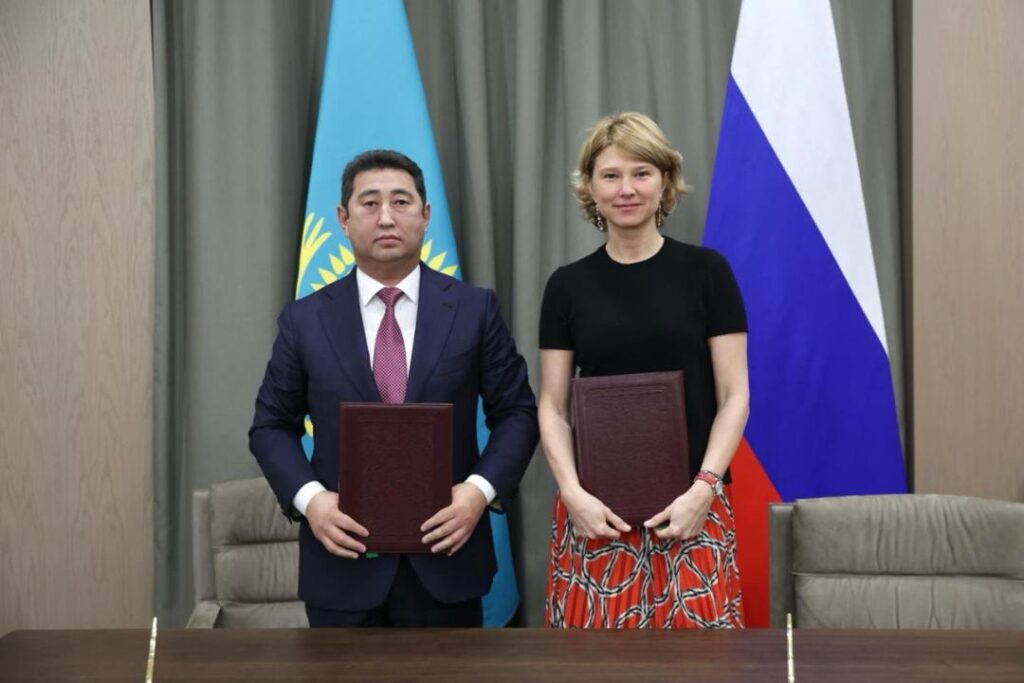
Kazakhstan is seeking to expand its agricultural exports to Russia as part of efforts to strengthen bilateral trade ties. On January 21, Minister of Agriculture Aidarbek Saparov met with his Russian counterpart Oksana Lut in Moscow to discuss lifting restrictions on the import and transit of agricultural products. Trade turnover in agricultural goods between the two countries reached $3.4 billion from January to November 2024, marking a 4.3% increase compared to the same period in the previous year. According to Saparov, Russia remains Kazakhstan's largest trading partner in the agricultural sector. Over the first 11 months of 2024, Kazakhstan’s agricultural exports to Russia totaled $502.9 million. “Kazakhstan is interested in increasing the presence of its agricultural products on the Russian market,” Saparov said. In recent months, both countries have made progress in easing trade restrictions. Kazakhstan has lifted all restrictions on Russian agricultural products, while Russia this month removed temporary bans on tomato imports from 36 Kazakh enterprises. Discussions are ongoing to further relax restrictions on the import and transit of Kazakh livestock and plant products. The Moscow meeting concluded with the signing of an action plan to enhance Russian-Kazakh agro-industrial cooperation. Key elements of the plan include: Preparing a joint project to establish an agrobiotechnopark. Creating a favorable framework for mutual food supplies. Finalizing the integration of veterinary and phytosanitary control information systems. These measures are expected to strengthen agricultural trade between the two countries and support the development of new joint projects in the agro-industrial sector.