
• KGS/USD = 0.01144 0%
  • KZT/USD = 0.00214 0%
  • TJS/USD = 0.10508 0%
  • UZS/USD = 0.00008 0%
  • TMT/USD = 0.28490 0%
  • KGS/USD = 0.01144 0%
  • KZT/USD = 0.00214 0%
  • TJS/USD = 0.10508 0%
  • UZS/USD = 0.00008 0%
  • TMT/USD = 0.28490 0%
  • KGS/USD = 0.01144 0%
  • KZT/USD = 0.00214 0%
  • TJS/USD = 0.10508 0%
  • UZS/USD = 0.00008 0%
  • TMT/USD = 0.28490 0%
  • KGS/USD = 0.01144 0%
  • KZT/USD = 0.00214 0%
  • TJS/USD = 0.10508 0%
  • UZS/USD = 0.00008 0%
  • TMT/USD = 0.28490 0%
  • KGS/USD = 0.01144 0%
  • KZT/USD = 0.00214 0%
  • TJS/USD = 0.10508 0%
  • UZS/USD = 0.00008 0%
  • TMT/USD = 0.28490 0%
  • KGS/USD = 0.01144 0%
  • KZT/USD = 0.00214 0%
  • TJS/USD = 0.10508 0%
  • UZS/USD = 0.00008 0%
  • TMT/USD = 0.28490 0%
  • KGS/USD = 0.01144 0%
  • KZT/USD = 0.00214 0%
  • TJS/USD = 0.10508 0%
  • UZS/USD = 0.00008 0%
  • TMT/USD = 0.28490 0%
  • KGS/USD = 0.01144 0%
  • KZT/USD = 0.00214 0%
  • TJS/USD = 0.10508 0%
  • UZS/USD = 0.00008 0%
  • TMT/USD = 0.28490 0%

Viewing results 463 - 468 of 3237

Kazakhstan’s Central Bank Raises Base Rate to 18% Amid Surging Inflation

The Monetary Policy Committee of the National Bank of Kazakhstan has raised the base rate to 18% per annum, with a corridor of +/- 1 percentage point, in an effort to contain accelerating inflation and stabilize macroeconomic conditions. "The easing of monetary conditions amid accelerating inflation, signs of demand outpacing supply growth, and an active fiscal policy required a significant response to stabilize inflation dynamics and prevent the risk of an inflationary spiral," the central bank said in a statement. According to the National Bank, inflation in Kazakhstan is rising across all major components. Annual inflation reached 12.9% in September, surpassing expectations. Food prices remain the primary contributor (up 12.7%), while non-food inflation is also accelerating (10.8%). "Inflation expectations among the population over a 12-month horizon remain elevated and volatile, with continued uncertainty in assessments. Market professionals have revised their inflation forecasts for the year from 11.3% to 12%. External inflationary pressure remains persistent. Risks are mounting, especially from global food markets, where record price increases have been observed in categories such as meat and vegetable oils. These dynamics, coupled with active exports, are feeding into higher domestic prices," the statement noted. In response to inflation exceeding projections, the Committee opted to tighten monetary policy by raising the base rate. It also signaled that further tightening may be considered if current measures prove insufficient. Economists are raising concerns as the country enters what they describe as a "phase of expensive money." According to a recent report by the Analytical Center of the Association of Financiers of Kazakhstan (AFK), banks are hiking interest rates, margins are narrowing, and access to credit for both households and businesses is declining. After a local peak of 7.1% in the first quarter of 2025, the real interest rate dropped sharply to 3.6%. With the base rate held steady, rising inflation eroded returns on tenge-denominated assets and weakened incentives for investment. The combination of a spring rate hike and rising inflation has hit deposit rates the hardest, which are growing faster than lending rates. The spread between corporate loan and deposit rates fell from 4.1% to 3.6%, while the spread for retail products narrowed from 7.8% to 6.7%. "Banks are operating under conditions of rising funding costs. The cost of attracting funds is increasing, while returns on loans are not keeping pace. This is squeezing margins and prompting banks to adopt a more cautious lending policy," the AFK report stated. The Times of Central Asia previously reported that inflation continues to exceed official forecasts. In August, annual inflation stood at 12.2%, and it is projected to reach 14% by the end of 2025, well above the National Bank's target range of 5-6%. Economists point to Kazakhstan’s reliance on imports, including food, fuel, medicine, equipment, and consumer goods, as a key driver of inflation. Wage and pension growth have failed to keep up with rising prices.
Kazakhstan and Germany Partner on Sustainable Water Management

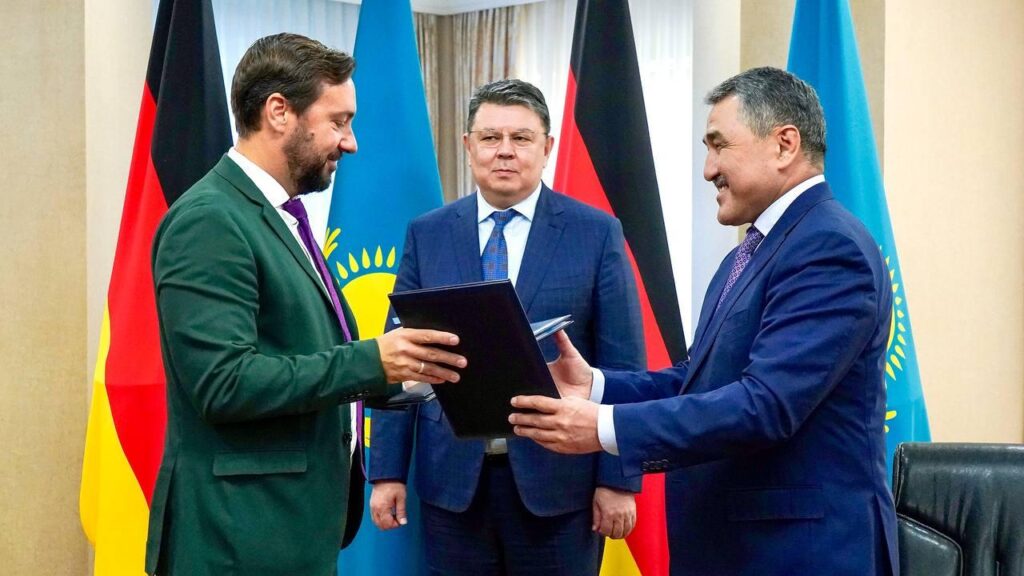
Kazakhstan’s Ministry of Water Resources and Irrigation and the German Water Partnership (GWP) signed a Strategic Partnership Agreement on October 8 aimed at enhancing bilateral cooperation in sustainable water management. The agreement will allow Kazakhstan to adopt international best practices and advanced water-saving technologies, strengthen climate resilience in the water sector, improve flood and drought response, and expand training for water-sector professionals. GWP is Germany’s leading water-sector network with a strong international focus. It brings together around 300 companies, trade associations, and institutions from business, science, and research. German expertise is already contributing to Kazakhstan’s digital projects in water resource forecasting, modeling, and accounting. German technologies are also being used in the construction of hydraulic infrastructure across the country. Following the signing, Deputy Prime Minister Kanat Bozumbayev and GWP Managing Director Boris Greifeneder discussed plans to deepen cooperation. One key proposal was the establishment of a Kazakh-German Water Innovation Hub, to be housed at the Information and Analytical Center of the Ministry of Water Resources and Irrigation, with GWP’s support. In a related initiative, the Kazakh-German University (DKU), the National Academy of Sciences of Kazakhstan, and the Kazakh National Agrarian Research University, supported by Germany’s Hanns Seidel Foundation, recently launched a new scientific and educational hub: the Kazakh-German Nexus Institute. Headquartered in Almaty, the Nexus Institute will focus on developing evidence-based policies for sustainable land and water use in Central Asia. Water resource management remains a critical priority for Kazakhstan, particularly in the country’s arid southern regions where agriculture depends heavily on efficient irrigation systems.

World Bank: Central Asia to Lead Regional Growth in 2025 Despite Global Slowdown

Economic growth in Europe and Central Asia (ECA) is slowing but remains resilient amid global and regional challenges, according to the World Bank’s latest Europe and Central Asia Economic Update: Jobs and Prosperity, released on October 7, 2025. The report projects GDP growth in the region at 2.4% in real terms this year, down from 3.7% in 2024. The slowdown is primarily attributed to weaker growth in Russia. However, excluding Russia, which accounts for about 40% of the region’s total economic output, growth is expected to hold steady at approximately 3.3% in both 2025 and 2026. “Developing economies in the region need bold reforms to turn resilience into stronger growth in productivity, output, and jobs,” said Antonella Bassani, World Bank Vice President for Europe and Central Asia. She stressed the importance of strengthening the private sector, improving education systems, and attracting more private investment to generate quality employment and address demographic changes. Central Asia remains the fastest-growing subregion for the third consecutive year, with growth expected to rise from 5.7% in 2024 to 5.9% in 2025. The World Bank attributes this momentum to increased oil production in Kazakhstan, higher remittance inflows, and rising public and private investment. Turkey and Poland are also highlighted for their strong performance, with forecast growth rates of 3.5% and 3.2%, respectively, supported by solid consumer demand and capital investment. Despite these positive signals, the World Bank warns that sluggish growth and weak reform momentum are exacerbating challenges in the labor market. While employment across the ECA region has expanded by 12% over the past 15 years, particularly in the services sector, many of the new jobs are low-skilled and offer limited income potential. Demographic shifts pose another challenge. The region’s working-age population is projected to shrink by 17 million in the coming decades, especially in Eastern and Central Europe and the Western Balkans. In contrast, Central Asia and Turkey are expected to see population growth, intensifying the need to generate sufficient employment opportunities. The report recommends that countries invest in infrastructure, education, and private-sector development to improve productivity. “Each country can tailor its approach to best use its assets, human talent, physical infrastructure, institutions, and natural resources,” said Ivailo Izvorski, World Bank Chief Economist for Europe and Central Asia. In Central Asia, economic growth is expected to be driven by expansion in agrifood and livestock processing, transport and logistics along Eurasian trade corridors, renewable energy investment, and tourism development. The World Bank notes that these sectors, supported by the region’s cultural and natural heritage, could help position Central Asia as one of the world’s most dynamic emerging markets.

Kazakhstan to Launch Unified Construction Portal in 2026

Kazakhstan will launch a unified electronic platform for the construction sector on January 1, 2026, Minister of Industry and Construction Yersayin Nagaspayev announced. The digital system aims to streamline operations for both developers and homebuyers by consolidating multiple existing databases into a single portal. Presenting the draft of the new Construction Code to parliament, Nagaspayev said the industry currently relies on several fragmented information systems, creating confusion and inefficiencies. “The new portal has already been developed and passed an information security audit. The only remaining step is to integrate two systems, private and state expertise. We expect full implementation by January,” the minister told the Mazhilis. The Construction Code introduces several digital innovations, including a unique identifier for every construction project, enabling traceability throughout its lifecycle. “If we compare it to everyday life, this unique number is similar to an individual identification number (IIN) for people,” Nagaspayev explained. “It will be assigned automatically at the planning stage within the state urban development cadastre and will remain in the system until the building’s demolition.” This measure will help homeowners access electronic documentation even years after a building’s completion. Currently, many property owners struggle to retrieve original technical or project documents required for renovations or modernization. The system will also include an electronic registry of licensed construction companies, listing only those that have undergone official accreditation. Nagaspayev acknowledged that a significant number of companies and licenses exist only on paper, lacking real production capacity or qualified personnel. “This situation poses risks to construction quality and safety, encourages fictitious participation in public procurement, and distorts the real picture of employment and business activity in the sector,” he said. The new registry will enable authorities to audit existing licenses and integrate the data with other government databases for automated compliance checks. It will also introduce joint liability among market participants, with the potential to suspend or ban companies that commit serious violations. Nagaspayev also announced plans to introduce certification for construction engineers, modeled on European Union practices and adapted to Kazakhstan’s legal framework. “This certification process will be handled in a competitive environment by market participants,” he noted. As previously reported by The Times of Central Asia, Kazakhstan faces a growing labor shortage in the construction sector. Some industry stakeholders are calling for simplified procedures to attract migrant workers to meet rising demand.

Uzbek Companies Begin Gas Exploration at Afghanistan’s Toti-Maidan Field

Uzbek companies have received official licenses from Afghanistan to explore and produce hydrocarbons, Uzbek Energy Minister Jurabek Mirzamakhmudov announced in a documentary titled The Path of a New Uzbekistan - A Truth Recognized by the World, broadcast on Uzbekistan 24. According to Mirzamakhmudov, Afghan authorities have granted Uzbek firms the right to conduct geological exploration and develop hydrocarbon deposits on Afghan territory. Work began in mid-September at the Toti-Maidan gas field in Jowzjan province under a 25-year contract signed with the Uzbek company Eriell KAM. “This will be the first stage,” Mirzamakhmudov said, as quoted by Uzbek media. “Depending on the results, we plan to expand cooperation to new sites. The project is being implemented as an initiative that will benefit both the Uzbek and Afghan economies.” The Toti-Maidan field spans approximately 7,500 square kilometers and includes around 30 wells, according to Afghanistan’s Ministry of Mines and Petroleum. Uzbekistan is expected to invest about $100 million annually over the next decade, with plans to process the extracted gas domestically. Mirzamakhmudov emphasized that the initiative reflects Uzbekistan’s growing role in regional energy cooperation and aligns with its policy of fostering mutually beneficial ties with neighboring countries. He noted that the project aims to support local industry development and job creation in both nations. In August 2025, Uzbek and Afghan energy companies signed a series of agreements in Kabul to implement four major infrastructure projects. These include the construction of a 500-kilovolt Surkhan-Dasht-e Alwan transmission line, substation expansions in Arghandeh and Nangarhar, and upgrades to the Kabul-Nangarhar power corridor.

Artificial Intelligence Joins Board of Directors at Samruk-Kazyna

For the first time in Central Asia, a neural network has been appointed to the board of directors of a major state fund. The SKAI system (Samruk-Kazyna Artificial Intelligence), developed around a domestic language model, now holds voting rights on the board of the Samruk-Kazyna National Wealth Fund. A Digital Voice in Governance SKAI was officially introduced in Astana at the Digital Bridge 2025 international forum. The system is described by the fund as the first AI-powered and independent board member in the region with decision-making powers. According to Samruk-Kazyna, SKAI analyzes internal and external regulations, board decisions dating back to 2008, and other corporate documentation. Its deployment is expected to improve “transparency and the quality of corporate governance” by enabling more data-driven decisions. Nurlan Zhakupov, Chairman of the Management Board of Samruk-Kazyna, hailed the development as a “quantum leap.” “Technology and people are beginning to make decisions together. Digitalization is moving beyond processes; it’s becoming part of leadership philosophy,” he said. Security and Supercomputing Cybersecurity was a top priority in SKAI’s development. It operates within a closed network on the Al Farabium supercomputer, owned by Kazakhtelecom, a portfolio company of the fund. Kazakhstan’s most powerful supercomputing resources, built with NVIDIA hardware, are being used to support the system. SKAI runs on Alem LLM, a large language model trained on Kazakh data, allowing it to process sensitive documents domestically without information being transmitted abroad. SKAI is expected to participate in upcoming board meetings as part of Samruk-Kazyna’s broader digital transformation agenda. AI at the Heart of National Strategy The initiative aligns with Kazakhstan’s national digital transformation strategy. Speaking at the Digital Bridge 2025 forum, President Kassym-Jomart Tokayev reiterated the goal of becoming a fully digital nation within three years. “We have set a clear objective: Kazakhstan must become a truly digital nation within three years. This is an ambitious task,” Tokayev said. He also reaffirmed Kazakhstan’s intent to engage in global AI governance efforts under the United Nations and welcomed China’s initiative to establish an international organization for AI cooperation. Institutions and Infrastructure In 2025, Kazakhstan launched the Ministry of Artificial Intelligence and Digital Development, as well as the region’s first AI Council. The government is also preparing legislation, including a dedicated Artificial Intelligence Law and a Digital Code, which will form the foundation for AI governance in education, healthcare, and the economy. Tokayev announced the establishment of Kazakhstan’s first AI-focused university and the Alem.ai International Center for Artificial Intelligence. He described the center as a “historic step” intended to become a platform for ethical AI development and a core institution within Central Asia’s emerging tech ecosystem. “Alem.ai will be a place where artificial intelligence technologies are implemented efficiently and ethically,” the president said. Established in 2008, Samruk-Kazyna manages national assets and spearheads economic modernization. The Government of Kazakhstan remains its sole shareholder. The fund’s Chairman of the Board of Directors is Prime Minister Olzhas Bektenov, and the Chairman of the Management Board is Nurlan Zhakupov. Samruk-Kazyna’s total assets are...
