• KGS/USD = 0.01144 0%
  • KZT/USD = 0.00216 0%
  • TJS/USD = 0.10659 0%
  • UZS/USD = 0.00008 0%
  • TMT/USD = 0.28530 0%
  • KGS/USD = 0.01144 0%
  • KZT/USD = 0.00216 0%
  • TJS/USD = 0.10659 0%
  • UZS/USD = 0.00008 0%
  • TMT/USD = 0.28530 0%
  • KGS/USD = 0.01144 0%
  • KZT/USD = 0.00216 0%
  • TJS/USD = 0.10659 0%
  • UZS/USD = 0.00008 0%
  • TMT/USD = 0.28530 0%
  • KGS/USD = 0.01144 0%
  • KZT/USD = 0.00216 0%
  • TJS/USD = 0.10659 0%
  • UZS/USD = 0.00008 0%
  • TMT/USD = 0.28530 0%
  • KGS/USD = 0.01144 0%
  • KZT/USD = 0.00216 0%
  • TJS/USD = 0.10659 0%
  • UZS/USD = 0.00008 0%
  • TMT/USD = 0.28530 0%
  • KGS/USD = 0.01144 0%
  • KZT/USD = 0.00216 0%
  • TJS/USD = 0.10659 0%
  • UZS/USD = 0.00008 0%
  • TMT/USD = 0.28530 0%
  • KGS/USD = 0.01144 0%
  • KZT/USD = 0.00216 0%
  • TJS/USD = 0.10659 0%
  • UZS/USD = 0.00008 0%
  • TMT/USD = 0.28530 0%
  • KGS/USD = 0.01144 0%
  • KZT/USD = 0.00216 0%
  • TJS/USD = 0.10659 0%
  • UZS/USD = 0.00008 0%
  • TMT/USD = 0.28530 0%

Viewing results 1867 - 1872 of 3582

The Power of Kindness: Psychologist Kamilla Turakhodjaeva Promotes the Value of Volunteering in Tashkent

In an ever-challenging world, volunteering is becoming a powerful tool to help and support people facing difficulties. In Tashkent, the capital of Uzbekistan, this activity has become increasingly important, uniting people who care about making the world a better place. Kamilla Turakhodjaeva, a psychologist at the first children's hospice in Uzbekistan and head of the volunteer initiative, Power of Kindness, shares her experience of the challenges faced by volunteers, the qualities required for such work, and how the state supports their noble efforts.   TCA: How long have you been volunteering in Tashkent, and what prompted you to engage in this activity? Working as a psychologist at the first children's oncology hospice in Tashkent since it opened in August 2022, I have long been attracted to the activities of various hospices elsewhere and realized that volunteers play a key role in the life of such institutions. These people give their time and energy to make the patients' stay more comfortable and enjoyable. They provide a variety of recreational and educational activities, help celebrate holidays, and provide support to both the patients and their families. Thanks to volunteers, a hospice provides not only medical care, but also mental support and a place where patients can safely voice their concerns. However, because many of us are intimidated by words such as hospice and cancer, it is not always clear how best to support and communicate with people facing such difficult situations. The importance of good practice at a time when people are afraid and in need of attention spurred the organization of ‘Training in Hospice and Hospital Care.’ To date, four streams of volunteers who participated in the course have either stayed with the hospice or are offering their help to cancer hospitals and societies for people with disabilities. The course covers important topics including skills in communicating with patients, the organization of workshops and how volunteers can take care of themselves to avoid ‘burning out.’ "The Power of Good" came about by chance, out of a desire to help improve our country’s treatment of those less fortunate than ourselves. All volunteers engaged in this initiative have completed a training course and are ready to offer their support in a way that will harm neither themselves nor others.   TCA: What areas or issues in the community have you chosen to volunteer in, and why are they important to you? Our first task was offering help to medical facilities, but over time, we realized that we have the resources to help in other areas as well. We hold various educational workshops at the Millennium Society for people with disabilities. Many of the adult members are unfortunately, unable to secure official employment and earn a decent living. All the Millennium children are very talented and hardworking, and our task is to channel their abilities in the right direction. The girls knit toys, make jewelry and handmade soap, which we sell at Teplomarket fairs. Volunteers have now developed a course especially for them, aimed...
Tajikistan Doubles Down on Fines for Wearing “Foreign Clothes”

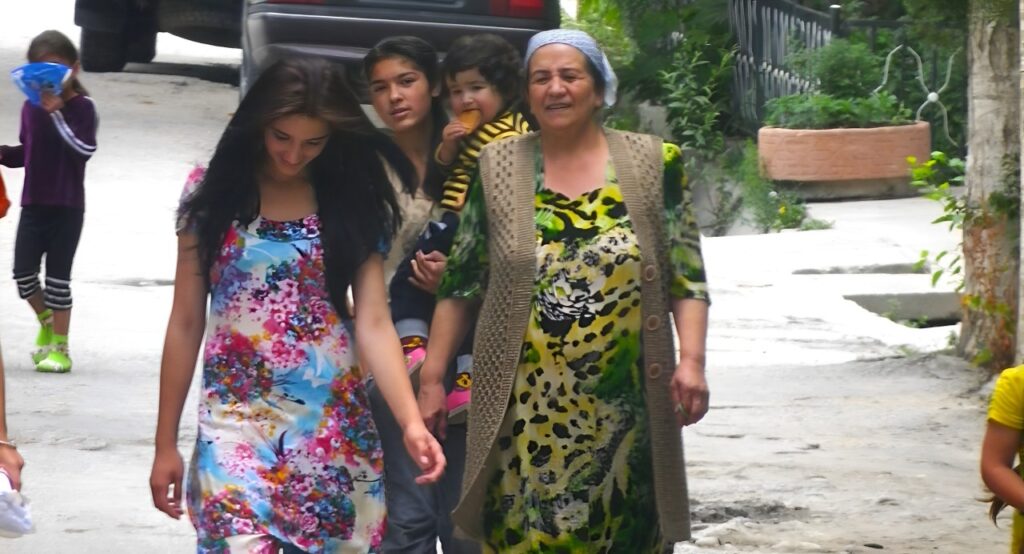
Residents of Tajikistan will face fines ranging from 8,000 to 65,000 somoni for "importing and selling clothes that do not correspond to the national culture" and for wearing such clothes in public places, as reported by Radio Ozodi. These regulations are outlined in Article 18 of the new version of the law "On Regulation of Traditions and Rites" and the Code of Administrative Offenses. The drafts were adopted by parliamentarians on May 8 this year. "In the draft law 'On the Regulation of Traditions and Rites,' a corresponding prohibiting norm is included in part two of Article 18. For its violation, amendments and additions to Article 481 of the Code of Administrative Offenses provide for administrative responsibility," explained Mavludakhon Mirzozoda, a deputy of the lower house of Tajikistan's parliament. Article 481 of the current Code of Administrative Offenses addresses not only Article 18, but also broader non-compliance with the norms of the Law on the Regulation of Traditions and Rites. According to this article: Individuals will be fined 7,920 somoni ($733). Officials will be fined 39,600 somoni ($3,665). Legal entities will be fined 57,600 somoni ($5,333). Individual entrepreneurs, scientists, and religious figures will be fined 54,000 somoni ($4,998). For repeated violations, fines will range from 46,000 to 86,000 somoni. The recent amendments have updated this article, although changes to the fine amounts are yet to be confirmed. The average wage in Tajikistan is approximately $172 a month. According to the current legislation, the amendments to the law come into force upon publication in the official press after approval by the Majlisi Milli (lower house) and the president's signature. However, citizens are already being compelled to comply with these new regulations. The current law does not specify which clothing is considered alien to Tajik national culture. Experts suggest that the law likely pertains to women's national dress, although the text itself does not differentiate between men's and women's clothing. Reactions within Tajik society have been mixed. Some residents of Dushanbe, during a street survey, expressed their opinion that people should have the freedom to choose their own attire without compulsion. Tajik authorities have long campaigned to encourage the wearing of national dress and to discourage the adoption of foreign styles. They prohibit women from wearing black clothing, black headscarves, and hijabs, considering them alien to Tajik culture and traditions. Although mini-skirts, sweaters, dresses with cleavage, tops, and transparent fabrics were also banned at one point, these restrictions were quickly "forgotten."

Central Asia’s Combined ‘Army of Turan’: Could a Hypothesis Become a Reality?

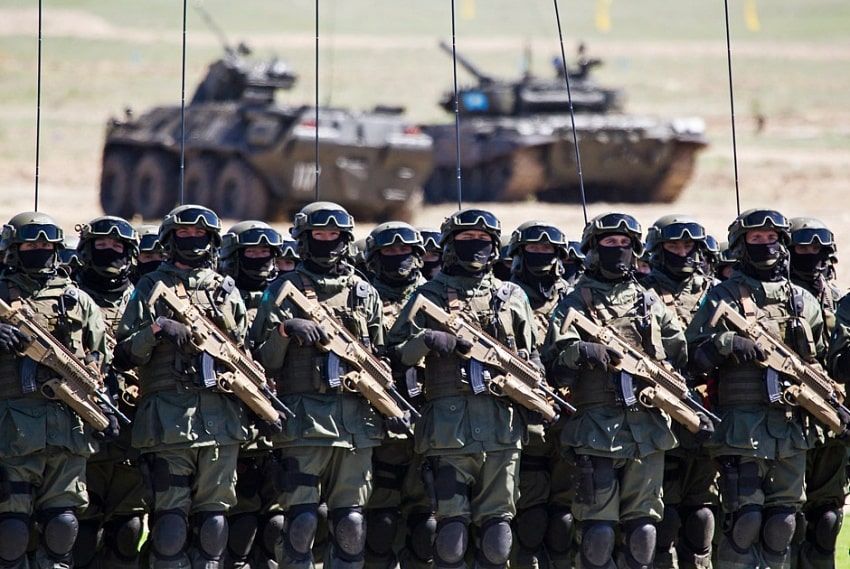
Kazakhstan will host the military exercise, "Birlestik-2024" in July of this year. Notably, this became known from the press service of the Ministry of Defense of Azerbaijan. The exercises will be jointly held by the Armed Forces of Azerbaijan, Kazakhstan, Kyrgyzstan, Tajikistan, and Uzbekistan. It is a convenient occasion to refresh the topic of the 'Army of Turan', which is periodically raised by experts both in Central Asia and neighboring countries. The Army of Turan is a hypothetical military bloc of Turkic-speaking countries. Its ideas have become relevant in the context of global geopolitical turbulence.   I hear the thunder of cannons... Most military analysts consider Azerbaijan to be Turkey's proxy in the South Caucasus. In general, Baku's rapprochement with the capitals of Turkic states (plus Dushanbe) meets Ankara's interests in creating a unified cultural and economic space: Turan. However, does the integration of Turkic states mean that they will eventually be able to create a NATO-style security pact in Central Asia? Such initiatives have resumed with renewed vigor after the end of the Azerbaijani-Armenian conflict, during which Turkey has shown the capability of its weapons. Indeed, in 2022, against the backdrop of the Russian invasion of Ukraine, Kazakhstan - the only country of the participants to share a land border with the Russian Federation - pondered how to protect itself from further expansion of the northern empire's borders. But in the run-up to the summer of 2024, fears have mostly subsided. Many were sobered by the obvious fact that loud declarations of assistance from strong states at best mean the delivery of obsolete weapons, but no more. At worst, your offender will be censured from high podiums, and you will be sympathized with. For example, Turkey, the most likely to defend Central Asia from outsider aggression, did not risk helping the Palestinians, its brothers in faith, and got away with accusing Israel of fascism. So, the 'Army of Turan' exists in the heads of fantasists and pan-Turkics, but in reality, something ordinary is going on — the arms trade. Let's see what the armies of the Central Asian republics are armed with, excluding Turkmenistan, which has declared neutrality.   Tajikistan and Kyrgyzstan The most troublesome neighbors in the region have not been able to complete their border delimitation process. As a result, quarrels periodically erupt, in which border guards from both sides intervene, staging mini-warfare. The cause of discord is usually the same: water. The Tajik and Kyrgyz militaries gain some combat experience in these micro-quarrels. Despite or based on this experience, Dushanbe relies on agreements with other countries -- Russia, China, India, Iran, and CSTO partners -- for its defense capability. Tajikistan's armed forces number only 9,000 men. They have 38 tanks (T-62 and T-72 modifications), 114 armored vehicles (APCs, BMPs, BRDMs), 40 artillery systems, and several short- and medium-range air defense units. The Air Force has four Czechoslovakian L-39 Albatross, combat trainers. Kyrgyzstan does not have much more power in the number of its troops, at around...

Focus on Ethnic Germans in Kazakhstan

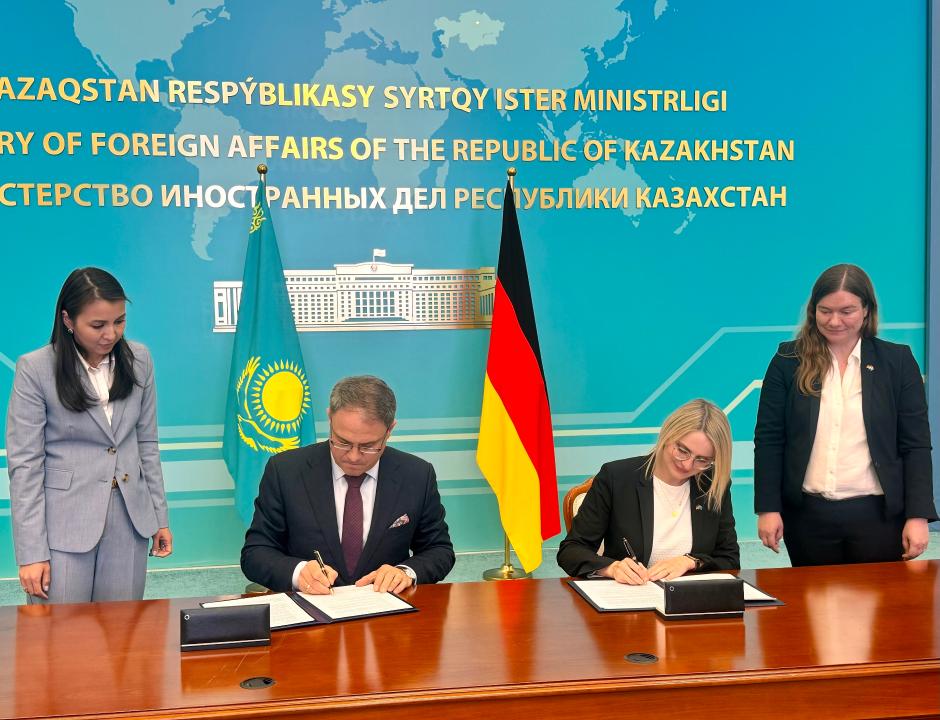
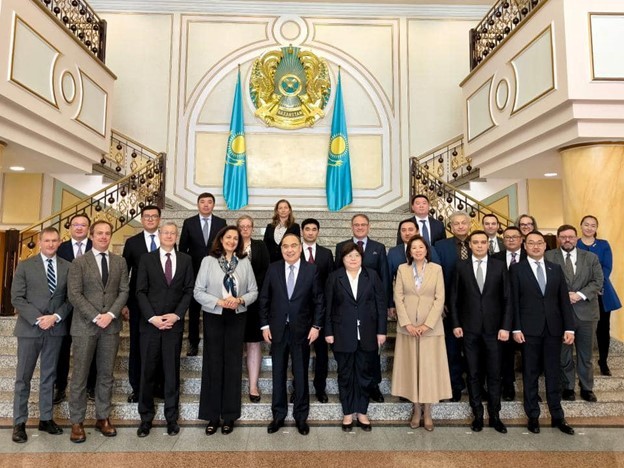
On 21 May, Astana hosted the 20th meeting of the Kazakh-German Intergovernmental Commission for the Affairs of Ethnic Germans in Kazakhstan, co-chaired by Deputy Minister of Foreign Affairs of Kazakhstan Roman Vassilenko and Germany’s Federal Government Commissioner for Matters Related to Ethnic German Resettlers and National Minorities, Member of the Bundestag, Natalie Pawlik. Representatives of the two countries’ ministries and organizations, including the Wiedergeburt (Rebirth) foundation also participated. The agenda focused on cooperation between Kazakhstan and Germany to support the cultural, linguistic, and national identity of Kazakh Germans, as well as the implementation of joint projects in science, education, and culture. The parties reiterated their mutual interest in expanding partnerships within the framework of the Intergovernmental Commission and strengthening the “living bridge” connecting Kazakhstan and Germany. During World War II, Stalin's henchman, Lavrentiy Beria supervized the mass deportation of the Volga Germans, Chechens, Ingush, Pontic Greeks, Crimean Tatars, Balkars and the Karachays, largely to Central Asia. With the crowded wagons stopping only to bury the dead in the snow, approximately 30% perished. According to statistics, 226,000 ethnic Germans reside in Kazakhstan, today, whilst some one million Germans have moved from Kazakhstan to their ancestral homeland. Emphasizing the importance of Kazakhstan’s multi-ethnic population in the successful development of the country, Vassilenko stated that: “Thousands of kilometers separating our countries do not hinder the development and deepening of Kazakh-German relations, as well as the promotion of rapprochement of our peoples. By virtue of history, Kazakhstan has a large German diaspora, while many former citizens of Kazakhstan have resettled in Germany.” Ethnic Germans are represented in all spheres of life in Kazakhstan. The Kazakh-German Center in Astana, the Kazakh-German University in Almaty, the Kazakh-German Institute of Sustainable Engineering in Aktau, the German Drama Theatre, as well as the Deutsche Allgemeine Zeitung newspaper play significant roles in strengthening cultural and humanitarian interaction between Kazakhstan and Germany. Natalie Pawlik welcomed the dynamically developing bilateral cooperation and emphasized that Germany regards Kazakhstan as a key partner in its relations with Central Asia. In her commendation of assistance provided by the German Federal Government to the Germans of Kazakhstan, she mentioned that the study of the German language in Kazakhstan can not only contribute to the preservation of the ethnic Germans’ national identity but prove beneficial to professionals engaging in joint investment projects.    

Amid Russian Sanctions, Kazakhstan Can Benefit From Shanghai Cooperation Organisation

After Astana hosted the latest meeting of the Council of Foreign Ministers of the Shanghai Cooperation Organisation (SCO) member states, Almaty-based financial analyst and expert in cross border business and asset value recovery, Rassul Rysmambetov believes that Kazakhstan still has huge potential in the organization that is yet to be utilized. The SCO was founded in 2001 by the leaders of China, Russia, Kazakhstan, Tajikistan, Kyrgyzstan and Uzbekistan. In 2017 India and Pakistan joined, followed by Iran in 2022. Belarus is expected to join the SCO this summer. The association's main objectives are to strengthen stability in the region, fight terrorism and drug trafficking, as well as develop economic cooperation, energy, scientific, and cultural partnerships. At the Astana meeting 22 decisions were adopted. The SCO's secretary general Zhang Ming praised Kazakhstan's work as the organization's chair, saying: "Since July 2023, within the framework of Kazakhstan's chairmanship in the SCO, the Kazakh side has organized more than 180 events in various fields. Kazakh partners have put a special emphasis on economic, investment, transportation, cultural and humanitarian issues." Sources report that Kazakh president Kassym-Jomart Tokayev met with the foreign ministers of the other SCO member states. He mentioned that more than 100 large-scale events have been held recently, including the SCO digital, tourism, and energy forums. "Work on the SCO project 'Spiritual Sanctuaries' is being completed. On our initiative, 2024 has been declared the SCO Year of Ecology. The government of Kazakhstan continues to prepare for several additional significant events in the spheres of energy, transportation, and culture. Of course, we pay great attention to the upcoming Astana SCO summit," Tokayev said. Financial analyst Rasul Rysmambetov, in a conversation with The Times of Central Asia, spoke about the SCO's significance on a global scale. "Its member states have a combined population of over three billion people," he said. "The SCO has not undergone any serious changes in its 22-year existence. Of course some countries try to promote a political agenda, but the organization is focused on economic and security interests." "Of course, the SCO benefits Kazakhstan in the context of western sanctions against Russia, because we have China, Pakistan, and Russia, all of which are large countries that are markets for our goods. Of course, we must open markets for them, but we are open to the goods of many countries within the WTO. Concerning Kazakhstan, sanctions are not an obstacle to the work of the SCO. We do not trade in weapons, so there are no problems. Members of the organization see sanctions restrictions in terms of re-exports, and everything works fine in terms of ordinary, non-sanctioned goods," Rysmambetov added. Regarding Belarus's imminent accession to the SCO, he said: "It's beneficial for us. We can't produce and sell much yet, but at least we'll earn on transit. This is an opportunity to develop our logistics, improving our export prospects when more production facilities are launched in Kazakhstan."

U.S. and Kazakhstan Discuss Shared Values at High-Level Dialogue on Human Rights and Democratic Reforms

The United States and the Republic of Kazakhstan held their third annual High-Level Dialogue on Human Rights and Democratic Reforms on May 20, 2024, in Astana, Kazakhstan. The U.S. delegation was headed by Under Secretary of State for Civilian Security, Democracy, and Human Rights Uzra Zeya, while the Kazakh delegation was led by Ambassador Erzhan Kazykhan, Assistant to the President of Kazakhstan for External Affairs. As in prior Dialogues, the United States and the Republic of Kazakhstan discussed their shared commitment to advancing human rights, rule of law, freedom of expression, and the protection of members of vulnerable and marginalized populations. In this context, The United States “reaffirmed its strong support for the full implementation of President Tokayev’s reform agenda and commended the Republic of Kazakhstan for progress made in the advancement of human rights including the passage of the April 2024 law recriminalizing domestic violence, a very important step in protecting survivors” while encouraging “advancement of Kazakhstan’s reform efforts with the full participation of, and in consultation with, civil society partners for transparency and accountability”. The United States stated that “Respect for human rights and fundamental freedoms are integral to a prosperous, vibrant “New Kazakhstan,” where independent media, civil society groups, and political parties can operate freely, without undue restrictions”. Multilateral cooperations, including with the United Nations High Commissioner for Refugees and C5+1 Platform were also discussed. The full press release of the US Department of State can be found here.