• KGS/USD = 0.01144 0%
  • KZT/USD = 0.00211 0%
  • TJS/USD = 0.10526 0%
  • UZS/USD = 0.00008 0%
  • TMT/USD = 0.28530 0%
  • KGS/USD = 0.01144 0%
  • KZT/USD = 0.00211 0%
  • TJS/USD = 0.10526 0%
  • UZS/USD = 0.00008 0%
  • TMT/USD = 0.28530 0%
  • KGS/USD = 0.01144 0%
  • KZT/USD = 0.00211 0%
  • TJS/USD = 0.10526 0%
  • UZS/USD = 0.00008 0%
  • TMT/USD = 0.28530 0%
  • KGS/USD = 0.01144 0%
  • KZT/USD = 0.00211 0%
  • TJS/USD = 0.10526 0%
  • UZS/USD = 0.00008 0%
  • TMT/USD = 0.28530 0%
  • KGS/USD = 0.01144 0%
  • KZT/USD = 0.00211 0%
  • TJS/USD = 0.10526 0%
  • UZS/USD = 0.00008 0%
  • TMT/USD = 0.28530 0%
  • KGS/USD = 0.01144 0%
  • KZT/USD = 0.00211 0%
  • TJS/USD = 0.10526 0%
  • UZS/USD = 0.00008 0%
  • TMT/USD = 0.28530 0%
  • KGS/USD = 0.01144 0%
  • KZT/USD = 0.00211 0%
  • TJS/USD = 0.10526 0%
  • UZS/USD = 0.00008 0%
  • TMT/USD = 0.28530 0%
  • KGS/USD = 0.01144 0%
  • KZT/USD = 0.00211 0%
  • TJS/USD = 0.10526 0%
  • UZS/USD = 0.00008 0%
  • TMT/USD = 0.28530 0%

Viewing results 415 - 420 of 2395

UN’s Guterres Back in Central Asia for Meetings About Development

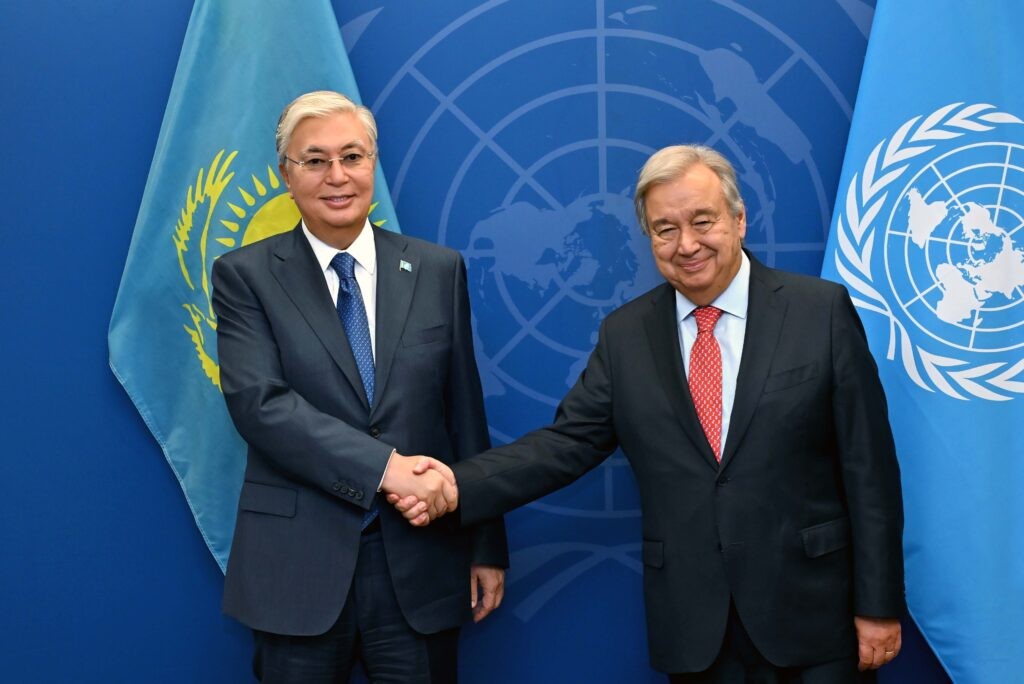
United Nations Secretary-General António Guterres is traveling to Central Asia this weekend to help promote stability and transformation in the region, his office says.  Guterres will be in Kazakhstan on Sunday to witness, alongside President Kassym-Jomart Tokayev, the signing of a host country agreement for a U.N. regional center for sustainable development goals for Central Asia and Afghanistan. Kazakhstan’s envoy to the U.N., Kairat Umarov, has said that the initiative aims to strengthen regional economies and trade networks, create jobs and cut migration flows.   “We are confident that over time, economic stability will pave the way for a gradual political transformation of Afghanistan, including progress in the field of women’s rights,” Umarov has said.  Trade between Central Asia and Afghanistan is increasing, but there are international concerns about Taliban-ruled Afghanistan’s humanitarian crisis, the threat of terrorism and human rights violations, particularly toward women and girls.  After the stop in Kazakhstan, Guterres will go to Awaza, Turkmenistan, to attend a U.N. conference on landlocked, developing countries.  “He will reaffirm the need to help the landlocked developing countries overcome physical barriers and connect to global markets, including by leveraging artificial intelligence to strengthen early warning systems,” said Farhan Haq, deputy spokesman for Guterres.  The August 5-8 conference will explore ways to expand the economic potential of countries that lack direct ocean access and rely on transit nations, thereby facing obstacles to trade and development. Countries that are classified as landlocked and developing by the conference include Afghanistan, ​Kazakhstan, Kyrgyzstan, Tajikistan, Turkmenistan and Uzbekistan.

China’s CNNC to Build Third Nuclear Power Plant in Kazakhstan

China National Nuclear Corporation (CNNC), which previously secured the contract for Kazakhstan’s second nuclear power plant, will now lead the construction of a third facility, according to First Deputy Prime Minister Roman Sklyar. In October 2024, Kazakh citizens voted in a national referendum in favor of nuclear energy development. Following the vote, President Kassym-Jomart Tokayev announced the need to construct at least two, and ideally three, nuclear power plants. In June 2025, Russia’s Rosatom was selected to build the first plant near the village of Ulken, on the western shore of Lake Balkhash, approximately 400 kilometers northwest of Almaty. Simultaneously, CNNC was announced as the builder for the second facility. Potential locations for this project include Kurchatov, near the former Semipalatinsk nuclear test site in eastern Kazakhstan, and Aktau, the former site of the Soviet-era BN-350 fast neutron reactor in the west. The identity of the third project’s contractor remained unclear until now. Alongside Rosatom and CNNC, South Korea’s KHNP and France’s EDF had been shortlisted. “The third nuclear power plant will also be built by China,” Sklyar confirmed during a press briefing. When asked whether this referred to CNNC specifically, he replied in the affirmative. Kazakhstan’s Atomic Energy Agency and Kazakhstan Atomic Power Plants LLP are currently evaluating potential sites for the second and third nuclear plants. “Work is underway, and I believe the locations will be announced later this year,” Sklyar said. “Each plant requires a permanent source of water and electricity, and the exact districts must be carefully selected.” Meanwhile, negotiations on the intergovernmental agreement for the first nuclear plant, being developed by Rosatom, are ongoing with Russian officials. “Once finalized, the agreement will be submitted to parliament for ratification,” Sklyar added. The first nuclear power plant is planned to have two units with a combined capacity of 2.4 gigawatts and is expected to be operational by 2035. The project is intended to help offset Kazakhstan’s growing electricity deficit, which reached 5.7 billion kWh in January 2025, up from 2.4 billion kWh a year earlier. To meet its current energy needs, Kazakhstan imports electricity primarily from Russia and recently signed an agreement with Tajikistan to purchase additional power from the Rogun Hydroelectric Power Plant.

Uzbek Migrants Coerced to Fight in Russia’s War

Russia has recruited at least 902 citizens of Uzbekistan to fight in its war against Ukraine since the beginning of 2025, including individuals as young as 19, according to the “I Want to Live” (Хочу жить) project, which cited sources within the Russian armed forces. Despite heightened scrutiny in Uzbekistan following earlier reports of its nationals joining the conflict, recruitment efforts have continued to expand. “These are people who no longer belong to themselves,” the project stated, adding that the recruitment methods remain largely unchanged. The group reported that Uzbek labor migrants arriving in Russia are often lured by promises of lucrative employment, typically in construction or rear-echelon military units. A key incentive remains the promise of expedited Russian citizenship. Meanwhile, Uzbek nationals serving prison terms in Russia are reportedly pressured into enlisting through threats and psychological coercion. The project also highlighted the use of blackmail, especially targeting migrants who recently obtained Russian citizenship. Alexander Bastrykin, head of Russia’s Investigative Committee, recently acknowledged that more than 5,000 raids had been carried out, during which 90,000 people were "caught", a term he used himself. Of those, 30,000 signed contracts and were sent to the front lines, reflecting the coercive nature of the campaign. The report added that prisoners of war from 33 countries are currently held in Ukraine, with Uzbekistan reportedly having the highest number of foreign nationals among them. Separately, on June 5, 2025, a delegation from Uzbekistan’s Defense Ministry, led by Deputy Minister Colonel Alisher Narbaev, visited the “Postoyalye Dvory” military training ground in Russia’s Kursk region. The visit has raised questions amid ongoing concerns about the recruitment of Uzbek citizens into Russia’s war effort. “Every signed contract is a one-way ticket,” the “I Want to Live” project warned, urging the Uzbek government to take a stronger stance in protecting its citizens from being drawn into the conflict. Earlier this year, The Times of Central Asia reported that Ukraine’s Defense Intelligence Service accused Russia of coercing Central Asian citizens, particularly labor migrants from Uzbekistan and Tajikistan, into military service. Many of those recruited under the guise of volunteering are sent directly to high-risk front-line positions, where survival chances are slim.

Turkmen Migrants Face Deportations as Russia Escalates Crackdown

Russian authorities are intensifying their deportation of foreign nationals under a sweeping crackdown on irregular migration, with Turkmen citizens increasingly targeted, according to Turkmen News. Deportation Without Trial Under new rules introduced in February 2025, Russian police and migration officials can summarily expel foreign nationals without awaiting court decisions. The measures coincide with a significant uptick in Turkmen migration: nearly 90,000 Turkmen citizens entered Russia in 2023, triple the number recorded in 2022. Now, reports of deportations are mounting. In July alone, media outlets across several Russian regions reported hundreds of foreigners, many of them from Turkmenistan, being forcibly removed. Key figures include: Astrakhan Region: 200 people Nizhny Novgorod Region: 518 people Republic of Dagestan: 260 people Stavropol Krai: 127 people Raids have also been carried out in other areas, though officials often refrain from disclosing detainees’ nationalities. For example, in early July, Moscow police raided hostels and prayer houses, detaining over 500 foreigners. More than 30 were later expelled for immigration violations, according to Kommersant. A recent case in Saratov Region highlighted the situation. On July 30, the Federal Bailiff Service (FSSP) announced the deportation of three Turkmen citizens for violating migration laws. Among them: a 27-year-old former student who overstayed his registration in Kazan, a 55-year-old man whose legal stay had expired in 2024, and a 47-year-old businessman who failed to obtain a work permit. All three cited lack of funds to return home. They were escorted to a Moscow-area airport and deported, receiving five-year re-entry bans. According to Turkmen News, they will also be placed on a "no-exit" list upon return, barring them from leaving Turkmenistan in the near future. Tougher Migration Regulations Millions of Central Asians live and work in Russia, forming the backbone of the country's migrant labor force. Official figures indicate that nearly 4 million citizens of Kazakhstan, Kyrgyzstan, Uzbekistan, Tajikistan, and Turkmenistan currently reside in Russia. An additional 670,000 foreigners are believed to be in the country without legal status. Uzbekistan and Tajikistan account for the largest share of migrant laborers. In 2023, over one million Tajik citizens entered Russia for work. However, the overall number of Central Asian migrants has been declining, driven by tighter restrictions, growing xenophobia, and fears of forced conscription. In 2024 alone, Russian authorities expelled around 15In 2025, Moscow introduced a new set of migration regulations aimed at curbing irregular migration. These measures authorize law enforcement to carry out deportations without judicial review, establish a centralized registry of undocumented foreigners, and set a deadline of September 10, 2025, for migrants to legalize their status. Those who fail to comply will face deportation and multi-year bans on re-entry. These efforts build on previous policies, including mandatory fingerprinting and photographing of all incoming migrant workers, reducing visa-free stays from 180 days to 90, and expanding the list of deportable offenses. The crackdown intensified following the March 2024 terrorist attack at Crocus City Hall in Moscow, which was allegedly carried out by suspects of Central Asian origin. The incident sparked a...

What Will Kazakhstan Make of the Novorossiysk Constraint?

Russia’s July decree requiring FSB approval for foreign vessels entering Novorossiysk introduces a new procedural constraint into the regional export environment. Modest in scope, the measure nevertheless grants Moscow a latent mechanism for influencing Kazakhstan’s primary oil export route via the CPC pipeline, and by extension, its westward orientation. The CPC terminus, long treated as infrastructurally neutral, has been “recoded” as a site of discretionary oversight. This development coincides with the gradual erosion of the energy governance model inaugurated by foreign concessions at Tengiz, Karachaganak, and Kashagan, where Production Sharing Agreements (PSAs) created juridical islands largely external to domestic legal and fiscal regimes. It is possible that a new phase is emerging whereby infrastructural flows are re-anchored in sovereign discretion, as an accumulation of procedural instruments favors regional currencies and reduces Western intermediation. Kazakhstan’s energy model was built on upstream Western capital and downstream Russian transit. The fragility of that erstwhile equilibrium has now been revealed, even though the disrupter is not a single actor but a convergence of pressures. This dual-dependency now appears more vulnerable, unsettled by converging geopolitical and institutional pressures. The superficial continuity of physical infrastructure masks deeper shifts in logistical autonomy, fiscal sovereignty, and international alignment. Structural Exposure and Strategic Compression The fiscal layer exposes the shifts. Revenues from Western-operated concessions are routed into the National Fund, which reinvests them into foreign debt instruments, often issued by the same economies that operate Kazakhstan’s extractive infrastructure. Kazakhstan’s export of physical assets and reinvestment into external liabilities constitutes a structural contradiction. The state’s constitutional control over subsoil resources is not matched by operational authority. The CPC pipeline, though formally multinational, is routed entirely through Russian territory. The new decree does not immediately alter its function, but it inserts a potential instrument of political leverage. The bargaining terrain has consequently already shifted: what was previously a matter of contractual detail is now entangled with external discretion. For the present, the decree’s practical impact is limited, but it reveals the current system’s embedded asymmetry. Moscow’s move signals a readiness to formalize political leverage. It lays the groundwork for a possible reconfiguration of Eurasian energy flows under post-conflict conditions. In this vision, transactions would be conducted through sovereign institutions, denominated in rubles, tenge, or other regional currencies. The intent is clear: to reduce reliance on Western frameworks and to re-anchor Russia’s “peripheries” within its institutional orbit. The maneuver unfolds within a broader context of strategic adjustment. Europe is searching for non-Russian energy inputs. Turkey is expanding corridor-based integration. China’s Belt and Road Initiative continues to institutionalize long-term infrastructural absorption. Kazakhstan has become a contested node within overlapping geopolitical networks that pull it in different vectorial directions. Against this backdrop, the once legal-technical re-negotiations over Tengiz, Karachaganak, and Kashagan are situated within a tectonically shifting geopolitical matrix. Trans-Caspian connectors, digital corridors, and regulatory frameworks are coalescing into a new infrastructural logic. The decree has little practical effect for now, but it points to a deeper condition where sovereignty is declared but not...

The View From Ankara – President Tokayev’s Working Visit to Turkey

The official visit of President of Kazakhstan Kassym-Jomart Tokayev to Turkey on July 29, 2025, carries a multidimensional and strategic significance that extends far beyond the boundaries of diplomatic protocol. This engagement stands out as part of an ongoing multidimensional process of transformation marked by deepening regional alliances in the fields of science, energy, and logistics. Invited by President Recep Tayyip Erdoğan, Tokayev co-chaired the fifth meeting of the Turkey-Kazakhstan High-Level Strategic Cooperation Council. As a result of this summit, 20 bilateral agreements were signed, encompassing new frameworks of regional integration, especially in the fields of mining, energy, transportation, and higher education. Energy Diplomacy and Resource Geopolitics One of the most striking dimensions of the visit was the negotiation of new cooperation mechanisms aimed at transporting Kazakh oil to global markets via Turkey. According to President Tokayev, currently 1.4 million tons of Kazakh oil are transported annually through the Baku–Tbilisi–Ceyhan pipeline. Under the newly signed memoranda of understanding, the parties aim to increase this volume. This development not only strengthens Turkey’s ambition to become a regional energy hub but also holds critical importance for Kazakhstan’s strategy to diversify export routes and secure access to safe ports. Furthermore, the expressed intent of Turkish Petroleum Corporation (TPAO) to operate in Kazakhstan signals that the collaboration may extend beyond transport into production processes as well. Kazakhstan's reserves of rare earth elements and strategic minerals are of considerable value to both European and Asian economies prioritizing green energy transitions. In this context, the agreements signed in the mining sector may herald a new phase — one that mandates not only commercial but also technological and scientific R&D collaborations. Strategic Dimensions of the Middle Corridor Another key agenda item during the visit was the development and activation of the Trans-Caspian International Transport Route, commonly referred to as the ‘Middle Corridor.’ According to data shared by Tokayev, approximately 85% of road freight transported between China and Europe passes through Kazakhstan. This positions Kazakhstan as the backbone of the region’s logistics infrastructure. Turkey’s central role in the Middle Corridor makes it a decisive actor in the route’s integration with Europe. In this regard, Kazakhstan’s efforts to modernize its rail and road infrastructure, alongside its revival of maritime transport on the Caspian Sea, when combined with Turkey’s port capacity and transportation infrastructure, offer significant synergistic potential. These developments also underscore the strategic importance of the Zangezur Corridor and reinforce the value of uninterrupted transportation from China to Europe via Turkey, bypassing the Iranian route. Education and Academic Diplomacy The visit also drew attention for its scientific and cultural dimensions, in addition to its economic focus. Joint initiatives such as Gazi University’s planned establishment of a branch within the South Kazakhstan Pedagogical University can contribute to aligning the Turkish higher education model with Kazakhstan’s ongoing education reforms. Moreover, the Turkish Maarif Foundation’s new school initiatives in Kazakhstan signify a broadening and institutionalization of bilateral cooperation in education. These efforts may extend beyond student exchange programs to encompass joint research...