
• KGS/USD = 0.01144 0%
  • KZT/USD = 0.00212 0%
  • TJS/USD = 0.10432 -0.29%
  • UZS/USD = 0.00008 0%
  • TMT/USD = 0.28571 0.28%
  • KGS/USD = 0.01144 0%
  • KZT/USD = 0.00212 0%
  • TJS/USD = 0.10432 -0.29%
  • UZS/USD = 0.00008 0%
  • TMT/USD = 0.28571 0.28%
  • KGS/USD = 0.01144 0%
  • KZT/USD = 0.00212 0%
  • TJS/USD = 0.10432 -0.29%
  • UZS/USD = 0.00008 0%
  • TMT/USD = 0.28571 0.28%
  • KGS/USD = 0.01144 0%
  • KZT/USD = 0.00212 0%
  • TJS/USD = 0.10432 -0.29%
  • UZS/USD = 0.00008 0%
  • TMT/USD = 0.28571 0.28%
  • KGS/USD = 0.01144 0%
  • KZT/USD = 0.00212 0%
  • TJS/USD = 0.10432 -0.29%
  • UZS/USD = 0.00008 0%
  • TMT/USD = 0.28571 0.28%
  • KGS/USD = 0.01144 0%
  • KZT/USD = 0.00212 0%
  • TJS/USD = 0.10432 -0.29%
  • UZS/USD = 0.00008 0%
  • TMT/USD = 0.28571 0.28%
  • KGS/USD = 0.01144 0%
  • KZT/USD = 0.00212 0%
  • TJS/USD = 0.10432 -0.29%
  • UZS/USD = 0.00008 0%
  • TMT/USD = 0.28571 0.28%
  • KGS/USD = 0.01144 0%
  • KZT/USD = 0.00212 0%
  • TJS/USD = 0.10432 -0.29%
  • UZS/USD = 0.00008 0%
  • TMT/USD = 0.28571 0.28%

Viewing results 451 - 456 of 1998

Shadows over the Trails: Mystical Legends of the Almaty Mountains

The mountains surrounding Almaty captivate not only with their natural beauty and fresh alpine air but also with the legends that echo along their winding trails. Travelers speak of a ghostly woman in white, a towering old man with a chessboard, and a mysterious "Japanese Road" haunted by the spirits of the past. The vistas are breathtaking, yet around every turn, a chilling tale may be waiting. Urban legends have become integral to the cultural fabric of the Almaty region, shaped by the imaginations of hikers and storytellers alike. But could there be a grain of truth behind these supernatural accounts? The Almarasanian Maiden Most Almaty residents are introduced to local folklore during childhood, particularly during overnight camps in the mountain foothills. Beneath the star-strewn sky and beside crackling campfires, counselors often begin the night's stories with: “Have you heard the tale of the Almarasanian Maiden?” The best-known legend describes a spectral woman dressed in white, appearing along treacherous mountain passes. But older residents tell a more detailed and tragic version. According to this tale, a woman once abandoned by her husband in the Zailiyskiy Alatau mountains was driven to madness. In her grief, she killed her two sons, hanging them from birch trees before taking her own life on a third. Struck by lightning but not destroyed, the three birches remain: two standing strong, the third broken but alive. Climbers later erected two crosses beneath them in remembrance. Since then, sightings of the woman in white have persisted. She is said to either warn travelers of danger or exact vengeance on those who betray loved ones. Though the story may sound fantastical, real-life tragedies have kept the legend alive. In May 2025, a rockfall in the Alma-Arasan Gorge killed a young woman and led to the trail’s temporary closure for reconstruction. In 2009, 11 people died in a horrific accident when a truck collided with a bus stop. While the official cause was listed as a heart attack suffered by the driver, witnesses reported that he remained conscious and tried to steer the vehicle moments before impact. His widow later stated that he had no history of heart problems. The Japanese Road After Japan’s defeat in Manchuria in 1945, many prisoners of war were sent to labor camps across the Soviet Union, including Kazakhstan. In Almaty, they constructed what is now known as the Japanese Road. Built under harsh conditions, the road was originally part of a water supply system connecting Big Almaty Lake to the city. Modern hikers report an eerie atmosphere. Some claim to see ghostly figures, presumed to be the spirits of those who died building the road. These apparitions are seen as ill omens, urging visitors to leave before nightfall. The White Old Man Among the most curious legends is that of a ghostly, two-meter-tall old man with a flowing beard, who carries a chessboard. He appears to hikers and shepherds, silently inviting them to play. Refusing is said to bring bad luck or worse....
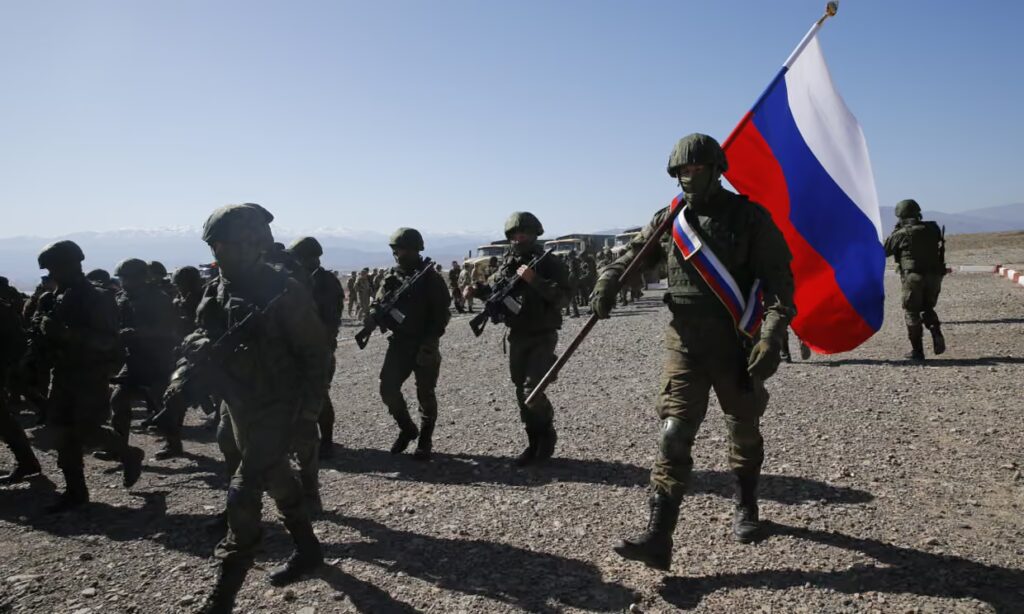
“Where a Russian Soldier Treads, That’s Ours”: Kazakhstan in the Crosshairs of Putin’s Neo-Imperial Playbook

In June 2025, Russian President Vladimir Putin made a chilling declaration at the St. Petersburg Economic Forum: ‘There’s an old rule – wherever a Russian soldier sets foot, that’s ours.’ Far from a metaphor, this line encapsulated the Kremlin’s evolving foreign policy doctrine. It is a doctrine where military occupation becomes territorial acquisition, and where presence becomes ownership.  But this ideology did not appear overnight. It has been systematically constructed through years of rhetorical groundwork, beginning with Putin's 2014 remark at the Seliger Youth Forum: ‘Nursultan Nazarbayev created a state on territory where there had never been a state. The Kazakhs never had statehood.’ In 2021, speaking at a Moscow press conference, Putin went further, describing Kazakhstan as ‘a Russian-speaking country in the full sense of the word.’  These comments expose a geopolitical logic that fuses cultural affinity, historical denial, and military dominance. They form the pillars of what scholars like Marlene Laruelle and Timothy Snyder describe as Russia’s ‘narrative imperialism’: the use of historical revisionism and linguistic hegemony to delegitimize the sovereignty of neighboring states.  Nowhere is this doctrine more clearly manifest than in the cases of Ukraine and Kazakhstan. In Ukraine, the justification for annexing Crimea in 2014 and launching a full-scale invasion in 2022 relied heavily on the protection of Russian-speaking populations and claims of historical unity. In Kazakhstan, the groundwork is rhetorical – but eerily similar.  In 2014, Putin reversed Nikita Khrushchev’s legacy by annexing Crimea, which Khrushchev had transferred to the Ukrainian SSR in 1954. At the same time, Kremlin-aligned voices began revisiting Khrushchev’s failed plan to remove five northern regions of Kazakhstan to form Russian 'Virgin Lands'.  This was not a mere administrative reform: the plan involved transferring the fertile, Slavic-populated regions of Akmolinsk, Kostanay, Pavlodar, North Kazakhstan, and East Kazakhstan regions from the Kazakh SSR to the Russian SFSR. The objective was both economic and political -- to consolidate agricultural output under Moscow's direct jurisdiction and reduce the autonomy of the Kazakh republic by undermining its territorial coherence and ethnic composition. These areas were the backbone of Khrushchev’s Virgin Lands Campaign and held great strategic value. The proposal sparked resistance from within the Kazakh leadership, most notably from Premier Zhumabek Tashenov, who openly opposed the Kremlin's intentions. As a result of his opposition, he was dismissed from his position, but he succeeded in preserving Kazakh territorial integrity.  These northern regions, like Crimea, are demographically significant: they are home to a large ethnic Russian population, many of whom speak only Russian, consume Russian media, and express nostalgia for Soviet-era unity. Cities like Petropavlovsk, where Russians still outnumber Kazakhs, mirror the pre-2014 situation in Donetsk and Luhansk.  In 2023, a group calling itself the ‘People’s Council of Workers’ in Petropavlovsk released a video declaring independence based on the 1937 Constitution of the Kazakh SSR. Prosecuted for inciting separatism, they nonetheless reflected growing latent support for Russian intervention.  Even earlier, in 2014, Russian ultra-nationalist Eduard Limonov made headlines by urging Russia to annex Northern Kazakhstan during...

Opinion: Why Russia May Stop Oil Supplies via the CPC

The global confrontation between the West and East could, quite literally, devastate the economies of Central Asian countries in the near future. Some experts argue that the position Kazakhstan and its regional neighbors now occupy, four years into the war between Russia and Ukraine, has spiraled beyond anyone’s control. The disruption began with Ukrainian drone strikes on Russian infrastructure used by the Caspian Pipeline Consortium (CPC), which indirectly impacted oil flows from Kazakhstan to Europe. On August 2, several media outlets, citing sources within the Ukrainian military, reported an attack on the Central Asia-Center (SAC) gas pipeline running through Kazakhstan. The attack allegedly caused an indefinite halt in gas deliveries that Russia had been sending in reverse flow to Uzbekistan. Kazakhstan also uses this gas domestically. Shortly after, the energy ministries of both Uzbekistan and Kazakhstan denied reports of any damage to the pipeline. Nonetheless, Ukraine’s classification of the SAC pipeline as a legitimate target remains on record. Notably, although Kazakhstan’s Foreign Ministry has issued a formal protest to Kyiv over the CPC attacks, it has yet to reveal any official response from the Ukrainian side. Kazakhstan thus finds itself in an extremely vulnerable position: its national budget is heavily dependent on oil exports, while its southern infrastructure increasingly relies on imported gas. For example, the planned conversion of Almaty’s TPP-2 to gas is unfeasible without stable fuel supplies. In other words, Kazakhstan has become fully dependent on developments in the Russian-Ukrainian war. Compounding the geopolitical tension, U.S. President Donald Trump has pursued an aggressive and often unpredictable foreign policy approach. He has threatened sanctions against Russia’s economic partners if they continue buying oil from President Vladimir Putin. This pressure is primarily directed at China and India, both of which have already signaled they do not intend to comply with Trump’s ultimatum. In response, Russia may adopt symmetrical countermeasures targeting American companies, specifically, by halting oil flows via the CPC. That’s the view of JPMorgan analysts, who suggest that such a move could drive global oil prices up to $80 per barrel. This would benefit Russia but would deal a serious blow to Kazakhstan, which relies on CPC to export up to a million barrels of oil per day. Unfortunately, Kazakhstan lacks viable alternatives. The Baku-Tbilisi-Ceyhan (BTC) pipeline, often cited as a backup route, depends heavily on Caspian Sea shipping, which is increasingly hindered by shallow waters. Heavier oil barges dispatched from Aktau to Baku risk running aground. As a result, Kazakhstan's oil volume transported via BTC is expected to increase by only 300,000 tons this year, from 1.4 to 1.7 million tons. It's worth noting that CPC exports oil produced by American firms Exxon and Chevron, the British company Shell, Italy's ENI, and France’s TotalEnergies. These are the very firms Russia could target in retaliation. As Trump’s statements deepen the appearance of a Russia-versus-West conflict, energy infrastructure could increasingly become a battlefield. Hints of Moscow’s readiness to act have already emerged. In mid-July, President Putin signed a decree mandating...

The Rise of Regionalism in Central Asia: From Divisions to Dialogue

In recent years, Central Asia has undergone a remarkable transformation — from a region historically marked by political divisions and competing national interests, to one increasingly characterised by cooperation and dialogue. Today, Central Asian countries are exploring the idea of strategic autonomy and greater regional solidarity, not as an abstract ambition, but as a practical response to the shared challenges and opportunities they have. A key institutional vehicle for this evolving cooperation is the Consultative Meeting of Central Asian Leaders. Unlike formal international summits, this forum allows for open and informal dialogue between heads of state. It is valued precisely because it enables leaders to discuss sensitive regional matters candidly, without the constraints of protocol. The momentum for regional cooperation is clearly growing, and this forum has become a symbol of Central Asia’s desire to take its future into its own hands. Beyond this, the countries of Central Asia cooperate through platforms such as the Shanghai Cooperation Organization (SCO) and the Organisation of Turkic States, both of which offer multilateral mechanisms for addressing regional security, economic integration, and cultural exchange. Importantly, what was once a region of competing national agendas is now evolving into a space of shared strategic vision, including coordinated positions in international forums such as the United Nations. Additionally, in recent years, the foreign policies of Central Asian countries have demonstrated more and more coordination and regional alignment, especially in their engagement with external partners. This shift is reflected in the emergence of multilateral dialogue formats between Central Asia and key global actors. Notably, the European Union–Central Asia Summit, most recently held in Samarkand in 2025, underlined a shared commitment to regional connectivity, sustainable development, and mutual security. Similar formats have been institutionalised with other global players, such as the C5+1 format with the United States, focusing on green transition, economic reforms, and regional security. Germany has also advanced a Central Asia–Germany high-level dialogue, including the “Berlin Initiative,” aimed at promoting green energy, vocational training, and the rule of law. Meanwhile, Italy has launched its Central Asia + Italy format as part of its strategy to diversify partnerships in Eurasia and promote economic diplomacy. These platforms reflect a common approach, where Central Asian countries are increasingly choosing to engage as a bloc, rather than solely through bilateral channels. This enhances their negotiating capacity, visibility, and strategic coherence on the global stage. While each country maintains its sovereignty and specific foreign policy priorities, there is a growing recognition that regional solidarity amplifies voices and leverage in an increasingly complex geopolitical landscape. This shift aligns with the broader regional identity-building efforts under the Consultative Meetings of Central Asian Leaders, and reflects a pragmatic understanding that shared challenges — such as water management, climate adaptation, and migration — are better addressed collectively and in concert with international partners. Common regional challenges also drive this growing convergence. Climate change, water scarcity, and labor migration are issues that transcend borders. One of the most pressing concerns is the region’s vulnerability due to...

Kazakhstan Mourns Talgat Musabayev – Cosmonaut, Space Agency Chief and Senator

Talgat Musabayev, a pilot and cosmonaut from Kazakhstan who flew on several space missions and conducted multiple spacewalks before becoming the head of his country’s space agency and a member of parliament, has died at the age of 74.   Musabayev traveled on Russian Soyuz spacecraft in 1994, 1998 and 2001, logging nearly a year in orbit. He stayed on the Soviet-built Mir space station on the first two voyages and spent a week on the International Space Station for a week on the third trip. Dennis Tito, the first paying space tourist, was on that third expedition with Musabayev, an event that set the stage for the nascent space tourism industry involving companies such as SpaceX and Blue Origin.  President Kassym-Jomart Tokayev expressed his condolences to Musabayev’s family on Monday.  Musabayev “is a hero who conquered space three times and performed spacewalks, glorifying our country with his feats,” Tokayev said in a statement. “He dedicated his entire working life to the progress of domestic cosmonautics. As a Senator and public figure, he initiated many good undertakings.” Among Musabayev’s highlights in space was, as commander, welcoming American astronauts aboard the Mir station in 1998, three years before the station was abandoned and made a controlled reentry into Earth’s atmosphere, mostly burning up in the process. Video shows Musabayev smiling broadly and embracing the Americans as they float through the hatch from the Discovery space shuttle into the Mir station. Musabayev gave a wrench to shuttle commander Charlie Precourt, saying it was a gift from Mir for the construction of the International Space Station.  After his career as a cosmonaut ended in 2003, Musabayev was appointed head of KazCosmos, Kazakhstan’s space agency, in 2007 and then served as a senator in Kazakhstan’s parliament from 2017 to 2023. He received numerous awards for his contribution to space flight, not just from Kazakhstan but also Russia and NASA, the U.S. space agency. A commemorative stamp with his image was released in Kazakhstan a decade ago.  In the mid-2000s, Musabayev became director of the joint Russian-Kazakh venture known as Baiterek, which aimed to build a new launch pad for the Soyuz-5 rocket at the Russia-operated Baikonur Cosmodrome in Kazakhstan. The goal was to replace deteriorating Soviet-era infrastructure and expand Kazakhstan’s own space ambitions, though the project ran into delays and funding problems.   Dmitry Bakanov, head of Russian space agency Roscosmos, said last month that, as part of the Baiterek venture, the Soyuz-5 rocket will launch from Baikonur at the end of 2025, Russia’s Interfax news agency reported.  Roscosmos also expressed condolences on learning of Musabayev’s death on Monday.  Musabayev, who was born in the Almaty area, graduated with a degree in radio electronic equipment from the Riga Civil Aviation Engineers Institute in Latvia, then under Soviet control, in 1974. The engineering school, renamed the Transport and Telecommunication Institute, said in a tribute that the alumnus from Kazakhstan as “a person whose humility, intellect, and dedication left a lasting impression on everyone who had the privilege of...

As UN’s Guterres Returns to Central Asia, Kazakhstan Advances Its Role as Regional Convenor

UN Secretary-General António Guterres returned to Central Asia this weekend, joining President Kassym-Jomart Tokayev in Astana to inaugurate a new UN Regional Center for Sustainable Development Goals (SDGs), with a scope covering Central Asia and Afghanistan. The initiative is meant to support regional economies, ease migration pressures, and introduce a framework for incremental political stabilization in Afghanistan. After Astana, Guterres is expected in Awaza, Turkmenistan, where he will address a UN conference focused on the challenges facing landlocked developing countries (LLDCs), notably trade, infrastructure, and regional resilience. It is Guterres's first visit to the region since July 2024, when he visited all five Central Asian republics. This time, the context has shifted. Long considered a peripheral space, or merely a corridor between larger powers, Central Asia has now become integral to multilateral thinking. The SDG Center in Almaty and the LLDC forum in Ashgabat reflect that change. Institutions are catching up to geography. Kazakhstan’s role is pivotal. Under Tokayev’s presidency, it has moved steadily into a position of structural convenor. That position rests on four broad dynamics: the diplomatic adjustments in the region following Russia’s war in Ukraine; the emergence of the Middle Corridor; Afghanistan’s reentry into regional frameworks via development; and the UN’s own internal recalibrations. The first is strategic drift away from Moscow. Since 2022, Kazakhstan has maintained a working relationship with Russia while expanding cooperation with China, the EU, and the Gulf. The tone has been restrained, but the implications are more consequential. This is a definitive move that has allowed the country to present itself as a non-aligned anchor for multilateral initiatives. The second is logistical. The Trans-Caspian International Trade Route (TITR, Middle Corridor) connects China to Europe across Kazakhstan, the South Caucasus, and Turkey. Its significance has grown as Russian routes become riskier. Almaty’s selection as the SDG Center’s home is no coincidence: it manifests the marriage of infrastructure with diplomacy. The third dynamic centers on Afghanistan. Direct diplomacy remains difficult here, but the need to address such issue-areas as humanitarian need, border tension, and migration does not go away. The SDG Center’s inclusion of Afghanistan in its mandate offers a different path: containment through technical coordination. That model works only where the host is both stable and neutral and Kazakhstan, under Tokayev’s reforms, fits that bill. Fourth is the institutional side. Since 2020, Guterres has promoted what he calls “networked multilateralism,” which seeks to shift in how the UN extends itself into contested spaces. The idea is to move from template-based programming drawn up in central bureaucratic offices to regionally adapted coordination centers. The Almaty SDG Center fits that mold. It is not a field office but a mechanism for structured interdependence in a space that resists more direct approaches. On August 3, Guterres and Tokayev signed the host-country agreement. The legal formalities were expected, but the clear signal given is that the UN is willing to treat Central Asia not simply as a collection of national teams, but as a zone where development...
