• KGS/USD = 0.01144 0%
  • KZT/USD = 0.00194 0%
  • TJS/USD = 0.10841 -0.37%
  • UZS/USD = 0.00008 0%
  • TMT/USD = 0.28571 0.28%
  • KGS/USD = 0.01144 0%
  • KZT/USD = 0.00194 0%
  • TJS/USD = 0.10841 -0.37%
  • UZS/USD = 0.00008 0%
  • TMT/USD = 0.28571 0.28%
  • KGS/USD = 0.01144 0%
  • KZT/USD = 0.00194 0%
  • TJS/USD = 0.10841 -0.37%
  • UZS/USD = 0.00008 0%
  • TMT/USD = 0.28571 0.28%
  • KGS/USD = 0.01144 0%
  • KZT/USD = 0.00194 0%
  • TJS/USD = 0.10841 -0.37%
  • UZS/USD = 0.00008 0%
  • TMT/USD = 0.28571 0.28%
  • KGS/USD = 0.01144 0%
  • KZT/USD = 0.00194 0%
  • TJS/USD = 0.10841 -0.37%
  • UZS/USD = 0.00008 0%
  • TMT/USD = 0.28571 0.28%
  • KGS/USD = 0.01144 0%
  • KZT/USD = 0.00194 0%
  • TJS/USD = 0.10841 -0.37%
  • UZS/USD = 0.00008 0%
  • TMT/USD = 0.28571 0.28%
  • KGS/USD = 0.01144 0%
  • KZT/USD = 0.00194 0%
  • TJS/USD = 0.10841 -0.37%
  • UZS/USD = 0.00008 0%
  • TMT/USD = 0.28571 0.28%
  • KGS/USD = 0.01144 0%
  • KZT/USD = 0.00194 0%
  • TJS/USD = 0.10841 -0.37%
  • UZS/USD = 0.00008 0%
  • TMT/USD = 0.28571 0.28%
17 December 2025

Viewing results 79 - 84 of 145

What Does the Future Hold for the Middle Corridor?

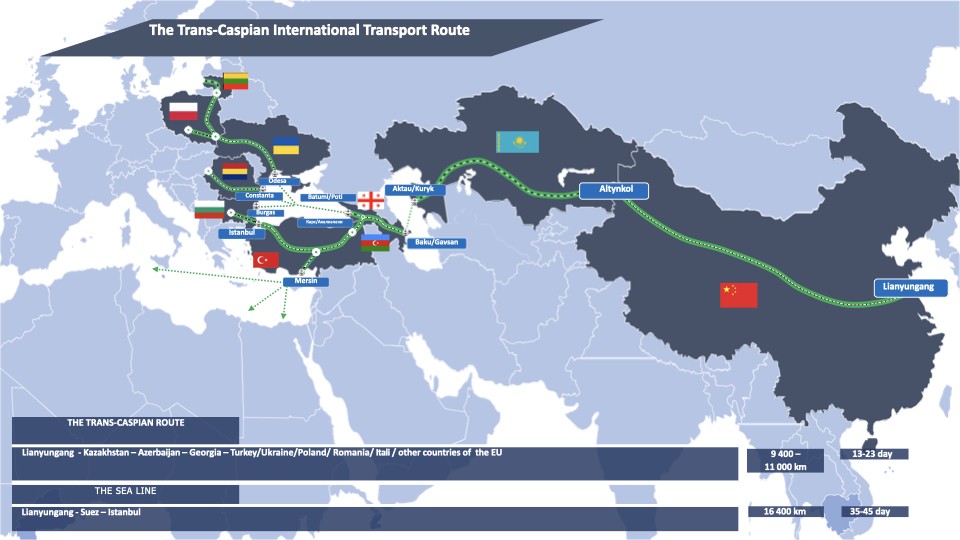
With the outbreak of Russia's war in Ukraine and the subsequent sanctions against Russia, the traditional logistics corridor between East and West has significantly narrowed. In order to ensure the safe and uninterrupted export of locally produced goods and attract transit cargoes, the Kazakh government is therefore developing new routes. One of these is the Trans-Caspian International Transport route. But, given the aggravated geopolitical situation in the region and growing competition for cargo transportation between the East and West, will the Caspian transport corridor - also known as the Middle Corridor - allow the government to meet its ambitions? Infrastructural vector of the Caspian Sea Logistics have focused on the transportation route across the Caspian Sea, considerably increasing the role of the Middle Corridor, which is facing a huge increase in demand. The countries along which the TITR route runs have started building their transport infrastructure capacities, replenishing their maritime fleets, and pooling capital and competencies in logistics and transportation. In particular, at the end of 2022, a Road Map on synchronous elimination of so-called "bottlenecks" along the route along the territories of Kazakhstan, Azerbaijan, and Turkey for 2022-2027 was signed. A joint venture, the Middle Corridor Multimodal, was established by the railway administrations of Kazakhstan, Azerbaijan, and Georgia to increase the volume of cargo transportation. A unified approach to infrastructure development by all route participants has been formed, and several projects are planned to improve the transportation infrastructure of the road's Kazakh, Azerbaijani, and Georgian sections. For the development of transportation on TITR through the seaports of Aktau and Kuryk, Kazakhstan plans to create a container hub in the port of Aktau, dredging, construction of additional berths in both harbors, restoration of oil infrastructure and renewal, as well as re-equipment of the transshipment park in the port of Aktau. In addition, a grain terminal will be built at Kuryk's seaport. Implementing these measures will increase the throughput capacity of Kazakhstan's sea harbors to 27.3 million tons per year and increase cargo traffic along the Middle Corridor. Ten oil barges, eight ferries, six tankers, and a container ship will start operating in the Caspian Sea by 2030. Furthermore, the construction in Aktau has attracted investment from the Chinese company, LLC GC Port Lianyungangan, which manages one of the largest ports in China and has signed an agreement to create a container hub at the seaport. Additionally, in partnership with the Singaporean company PSA Eagle Pte., a joint venture called KPMC Ltd has been established at the Astana International Financial Center. This venture aims to attract more cargo to the Middle Corridor, develop a digital transport corridor to optimize transportation processes, enhance the competitiveness of routes, streamline interactions, integrate partners along the cargo flow path, and improve supply chain management. Work is being undertaken to expand the presence of companies from the Caspian region in global markets. Establishing such transport and logistics enterprises along the Middle Corridor will improve transportation organization and build efficient logistics chains. The willingness of large enterprises,...

Kazakhstan Intensifies Efforts to Combat Extremism

There appears to be a small, but growing problem with terrorism and extremism in Kazakhstan. More than 30 people from regions around the country have been detained in Kazakhstan so far in 2024, and in March, Russia’s Federal Security Service (FSB) killed two Kazakh citizens who were in Russia, allegedly to carry out a terrorist attack. In response, the country’s Committee for National Security (KNB) had conducted dozens of raids. Kazakhstan’s government gave the KNB additional powers to monitor the internet, and authorities are tightening the law on religion. Kazakhstan’s southern neighbors, Tajikistan, Turkmenistan, and Uzbekistan, border Afghanistan. Tajikistan and Uzbekistan have had problems with the Taliban and other militant groups during the last 25 years. These include domestic terrorist groups, the Islamic Movement of Uzbekistan and the Tajik-led Jamaat Ansarullah, both of which have been based in northern Afghanistan. Kazakhstan has largely avoided problems with Islamic radicals. Citizens from all the Central Asian states have gone to Afghanistan and Middle Eastern countries to join jihadist groups, including a small number of Kazakh citizens. Turkey extradited a 22-year-old Kazakh citizen back to Kazakhstan on January 27, 2024. The Kazakh national, according to the KNB, was a “native of the Turkestan region [who] went to Syria in 2020, where he joined one of the armed groups operating there.” The Islamic State of Iraq and Syria (ISIS) released a propaganda video in November 2014 that showed Kazakh nationals, including children, in a training camp in Syria. The video described them as “some of our newest brothers from the land of Kazakhstan.” A group of some 25 men whom authorities said were Islamic militants staged attacks in the northwestern Kazakh city of Aktobe, near the Russian border in early June 2016. The group robbed two stores that sold hunting rifles and were involved in shoot-outs with the police and soldiers. At least 25 people were killed, most of them the attackers. Deputies in Kazakhstan’s Mazhilis, the lower house of parliament, voiced concerns in October 2023 that radical forms of Islam were spreading in Kazakhstan. Controversial MP Yermurat Bapi said followers of these radical Islamic groups were taking over bazaars in the Atyrau, Aktobe, Mangystau, Ulytau, and Almaty provinces. Bapi and 13 other deputies called on the government and KNB to take measures against these groups and stem extremist and terrorist propaganda from being disseminated inside Kazakhstan. On February 17, 2024, the KNB staged a combined 49 raids on eight unspecified religious extremist groups in the Aktobe, Atyrau, East Kazakhstan, Zhambyl, West Kazakhstan, Turkestan, and Zhetysu provinces. The KNB said it detained 23 people and seized weapons, ammunition, religious literature, narcotics, and cash. On April 1, 2024, the KNB detained a man in the Caspian coastal city of Aktau and found material for making explosives. According to the KNB, the suspect was a follower of a “radical religious ideology,” and was planning to carry out a terrorist attack.” At the start of July, five people were detained in KNB raids in the Atyrau and...

Saudi Islamic Development Bank Increasing Its Presence in Central Asia

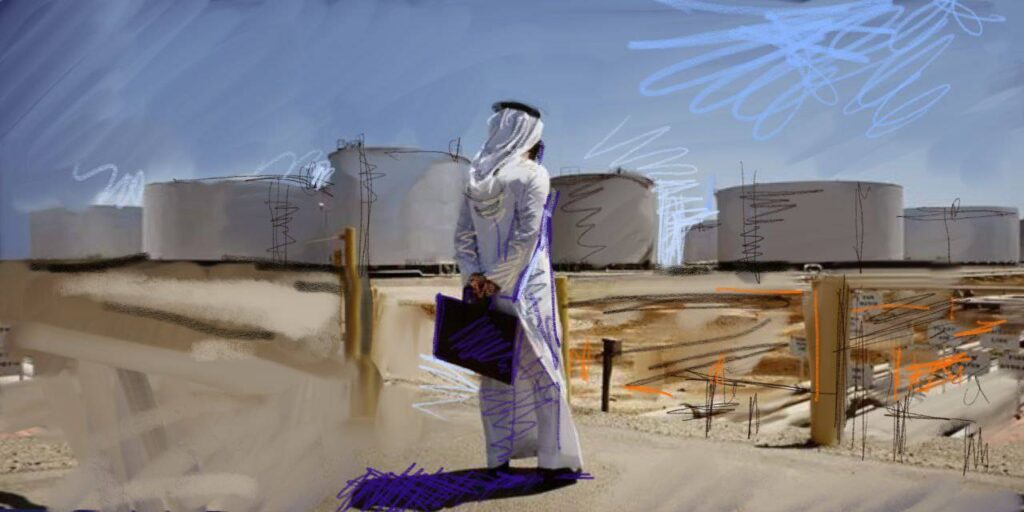
The Saudi-based Islamic Development Bank (IDB) has been particularly active in Central Asia so far in 2024. The growing IDB role is part of Central Asian region’s foreign policy shift toward the Arab world as financial backers to replace Russia, which is devoting huge attention and resources to its war in Ukraine, and China, which is increasingly reluctant to spend large sums of money in Central Asia after pouring in tens of billions of dollars there during the last 25 years. Some of the Central Asian governments owe China substantial amounts of money that they are unlikely to be able to pay for possibly decades. The Central Asian states have been members of the IDB for many years. Kyrgyzstan was first, joining in 1993, followed by Turkmenistan in 1994, Kazakhstan in 1995, Tajikistan in 1996, and Uzbekistan in 2003. One of the IDB’s three regional offices is in Almaty, Kazakhstan (the other two are in Kuala Lumpur, Malaysia and Rabat, Morocco).  The IDB has been dealing individually with the five Central Asian countries on a wide range of projects and programs in recent months. Energy Resources In February, Tajik Minister of Economic Development and Trade Zavqi Zavqizoda announced a deal was reached for the IDB to provide $250 million to Tajikistan. Zavqizoda said $150 million of that would go toward construction of the Rogun hydropower plant (HPP).  The Rogun HPP was a Soviet-era project. Construction started in 1976 but was discontinued shortly after the Soviet Union collapsed. Tajikistan restarted work on the HPP in 2008. Tajik President Emomali Rahmon has repeatedly said that building the HPP with a planned 3600 MW capacity will make the country energy independent and even allow Tajikistan to bring in extra revenue exporting electricity to neighboring countries.  In its 28 years as an IDB member, Tajikistan had received some $620 million from the IDB, so the $250 million announced in February 2024 represents a significant jump in IDB financial help. Not surprisingly, when IDB President Muhammad Al-Jasser visited Kyrgyzstan in June, Kyrgyz President Sadyr Japarov sought IDB investment in the Kambar-Ata-1 HPP, another decades-old project with a multi-billion-dollar price tag that has barely made any progress in being realized during the 33 years Kyrgyzstan has been independent. Al-Jasser did not commit to IDB financing for the Kyrgyz HPP. However, less than a week after Al-Jasser was in Kyrgyzstan, the IDB was one of several international financial organizations that signed on at a conference in Vienna to be a members of a coordination donors’ committee for the Kambar-Ata-1 projects. At a meeting in Istanbul in February, the IDB reaffirmed its support for the Central Asia-South Asia-1000 (CASA-1000) project that aims to export electricity from HPPs in Kyrgyzstan and Tajikistan to Afghanistan and Pakistan. Kyrgyz Energy Minister Taalaybek Ibrayev met with Al-Jasser in June during the latter’s visit to Kyrgyzstan to discuss funding for Kyrgyzstan’s section of CASA-1000. Not Only Energy In June, the IDB pledged up to $2 billion in funding for improvements to water management...

Almaty’s Aspan Gallery Champions Central Asian Art at Home and Abroad

“It’s difficult to be a point, but it’s easy to be a line, as everything in our world is moving.” The quote by Soviet avant-garde artist Sergey Kalmykov became the title of a 2020 show by Kazakh artists Almagul Menlibayeva and Yerbossyn Meldibekov, the first exhibition by Almaty-based gallery Aspan to be staged in the UK. This concept of continuous movement aptly describes the nine-year trajectory of the Aspan Gallery, founded and directed by Meruyert Kaliyeva. Maintaining its focus on contemporary Central Asian art, the gallery is constantly expanding and adapting to the dynamic of the international art world. [caption id="attachment_20211" align="aligncenter" width="776"] Dilyara Kaipova @Aspan[/caption]   The story of how the gallery came into being is unconventional. Meruyert Kaliyeva studied art in the UK, with the intention of practicing as an artist. She soon discovered, however, that the life of an artist was not for her and explained to TCA: “To be an artist, you must sacrifice your social and family life. You must disconnect from it all, and I was not willing to do that.” At the same time, she noticed that unlike her, many individuals at art school seemed destined to become artists. "Some people don’t have the luxury of choice,” she recalls. “I felt that these people needed to focus solely on creating art, and I realised I could help unburden them from some practical preoccupations.” After four years and a half working in auction houses in the UK, Kaliyeva finally decided to return to Kazakhstan. Having quickly realised the importance of supporting artists in a region where institutional support for contemporary art is extremely limited, she opened what is now the Aspan Gallery. Kaliyeva’s mission was  twofold. In tandem with developing the Central Asian art scene locally, through staging important historical exhibitions, publishing books and catalogues, and commissioning artists, she also concentrated on disseminating knowledge of Central Asian art abroad. A case in point is Aspan’s recent, significant donation to the Stedelijk Museum in Amsterdam. The donation was curated by Robbie Schweiger, based on research conducted in Kazakhstan, Kyrgyzstan, and Uzbekistan, and with input from Kaliyeva, connections were drawn between Central Asian artists and the Stedelijk’s permanent collection. The Times of Central Asia spoke to Kaliyeva about both the donation and the growth of the Kazakh art scene over the past few years. TCA: Why did you choose the Stedelijk Museum in Amsterdam for such a significant donation? MK: We were keen to have some of our artists represented in major institutions and identified three museums as contenders. The first on the list was the Stedelijk, which already held a collection of Central Asian art. The donation comprised 22 works by 13 artists from Kazakhstan, Kyrgyzstan, and Uzbekistan, spanning almost fifty years, from 1974 to 2020. Works from the 1970s and 1980s, created by artists associated with the underground art scene of the former Soviet republics, were complemented by work made after these republics gained independence in the early 1990s., in which  artists explored national...

SCO Summit: A Battle for Influence in Central Asia

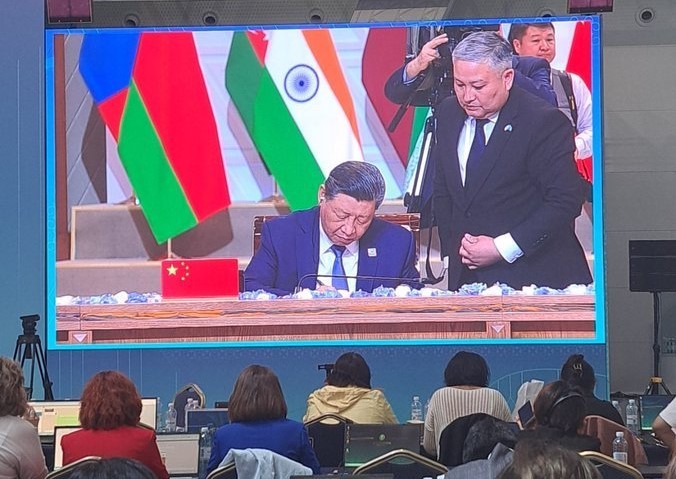
For Central Asian countries, the Shanghai Cooperation Organization (SCO) is a tool that allows them to improve their position in the global arena, and develop closer economic ties with other members of the world’s largest multilateral group. But for Russia and China, the SCO is an instrument that gives them an opportunity to strengthen their influence in the strategically important region of Central Asia. Last week, the SCO (whose members are Russia, China, India, Iran, Kyrgyzstan, Kazakhstan, Pakistan, Tajikistan, Uzbekistan, as well as Belarus, the entrant at the meeting in Astana on July 3-4) held the summit of the Council of Heads of State of the SCO in the Kazakh capital of Astana where its leaders adopted a series of documents – from the Astana Declaration, underscoring the organization’s role in bolstering global peace, security and stability, through the SCO Development Strategy until 2035, to the group’s Economic Development Strategy’s Action Plan until 2030. Prior to the meeting of what is often described as “the world’s least known and least analyzed” multilateral group, Kazakhstan’s President Kassym-Jomart Tokayev repeatedly stated that, over the past 20 years it was not possible to implement a single major economic project under the auspices of the SCO. Indeed, ever since its foundation in 2001, the SCO has mostly been focusing on security issues, and during the summit in Astana security was yet again at the top of the agenda. But as the largest Central Asian nation’s Deputy Foreign Minister Roman Vassilenko told me at the briefing with the foreign journalists on July 4, SCO members still work more on a bilateral rather than on a multilateral basis. In his view, advancing economic cooperation within the organization of very diverse nations is not an easy task. Quite aware of that, China seeks to strengthen its economic presence in Central Asia through other formats such as the Belt and Road Initiative, and the China-plus-Central Asia format. In the past, Beijing was actively pushing for closer economic integration between SCO members, but Russia reportedly blocked Chinese initiatives. As a result, the People’s Republic began to sign bilateral agreements with regional countries, aiming to strengthen its role in Central Asia. Kazakhstan, as the region’s largest economy, is no exception. Despite being a Russian ally in the Collective Security Treaty Organization (CSTO), and a member of the Russian-led Eurasian Economic Union, Astana seems to see Beijing, rather than Moscow, as the de facto leader of the SCO. As Vassilenko stressed, out of 10,000 people who came to Astana for the summit, more than half of them were Chinese, which indicates that the SCO holds a huge importance in Beijing’s foreign policy. Moreover, Chinese President Xi Jinping seems to have received a warmer welcome in the Kazakh capital than Russian leader Vladimir Putin or the heads of states of other SCO members. At the airport, where Xi was welcomed by his Kazakh counterpart Kassym-Jomart Tokayev, a group of Kazakh children sang the song "Ode to the Motherland" in Chinese, while Chinese...

Kazakh Government Is Trying (Again) To Introduce An Unpopular Betting Law

A newly resurrected Law on Gambling Business is set to come into force in Kazakhstan. The law will see the introduction of a new private betting regulator that will be granted extensive government powers, and pocket 1.5% of all betting transactions. Its return bodes yet another bout of strategic networks in the Kazakh government, where powerful lobbying forces from private companies are increasingly finding a presence in the corridors of power. The fast track of this new regulator is unusual. Despite protests from the betting industry, the bill passed the second reading. The regulator, formerly known as the Betting Accounting Centre (BAC) and now renamed the Unified Accounting System (UAS), passed the first reading in Parliament on June 3, and the second reading on June 5. Later on 28 June, the Senate approved the bill and it is now waiting to be signed into law. Several consequences could follow once this new regulator is enforced. They include the new body performing as a gambling referee, and therefore possessing privileges in terms of resource allocation, production, and sales. At the same time, the regulator will determine market competition and pocket 1.5% of all profits. With such sweeping powers, there is no mention as to how the regulator will be monitored and controlled to ensure it acts transparently. In January this year, the Kazakh parliament announced that it intended to reintroduce the new betting law in parliament, two years after a scandal involving a deputy minister accepting bribes from pro-regulator lobbyists forced the government to abandon its first attempt to pass the law. This year’s bill would be identical to the previous one, except for two changes: the term “Betting Account Centre” will be replaced by the more circumlocutious “Unified Accounting System”; and the regulator will perform the role of a fintech company controlling all financial transactions of the betting sector. The introduction of the bill just over two years ago shocked the Kazakh betting industry. The introduction of a third-party regulator with government powers that could control and determine market players and obtain 1.5% of profits drew immediate comparisons to old Kazakhstan, a troubled history which president Tokayev insists the country is moving away from. After speaking up against the regulator in 2019, particularly on its powers to obtain shady profits and capacity for abuse, the owners of independent bookmaking company Olimp were arrested by the government as members of ‘organised crime syndicates.’ The conventional wisdom was that the parliament had learned from the debacle and would now be pursuing more subtle means of silencing the opposition to this bill. So, besides the polishing up of the regulator label, what has changed? And why might the Kazakh parliament think things will turn out differently for them this year? For one, the Kazakh parliament has labelled this new law under the guise of a public health concern and to help the younger generation combat the rising problem of gambling addiction in Kazakhstan. This includes increasing the age of betting to 21 and...