• KGS/USD = 0.01144 0%
  • KZT/USD = 0.00216 0%
  • TJS/USD = 0.10456 0%
  • UZS/USD = 0.00008 0%
  • TMT/USD = 0.28571 0%
  • KGS/USD = 0.01144 0%
  • KZT/USD = 0.00216 0%
  • TJS/USD = 0.10456 0%
  • UZS/USD = 0.00008 0%
  • TMT/USD = 0.28571 0%
  • KGS/USD = 0.01144 0%
  • KZT/USD = 0.00216 0%
  • TJS/USD = 0.10456 0%
  • UZS/USD = 0.00008 0%
  • TMT/USD = 0.28571 0%
  • KGS/USD = 0.01144 0%
  • KZT/USD = 0.00216 0%
  • TJS/USD = 0.10456 0%
  • UZS/USD = 0.00008 0%
  • TMT/USD = 0.28571 0%
  • KGS/USD = 0.01144 0%
  • KZT/USD = 0.00216 0%
  • TJS/USD = 0.10456 0%
  • UZS/USD = 0.00008 0%
  • TMT/USD = 0.28571 0%
  • KGS/USD = 0.01144 0%
  • KZT/USD = 0.00216 0%
  • TJS/USD = 0.10456 0%
  • UZS/USD = 0.00008 0%
  • TMT/USD = 0.28571 0%
  • KGS/USD = 0.01144 0%
  • KZT/USD = 0.00216 0%
  • TJS/USD = 0.10456 0%
  • UZS/USD = 0.00008 0%
  • TMT/USD = 0.28571 0%
  • KGS/USD = 0.01144 0%
  • KZT/USD = 0.00216 0%
  • TJS/USD = 0.10456 0%
  • UZS/USD = 0.00008 0%
  • TMT/USD = 0.28571 0%

Viewing results 115 - 120 of 1148

Mirziyoyev Begins Japan Visit With Central Asia Leaders’ Reception in Tokyo

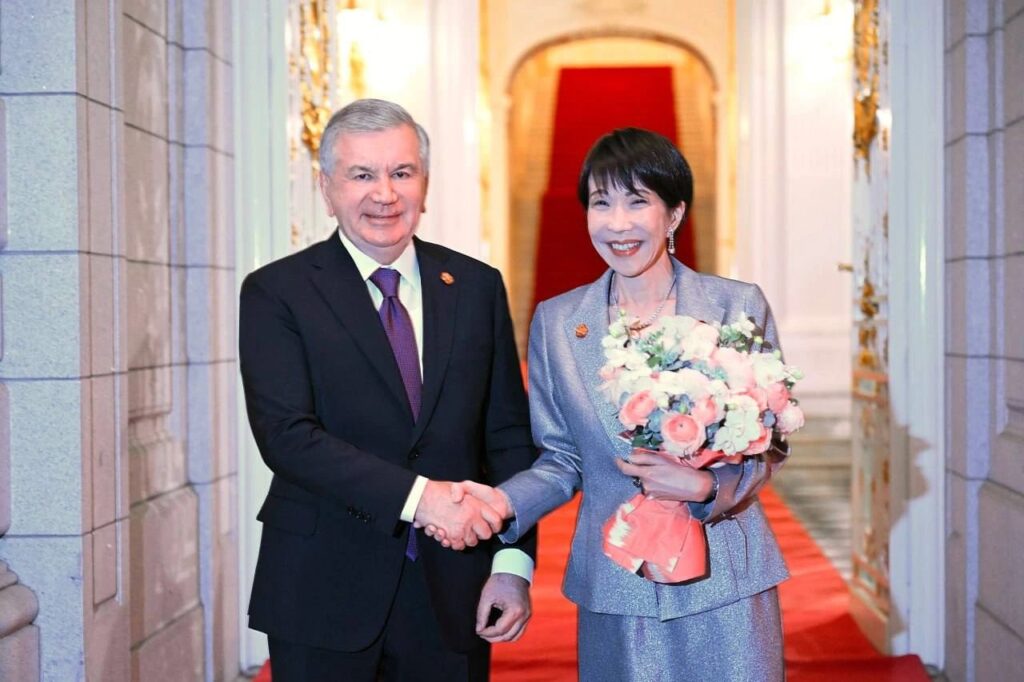
President Shavkat Mirziyoyev of Uzbekistan began his visit to Japan on Thursday by attending an official reception hosted by Japan’s Prime Minister Sanae Takaichi at the Akasaka Palace in Tokyo. The event marked the opening of a series of engagements bringing together the leaders of Central Asia and Japan, with a focus on strengthening regional cooperation. The reception brought together the presidents of all five Central Asian states. Alongside Mirziyoyev were President Kassym-Jomart Tokayev of Kazakhstan, President Sadyr Japarov of Kyrgyzstan, President Emomali Rahmon of Tajikistan, and President Serdar Berdimuhamedov of Turkmenistan. The gathering underscored Japan’s effort to engage the region as a group, rather than solely through bilateral ties. Mirziyoyev’s presence at the Akasaka Palace, a venue reserved for state-level diplomacy, highlighted Uzbekistan’s growing role in Central Asia and its expanding foreign policy outreach beyond the immediate region. In recent years, Tashkent has sought to deepen ties with Asian partners, including Japan, in areas ranging from infrastructure and energy to education and technology. According to the visit programme, Mirziyoyev will hold high-level talks with Japanese government officials on December 20. Those discussions are expected to focus on trade and investment, technological cooperation, and sustainable development, including green energy and climate resilience. Japan has been a long-standing development partner for Uzbekistan, providing loans, grants, and technical assistance through agencies such as the Japan International Cooperation Agency. The visit will feature the inaugural leaders-level “Central Asia + Japan” Dialogue Summit, bringing all six sides together in a multilateral format. The summit is intended to build on earlier dialogue mechanisms and explore joint approaches to economic connectivity, regional stability, and long-term growth. For Mirziyoyev, the Tokyo meetings offer an opportunity to reinforce Uzbekistan’s reform agenda on an international stage and to position the country as an active participant in shaping Central Asia’s collective engagement with major partners such as Japan.

UK Adds Uzbekistan-Based Companies and Tashkent Businessman to Russia Sanctions List

Britain has expanded its Russia sanctions regime to include four companies based in Uzbekistan and one Tashkent-born businessman, according to official documents published on 18 December 2025. The measures form part of a wider update that added 24 new individuals and entities to the UK’s consolidated sanctions list under the Russia (Sanctions) (EU Exit) Regulations 2019. The update was set out in a Financial Sanctions Notice issued by HM Treasury and an accompanying Foreign Office policy paper, “List of Russia sanctions targets, 18 December 2025.” The documents confirm that all newly designated names are now subject to an asset freeze and associated financial restrictions in the UK. The four Uzbekistan-linked companies named in the notice are Fargona Kimyo Zavodi LLC, also listed under the English alias Fergana Chemical Plant; Gelion Business Trade MCHJ, registered in Tashkent; Raw Materials Cellulose MCHJ, based in the Jizzakh region; and LLC JV Chemistry International, located in the Navoi region. Each company is subject to an asset freeze, requiring that any funds or economic resources they own or control in the UK be frozen and that UK persons do not make funds or resources available to them without a licence. The Treasury notice also applies restrictions on trust services. Under UK sanctions law, this restricts UK persons from providing trust services to or for the benefit of designated persons unless an exemption applies or a licence is granted. Compliance guidance is published by the Office of Financial Sanctions Implementation and linked through the British government’s Sanctions List. The documents do not provide detailed descriptions of the companies’ commercial activities, instead using standard statutory wording. In each case, the Secretary of State notes that there are reasonable grounds to suspect the entity “is or has been involved in destabilising Ukraine or undermining or threatening the territorial integrity, sovereignty or independence of Ukraine,” including by making available goods or technologies that could contribute to those outcomes. The sanctions update also includes Rustam Muminov, born in Tashkent in 1953. The Treasury notice lists his nationalities as Uzbek, Israeli, and Russian. Muminov is subject to an asset freeze and trust services restrictions, with the reason stated being that the British authorities have reasonable grounds to suspect he has been involved in destabilizing Ukraine by providing financial services or by making available funds, economic resources, goods, or technology. The Foreign Office policy paper groups the new designations with others added on the same date, which include entities linked to Russia’s energy sector, financial circumvention, and the military-industrial complex. The government says the measures are intended to limit access to financial services and resources that could support Russia’s actions against Ukraine.

EDB Forecasts Strong Economic Growth in 2026 for Kazakhstan, Kyrgyzstan, Tajikistan, and Uzbekistan

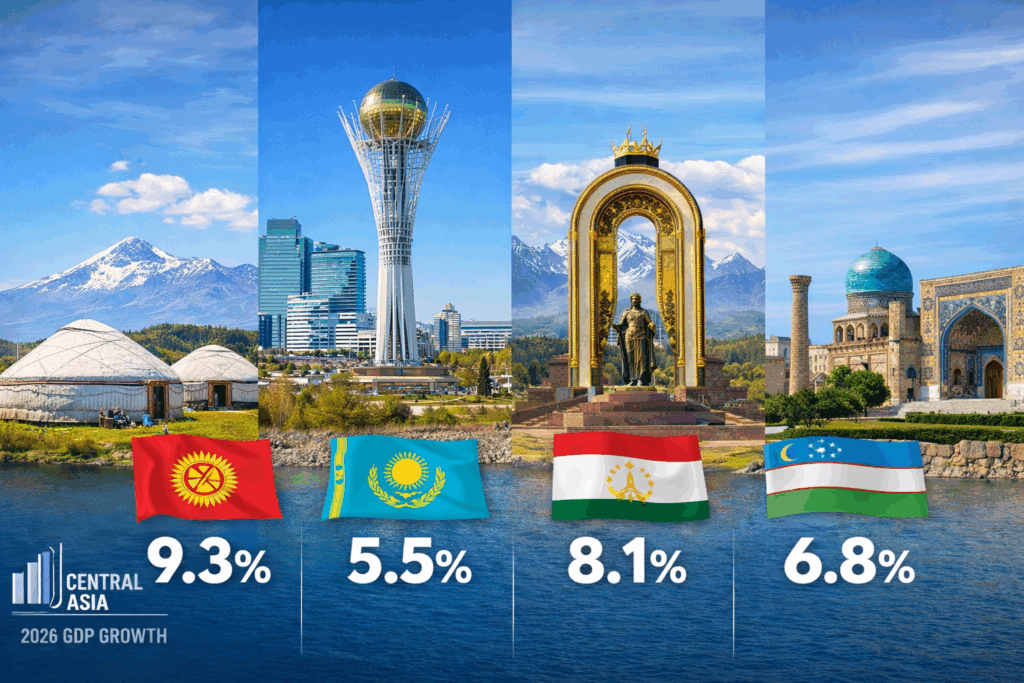
On December 18, the Eurasian Development Bank (EDB) published its Macroeconomic Outlook for 2026-2028, reviewing recent economic developments and offering projections for its seven member states: Armenia, Belarus, Kazakhstan, Kyrgyzstan, Russia, Tajikistan, and Uzbekistan. According to the report, aggregate GDP growth across the EDB region is forecast to reach 2.3% in 2026. Kyrgyzstan (9.3%), Tajikistan (8.1%), Uzbekistan (6.8%), and Kazakhstan (5.5%) are expected to remain the region’s fastest-growing economies. After two years of rapid expansion, the region’s GDP growth is set to moderate to 1.9% in 2025, down from 4.5% in 2024, mainly due to a slowdown in Russia’s economy. Although lower oil prices are expected to reduce export revenues for energy exporters such as Kazakhstan and Russia, the impact on overall growth will be limited. Meanwhile, net oil importers, including Armenia, Belarus, Kyrgyzstan, Tajikistan, and Uzbekistan, will benefit from improved terms of trade and reduced inflationary pressure. High global gold prices will support foreign exchange earnings for key regional exporters, including Kyrgyzstan, Tajikistan, and Uzbekistan. The report also notes a gradual decline in the U.S. dollar’s share in central bank reserves across the region, though its role in international settlements remains stable. Kazakhstan Kazakhstan’s economy is projected to grow by 5.5% in 2026, supported by the implementation of the National Infrastructure Plan and the state program “Order for Investment,” which are expected to cushion the effects of lower oil prices. Growth in non-commodity exports will also play a stabilizing role. Inflation is forecast to decline to 9.7% by the end of 2026, after peaking early in the year due to a value-added tax (VAT) increase. The average tenge exchange rate is expected to be KZT 535 per U.S. dollar, underpinned by a high base interest rate and rising export revenues. Kyrgyzstan Kyrgyzstan is forecast to lead the region in GDP growth at 9.3% in 2026, driven by higher investment in transport, energy, water infrastructure, and housing construction. Inflation is expected to ease to 8.3%, although further declines will be constrained by higher tariffs and excise taxes. The average exchange rate is projected at KGS 89.2 per U.S. dollar, supported by robust remittance inflows and high global gold prices, gold being the country’s main export commodity. Tajikistan Tajikistan is projected to maintain high GDP growth of 8.1% in 2026, fueled by capacity expansion in the energy and manufacturing sectors, along with rising prices for gold and non-ferrous metals. Inflation is expected to reach 4.5% by year-end. The somoni is expected to remain stable, with an average exchange rate of TJS 9.8 per U.S. dollar, supported by growth in exports and remittances. Uzbekistan Uzbekistan’s economy is forecast to expand by 6.8% in 2026, sustained by strong investment activity and favorable gold prices. Inflation is projected to decline to 6.7%, helped by tight monetary policy and a stable exchange rate. The average soum exchange rate is expected to be UZS 12,800 per U.S. dollar, supported by high remittances and increased metal exports.

Thousands Donate in Name of Uzbek-American Student Killed at Brown University

A fundraising campaign dedicated to an 18-year-old Uzbek-American student who was killed in a shooting at Brown University in Rhode Island has collected more than half a million U.S. dollars. MukhammadAziz Umurzokov, who went to high school in Virginia, and another Brown student, 19-year-old Ella Cook of Alabama, died in the attack in a university building on December 13. Nine other students were injured. Law enforcement agencies are searching for the suspect and have not publicly commented on a possible motive. One of Umurzokov’s sisters, Samira Umurzokova, set up a GoFundMe page that had drawn more than 10,000 donations totaling over $500,000 by Thursday. “Our family is incredibly devastated by this loss. Any donations will help significantly with any expenses my family will have to face, and the rest of the funds will be donated to charity in his name,” the page reads. Without providing personal details, it lists a William Ackman as making the top donation of $18,000. American billionaire investor William, or Bill, Ackman, has been active in other fundraising campaigns, including the GoFundMe campaign for Ahmed al-Ahmed, a man who disarmed one of the two shooters in the attack at Sydney’s Bondi Beach that killed 15 people on December 14. Al-Ahmed was hospitalized after being shot. One of two gunmen, believed to have been inspired by the Islamic State group, was killed; the second was injured and has been charged with murder and terrorism. Umurzokova has said that her brother, who was a first-year student at Brown, had suffered Chiari malformation, in which brain tissue extends into the spinal canal, as a child. He wanted to become a doctor so that he could help people in the same way that he was helped, she said. “He’s a real person. He had real ambitious goals and aspirations, like anyone else would,” Umurzokova said in a CNN interview. “I want people to know that him and the other victims are not just numbers. They’re not just statistics. They’re real people and real families are genuinely hurting like crazy because of their loss.” Umurzokova said her parents wanted people to “hear their son’s name, see their son’s picture, instead of, you know, seeing ‘two dead nine injured.´” Cook, the other student who was killed in the Brown shooting, was a sophomore focusing on French and mathematics-economics.

Japan Steps Out of the Shadows With First Central Asia Leaders’ Summit

On December 19-20, Tokyo will host a landmark summit poised to reshape Eurasian cooperation. For the first time in the 20-year history of the “Central Asia + Japan” format, the dialogue is being elevated to the level of heads of state. For Japan, this represents more than a diplomatic gesture; it signals a shift from what analysts often describe as cautious “silk diplomacy” to a more substantive political and economic partnership with a region increasingly central to global competition over resources and trade routes. The summit will be chaired by Japanese Prime Minister Sanae Takaichi. The leaders of all five Central Asian states, Kazakhstan, Kyrgyzstan, Tajikistan, Turkmenistan, and Uzbekistan, have confirmed their participation. Alongside the plenary session, bilateral meetings and a parallel business forum are scheduled to take place. Why Now? Established in 2004, the “Central Asia + Japan” format has largely functioned as a platform for foreign ministers and technical cooperation. According to Esbul Sartayev, assistant professor at the Center for Global Risks at Nagasaki University, raising the dialogue to the head-of-state level marks a deliberate step by Japan to abandon its traditionally “secondary” role in a region historically dominated by Russia and China. This shift comes amid a changing geopolitical context: disrupted global supply chains, intensifying competition for critical and rare earth resources, and a growing U.S. and EU presence in Central Asia. In this environment, Tokyo is promoting a coordinated approach to global order “based on the rule of law”, a neutral-sounding phrase with clear geopolitical resonance. Unlike other external actors in Central Asia, Japan has historically emphasized long-term development financing, technology transfer, and institutional capacity-building rather than security alliances or resource extraction. Japanese engagement has focused on infrastructure quality, human capital, and governance standards, allowing Tokyo to position itself as a complementary partner rather than a rival power in the region. Economy, Logistics, and AI The summit agenda encompasses a range of priorities: sustainable development, trade and investment expansion, infrastructure and logistics, and digital technology. Notably, the summit is expected to include a new framework for artificial intelligence cooperation aimed at strengthening economic security and supply chain development. It is also likely to reference expanded infrastructure cooperation, including transport routes linking Central Asia to Europe. As a resource-dependent country, Japan sees Central Asia as part of its evolving “resource and technological realism” strategy. For the Central Asian states, this presents a chance to integrate into new global value chains without being relegated to the role of raw material suppliers. Kazakhstan: Deals Worth Billions The summit coincides with Kazakh President Kassym-Jomart Tokayev’s official visit to Japan from December 18-20. During the visit, more than 40 agreements totaling over $3.7 billion are expected to be signed. These span energy, renewables, digitalization, mining, and transport. Participants include Samruk-Kazyna, KEGOC, Kazatomprom, KTZ, and major Japanese corporations such as Marubeni, Mitsubishi Heavy Industries, Toshiba, and JOGMEC. Japan’s ambassador to Kazakhstan, Yasumasa Iijima, has referred to Kazakhstan as a future Eurasian transport and logistics hub, highlighting its strategic role in developing the Trans-Caspian...

Financing Agreement for China-Kyrgyzstan-Uzbekistan Railway Project Signed in Bishkek

On December 16, a loan agreement was signed in Bishkek to finance the construction of the China-Kyrgyzstan-Uzbekistan (CKU) railway, an ambitious regional transport project intended to bolster connectivity across Central and South Asia. According to the Kyrgyz government, the agreement was concluded between China-Kyrgyzstan-Uzbekistan Railway Company LLC, a joint venture formed by the three participating countries and a syndicate of Chinese banks, including the China Development Bank and Eximbank. The CKU railway has been discussed for more than two decades, but repeatedly stalled over financing, route selection, and technical concerns. Momentum increased after 2022 as China sought alternative westbound transport corridors and Central Asian states looked to diversify trade routes and reduce reliance on existing transit pathways. The total cost of the railway project is estimated at $4.7 billion. Half of that amount, approximately $2.3 billion, will be provided as a 35-year loan from China to the joint project company, which will be responsible for repayment. The remaining $2.3 billion will be contributed to the company’s authorized capital: China will cover 51%, while Kyrgyzstan and Uzbekistan will each provide 24.5%. The CKU railway is a strategically significant infrastructure initiative spanning 523 kilometers. Construction officially began on December 27, 2024, in Kyrgyzstan’s Jalal-Abad region. Once completed, the railway will link Kashgar in China with Torugart, Makmal, and Jalal-Abad in Kyrgyzstan, and continue on to Andijan in Uzbekistan. A cargo transshipment station and logistics hub are planned in Makmal. The railway is expected to handle up to 15 million tons of cargo annually. Despite its strategic appeal, the project has raised concerns about debt exposure, particularly for Kyrgyzstan, which already relies heavily on Chinese financing. Officials say the joint-venture structure and long loan maturity will limit fiscal risks, though critics argue projected cargo volumes will need to be met for the railway to be financially sustainable. Currently, neither Kyrgyzstan nor Uzbekistan has a direct rail link with China; the only such connection in Central Asia runs through Kazakhstan. For Uzbekistan, the railway is expected to shorten transit times to Chinese markets and expand export capacity for industrial and agricultural goods. Officials in Tashkent have argued that the CKU route could reduce delivery times by several days compared with existing rail corridors. The CKU railway is among the most technically complex projects in the region. It includes the construction of 50 bridges and 29 tunnels, totaling 120 kilometers in length, meaning roughly 40% of the route will consist of bridges and tunnels. The Kyrgyz section alone will cover 304 kilometers. On December 5, Chairman of the Kyrgyz Cabinet of Ministers Adylbek Kasymaliev visited the construction site of one of the tunnels in the Jalal-Abad region to inspect progress. According to government sources, work has begun on 18 of the 29 planned tunnels and 17 of the 50 bridges. The project currently involves 5,695 pieces of machinery and over 5,000 workers. For Kyrgyzstan, the CKU railway represents the largest infrastructure project in the country’s history. Authorities view the project as a chance to transform...