• KGS/USD = 0.01144 0%
  • KZT/USD = 0.00212 0%
  • TJS/USD = 0.10456 0.19%
  • UZS/USD = 0.00008 0%
  • TMT/USD = 0.28490 0%
  • KGS/USD = 0.01144 0%
  • KZT/USD = 0.00212 0%
  • TJS/USD = 0.10456 0.19%
  • UZS/USD = 0.00008 0%
  • TMT/USD = 0.28490 0%
  • KGS/USD = 0.01144 0%
  • KZT/USD = 0.00212 0%
  • TJS/USD = 0.10456 0.19%
  • UZS/USD = 0.00008 0%
  • TMT/USD = 0.28490 0%
  • KGS/USD = 0.01144 0%
  • KZT/USD = 0.00212 0%
  • TJS/USD = 0.10456 0.19%
  • UZS/USD = 0.00008 0%
  • TMT/USD = 0.28490 0%
  • KGS/USD = 0.01144 0%
  • KZT/USD = 0.00212 0%
  • TJS/USD = 0.10456 0.19%
  • UZS/USD = 0.00008 0%
  • TMT/USD = 0.28490 0%
  • KGS/USD = 0.01144 0%
  • KZT/USD = 0.00212 0%
  • TJS/USD = 0.10456 0.19%
  • UZS/USD = 0.00008 0%
  • TMT/USD = 0.28490 0%
  • KGS/USD = 0.01144 0%
  • KZT/USD = 0.00212 0%
  • TJS/USD = 0.10456 0.19%
  • UZS/USD = 0.00008 0%
  • TMT/USD = 0.28490 0%
  • KGS/USD = 0.01144 0%
  • KZT/USD = 0.00212 0%
  • TJS/USD = 0.10456 0.19%
  • UZS/USD = 0.00008 0%
  • TMT/USD = 0.28490 0%

Our People > Duisenali Alimakyn

Duisenali Alimakyn's Avatar

Duisenali Alimakyn is a Kazakh journalist, translator, and researcher covering literature, culture, and science. His research, including at the George Washington University, has a strong focus on Western narratives about Central Asia over the centuries.

Articles

Kazakh Entrepreneur in Paris Launches Perfume Inspired by the “Kiz-Jibek” Epic

An ethnic Kazakh living in Paris has launched a perfume called Kiz-Jibek on the French market. Its founder, Nurzhan Tolegen, was born in China’s Ili Kazakh region and grew up in Kulja before eventually settling in the French capital. “I am the grandson of a nomadic people. My grandparents left their homeland during the civil war, carrying with them the soul of Kazakhstan etched into their stories, their songs, and their memories. Yet I had never set foot on those vast steppes whose grandeur my mother, a professor of literature, so often evoked,” he shares on his personal website. [caption id="attachment_35686" align="aligncenter" width="466"] Nurzhan Tolegen; image: www.tolegenparis.com[/caption] In 2021, Nurzhan traveled to Kazakhstan for the first time, spending a month reconnecting with his ancestral homeland. Those four weeks felt like a rebirth for him and marked a turning point in his life. Returning to France, he established a luxury perfume house, Tolegen Paris: a tribute to both his surname and to a heroic figure celebrated in a 16th-century Kazakh epic. In May 2025 he introduced Kiz-Jibek, describing it as “a fragrance honoring eternal love” and “a scent laced with wormwood.” The Kiz-Jibek epic, a cornerstone of Kazakh cultural heritage, reflects the values of traditional society. It emphasizes unity and loyalty to the homeland while exploring universal themes of love, virtue, honesty, and beauty. Through the character of Kiz-Jibek, one encounters the timeless image of the Kazakh woman—gentle yet resilient, modest yet dignified. [caption id="attachment_35688" align="aligncenter" width="624"] The epic characters Kiz-Jibek and Tolegen[/caption] For over five centuries, Kazakhs have sung the tale of Kiz-Jibek. Its central figures—Bazarbai, Tolegen, Kiz-Jibek, and Sansyzbai—are believed to have lived in history, with the story unfolding along the Ural River among the Jagalbaily tribe. In both the epic and the famous film, Tolegen is treacherously slain by Bekezhan, after which Kiz-Jibek, devastated by grief, throws herself into the river.

7 months ago

Henry Wallace’s Journey to Central Asia and Its Connection to Kazakhstan

Central Asia has long held significance for the Western world — both in the past century and today. The region is home to ancient peoples and rich indigenous traditions. As a journalist from Kazakhstan, I became curious about the cultural ties between the United States and my country. In 2023, I studied at George Washington University through the Bolashak scholarship program to explore this subject in depth. My research led me to numerous works written by American travelers and scholars. Among them, I discovered a book authored by former U.S. Vice President Henry Wallace, based on his journey to Central Asia. [caption id="attachment_35215" align="aligncenter" width="351"] Henry WallaceCredit Hudson Institute[/caption] His book, Soviet Asia Mission, was published in New York in 1946 and reflects observations from that trip. During this special mission in 1944, Wallace first traveled through Siberia, where he studied the conditions of the local population, before continuing on to the Kazakh steppe. Wallace describes the social and political realities of Kazakhstan under Soviet rule, as well as the industrial projects that caught his attention. As a senior American politician, he was particularly interested in production and agriculture. “Down to meet us at the airfield was the director, Georg Georgevich Spitsen. In motorcars, we drove at once to the largest of Karaganda's three big open-pit coal mines. With a sweeping gesture, Spitsen said: “We are digging 6,000 tons of coal a day here. Production began a year ago." A proud shovel operator, scooping up tons of run-of-mine coal to load into steel hopper cars, waved to us. The tracks were driven directly into the cut. We looked closely at the shovel's trademark. It was a Bucyrus Erie electric shovel, one of three at work here, and had been shipped in under lend-lease from the United States.” His journey to Kazakhstan in the previous century demonstrates that U.S.–Kazakh political contacts began earlier than is often assumed.. Although Kazakhstan’s place in the Soviet system was highly constrained, Wallace’s account provides valuable insight into the wartime Soviet republics.. “After lunch at Karaganda, we took off, flying southwest over very dry country. Even the streams were dried out, except in deep valleys where clusters of huts could be seen in the midst of green oases. When still a long distance away, we could see a wide expanse of water ahead. It was Lake Balkhash, bright blue in the midst of gray, treeless country. Along the shore rose the smoking stacks of smelters. On landing at the dirt airfield, we were welcomed to the copper-smelting town of Balkhash by its mayor, Anna Stepanovna Piribinus, president of the city Soviet.” His next stop was Semipalatinsk (today’s Semey). There Wallace spoke with Dimitri Chuvakhin of the Soviet Foreign Office, who accompanied him on the trip. “This kind of thing,” he said, referring to the new towns we had seen, “this kind of thing saved Russia. Trotsky was against it; he thought there had to be a world revolution. Stalin had faith in the moral stamina of...

8 months ago

How Did Kazakh Poet Abai Qunanbaiuly`s Name Reach the U.S.?

Kazakh literature is filled with towering figures who have shaped the nation’s cultural and spiritual identity. Among them, Abai Qunanbaiuly (1845–1904) remains the most iconic. A poet, philosopher, and intellectual of global stature, Abai left behind a legacy that continues to resonate within world literature. As Kazakhstan celebrates the 180th anniversary of his birth, it is a fitting moment to explore how his influence extended far beyond the steppe, reaching as far as the United States. George Kennan: The American Who Introduced Abai to the World In 1885, American journalist George Kennan visited Semey (then Semipalatinsk) and was deeply impressed by the city’s public library. To his surprise, local Kazakhs actively borrowed and read books, a rare sight for that time and region. In his influential work Siberia and the Exile System, Kennan specifically mentioned Abai, marking one of the earliest references to the Kazakh thinker in Western literature. Kennan’s account stands out for its authenticity. It is based not on secondhand stories but on direct observation. His writings confirm Abai’s presence in Semey’s intellectual life and suggest that the poet had begun to attract attention well beyond the Kazakh steppe. [caption id="attachment_34625" align="alignnone" width="232"] Credit «Siberia and the Exile System», by George Kennan[/caption] From Kennan’s descriptions, we gain insight into what Abai read, who his associates were, and how his worldview aligned with major thinkers of the time. Abai’s intellectual growth was greatly influenced by E. P. Mikhaelis, a Russian political exile and lifelong friend. Under Mikhaelis’s guidance, Abai refined his reading habits and began a new phase of self-education. Through Mikhaelis, he was introduced to other exiled Russian intellectuals such as S. S. Gross, A. A. Leontiev, and N. I. Dolgopolov. These thinkers were struck by Abai’s intellectual depth, civic engagement, and dedication to the betterment of his people. In return, Abai introduced them to Kazakh culture, history, and oral traditions, becoming a cultural bridge between East and West. [caption id="attachment_34627" align="alignnone" width="300"] Аbai and E.P. Mikhaelis[/caption] Kennan also described the library in Semey, where Abai was a frequent visitor and reader. Since the original excerpt is in English, it is often shared as an image in historical archives rather than a transcription. [caption id="attachment_34628" align="alignnone" width="201"] Credit «Siberia and the Exile System», by George Kennan[/caption] [caption id="attachment_34629" align="alignnone" width="300"] The exterior appearance of the library in Semey where Abai was a reader[/caption] Abai’s Songs and Wesleyan University Abai’s influence extended not only through literature but also through music. In 1970, Wesleyan University Press in Connecticut published Music of Central Asia: Essays on the History of Music of the Peoples of the USSR, a groundbreaking volume by V. Belyaev and other scholars. The book includes a chapter titled Kazakh Music: From the 15th Century to the Mid-18th Century, which devotes special attention to Abai’s musical legacy. Belyaev describes Abai as a progressive thinker and a voice for enlightenment, quoting one of his famous verses: "Song opens the doors of the world to you, Song opens the death to...

8 months ago

The First Kazakh Comic and Its Cultural Significance

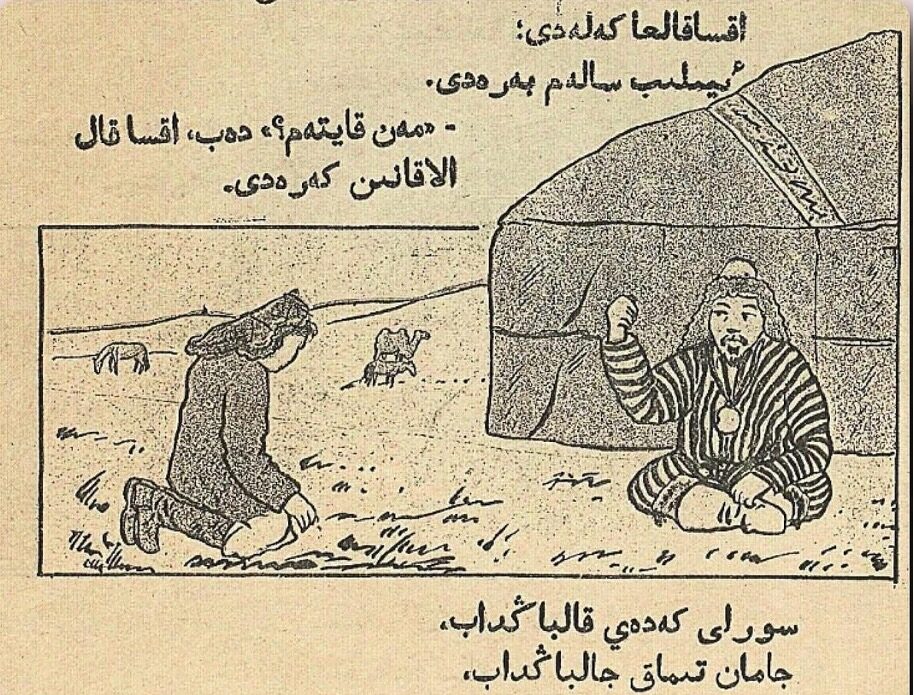
In the early 20th century, educated Kazakh thinkers were known as Alash intellectuals. Disillusioned by the Russian Empire’s growing control over the Kazakh people, they sought to establish an independent Kazakh state and protect their nation from imperial oppression. Their political and cultural struggle laid the foundation for modern Kazakhstan’s independence. The Alash Orda, a successor to the 19th-century Kazakh enlightenment movement, evolved into a more politically assertive and nationalist organization representing Kazakhs in southern Central Asia. Formed in March 1917 by prominent figures including Alikhan Bokeikhanuly, Akhmet Baitursynuly, Mirzhakyp Dulatuly, and Khalel Dosmukhameduly, the group participated in the Pan-Muslim Congress in Moscow that May. However, the congress, largely driven by Tatar leaders, failed to address Kazakh concerns, further alienating them. As a result, the Kazakhs withdrew from future congresses and focused on developing their own political structures. The Alash movement ultimately became the leading force guiding the Kazakh people during this turbulent era. [caption id="attachment_34521" align="aligncenter" width="347"] Zhusipbek Aimauytov with his daughter; image: alash.semeylib.kz[/caption] Zhusipbek Aimauytov, one of the prominent members of the Alash movement, authored important literary works such as Kartkózha, Akbilek, and Kúnékéýdiń jazyq dalasy. He was also a statesman and cultural figure who fell victim to Soviet repression, accused of nationalist sympathies. Arrested in 1929, he was sentenced to death in absentia in 1931. Despite his short life, Aimauytov left a lasting mark on Kazakh culture and literature. His writings consistently emphasized that national progress requires sacrifice, effort, and resistance against ignorance and injustice. [caption id="attachment_34523" align="aligncenter" width="826"] Cover page of Aimauytov`s comic book published in 1929[/caption] One of Aimauytov’s lesser-known yet significant contributions was the first Kazakh comic book, Ugly Headwear, which was written for children. Published in 1929 by the Kazidat publishing house, the work is composed in verse and meant to both entertain and educate young readers. The story explores timeless themes such as social injustice, class conflict, and moral reasoning. The tale begins with a poor villager and his family — a frail wife and three strong sons. They own little: one brown horse and a single cow. When the village head visits and demands taxes, he takes the family’s only cow by force and beats the father. This dramatic opening immediately draws the reader in and sets the tone for the rest of the story, which critiques the social conditions of the time. The motif of the marginalized challenging the dominant recurs across many world literatures. Known for addressing political and societal issues in his work, Aimauytov continues this in Ugly Headwear. The village leaders, religious figures, and even the wealthy refuse to help the poor man, claiming taxes are mandated by the Tsar and must be paid. Eventually, the desperate man turns to the Russian district chief, only to be humiliated and chased away. In a symbolic scene, the man’s hat — the “ugly headwear” — becomes the central object of the story. It is lost, found by a dog, taken to a barn, and later discovered by someone who...

8 months ago

Bridging Empires: A Japanese Historian on Kazakh-Qing Relations

Last year, I came across Professor Jin Noda’s research from the Tokyo University of Foreign Studies: The Kazakh Khanates Between the Russian and Qing Empires: Central Eurasia International Relations during the 18th–19th Centuries. As it explores Kazakh history, particularly letters written by Khan Ablai and other sultans to the Qing emperor, I reached out to Professor Noda to ask a few questions. TCA: What inspired you to write this book? Noda: I thought there was a great divide between studies of Central Asia from the Russian side and those from the Qing Chinese side. To bridge this gap, I decided to research Kazakh history using both Russian and Chinese sources. TCA: You published letters from 1779 related to Ablai Khan. What is their social significance? Jin Noda: While the “social significance” isn’t entirely clear to me, the letters are important for Kazakhs as evidence of relations with the Qing Dynasty. They also reflect Ablai’s authority — sending letters to the Qing emperor signified his direct contact with the imperial court. TCA: Were these letters originals? What challenges did you face studying them? Jin Noda: I accessed microfilmed versions at the First Historical Archive in Beijing. The poor image quality made them difficult to read, and some texts were unreadable. TCA: How much did you rely on Chinese sources, and how reliable are they? Jin Noda: For my PhD and the book, I used many Manchu documents. While they have their biases, they also offer valuable new information on the Kazakhs. I cross-referenced them with Russian sources from the same era. TCA: Are there many historical records about Kazakhs in Japan? How should they be studied? Jin Noda: Some records exist, particularly from the Japanese military’s interest in Xinjiang after the Russo-Japanese War. For Kazakhs under Russian rule, one rare case is the Kazakh politician Marsekov contacting the Japanese government during the revolution. His letter’s translation is preserved in a Japanese archive and was recently studied by Prof. Uyama and Mr. Ono. TCA: Apart from Sultan Gubaidolla’s well-known letter, did you find other sources related to him? Jin Noda: I collected Russian archival documents on his activity around 1824 in Almay and Omsk. He is known for his role in protesting Russian colonisation. TCA: As a foreign researcher, how do you assess Kazakh-Qing political relations? Jin Noda: Traditionally, Chinese discourse portrayed the Kazakhs as distant vassals. However, Qing sources place them closer to the empire, like the Mongols or the Torghuts. I believe the Kazakh khans understood the strategic advantage in their relations with the Qing. These ties held unique importance for both sides. TCA: You’ve also used Manchu archives. What did they reveal? Jin Noda: Manchu documents are rich sources — essentially direct reports from Xinjiang officials to the emperor. While they reflect the officials’ own motivations, they offer a vivid picture of the Kazakhs’ contact with the Qing. TCA: Have you received proposals to translate your book into Kazakh? Jin Noda: I’ve recently received a proposal to translate it...

9 months ago