Central Asia has long held significance for the Western world — both in the past century and today. The region is home to ancient peoples and rich indigenous traditions. As a journalist from Kazakhstan, I became curious about the cultural ties between the United States and my country. In 2023, I studied at George Washington University through the Bolashak scholarship program to explore this subject in depth. My research led me to numerous works written by American travelers and scholars. Among them, I discovered a book authored by former U.S. Vice President Henry Wallace, based on his journey to Central Asia.

Henry Wallace
Credit Hudson Institute
His book, Soviet Asia Mission, was published in New York in 1946 and reflects observations from that trip. During this special mission in 1944, Wallace first traveled through Siberia, where he studied the conditions of the local population, before continuing on to the Kazakh steppe.
Wallace describes the social and political realities of Kazakhstan under Soviet rule, as well as the industrial projects that caught his attention. As a senior American politician, he was particularly interested in production and agriculture. “Down to meet us at the airfield was the director, Georg Georgevich Spitsen. In motorcars, we drove at once to the largest of Karaganda’s three big open-pit coal mines. With a sweeping gesture, Spitsen said: “We are digging 6,000 tons of coal a day here. Production began a year ago.” A proud shovel operator, scooping up tons of run-of-mine coal to load into steel hopper cars, waved to us. The tracks were driven directly into the cut. We looked closely at the shovel’s trademark. It was a Bucyrus Erie electric shovel, one of three at work here, and had been shipped in under lend-lease from the United States.”

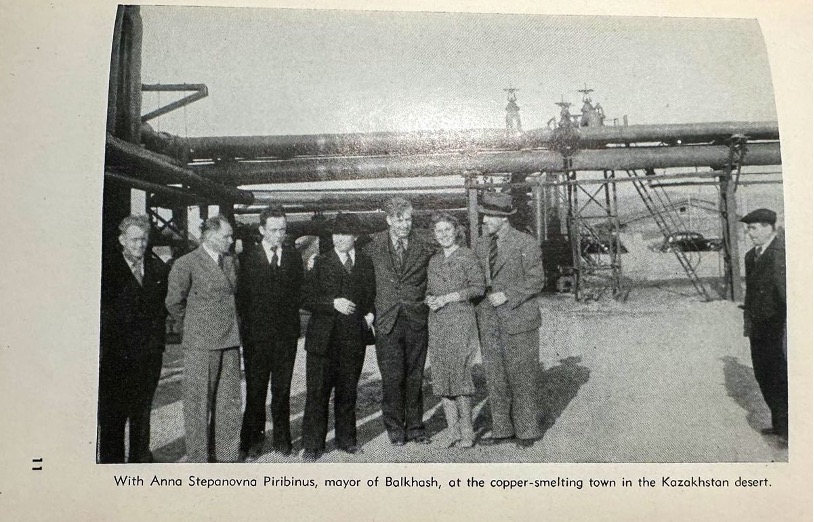
His journey to Kazakhstan in the previous century demonstrates that U.S.–Kazakh political contacts began earlier than is often assumed.. Although Kazakhstan’s place in the Soviet system was highly constrained, Wallace’s account provides valuable insight into the wartime Soviet republics.. “After lunch at Karaganda, we took off, flying southwest over very dry country. Even the streams were dried out, except in deep valleys where clusters of huts could be seen in the midst of green oases. When still a long distance away, we could see a wide expanse of water ahead. It was Lake Balkhash, bright blue in the midst of gray, treeless country. Along the shore rose the smoking stacks of smelters. On landing at the dirt airfield, we were welcomed to the copper-smelting town of Balkhash by its mayor, Anna Stepanovna Piribinus, president of the city Soviet.”
His next stop was Semipalatinsk (today’s Semey). There Wallace spoke with Dimitri Chuvakhin of the Soviet Foreign Office, who accompanied him on the trip. “This kind of thing,” he said, referring to the new towns we had seen, “this kind of thing saved Russia. Trotsky was against it; he thought there had to be a world revolution. Stalin had faith in the moral stamina of the Russian people. Stalin said: We can and we will. And our people did. They created the necessary capital out of their own hides. Russia would have lost the war without Karaganda.”

Henry A. Wallace was greeted with music and performances throughout his tour
Credit Wallace Center of Iowa
History records that livestock numbers in Kazakhstan dropped sharply during Soviet collectivization and wartime requisitioning, leading to widespread famine. Wallace noted these hardships in his book “During the war, the Far Eastern farms helped supply the Red Army. The flour milled at Karaganda was being shipped to soldiers at the front. Siberia is also aiding in the restoration of agriculture in the devastated areas of European Russia. A typical example is Semipalatinsk oblast, which sent 5 carloads of relief goods, 40,000 head of cattle, and 2,000 farm workers to help re-establish the cattle industry in reoccupied territory. These contributions to the national farm life are a further illustration of the present strength of Siberian agriculture. Its future is assured.”

Nurtas Undasynov, Prime Minister of Kazakhstan, 1938-1951
At a welcome banquet, Wallace sat beside Nurtas Undasynov, then chairman of the Council of Minsters of the Kazakh Soviet Socialist Republic. Wallace mistakenly referred to him as “President” in his book. Wallace notes that Undasynov is the chief executive in a country four times the size of Texas, a region that provides the Soviet Union with 40 percent of its copper and more than 80 percent of its lead, and has reserves of strategic minerals-tungsten, molybdenum, mercury, tin, and uranium, source of atomic energy.

Route of the Wallace mission, 1944.
Credit Henry A. Wallace, Soviet Asia Mission
(New York: Reynal and Hitchcock, 1946).
Different historical sources record Kazakhstan’s population in the 20th century with some variation. Wallace offered his own impression: “In other words, the Kazakh Soviet Republic has a population comparable to that of New York City, dispersed in an area as large as the United States east of the Mississippi. The Russian [republic] is four times greater in extent but with a comparably sparse settlement. The Uzbek is the most densely populated of these three republics, which contain 95 percent of the land and go percent of the People of Soviet Asia. Soviet Asia’s remaining three union republics-the Turkmen, the Tadzhik, and the Kirghiz, all in its central section have a combined area of about 300,000 square miles and in 1939 had a combined population of 4,500,000—both figures comparable to the single state of Texas.”

Despite the limits of his perspective, Wallace’s records remain significant. He began his chapter on Kazakhstan with a clear statement: “I expressed my opinion about the need to raise the standard of living of the people here. I am sure that it is impossible to achieve lasting peace without it. The next morning, June 18, I said goodbye to Ambassador Harriman, who was about to return to Moscow, and he told me that my visit would bring a positive start.”
Henry Wallace’s Soviet Asia Mission remains one of the most detailed American accounts of Central Asia during the Soviet era. His observations of Kazakhstan and its neighbors provide a rare Western perspective on the region at a pivotal moment in world history.