Tokayev Backs Azerbaijan to Join Central Asia-U.S. Summit
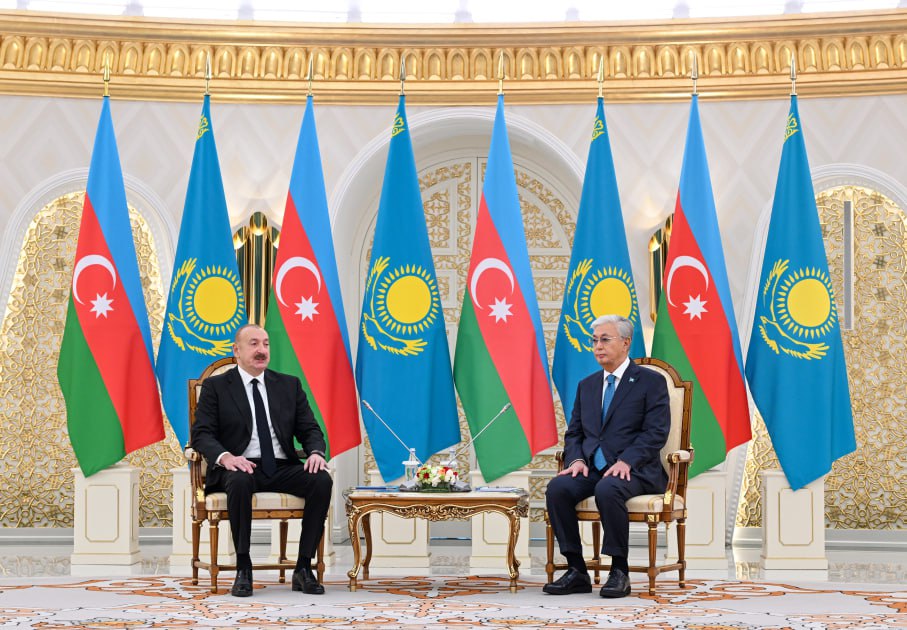
Kazakhstan’s President Kassym-Jomart Tokayev has said he would welcome Azerbaijan’s participation in the upcoming Central Asia-U.S. Summit in Washington. In an exclusive comment to Azerbaijani outlet Minval Politika, Tokayev praised Azerbaijan’s regional role and even called the country a “natural part of Greater Central Asia.” “I consider Azerbaijan’s participation in such an important forum desirable. Given its energy resources, favorable geographic location, strategic vision, and the political will of President Ilham Aliyev, this country plays a crucial role in the South Caucasus and beyond, essentially becoming a regional transport, logistics, and energy powerhouse,” Tokayev said. “Azerbaijan can be considered a natural part of Greater Central Asia. I also consider President Donald Trump’s initiative to hold a summit in Washington in the very near future to be very timely and worthy of support. I am confident this event will be productive and mutually beneficial,” the Kazakh leader noted. The planned summit on November 6 falls under the C5+1 format that brings together the U.S. and the five countries of Central Asia. It will mark the first such gathering held in Washington, after an initial presidential meeting took place on the sidelines of the UN General Assembly in 2023. Donald Trump has formally invited the leaders of Kazakhstan, Kyrgyzstan, Tajikistan, Turkmenistan, and Uzbekistan to attend. The meeting will coincide with the tenth anniversary of the C5+1 diplomatic platform, which was launched in 2015 to deepen cooperation between Central Asia and the U.S. on security, economic and other issues. Tokayev’s remarks about Azerbaijan reflect a growing view that Azerbaijan is increasingly integrated with Central Asia. In recent years, Baku has been invited to Central Asian heads-of-state consultative summits as a special participant, underscoring what analysts call the “growing importance of the South Caucasus as a gateway for Central Asia to European markets”. During the most recent Central Asia leaders’ meeting in Astana in August, Azerbaijan was designated a key partner in regional initiatives, and Aliyev stressed that Azerbaijan and the Central Asian countries “represent a single historical, cultural, and geopolitical space” with deep-rooted ties. That brotherly affinity is reinforced by Turkic cultural links and mutual strategic interests. Tokayev himself, in talks with Aliyev, has called Azerbaijan “a regional power” and “a fraternal state” for Kazakhstan. Azerbaijan indeed wields significant influence as an energy and transport hub connecting Eurasia. The country is a major oil and gas producer that has steadily expanded exports to Europe, and it anchors the Trans-Caspian trade routes linking China and Central Asia to the West via the Caucasus. Since Russia’s 2022 invasion of Ukraine disrupted traditional east–west corridors, the so-called Middle Corridor -- running from Central Asia across the Caspian Sea through Azerbaijan -- has taken on greater importance. Kazakhstan and Azerbaijan have positioned themselves as “key actors” in this reconfigured Eurasian logistics network that bypasses Russian territory. The United States is also paying close attention to these routes: officials have indicated that the Washington summit will spotlight development of the Trans-Caspian corridor, with the U.S. “keen to promote logistics...
5 months ago