• KGS/USD = 0.01144 0%
  • KZT/USD = 0.00208 0%
  • TJS/USD = 0.10396 -0.29%
  • UZS/USD = 0.00008 0%
  • TMT/USD = 0.28490 0%
  • KGS/USD = 0.01144 0%
  • KZT/USD = 0.00208 0%
  • TJS/USD = 0.10396 -0.29%
  • UZS/USD = 0.00008 0%
  • TMT/USD = 0.28490 0%
  • KGS/USD = 0.01144 0%
  • KZT/USD = 0.00208 0%
  • TJS/USD = 0.10396 -0.29%
  • UZS/USD = 0.00008 0%
  • TMT/USD = 0.28490 0%
  • KGS/USD = 0.01144 0%
  • KZT/USD = 0.00208 0%
  • TJS/USD = 0.10396 -0.29%
  • UZS/USD = 0.00008 0%
  • TMT/USD = 0.28490 0%
  • KGS/USD = 0.01144 0%
  • KZT/USD = 0.00208 0%
  • TJS/USD = 0.10396 -0.29%
  • UZS/USD = 0.00008 0%
  • TMT/USD = 0.28490 0%
  • KGS/USD = 0.01144 0%
  • KZT/USD = 0.00208 0%
  • TJS/USD = 0.10396 -0.29%
  • UZS/USD = 0.00008 0%
  • TMT/USD = 0.28490 0%
  • KGS/USD = 0.01144 0%
  • KZT/USD = 0.00208 0%
  • TJS/USD = 0.10396 -0.29%
  • UZS/USD = 0.00008 0%
  • TMT/USD = 0.28490 0%
  • KGS/USD = 0.01144 0%
  • KZT/USD = 0.00208 0%
  • TJS/USD = 0.10396 -0.29%
  • UZS/USD = 0.00008 0%
  • TMT/USD = 0.28490 0%

Viewing results 1 - 6 of 52

Uzbekistan’s External Debt Reaches $43.97 Billion

Uzbekistan’s external debt reached 43.97 billion dollars as of October 1, according to data released by the Ministry of Economy and Finance. The increase of 473 million dollars over the previous quarter reflects a slowdown in borrowing, even as the government continues to rely on foreign funding to sustain public spending and major infrastructure projects. The country’s largest creditor remains the World Bank, which has extended 8 billion dollars in loans. This is followed by the Asian Development Bank with 7.5 billion dollars and international investors who hold 5.8 billion dollars in Eurobonds. Loans from Chinese financial institutions total 3.7 billion dollars, while Japanese lenders account for 3.1 billion dollars. Additional borrowing includes 1.7 billion dollars from the Asian Infrastructure Investment Bank and 1.2 billion dollars from France. Multilateral lenders such as the Islamic Development Bank also contribute to the total, along with a group of smaller international creditors that collectively account for 2.5 billion dollars. Debt denominated in U.S. dollars comprises 63% of Uzbekistan’s total external debt, while 12% is in Uzbek som, 8% in euros, and 6% in Japanese yen. The remainder is held in Special Drawing Rights and other currencies. In a related development, RIA Novosti, citing World Bank figures, reported that Uzbekistan increased its debt to Russia by 39 million dollars in 2024. This small rise came amid a broader trend across 38 countries whose combined debt to Russia grew to 33.1 billion dollars last year, the highest level since 1998.
ADB Commits $10 Billion to CAREC, $700 Million to Kyrgyzstan

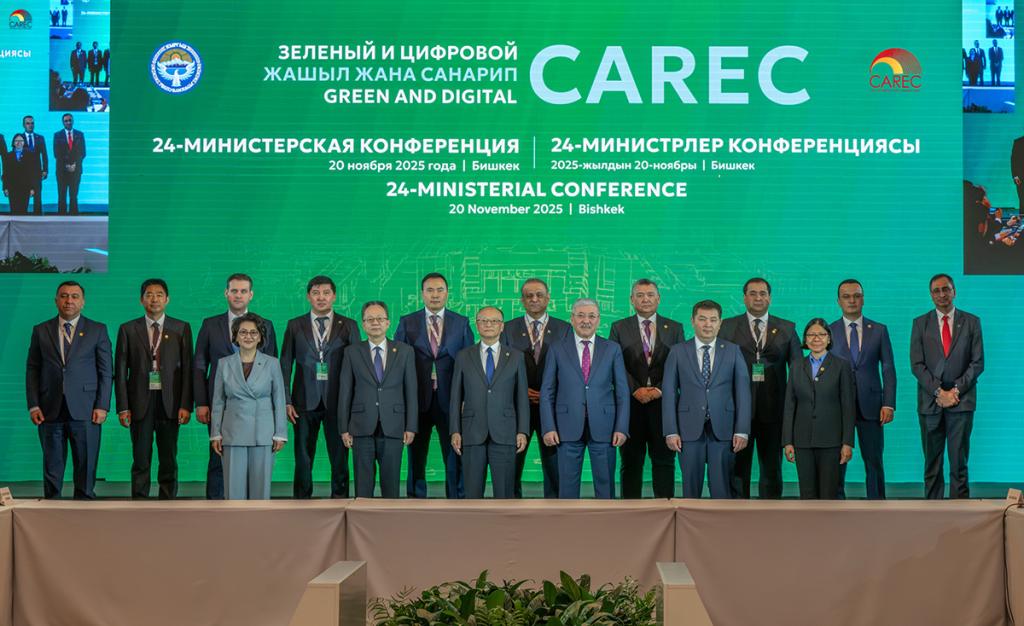
At the 24th Ministerial Conference of the Central Asia Regional Economic Cooperation (CAREC) Program held in Bishkek on November 20, Asian Development Bank (ADB) President Masato Kanda announced a commitment of more than $10 billion in financing through 2030 to strengthen regional integration, connectivity, and resilience. The CAREC Program brings together 11 member countries – Afghanistan, Azerbaijan, China, Georgia, Kazakhstan, Kyrgyzstan, Mongolia, Pakistan, Tajikistan, Turkmenistan, and Uzbekistan – along with international development partners, to promote sustainable economic growth through regional cooperation. Since its inception in 2001, CAREC has mobilized approximately $54 billion in funding for regional projects. The ADB serves as the host institution for the CAREC Secretariat. “Our vision for CAREC is clear: a region that is economically resilient, environmentally sustainable, socially inclusive, and digitally connected,” Kanda said in his keynote address. “We are scaling up support with over $10 billion in financing through 2030. These projects will catalyze greater integration, resilience, and shared growth.” During the conference, ministers endorsed the Bishkek Declaration, initiating formal negotiations on trade and investment facilitation. The initiative aims to reduce cross-border barriers, increase investment flows, and promote cooperation in emerging areas such as digital trade and the green economy. On the sidelines of the conference, Kanda met with Kyrgyz President Sadyr Japarov to reaffirm ADB’s commitment to Kyrgyzstan’s development goals. ADB plans to provide over $700 million in financing for the country between 2025 and 2027. “The Kyrgyz Republic has shown remarkable commitment to building a greener, more connected, and resilient future,” Kanda said. “As the country’s largest multilateral development partner, ADB is ready to deepen support for national priorities and strengthen Kyrgyzstan’s role as a regional leader in connectivity and clean energy.” Kanda also met with Chairman of the Cabinet of Ministers Adylbek Kasymaliev to sign a memorandum of understanding with the Ministry of Finance. The agreement outlines a new financing framework for 2026-2027 and includes three projects under the existing 2025 framework. These focus areas include green transformation, disaster resilience, and affordable housing. Altogether, the 2025 and planned 2026-2027 packages will provide more than $700 million in ADB support for Kyrgyzstan. Upcoming projects will aim to boost energy efficiency and climate resilience in public infrastructure, enhance water resource management and disaster preparedness, and improve access to energy-efficient housing and affordable mortgage financing.

ADB Approves $56.4 Million Disaster-Response Package for Tajikistan and Kyrgyzstan

The Asian Development Bank (ADB) has approved a $56.4 million program aimed at strengthening disaster-response capacity in Tajikistan and Kyrgyzstan, the bank announced in an official statement. According to the ADB, both countries face high exposure to earthquakes, floods, and other climate-related hazards. Their ability to respond effectively remains limited by constrained fiscal resources and a lack of risk-transfer mechanisms. The newly approved program is designed to enhance financial preparedness through two pre-arranged ADB financing instruments, each tailored to different levels of disaster risk. Innovative Tools for Disaster-Risk Financing The program incorporates two key components: Contingent Disaster Financing (CDF) and Disaster Resilience Bonds (DRB). CDF provides budgetary support during medium-scale natural disasters or public health emergencies. DRBs, issued on international capital markets, offer rapid liquidity for major, high-severity disasters. “This program will help reduce the fiscal burden on both countries following natural disasters, including geophysical events, extreme weather, and health emergencies,” said Leah Gutierrez, ADB Director General for Central and West Asia. She emphasized that the combination of policy reforms, institutional strengthening, and innovative financing marks a shift from reactive response to proactive disaster-risk management. Focus on Institutional Reforms and Regional Cooperation The initiative also emphasizes strategic policy reforms, capacity building, and governance improvements to ensure a coordinated and transparent disaster-risk management system. It was developed under ADB’s technical assistance program to establish disaster-risk transfer mechanisms in the Central Asia Regional Economic Cooperation (CAREC) region, a partnership supporting sustainable development and regional integration. The program will be financed through a $53.1 million grant from the Asian Development Fund (ADF), with an additional $3.3 million from the Asia-Pacific Climate Fund. ADF grants are targeted at the poorest and most vulnerable countries in the Asia-Pacific. From 2021 to 2024, the fund supported the lifting of 384,000 people out of poverty and the creation of approximately 500,000 jobs.

Uzbekistan and SOCAR Advance $2 Billion Ustyurt Energy Project

Uzbekistan’s Minister of Energy, Jorabek Mirzamahmudov, has outlined the country’s deepening energy cooperation with Azerbaijan’s state oil company SOCAR, highlighting progress on a recently signed Production Sharing Agreement (PSA) for the Ustyurt region and broader plans in petrochemicals and electricity trade. In an interview with Azerbaijani media outlet Report, Mirzamahmudov confirmed that Uzbekistan, SOCAR, and Uzbekneftegaz have already established a joint operating company to oversee the Ustyurt project. Fieldwork is expected to accelerate soon, with seismic surveys covering over 3,000 linear kilometers set to begin before year-end, followed by the drilling of the first exploration well. The PSA structure splits ownership equally between the state and investors, with SOCAR and Uzbekneftegaz as the primary partners. British energy major BP has shown interest and is in preliminary discussions to join the consortium. Azerbaijani President Ilham Aliyev stated in August that SOCAR had commenced work at an Uzbek oil field following the contract signing. He expressed optimism about potential discoveries within the next one to two years. Mirzamahmudov acknowledged that earlier data on Ustyurt had not suggested large hydrocarbon reserves but said that modern interpretation techniques have revealed greater potential. While refraining from early reserve estimates, he said SOCAR specialists are optimistic about promising oil indicators. If confirmed, Uzbekistan plans to build a new refinery. Total investment in the Ustyurt project is projected at around $2 billion. The minister said SOCAR and Uzbekneftegaz would finance the project’s initial stages, with BP possibly joining later. He did not rule out future collaboration with Azerbaijan on major fields like Shah Deniz or Absheron but emphasized that Uzbekistan’s current priority is increasing domestic production. In the long term, joint ventures in third countries are also being considered. Trans-Caspian Energy and Renewables Push Mirzamahmudov also discussed the proposed trans-Caspian high-voltage direct current (HVDC) cable project aimed at exporting renewable energy to Europe. A joint venture involving Azerbaijan, Kazakhstan, and Uzbekistan has already been formed. The Asian Development Bank is assisting in selecting a consultant for the project’s feasibility study. Several countries, including Saudi Arabia, have expressed interest. Uzbekistan currently generates more than 20% of its electricity from renewables and aims to increase that share to 54% by 2030. In the Ustyurt region alone, wind projects totaling over 2.5 GW are under development, with the first 100 MW already operational. The government also plans to deploy hybrid wind-solar-storage systems with a minimum capacity of 5 GW. Localization and Petrochemical Cooperation Mirzamahmudov noted that future oil and gas processing facilities could be localized in special economic zones in Bukhara, Karakalpakstan, and Khorezm, which are currently being evaluated for infrastructure and logistics readiness. A joint venture with SOCAR Trading is already exporting polymer products, and ongoing discussions aim to expand cooperation in fuel production and fertilizer manufacturing.

ADB Approves $300 Million Loan to Support Small Business Growth in Uzbekistan

The Asian Development Bank (ADB) has approved a $300 million policy-based loan to boost the development of micro, small, and medium-sized enterprises (MSMEs) in Uzbekistan, with a particular focus on women-led businesses. The bank announced the decision on November 12. Of the total funding, $100 million will be provided on concessional terms to expand access to finance for MSMEs and strengthen Uzbekistan’s microfinance sector. The loan forms part of the second phase of the ADB’s Inclusive Finance Sector Development Program, which builds on earlier efforts to improve the legal and institutional framework for inclusive finance in the country. Key reforms have included raising the ceiling on microloans, modernizing microfinance regulations, joining the Women Entrepreneurs Finance Code, and introducing frameworks for Islamic microfinance. “ADB is proud to support Uzbekistan’s transition to a more inclusive and market-based financial system,” said ADB Country Director for Uzbekistan Kanokpan Lao-Araya. “This program will help unlock access to finance for the self-employed and microentrepreneurs, promote gender equality, and strengthen consumer protection in the financial sector.” The latest phase of the program introduces new policy measures aimed at enhancing responsible lending, regulating emerging products such as “buy now, pay later” services, and strengthening digital financial supervision. It also advances gender equality by supporting sectoral policies that implement gender-based financing quotas and improve the reporting of sex-disaggregated data. An evaluation of Uzbekistan’s National Financial Inclusion Strategy (2021-2023) revealed that 60 percent of adults now hold accounts with formal financial institutions, a significant gain attributed to rapid digitalization. The new program aims to further modernize the microfinance sector by allowing the creation of deposit-taking microfinance banks, two of which have already received preliminary licenses. This year marks the 30th anniversary of ADB-Uzbekistan cooperation. Since 1995, the bank has committed $14.6 billion in loans, grants, and technical assistance to the country. Uzbekistan has also been selected to chair the ADB Board of Governors for 2025-2026. Samarkand is set to host the ADB’s 59th Annual Meeting in May 2026.

Central Asia Faces Billions in Climate Adaptation Costs, UNEP Warns

Central Asia ranks among the most climate-vulnerable regions in the world and will require tens of billions of dollars to adapt to the accelerating effects of global warming, according to a new report by the United Nations Environment Programme (UNEP). The report identifies Central Asia as one of the fastest-warming areas globally. However, current adaptation funding remains drastically insufficient to meet the growing threat. A Region Under Threat Developing countries worldwide, including those in Central Asia, will need up to $310 billion annually by 2035 to adapt to climate change. UNEP highlights the region’s specific challenges: rapidly melting glaciers, widespread soil degradation, worsening water scarcity, and increasing aridity, all of which endanger food security and energy sustainability. “If we don't start investing in adaptation now, we will face increasing costs every year,” said UNEP Executive Director Inger Andersen. Tajikistan and Kyrgyzstan are particularly exposed, with more than 70% of their populations employed in agriculture, which depends heavily on mountain rivers fed by glacial runoff. According to UNEP, glacier volumes in the region have shrunk by over 30% in the past decade. The changing flow of the Amu Darya and Syr Darya rivers threatens not only agriculture but also the hydropower sectors in both countries. Diminished access to water could lead to socio-economic instability in vulnerable communities. Funding Gap Widens UNEP estimates that developing countries in Europe and Central Asia need roughly $51 billion annually for adaptation. Yet, only a fraction of that figure is currently being met. Tajikistan, for example, has outlined total climate financing needs of $8 billion by 2030 and $17 billion by 2050. In Uzbekistan, the cost of modernizing irrigation and water management systems alone is expected to approach $10 billion by 2030. UNEP has urged governments in the region to accelerate the updating of national adaptation plans, many of which have not been revised in over a decade, and to enhance cooperation in the Amu Darya and Syr Darya basins. Priority areas include investment in irrigation infrastructure, early warning systems, and flood control. From Glaciers to Farms In response to UNEP’s findings, international organizations have begun to fund targeted adaptation initiatives. The Green Climate Fund, for instance, has approved $250 million for the From Glaciers to Farms program, spearheaded by the Asian Development Bank. The project aims to strengthen agricultural and water resilience in glacier-dependent countries in Central Asia, the South Caucasus, and parts of South Asia. It covers four major river basins: the Naryn and Panj in Central Asia, the Kura in the South Caucasus, and the Swat in Pakistan, benefiting approximately 13 million people. Funding will support the development of irrigation networks, reservoir construction, glacier monitoring, and early warning systems. The program also places a strong emphasis on empowering women entrepreneurs in agriculture and improving the financial sustainability of rural communities.