• KGS/USD = 0.01144 0%
  • KZT/USD = 0.00199 0%
  • TJS/USD = 0.10857 -0.18%
  • UZS/USD = 0.00008 0%
  • TMT/USD = 0.28571 0%
  • KGS/USD = 0.01144 0%
  • KZT/USD = 0.00199 0%
  • TJS/USD = 0.10857 -0.18%
  • UZS/USD = 0.00008 0%
  • TMT/USD = 0.28571 0%
  • KGS/USD = 0.01144 0%
  • KZT/USD = 0.00199 0%
  • TJS/USD = 0.10857 -0.18%
  • UZS/USD = 0.00008 0%
  • TMT/USD = 0.28571 0%
  • KGS/USD = 0.01144 0%
  • KZT/USD = 0.00199 0%
  • TJS/USD = 0.10857 -0.18%
  • UZS/USD = 0.00008 0%
  • TMT/USD = 0.28571 0%
  • KGS/USD = 0.01144 0%
  • KZT/USD = 0.00199 0%
  • TJS/USD = 0.10857 -0.18%
  • UZS/USD = 0.00008 0%
  • TMT/USD = 0.28571 0%
  • KGS/USD = 0.01144 0%
  • KZT/USD = 0.00199 0%
  • TJS/USD = 0.10857 -0.18%
  • UZS/USD = 0.00008 0%
  • TMT/USD = 0.28571 0%
  • KGS/USD = 0.01144 0%
  • KZT/USD = 0.00199 0%
  • TJS/USD = 0.10857 -0.18%
  • UZS/USD = 0.00008 0%
  • TMT/USD = 0.28571 0%
  • KGS/USD = 0.01144 0%
  • KZT/USD = 0.00199 0%
  • TJS/USD = 0.10857 -0.18%
  • UZS/USD = 0.00008 0%
  • TMT/USD = 0.28571 0%
05 December 2025

Viewing results 1 - 6 of 80

Kyrgyzstan and China Aim to Increase Trade

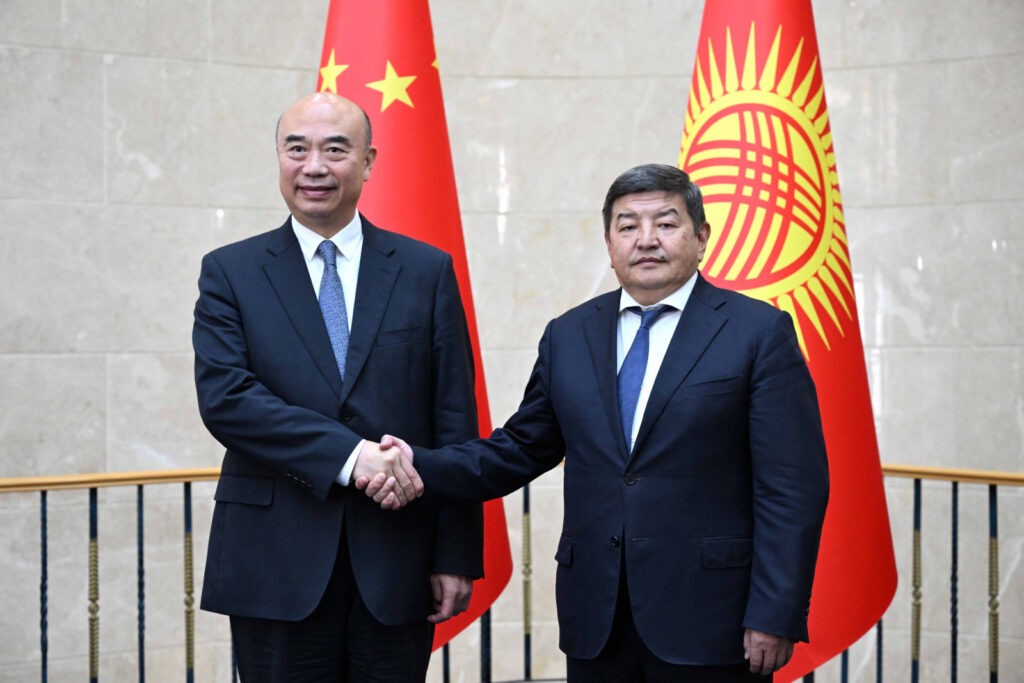
On May 18 in Bishkek, Chairman of the Cabinet of Ministers of the Kyrgyz Republic, Akylbek Japarov held talks with Vice Premier of the State Council of the People's Republic of China, Liu Guozhong. Emphasizing that China is one of Kyrgyzstan’s main trade and investment partners, Japarov stated that bilateral trade turnover is growing every year and reached $19.8 billion in 2023, an increase of 30% compared to 2022. “But this is not the limit, and the Kyrgyz Republic is ready to jointly make efforts to increase all trade and economic indicators,” he stated. Japarov stressed the importance of the full and uninterrupted functionality of the Torugart and Irkeshtam checkpoints on the Kyrgyz-Chinese border to further increases in trade between the two countries. According to Japarov, the Kyrgyz side is aiming to develop transport and logistics infrastructure, removing restrictions that impede trade exchanges, and creating mutually beneficial conditions. “We would like to expand our capabilities and switch to daily and round-the-clock operation of these border checkpoints. I believe this will also be useful for the Chinese side, as it will allow an even larger volume of cargo and goods to be exported from China to Kyrgyzstan, and on to third countries. We are aiming to increase the throughput capacity of the border checkpoints to 1,000 vehicles per day,” the prime minister said. Kyrgyzstan also expects to sign protocols on new types of agricultural products and simplify procedures for the export of these products from Kyrgyzstan to China. In turn, Vice Premier Liu Guozhong noted the high level of Kyrgyz-Chinese relations and the readiness to further develop and strengthen mutually beneficial and multifaceted cooperation. Guozhong stated that construction of the China-Kyrgyzstan-Uzbekistan railway is of strategic importance for the entire region and urged that its construction start sooner. He also noted the importance of increasing trade turnover, increasing the capacity at border checkpoints, opening the new Bedel border checkpoint this year, and expanding cooperation in tourism. Guozhong also stated that the Chinese market is open to the import of Kyrgyz agricultural products.

Kazakhstan and Vietnam Look to Expand Economic Cooperation

Potential areas for increasing trade between Kazakhstan and Vietnam were discussed on May 15 by the Minister of Industry and Construction of Kazakhstan, Kanat Sharlapaev and the Minister of Industry and Trade of Vietnam, Nguyen Hong Dien. The parties noted that trade turnover between the two countries amounted to US $979 million in 2023, including $958 million in the trade of industrial products. From January-March 2024, bilateral trade reached $229 million. The Vietnamese side expressed interest in developing mineral deposits in Kazakhstan, as well as engaging in cooperation in the chemical industry. In turn, the Kazakh minister echoed the high potential for industrial cooperation between the two countries. Other sectors earmarked for cooperative development included the production of equipment for light industry, mechanical engineering, energy, agriculture, and food production.    

Kazakhstan and Tajikistan Plan to Double Trade to $2 Billion

On 30 April, talks held in Dushanbe between Prime Minister of Kazakhstan Olzhas Bektenov and Prime Minister of Tajikistan Kokhir Rasulzoda focused on Kazakh-Tajik cooperation in trade and investment, industrial cooperation, agriculture, transport connectivity, water, and energy. Kazakhstan is Tajikistan's fourth largest trading partner and with the aim to double bilateral trade to $2 billion,  Kazakhstan announced its readiness to increase exports of 85 commodities worth about $190 million. Both governments stressed the importance of developing industrial cooperation by creating new export-oriented joint ventures, with specific reference to Kazakhstan’s large production capacity of equipment for Tajik railways, including  electric and diesel locomotives, in addition to locally manufactured transformers, agricultural machinery, batteries and motor vehicles. An important issue on the bilateral agenda is cooperation in the water sector and the need for joint action to ensure  the smooth operation of Tajikistan’s Bakhri Tojik reservoir during the growing season. In further discussions on agricultural cooperation, both parties noted that in January-February, bilateral trade of agricultural products totalled $84.9 million, an increase of 8.9 percent compared to the same period in 2023. Future plans include increasing Kazakh wheat and flour exports to Tajikistan, and creating joint ventures for flour milling and processing of livestock products.  

Turkmenistan’s Gas and Türkiye’s Plans to Become a Gas Hub

A series of ongoing political consultations between Turkmenistan and Türkiye continued on 25–26 April, as a Turkmen delegation led by Deputy Minister of Foreign Affairs Ahmet Gurbanov visited Ankara, hosted by Turkish counterpart Burak Akçapar. Beyond the regular bilateral agenda of political-diplomatic, trade-economic and cultural-humanitarian cooperation, the two sides emphasized the implementation of bilateral agreements reached at the third Antalya Diplomatic Forum in early March, particularly the prospects for cooperation in the energy sector. On 1 March 2024, Turkmenistan and Türkiye signed two documents — a memorandum of understanding (MoU) and a letter of intent — aimed at strengthening cooperation in the natural gas sector. In theory, this seems to be a positive development for the two countries as well as for Europe. The two possible routes for Turkmen gas to reach Türkiye and Europe are (1) via the Caspian Sea and Azerbaijan, and (2) through Iran's existing pipeline infrastructure via a gas swap agreement. Neither one is likely to happen soon. The project to export Turkmen gas to Europe through a shore-to-shore high volume pipeline, at 31 billion cubic meters per year (bcm/y) is no longer alive after various parties have failed to realize it over the past quarter-century. It was bruited when it was announced that Turkmen President Serdar Berdimuhamedov planned to visit Brussels in late 2023 (which ended up not happening) and definitively killed when the initiative by American company Trans-Caspian Resources (headed by a retired U.S. ambassador to Turkmenistan) failed to persuade Ashgabat to construct short low-volume (8–11 bcm/y) "Platform Option" pipeline in the Caspian Sea.   Gas "swaps" and Türkiye’s ambitions The idea of a "Turkish gas hub" arose from Russia's search to depoliticize trade between Gazprom and European firms by facilitating a platform where Gazprom's origination of the gas would be obscured and anonymized. Buyers and sellers could meet through Turkish intermediation. Türkiye, however, seeks to draw advantage by imposing the condition of long-term contracts with Gazprom for gas sales at below-market prices. This would guarantee a role for the Turkish intermediaries and, moreover, ensure for them a profit margin through mandatory service fees. "Swap" operations mean an exchange of gas amongst Turkmenistan, Iran and Azerbaijan; however, this would involve only a few billion cubic meters. Even if all participants agree, several questions still remain: Will swap transactions be profitable, given the price of gas in Europe? Even if Iran agreed to a Turkmen gas swap, would Tehran execute the agreement in good faith? In fact, Tehran would prefer to offer its own gas to Turkish and European markets, rather than transit competitive Turkmen gas through his territory. In addition, the gas that Azerbaijan produces for export already has contracted buyers under long-term agreements. Azerbaijan would be interested in the Turkish gas hub only if it should in future produce surpluses of gas that cannot be sold under long-term contracts. Then, such surpluses could be sold at a gas hub under short-term contracts, assuming that transit and profitability are guaranteed.   Challenges to Türkiye’s...

Azerbaijan and Kyrgyzstan Expand Economic and Transport Cooperation

During a state visit to Azerbaijan on 24 April, Kyrgyzstan President Sadyr Japarov joined President Ilham Aliyev in bilateral talks at the 2nd gathering of the Interstate Council of Azerbaijan and Kyrgyzstan. As a result of the meeting in Baku and in support of a joint declaration to deepen relations, the leaders signed a strategic partnership agreement between Azerbaijan and the Kyrgyz Republic. In a statement to journalists, President Aliyev referred to centuries-old ties of cooperation, friendship and interaction enjoyed by Azerbaijan and Central Asia, and announced, “Today, the regions of Central Asia, the Caspian Sea and Azerbaijan are of great importance in terms of energy resources, transportation routes and trade. We are seeing great potential here and are strengthening interaction with our traditional partners from brotherly countries. Among them, cooperation with Kyrgyzstan is of particular importance.” During the meeting, the two governments signed an addendum to the agreement on the authorized capital of the Azerbaijani-Kyrgyz Development Fund, to quadruple it from $25 million to $100 million. To date, the Fund has received over 40 applications for investment projects in Kyrgyzstan and according to Aliyev, the construction of a five-star hotel financed by Azerbaijan already begun at Kyrgyzstan’s Lake Issyk-Kul, is due for completion by the end of next year. The president commended the significant increase and potential for growth in trade between Azerbaijan and Kyrgyzstan and reported Azerbaijan’s interest in investing in renewable energy projects in Kyrgyzstan. With reference to transport, he recommended that consultations proceed on coordination of transport routes in terms of digitalization and tariff policy, to make the route via the Caspian Sea and Central Asia to Europe both faster and more commercially viable. President Japarov, in turn, referenced Kyrgyzstan’s construction of a secondary school in the Aghdam district of Azerbaijan, saying, “The construction of this school is Kyrgyzstan's contribution to the restoration of peace in the regions affected by the [Azeri-Armenian] conflict.”

Kazakhstan and Kyrgyzstan Sign Commercial Deals Worth $300 Million

On the side-lines of the Kazakhstan and Kyrgyzstan business forum on April 17 in Astana, businesses signed off commercial deals totalling $300 million. Attended by Deputy Prime Ministers of Kazakhstan and Kyrgyzstan, Serik Zhumangarin and Adylbek Kasymaliev, the forum attracted companies engaged in mechanical engineering, industry, metallurgy, construction, logistics, agriculture, pharmaceuticals, investment, and service industries. According to a report by the Kazakh Ministry of Trade and Integration, lucrative joint projects include the construction of solar power plants, a ferroalloy plant, a distribution centre in Kyrgyzstan, and the exchange of supplies of agricultural and other products. In 2023, trade turnover between Kazakhstan and Kyrgyzstan rose by 26% compared to the previous year, reaching $1.6 billion. Kazakhstan’s exports accounted for $1.1 billion, an increase of 35.8%, and imports stood at $495.2 million, an increase of 9%.