• KGS/USD = 0.01144 0%
  • KZT/USD = 0.00205 0%
  • TJS/USD = 0.10731 0%
  • UZS/USD = 0.00008 0%
  • TMT/USD = 0.28612 0.42%
  • KGS/USD = 0.01144 0%
  • KZT/USD = 0.00205 0%
  • TJS/USD = 0.10731 0%
  • UZS/USD = 0.00008 0%
  • TMT/USD = 0.28612 0.42%
  • KGS/USD = 0.01144 0%
  • KZT/USD = 0.00205 0%
  • TJS/USD = 0.10731 0%
  • UZS/USD = 0.00008 0%
  • TMT/USD = 0.28612 0.42%
  • KGS/USD = 0.01144 0%
  • KZT/USD = 0.00205 0%
  • TJS/USD = 0.10731 0%
  • UZS/USD = 0.00008 0%
  • TMT/USD = 0.28612 0.42%
  • KGS/USD = 0.01144 0%
  • KZT/USD = 0.00205 0%
  • TJS/USD = 0.10731 0%
  • UZS/USD = 0.00008 0%
  • TMT/USD = 0.28612 0.42%
  • KGS/USD = 0.01144 0%
  • KZT/USD = 0.00205 0%
  • TJS/USD = 0.10731 0%
  • UZS/USD = 0.00008 0%
  • TMT/USD = 0.28612 0.42%
  • KGS/USD = 0.01144 0%
  • KZT/USD = 0.00205 0%
  • TJS/USD = 0.10731 0%
  • UZS/USD = 0.00008 0%
  • TMT/USD = 0.28612 0.42%
  • KGS/USD = 0.01144 0%
  • KZT/USD = 0.00205 0%
  • TJS/USD = 0.10731 0%
  • UZS/USD = 0.00008 0%
  • TMT/USD = 0.28612 0.42%

Viewing results 1 - 6 of 23

Kyrgyzstan Advances New Cross-Border Transport Corridor with China via Bedel Pass

Kyrgyzstan is advancing plans to develop a new international transport corridor through the Bedel checkpoint on the Chinese border, aiming to boost cross-border trade and reduce reliance on high-altitude routes that are often impassable in winter. Bedel Corridor Gains Momentum The proposed corridor was a central focus during Deputy Chairman of the Cabinet of Ministers Bakyt Torobaev’s July 8 visit to Beijing. Torobaev met with Chinese corporate leaders to discuss the construction of the Barskoon-Uchturfan-Aksu highway, which would link Kyrgyzstan’s Issyk-Kul Region with China’s Aksu Prefecture in Xinjiang via the Bedel Pass. The Bedel checkpoint, located in a remote mountainous region of southeastern Kyrgyzstan, was first opened under a simplified regime in September 2024. It lies roughly equidistant from Karakol and Aksu and currently operates with temporary infrastructure. According to the Kyrgyz government, the route’s full-scale development, including a modern highway and internationally compliant border facilities, is scheduled for completion by 2027. Bedel will become Kyrgyzstan’s third automobile crossing point with China, alongside the Irkeshtam (Osh Region) and Torugart (Naryn Region) passes. These older routes are frequently disrupted by severe winter weather. The new corridor is expected to offer a more reliable and time-efficient alternative for cargo moving between Xinjiang and Kyrgyzstan, reducing dependence on the longer Kashgar-Torugart-Naryn-Bishkek route. In Beijing, Torobaev and Chinese officials agreed to organize reciprocal business visits and establish joint working groups with representatives from both governments to coordinate the project. The corridor is expected to strengthen Kyrgyzstan’s role as a regional transit hub, facilitating the re-export of Chinese goods to third countries. Bilateral trade between Kyrgyzstan and China reached $23 billion in 2024, an eightfold increase in recent years. Progress on China-Kyrgyzstan-Uzbekistan Railway During his Beijing visit, Torobaev also attended the 12th World Congress on High-Speed Rail, where he emphasized the strategic importance of the China-Kyrgyzstan-Uzbekistan (CKU) railway project. The 523-kilometer line includes 304 kilometers running through Kyrgyz territory. Construction officially began on December 27, 2024, in Jalal-Abad. Once complete, the railway will link China’s Kashgar with the Kyrgyz cities, Torugart, Makmal, and Jalal-Abad, before continuing to Andijan in Uzbekistan. The project is designed to handle up to 15 million tons of cargo annually and carries an estimated investment of $4.7 billion. Torobaev noted that the Makmal transshipment station will serve as the core logistics hub on the Kyrgyz side, featuring customs infrastructure, storage facilities, and multimodal services to ensure smooth cargo transit between China and Uzbekistan. “The CKU railway is the shortest route between East and West,” he said. “It will connect China to European and Middle Eastern markets, forming a vital transport artery.” Torobaev also announced a proposed rail extension between Aksu in China and Balykchy in Kyrgyzstan via the Bedel checkpoint, which would further enhance the regional transport network.

Tajikistan Seeks to Join China-Kyrgyzstan-Uzbekistan Railway Project

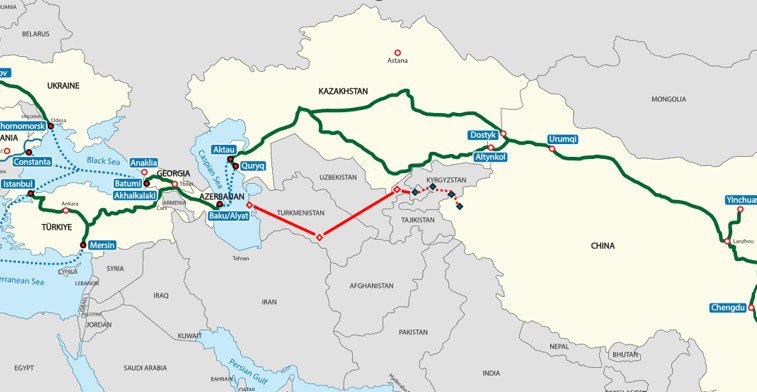
Tajikistan has officially expressed interest in joining the China-Kyrgyzstan-Uzbekistan (CKU) railway construction project, an ambitious regional transport initiative designed to enhance connectivity across Central and South Asia. The proposal was raised during a meeting between Tajik Minister of Transport Azim Ibrahim and Chinese Minister of Transport Liu Wei on July 2 in Tianjin, on the sidelines of the 12th Meeting of Transport Ministers of the Shanghai Cooperation Organization (SCO) Member States. According to the Tajik Ministry of Transport, the two sides discussed potential Chinese support for Tajikistan’s accession to the CKU railway project, as well as participation in the development of a broader multimodal corridor linking China, Tajikistan, Uzbekistan, Turkmenistan, Iran, Turkey, and Europe. The CKU railway, a strategically vital infrastructure project, spans 523 kilometers. Construction officially began on December 27, 2024, in Jalal-Abad, Kyrgyzstan. Once completed, the route will connect Kashgar in China with Torugart, Makmal, and Jalal-Abad in Kyrgyzstan, and Andijan in Uzbekistan. The railway is projected to handle up to 15 million tons of cargo annually. Currently, neither Kyrgyzstan nor Uzbekistan has a direct rail link with China, the only such connection in Central Asia runs through Kazakhstan. At the SCO ministerial meeting, Minister Ibrahim noted that the SCO region already functions as a strategic bridge between East and West, North and South. He also outlined key emerging challenges, including the need to strengthen transport chain resilience, accelerate digitalization, reduce carbon emissions, and promote green logistics solutions. To that end, Ibrahim proposed the establishment of a Unified SCO Digital Platform for managing multimodal transportation. This platform would harmonize customs, border, and transport procedures, enable real-time cargo tracking, streamline documentation, and enhance operational transparency. The minister further emphasized the need to advance and integrate several major international corridors: China - Kyrgyzstan - Tajikistan - Afghanistan - Pakistan - Indian Ocean China - Tajikistan - Uzbekistan - Turkmenistan - Iran - Turkey - Europe Trans-Caspian International Transport Route (TITR) He also underscored the importance of attracting international partners to help restore and expand transport infrastructure through Afghanistan, describing it as key to unlocking new regional trade routes.

Kyrgyzstan Breaks Ground on First Tunnel of China-Kyrgyzstan-Uzbekistan Railway

Construction of a 12-kilometer tunnel has commenced in Kyrgyzstan’s Jalal-Abad region, marking a significant milestone in the development of the China-Kyrgyzstan-Uzbekistan railway, a strategically important transport corridor aimed at linking East and West. At the groundbreaking ceremony on April 29, Kyrgyz Deputy Chairman of the Cabinet of Ministers Bakyt Torobayev emphasized the railway's broader significance. “This project is not only of infrastructural importance. It opens the way to improving the quality of life, economic growth, and strengthening ties between regions and peoples. It will create new opportunities for trade, investment, industrial development and logistics, provide thousands of jobs, and give a powerful impetus to the economies of our countries,” he said. A Major Infrastructure Undertaking The railway will span 523 kilometers, with over 300 kilometers passing through Kyrgyzstan. In addition to the current tunnel project, two more large tunnels are planned in the Naryn and Jalal-Abad regions. The project involves challenging terrain and extensive engineering work, including the construction of 46 bridges and 27 tunnels. The China-Kyrgyzstan-Uzbekistan railway was officially launched during a ceremony in Jalal-Abad on December 27, 2024. Once completed, the route will connect Kashgar (China), Torugart, Makmal, and Jalal-Abad (Kyrgyzstan), and Andijan (Uzbekistan). The railway is expected to have an annual cargo capacity of up to 15 million tons. Currently, neither Kyrgyzstan nor Uzbekistan has a direct railway connection with China. At present, Central Asia’s only rail link to China passes through Kazakhstan, underscoring the significance of this long-anticipated trilateral project.

First PPP Project to Build Major Railway Launched in Kyrgyzstan

On February 19, a public-private partnership (PPP) agreement was signed in Bishkek for the "Trans-Eurasian Route" railway project, marking Kyrgyzstan’s first PPP initiative in the railway sector. The agreement was signed between the National Investment Agency under the President of the Kyrgyz Republic, Kyrgyzstan’s national railway company Kyrgyz Temir Zholu, and the U.S.-based consortium All American Rail Group Global Infrastructure Partner LLC. The project involves constructing a railway across central Kyrgyzstan, traversing mountainous terrain from east to west, and connecting Karakol in the northeastern Issyk-Kul region with Makmal in the southwestern Jalal-Abad region. According to the National Investment Agency, the railway will be a key step in modernizing Kyrgyzstan’s transport infrastructure, enhancing regional connectivity and economic development. National Investment Agency Director Talantbek Imanov stated that the project represents an investment of approximately $3 billion, expected to create new jobs, improve the national transport network, and generate long-term economic benefits. Additionally, the railway will enhance Kyrgyzstan’s connectivity with neighboring countries, particularly through its link to the China-Kyrgyzstan-Uzbekistan railway, which will pass through Makmal. The China-Kyrgyzstan-Uzbekistan (CKU) railway project, officially launched in December 2024, aims to serve as a major East-West trade route. Construction of the CKU railway is already underway. The 523-kilometer CKU railway will connect Kashgar (China), Torugart, Makmal, Jalal-Abad (Kyrgyzstan), and Andijan (Uzbekistan). Once completed, it is expected to transport up to 15 million tons of cargo annually, facilitating trade between China, Central Asia, the Middle East — including Turkey — and the European Union.

Uzbekistan Extends Agreement on Hairaton-Mazar-e-Sharif Railway with Afghanistan

Uzbekistan has reached an agreement with Afghanistan's Taliban interim government to extend the contract for operating and maintaining the Hairaton-Mazar-e-Sharif railway. Uzbekistan’s Minister of Transport, Ilhom Mahkamov, met with Mohammad Ishaq Sahibzada, Afghanistan’s Deputy Minister of Public Works for Railways, during talks held in Tashkent from January 21 to 23. Uzbekistan's Ministry of Transport agreement has confirmed the agreement. The meetings, chaired by Mahkamov, focused on accelerating the construction of the Trans-Afghan Railway project and planning the next stages of work. Both sides emphasized the importance of enhancing regional connectivity and ensuring the smooth operation of the existing railway infrastructure. Under the extended agreement, Sogdiana Trans LLC, a subsidiary of Uzbekistan Railways Joint Stock Company, will continue managing the Hairaton-Mazar-e-Sharif railway. This railway, constructed in 2010 for $129 million, has been operated by Sogdiana Trans since its completion. In August 2024, the Naibabad railway station — part of the Hairaton-Naibabad-Mazar-e-Sharif railway line — was reopened after restoration. The work was carried out by Sogdiana Trans in collaboration with the Termez Regional Railway Hub under a contract with the Afghan Railways Administration. Despite a 2022 proposal from Afghan authorities to transfer the railway’s management to local companies to reduce operational costs, the plan wasn't implemented. In 2024, the Hairaton-Mazar-e-Sharif railway facilitated the transport of 4,200 containers of goods between Afghanistan and China, according to the Afghan Ministry of Public Works. The Hairaton-Mazar-e-Sharif railway forms a critical part of the China-Kyrgyzstan-Uzbekistan-Afghanistan railway corridor. The corridor’s capacity is expected to expand significantly following the completion of the China-Kyrgyzstan-Uzbekistan railway. Currently, neither Kyrgyzstan nor Uzbekistan has a direct rail connection to China, with Central Asia’s rail access to China limited to a route through Kazakhstan. Construction of the China-Kyrgyzstan-Uzbekistan railway officially began on December 27, 2024. The 523-kilometer route will run from Kashgar (China) through Torugart, Makmal, and Jalal-Abad (Kyrgyzstan), before reaching Andijan (Uzbekistan). Once operational, the railway is expected to handle up to 15 million tons of cargo annually, creating a vital new trade link across the region. This agreement between Uzbekistan and Afghanistan secures the continued operation of the Hairaton-Mazar-e-Sharif railway and reinforces Uzbekistan’s commitment to regional cooperation and infrastructure development. These efforts aim to boost trade, connectivity, and economic opportunities across Central and South Asia.

Long-Awaited Construction of China-Kyrgyzstan-Uzbekistan Railway Officially Launched

On December 27, Kyrgyzstan's President Sadyr Japarov, the Chairman of the National Development and Reform Commission of the People's Republic of China, Zheng Shanjie, and Uzbekistan’s Deputy Prime Minister Jamshid Khodjayev participated in a ceremony to mark the start of construction on the China-Kyrgyzstan-Uzbekistan railway. The event occurred in the village of Tosh-Kutchu in Kyrgyzstan’s Jalal-Abad region, where they laid the first stone for this significant regional transportation project. Speaking at the ceremony, President Japarov highlighted the importance of the China-Kyrgyzstan-Uzbekistan railway as more than just a transportation route, describing it as a critical strategic bridge linking the East and West. "This route will ensure the delivery of goods from China to Kyrgyzstan, as well as to the countries of Central Asia and the Middle East, including Turkey, and on to the European Union. The project will strengthen interregional ties, help diversify transport routes and increase the competitiveness of the region as an international transport and transit hub, which is in line with the goals of the Central Asian countries," Japarov said. Zheng Shanjie delivered a message from Chinese President Xi Jinping, highlighting that the new land corridor connecting Asia and Europe will significantly increase the flow of people and trade among the three countries. According to the message, the project is expected to drive regional prosperity by fostering industrial and resource development, boosting trade, and attracting investment. Uzbekistan's President Shavkat Mirziyoyev, in an address read by Deputy Prime Minister Khodjayev, called the launch of railway construction a historic milestone that the three nations had been working toward for nearly 30 years. The Uzbek leader noted that the new transportation artery, which will establish the shortest land route connecting Central Asia and China, will strengthen the strategic partnership between the three nations. The 523-kilometer railway will traverse Kashgar (China), Torugart, Makmal, Jalal-Abad (Kyrgyzstan), and Andijan (Uzbekistan). Once completed, the railway is expected to handle up to 15 million tons of cargo annually. Currently, neither Kyrgyzstan nor Uzbekistan has a direct railway connection to China. Central Asia’s rail link to China is limited to a route through Kazakhstan, leaving Kyrgyzstan and Uzbekistan without a direct connection.