• KZT/USD = 0.00219
  • TJS/USD = 0.10810
  • UZS/USD = 0.00009
  • TMT/USD = 0.29760
  • KZT/USD = 0.00219
  • TJS/USD = 0.10810
  • UZS/USD = 0.00009
  • TMT/USD = 0.29760
  • KZT/USD = 0.00219
  • TJS/USD = 0.10810
  • UZS/USD = 0.00009
  • TMT/USD = 0.29760
  • KZT/USD = 0.00219
  • TJS/USD = 0.10810
  • UZS/USD = 0.00009
  • TMT/USD = 0.29760
  • KZT/USD = 0.00219
  • TJS/USD = 0.10810
  • UZS/USD = 0.00009
  • TMT/USD = 0.29760
  • KZT/USD = 0.00219
  • TJS/USD = 0.10810
  • UZS/USD = 0.00009
  • TMT/USD = 0.29760
  • KZT/USD = 0.00219
  • TJS/USD = 0.10810
  • UZS/USD = 0.00009
  • TMT/USD = 0.29760
  • KZT/USD = 0.00219
  • TJS/USD = 0.10810
  • UZS/USD = 0.00009
  • TMT/USD = 0.29760
02 September 2026

Viewing results 1 - 6 of 32

ICAO to Develop Master Plan for Kazakhstan’s Civil Aviation

Kazakhstan’s Ministry of Transport and the International Civil Aviation Organization (ICAO) have signed an agreement to develop a strategic Master Plan for the Development of Kazakhstan’s Civil Aviation through 2050. The plan will outline a comprehensive strategy for the country’s civil aviation sector, covering the development of airports, air navigation systems, and airlines. It will also focus on improving flight safety, aviation security, accessibility, and the liberalization of air transport. Kazakhstan is the first country in Central Asia and the Commonwealth of Independent States (CIS) to establish a strategic partnership with ICAO for the sustainable development and modernization of its civil aviation sector. The initiative aligns with national objectives to enhance Kazakhstan’s role as a regional transit and transport hub. According to the Ministry of Transport, domestic airlines carried 14.3 million passengers in 2024, a 9% increase from 2023. Passenger traffic at Kazakhstan’s airports also grew by 14%, reaching 29.7 million people. Kazakhstan currently operates 582 flights per week to 31 countries, including Russia, Kyrgyzstan, Uzbekistan, Tajikistan, Georgia, Belarus, Azerbaijan, the United Arab Emirates, Saudi Arabia, Qatar, South Korea, China, India, and several European nations such as Germany, Italy, and the Netherlands. Additional destinations include countries in Southeast Asia, the Middle East, South Asia, Turkey, and the Maldives.

Kazakhstan to Release Preliminary Report on Aktau Plane Crash in Coming Days

Kazakhstan’s Minister of Transport, Marat Karabayev, has announced that a preliminary report on the investigation into the crash of an Azerbaijan Airlines (AZAL) aircraft near Aktau will be published in the coming days. On December 25, 2024, an Embraer 190 aircraft operated by AZAL crashed approximately three kilometers from Aktau airport while attempting an emergency landing. The flight, en route from Baku to the Russian city of Grozny, was carrying 62 passengers and five crew members. Thirty-eight people were killed in the crash. Footage from the crash site shows significant damage to the fuselage, with some reports suggesting a pattern consistent with air defense missile fragment impacts. The aircraft had initially requested permission to land at Grozny airport before abruptly changing course toward Aktau. Among the possible causes under investigation are a missile strike, and electronic system malfunctions due to radio signal suppression in Grozny linked to Russian efforts to repel Ukrainian drone attacks. Initially, the possibility of a bird strike was also mooted. Kazakhstan is leading the investigation under the International Civil Aviation Organization (ICAO) Convention, as the crash occurred within its territory. Specialists from Azerbaijan, Russia, and Brazil, along with international aviation experts and representatives from Embraer, are involved in the inquiry. “The specialists need time to complete their work, and we will not provide comments until the preliminary report is published. However, I promise that the report will be released in the coming days,” Karabayev said at a press conference in Astana on Tuesday. The investigation is in its final stages, he added, noting that experts from Azerbaijan, Russia, Brazil’s Center for Investigation and Prevention of Aviation Accidents (CENIPA), and ICAO have all contributed. “I hope that in the near future, we will publish a preliminary report on our website,” the minister stated. Karabayev specified that the report will be made available on the website of the Civil Aviation Committee, which operates under the Ministry of Transport. The Brazilian CENIPA has completed its analysis of the aircraft’s black boxes, and the decoded data has been sent to Kazakh authorities. “The conclusions drawn from this analysis, and those published in the final crash report, are the sole responsibility of Kazakhstan’s investigative body,” CENIPA stated. According to ICAO regulations, a preliminary report should be issued within 30 days of an incident. In late January, Kazakhstan’s Deputy Prime Minister, Kanat Bozumbayev, expressed hope that the initial findings would be released by the end of the month, but no report has yet been published. “Specialists need time to complete the work. It is a very complex and meticulous process,” Karabayev reiterated in response to questions about the delay. As The Times of Central Asia previously reported, the plane crash has contributed to tensions between Azerbaijan and Russia.

Uzbekistan Airways Reroutes Flights to Europe, Avoiding Russia and Belarus

Uzbekistan Airways has altered its flight routes to Europe, bypassing Russian and Belarusian airspace. The airline’s chairman, Shukhrat Khudoykulov, announced the decision at a press conference on January 28, according to local media reports. Flights are now taking a more southern route through Azerbaijan and Turkey. The change took effect on January 20, 2025. Reason for the Rerouting The airline’s press service told Kun.uz that the decision was made based on a recommendation from the European Union Aviation Safety Agency (EASA) and was not related to the recent Azerbaijan Airlines crash. “This is a recommendation from the European Aviation Safety Agency since we also serve European passengers,” the airline’s statement said. The change comes in the wake of the Azerbaijan Airlines crash on December 25, 2024. The aircraft, which was flying from Baku to the Russian city of Grozny, crashed near Aktau, Kazakhstan. Of the 67 people on board, 38 died, while 29 survived. Initial reports suggested that a Russian air defense system may have mistakenly shot down the plane during a Ukrainian drone attack on Grozny. A missile reportedly exploded near the aircraft, damaging its fuselage. Kazakhstan, which initially led the investigation, has transferred the case to Brazil’s aviation safety agency (CENIPA). The findings have been sent back to Kazakhstan and are expected to be released soon. Impact on Flight Times and Costs In response to Repost.uz, Uzbekistan Airways clarified that the change was made as a precautionary measure and also to helps optimize flight routes. The rerouting has increased travel distances. For example, the Tashkent-Munich flight, which previously covered 4,849 kilometers when flying through Russia, now spans 5,156 kilometers. This adds 30 to 40 minutes to flight times and raises operational costs for the airline.

Kyrgyzstan’s Airlines Could Be Removed from EU Blacklist in 2025

Kyrgyzstan’s airlines may soon achieve a significant milestone by being removed from the European Union’s Air Safety List, which currently bans them from operating flights to Europe. Kyrgyz President Sadyr Japarov made this announcement on November 27 during a meeting in Berlin with Johan Pelissier, the head of Airbus Europe, where they discussed the future of Kyrgyzstan’s aviation sector. Japarov emphasized the government’s concerted efforts to enhance aviation safety, implement international standards, and modernize infrastructure. He expressed optimism that these measures have significantly improved the likelihood of lifting restrictions on Kyrgyz airlines. As part of these developments, Japarov highlighted the government’s support for the national carrier, Asman Airlines. Under an initial agreement with Airbus, the airline plans to lease two A320 or A321 aircraft to establish direct routes to Europe, including destinations such as Paris, Berlin, and London. This initiative marks a critical step toward integrating Kyrgyzstan into the global aviation network. Looking ahead, Kyrgyzstan aims to expand its fleet and deepen cooperation with Airbus, fostering stronger connections with the international aviation community. At the conclusion of the meeting, Japarov extended an invitation to Pelissier to visit Kyrgyzstan for further discussions with local aviation representatives. Background: A Longstanding Ban Kyrgyz airlines was added to the EU’s Air Safety List in 2006 after failing to meet international safety standards. This decision, based on assessments that the country’s legal framework did not adequately ensure flight safety, has prohibited Kyrgyz airlines from flying to EU destinations for over 18 years. The ban has had a profound impact on the aviation sector, limiting its operational scope and market reach. Efforts to address these shortcomings represent a turning point, with the potential removal from the blacklist signaling a new chapter for Kyrgyz aviation. If successful, this move could open up significant opportunities for growth and international collaboration.

Kazakh National Rail Service Eyes Move to Hub Model for Integrated Passenger Transport

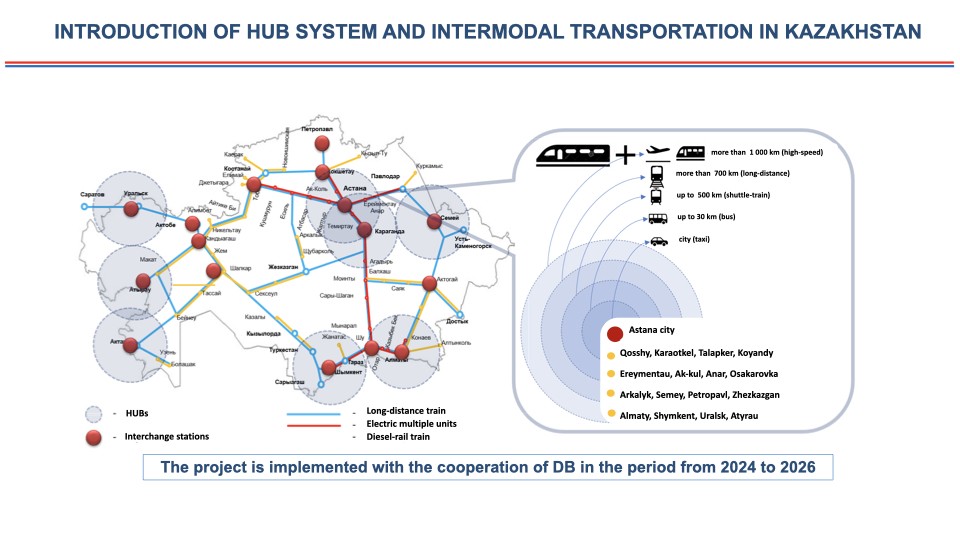
Kazakhstan's national rail carrier, Passenger Transportation JSC, plans to revamp the railway's passenger transport division to cut its losses and meet the demand for transportation services. In order to do so, it is developing a project using the so-called hub model. The hub system involves organizing passenger transport around connections of mainline and regional services in transport hubs. Each transport hub will connect not only trains but also other modes of transport, thus realizing a no less important project - intermodal passenger transportation. The hub system aims to ensure rail passenger transport's competitiveness and reduce operating costs, while contributing to environmental goals by encouraging people to choose public transport over private. The hub model for passenger transport is being implemented via a cooperation framework between Passenger Transportation JSC and consultants from Germany's DB Engineering & Consulting GmbH. To better understand how this project will be implemented, The Times of Central Asia spoke with the executive director of the intermodal transportation project at Passenger Transportation JSC, Zhambul Baideldinov, and the director of intermodal transportation of DB Engineering & Consulting, Nikolai Sidorvs. According to Baideldinov, the hub model of passenger transport in Kazakhstan is aimed at creating convenient, rapid transport links between the hubs of Astana, Almaty, and Shymkent, as well as regional transfer points. Such a model aims to develop hubs where passengers can comfortably transfer from one mode of transport to another, including rail and road and, in the future, air transport. “Successful implementation of the project will allow us to solve the problem of seasonal shortages of seats in passenger trains, as well as expand the range of services provided,” explained Baideldinov. According to Sidorvs, the regions and cities that will host the transport hubs were selected on the basis of several key factors. First, the geographical significance and the city's role as a logistics center linking major traffic flows were considered. Second, current passenger traffic volumes and their future growth potential were analyzed. Priority was also given to cities with developed transport infrastructure that would allow for effective integration of different modes of transport. “In the initial stage, the plan calls for creating a hub at the Nurly Zhol railway station in Astana. At subsequent stages, other hubs will be established in the cities of Shymkent, Semey, and Almaty,” explained Sidorvs. The Nurly Zhol complex in the capital is expected to become an example for further projects.  Plans also call for modernizing transport infrastructure to create efficient and convenient transfer hubs in different regions of Kazakhstan. In addition to large hubs, such as Nurly Zhol, the establishment of regional hubs is planned. Passenger Transportation JSC is currently setting up programs to develop regional transfer points. Within the framework of these initiatives, the national passenger carrier is also working closely with government agencies and local government leaders, making it possible to combine efforts and attract additional resources. “A pilot project for intermodal transportation has already been implemented by the company. Passengers who purchase travel tickets for a number of...

Regional Civil Aviation Organization Established for the First Time in Central Asia

The Eurasian Civil Aviation Conference (EACAC) has held its first meeting in Almaty, with the participation of the aviation authorities from participating countries. The meeting included participants from Armenia, Kazakhstan, Kyrgyzstan, Tajikistan and Uzbekistan, who discussed joint initiatives to strengthen cooperation in flight safety and sustainable aviation development. Representatives from Mongolia also participated as observers. Opening the event, Vice Minister of Transport of Kazakhstan, Talgat Lastayev, noted that EACAC will become a platform to share experiences and address issues related to future challenges in civil aviation. During the meeting, a declaration on the establishment of EACAC was signed, and the document was certified by the Chairman of the Civil Aviation Committee, Saltanat Tompieva, from Kazakhstan. EACAC will allow for the consolidated expression of positions within the framework of interactions with such institutions as the ICAO, the European Commission, IATA, and other international organizations. Katalin Radu, Director General of the Aviation Administration of Kazakhstan, stressed that the new organization would ensure unity in the positions of member countries in the international aviation arena and strengthen cooperation with such associations as ACAO, AFCAC, ECAC, and LACAC. Key tasks of EACAC include the coordination of regional efforts in aviation security, creating common standards, developing unmanned aviation, and training personnel. The initiative was first announced in May 2023 during Kazakhstan's first Aviation Dialogue, “Energy Transition for Sustainable Development and Realization of Central Asia's Transit Potential.” In April 2024, the project was presented during the Directors General of Civil Aviation meeting of the European and North Atlantic Bureau of ICAO (EURNAT-DGCA) in Toulouse, France.