• KZT/USD = 0.00222
  • TJS/USD = 0.10810
  • UZS/USD = 0.00009
  • TMT/USD = 0.29850
  • KZT/USD = 0.00222
  • TJS/USD = 0.10810
  • UZS/USD = 0.00009
  • TMT/USD = 0.29850
  • KZT/USD = 0.00222
  • TJS/USD = 0.10810
  • UZS/USD = 0.00009
  • TMT/USD = 0.29850
  • KZT/USD = 0.00222
  • TJS/USD = 0.10810
  • UZS/USD = 0.00009
  • TMT/USD = 0.29850
  • KZT/USD = 0.00222
  • TJS/USD = 0.10810
  • UZS/USD = 0.00009
  • TMT/USD = 0.29850
  • KZT/USD = 0.00222
  • TJS/USD = 0.10810
  • UZS/USD = 0.00009
  • TMT/USD = 0.29850
  • KZT/USD = 0.00222
  • TJS/USD = 0.10810
  • UZS/USD = 0.00009
  • TMT/USD = 0.29850
  • KZT/USD = 0.00222
  • TJS/USD = 0.10810
  • UZS/USD = 0.00009
  • TMT/USD = 0.29850
15 September 2026

Viewing results 1 - 6 of 3

Space Days Kazakhstan Highlights Push Beyond Baikonur

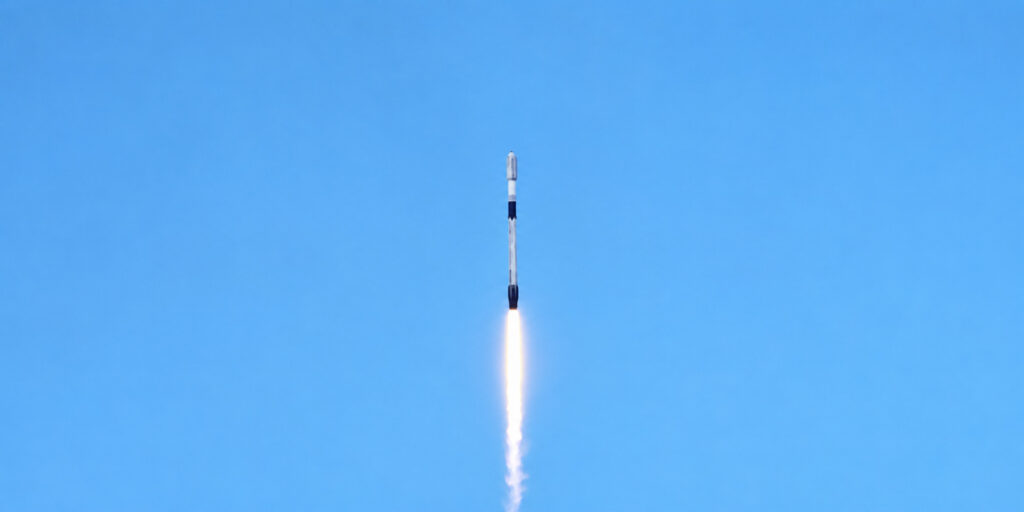
Kazakhstan is home to Baikonur, the cosmodrome from which the Space Age began, but the country has spent three decades trying to turn that Soviet inheritance into a space sector of its own. At Space Days Kazakhstan, held on September 7–9 in Astana and Baikonur, Kazakhstan presented new satellite projects and plans for international cooperation. A day later, talks with China were announced on a separate five-satellite network for Central Asia. By 2030, Astana plans to assemble an international constellation of nine Earth-observation satellites, six of them Kazakh. The country is also upgrading its national satellite communications system, developing new Earth-observation spacecraft at home, and expanding cooperation with China and other partners. Kazakhstan still relies heavily on Russia at Baikonur, and many of its newer projects depend on foreign technology and cooperation. Nevertheless, Astana is seeking greater control over the infrastructure and spacecraft on its own territory while widening the number of countries it works with. Taking More Control at Baikonur One of the clearest examples of Kazakhstan’s attempt to gain more control over its space sector is Baiterek, a joint project with Russia that dates back to 2004. The original agreement called for a new launch complex at Baikonur. But the project spent much of the next two decades being redesigned as Russia changed the rocket it planned to use. Baiterek was first intended for the Angara rocket, then Zenit, and finally Soyuz-5, known in Kazakhstan as Sunkar. Each change brought further delays. After launch targets in 2023, 2024, and 2025 slipped, Soyuz-5 finally lifted off from Baikonur on April 30, 2026. The rocket carried a dummy payload on the first flight in the test program. The launch mattered less for what it carried than for what it represented. Kazakhstan now operates the launch pad and ground infrastructure used by Baiterek, giving it a larger role at a cosmodrome long dominated by Russia. But Russia still builds the rocket. That reflects the wider relationship at Baikonur. The cosmodrome remained on Kazakh territory after the collapse of the Soviet Union, but Russia leases it through 2050 for $115 million a year and continues to use it for its human spaceflight program. In July 2026, Baikonur was again used for an international mission to the ISS. Kazakhstan is therefore not replacing Russia at Baikonur. It is trying to take a larger role in a space complex where Russia remains deeply embedded. But launch infrastructure is only one part of Kazakhstan’s attempt to develop capabilities of its own. Increasingly, the focus is on satellites. Building Satellites at Home KazSat is the country’s national satellite communications and broadcasting system. KazSat-3 currently provides data transmission, television, and other communications services. Its planned operating life ends in late 2029. KazSat-3R is being developed as its replacement. The national operator, the Republican Center for Space Communication, invited more than 40 spacecraft manufacturers to participate in the selection process. Fourteen companies responded: two from Kazakhstan and twelve from abroad. The operator plans to cover more than half...

Uzbekistan’s AI Module Reaches Orbit Aboard Samarqand-2028 Satellite

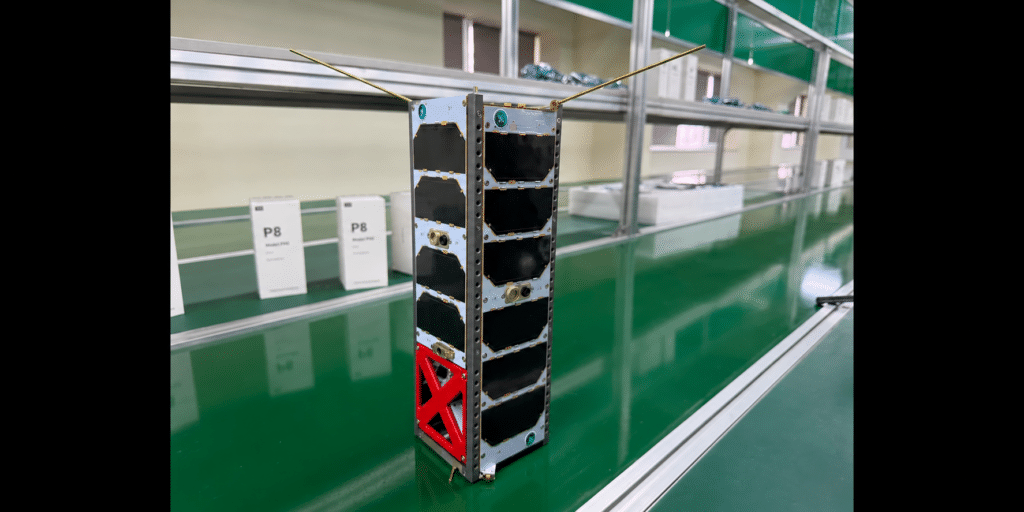
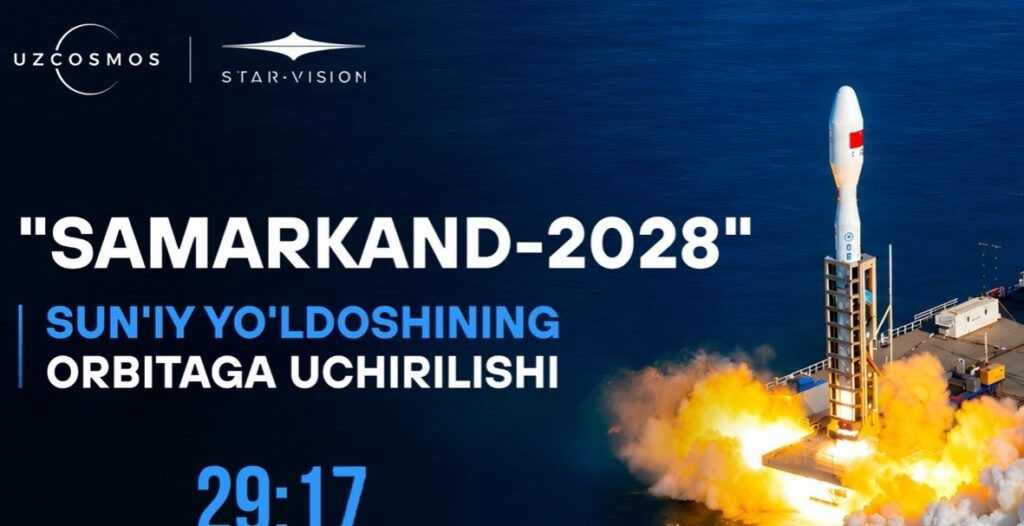
A Chinese-built Earth observation satellite carrying artificial intelligence developed by Uzbek specialists was launched from a sea platform off China’s Shandong province on August 5. The Samarqand-2028 satellite was launched alongside Lampung-1, another Earth observation satellite from China’s STAR.VISION Aerospace. A livestream showed the rocket lifting off from the platform. STAR.VISION developed Samarqand-2028, while specialists from Uzbekistan’s national space agency, Uzbekcosmos, created its onboard AI module. Uzbekcosmos said this was the first time Uzbek specialists had participated in developing artificial intelligence for a satellite. Samarqand-2028 carries a hyperspectral sensor that records reflected light in 22 wavelength bands. A conventional color image records visible light in only three broad bands, while the additional bands can reveal details difficult to see with the human eye. Uzbekcosmos plans to use the images to create national maps of cotton and wheat cultivation and make initial assessments of air quality. As The Times of Central Asia reported on August 4, processing images onboard the satellite could reduce the amount of data transmitted to Earth and allow useful information to reach officials more quickly. Samarqand-2028 is separate from Uzbekistan’s first national scientific satellite, Mirzo Ulugbek. Seven Uzbek engineers studying at Kyushu Institute of Technology in Japan have begun developing the 6U satellite, which is scheduled for launch in 2028. The program is intended to train specialists and establish a domestic satellite engineering team. The next stage will be commissioning Samarqand-2028 and testing whether its AI module functions as intended in orbit. Its practical value will depend on whether Uzbek institutions can convert the imagery into useful information for agriculture and environmental monitoring.

Uzbekistan-China Satellite Project Advances with AI Module

Uzbek engineers are developing an onboard artificial intelligence module for a new Earth observation satellite being built in partnership with a Chinese aerospace company. The satellite, named Samarqand-2028, is being developed under an agreement between Uzbekistan’s national space agency, Uzbekcosmos, and China’s STAR.VISION Aerospace. The Chinese company is developing the satellite itself, while Uzbek specialists are working on an onboard AI system that will help process the information it collects. The spacecraft will use hyperspectral imaging, which can detect features invisible to the human eye. Uzbekcosmos said the satellite could be used to monitor agriculture and the environment, as well as provide information for other parts of the economy. The project could include the creation of national maps showing where cotton and wheat are grown. It remains unclear when the satellite will be launched. It was expected to enter orbit in May 2026, but that target passed without a launch. In its latest update, Uzbekcosmos referred only to an upcoming launch and did not provide a revised date. Samarkand was selected to host the 2028 International Astronautical Congress in October 2025. It will be the first time the event, one of the world’s largest annual gatherings for the space industry, has been held in Central Asia. Hosting the congress will bring international attention to Uzbekistan’s space ambitions. Its longer-term impact, however, will depend on whether projects such as Samarqand-2028 help Uzbek specialists develop skills and build technology that can be used inside the country. The government has identified the space sector as one of the country's emerging high-technology priorities and is using the 2028 congress to showcase those ambitions. As The Times of Central Asia previously reported, Uzbekistan is also preparing to launch its first domestically developed scientific satellite and has begun a program to train the country’s first astronaut.