• KZT/USD = 0.00212
  • TJS/USD = 0.10810
  • UZS/USD = 0.00008
  • TMT/USD = 0.29850
  • KZT/USD = 0.00212
  • TJS/USD = 0.10810
  • UZS/USD = 0.00008
  • TMT/USD = 0.29850
  • KZT/USD = 0.00212
  • TJS/USD = 0.10810
  • UZS/USD = 0.00008
  • TMT/USD = 0.29850
  • KZT/USD = 0.00212
  • TJS/USD = 0.10810
  • UZS/USD = 0.00008
  • TMT/USD = 0.29850
  • KZT/USD = 0.00212
  • TJS/USD = 0.10810
  • UZS/USD = 0.00008
  • TMT/USD = 0.29850
  • KZT/USD = 0.00212
  • TJS/USD = 0.10810
  • UZS/USD = 0.00008
  • TMT/USD = 0.29850
  • KZT/USD = 0.00212
  • TJS/USD = 0.10810
  • UZS/USD = 0.00008
  • TMT/USD = 0.29850
  • KZT/USD = 0.00212
  • TJS/USD = 0.10810
  • UZS/USD = 0.00008
  • TMT/USD = 0.29850
04 August 2026

Viewing results 1 - 6 of 23

In Kyrgyzstan, 13,000 Low-Income Families Receive Funds to Launch Businesses

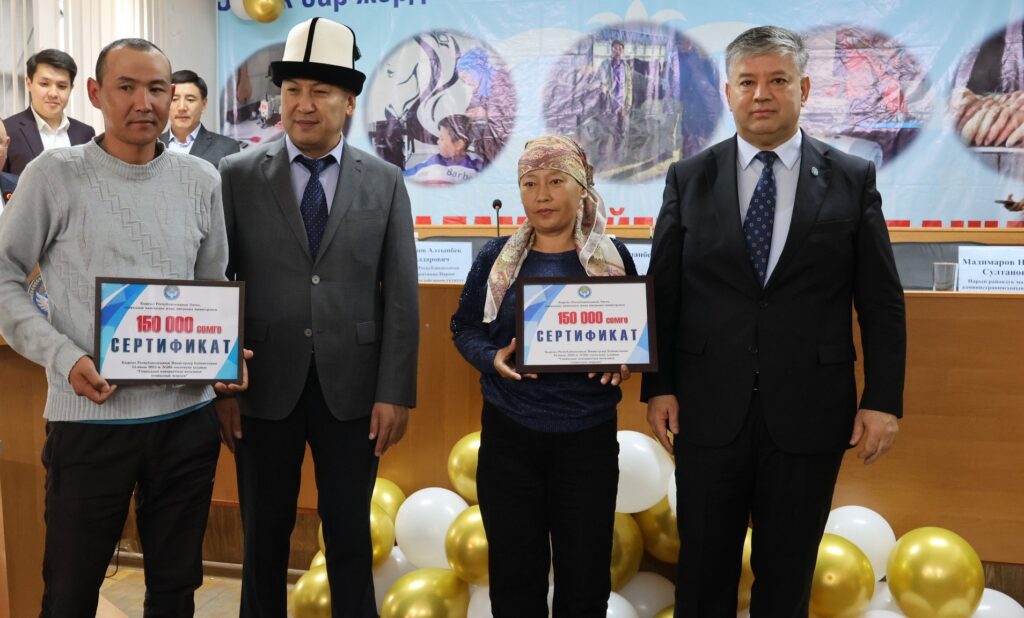
Over the past two years, 13,333 families in Kyrgyzstan living below the subsistence level have signed social contracts with the state. Through this initiative, each family received an interest-free loan of $1,700 to start a small business. According to the Ministry of Labor, the social contract program is designed to help families break the cycle of poverty by providing both start-up capital and practical support. Recipients use the funds to establish businesses, engage in subsistence farming, or purchase tools and equipment. In addition to financial assistance, the program offers training and consulting in sustainable agriculture and income-generating practices. How the Program Works Participants can use the funds to acquire equipment, materials, and other business essentials. The initiative has supported the creation of sewing workshops, food production facilities, apiaries, and small-scale poultry farms. Many recipients now produce honey, natural juices, felt goods, and meat products. The program is open to both new ventures and the expansion of existing microbusinesses. Specially trained consultants guide participants through the process of launching and managing their businesses, helping to increase long-term viability. Results and Regional Reach Although the social contract program was launched five years ago, its most significant impact has been seen in the past two years. More than 13,000 families have become self-sufficient and no longer require government aid. The majority of successful projects have emerged in Kyrgyzstan’s southern provinces, particularly Jalal-Abad and Osh, where rural entrepreneurship has rapidly expanded. Government data indicates that over 280 different products have been developed through the program. While most are sold domestically, a small number are now being exported abroad. This social contract initiative is a cornerstone of the government’s strategy to combat poverty and promote self-employment. Authorities emphasize its role in stimulating economic activity in rural areas and encouraging entrepreneurship among vulnerable populations.

Kazakhstan’s Youth Face Barriers to Entrepreneurship

A recent analysis by the analytical portal Ranking.kz reveals a concerning stagnation in youth entrepreneurship in Kazakhstan. Despite government rhetoric promoting innovation and small business, the number of young individual entrepreneurs has remained nearly flat over the past two years. Youth Entrepreneurship by the Numbers As of the end of Q1 2025, Kazakhstan recorded 736,100 individual entrepreneurs (IE) under the age of 35. Of these, 698,900 are active. The growth rate over two years is just 0.2%, signaling stagnation rather than progress. The decline in young entrepreneurs' share of the total business landscape underscores this trend. In 2023, they made up 50.9% of all active IEs; by 2025, that figure dropped to 47.3%. According to the National Statistics Bureau, today’s young entrepreneur in Kazakhstan is more likely to be a woman (55.4%) than a man (44.6%). Urban residents dominate the demographic, comprising about 75.3% of the total, while rural entrepreneurs represent only 24.7%. Sectoral Growth and Decline Trade remains the leading sector for young entrepreneurs, employing 303,300 individuals, though it saw no growth over the past year. The most significant expansion occurred in transportation and logistics, which grew by 90.1% to 49,700 entrepreneurs. Construction also showed positive movement, with a 10.7% increase, totaling 21,000 entrepreneurs. In contrast, other sectors experienced contraction: agriculture dropped by 25.1%, manufacturing by 11.9%, and real estate by 2.8%. These declines suggest a shift away from traditionally accessible sectors for new entrepreneurs. Geographically, growth was concentrated in major urban centers. Almaty leads with 121,200 active young entrepreneurs, followed by Astana (89,500) and Shymkent (62,100). Modest gains were also observed in the Almaty, Kostanay, Pavlodar, and North Kazakhstan regions. The Ulytau region registered the lowest number, with just 6,700 young individual entrepreneurs. Barriers to Growth The Atameken National Chamber of Entrepreneurs' 2024 "Business Climate" rating provides insight into regional variations in the ease of doing business. Entrepreneurs in Shymkent, Kyzylorda, and Ulytau reported the most favorable conditions. Conversely, Astana, Pavlodar, and North Kazakhstan ranked lowest. Key challenges cited by entrepreneurs include: High tax burdens (44% of respondents) Excessive bureaucracy and a complex licensing system (43.1%) Frequent inspections by regulatory authorities (42.4%) Corruption, especially in land allocation and public procurement These issues are reflected in the National Bank's 2025 Q1 business sentiment survey, where 31.4% of respondents cited taxes as the primary obstacle, while 30% pointed to broader economic conditions and high competition. Despite a vibrant and youthful potential workforce, Kazakhstan’s business environment continues to present structural challenges that deter innovation and sustainable growth. Addressing these barriers will be critical if the country is to harness its demographic dividend and support the next generation of entrepreneurs.

Success of Kazakhstan’s JobEscape Start-up

Kazakhstan’s largest venture fund, Tumar Venture LP, whose key investors are the World Bank and the Kazakh Ministry of Digital Development, Innovation and Aerospace Industry, has invested a further 250 thousand US dollars in the Kazakh start-up JobEscape. As announced by the Ministry of Digital Development on 17 June, the total investment in the project now stands at 450 thousand US dollars. JobEscape is a platform that facilitates the acquisition of new skills required to start a freelancing career, through the provision of solutions unique to freelancers and career changers, access to training and a wide range of AI tools. A global project, JobEscape has users from the USA, Canada, Australia, and European countries. Regarding funding, Aslan Sultanov, CEO of Tumar VF, stated: “We invested in JobEscape in the last round and have seen the project grow from literally $10,000 in monthly revenue to almost $1 million in annual revenue. Seeing this dynamic rise, we are confident that the start-up has the potential to grow into a billion-dollar company with roots in Kazakhstan. We are pleased to support the team in creating such a global initiative.” Similarly encouraged by the platform’s development, Miras Sovetov, CEO and co-founder of JobEscape, said: “At the moment, the company’s annual revenue is already close to $1 million. The goal is to grow to US$6 million in 2025. The product is now being widely used in Western markets due to the rapid development of products in the field of AI. Investments in this round will help the company increase its customer base and increase the number of AI tools on the platform. Investors from the UAE and Azerbaijan are already entering the project, which confirms its competitiveness in the global market. The next step will be raising money from American funds for further growth and potential exit (sale of the start-up).”    

U.S. Program Promotes Women Entrepreneurship in Turkmenistan

On June 8, participants in the first Academy for Women Entrepreneurs (AWE) program in Turkmenistan submitted their business proposals to a panel of experts in Ashgabat. The event marked the conclusion of the AWE program launched by the U.S. Embassy in Turkmenistan in partnership with the Union of Economists of Turkmenistan in March this year. As reported by the U.S. Embassy, the ‘graduation’ ceremony was the culmination of three months’ work, consisting of an online business course developed by Arizona State University’s Thunderbird School of Global Management, weekly face-to-face sessions, and the development of a business plan. AWE is a U.S. State Department program that provides women entrepreneurs with the knowledge, networks and access required to start and grow successful businesses. The first 50 Turkmen graduates of the program now join a global community of over 25,000 AWE alumnae. Opening the event, U.S. Chargé d’Affaires Vaida Vidugiris said: “We are so pleased that this year, Turkmenistan joined more than 100 participating countries of AWE. I am especially proud that this program took place not only in Ashgabat, but also in Dashoguz, Mary, and Turkmenabat where we have our American Corners. It underscores our belief in the untapped potential of women entrepreneurs who, with the right support and resources, can transform economies, uplift communities, and inspire future generations.”    

Kyrgyzstan President Announces New Social Welfare Measures

In his address at the National Congress on Social Mobilization on 22 May, Kyrgyzstan President Sadyr Japarov announced several initiatives aimed at raising the standard of living of the country’s citizens. The event was attended by participants of a nationwide Social Contract program through which the Ministry of Labor, Social Security and Migration provides grants of 100 thousand soms/ $1,130, to low-income families wishing to open small businesses. Launched three years ago, the program has enabled some 13,000 people to develop their businesses, created jobs, and generally enhanced the livelihoods of families and local communities. Highly effective, the initiative has to date, benefited over 70,000 people across the country. In addition to a government allocation of 2 billion soms to maintain the program, the president announced plans to boost the economy and improve the wellbeing of Kyrgyzstan citizens, by establishing new enterprises, industrial facilities and in turn, more jobs. President Japarov stated that the Cabinet of Ministers and local authorities had been tasked to support entrepreneurs at all levels from small workshops, fruit processing plants and retail outlets to tourist bed and breakfast services and cafes. To ease the financial burden on small and medium-sized businesses, the president announced a reduction in social tax from 27 percent to 12 percent. In addition, the president has introduced a strict moratorium on inspections of businesses to further support entrepreneurs. Referencing amendments to the Constitution made in 2021 which guaranteed that pensions would not fall below the minimum living wage, the head of state announced that from 1 October, 2024, pensions in Kyrgyzstan will exceed the minimum living wage of 6,800 soms/ $77. The president confirmed the government’s commitment to its provision affordable housing and reported that the construction of multi-storey buildings through the State Mortgage Company has enabled public sector employees and private individuals alike, to obtain mortgages on apartments. He continued by stating that 11,495 apartments are currently being built across the country and the construction of 12,000 apartments will begin before the end of this year. In the healthcare sector, the president has instructed that from 1 July, the number of doctors participating in the program to locate medics in remote areas, small towns, and villages, is to increase from 200 to 500. Regarding the shortage of doctors in the regions, the president has approved the introduction of an additional monthly payment of 20,000 soms/ $226 to paediatricians, neonatologists, surgeons, anaesthesiologists, and resuscitation doctors working outside Bishkek

Innovating in Uzbekistan: Council Aims to Nurture Young Scientists

TASHKENT, Uzbekistan - Uzbekistan has this to say to any young Uzbek citizen interested in science: Step up and collaborate. Uzbekistan’s Council of Young Scientists, or CYS, is seeking to expand the ranks of fledgling scientists, overseeing financial and other support as well as programs to attract researchers. The group, founded in 2017 under a presidential initiative, had more than 10,000 members in 2022 and the number has tripled since then, according to director, Sayyora Saidova. In an interview with The Times of Central Asia, Saidova talked about the surge of interest in science in Uzbekistan. “Even though the age limit for membership in the organization is 30, scientists under 45 are also members of our organization,” said Saidova, who has a PhD in philosophy. “We are ready to accept every young person interested in science as a member of the organization. In most cases, young scientists apply to CYS to find a scientific supervisor.” The non-governmental group has organized free online and in-person conferences, offering a platform for young people to publish articles that are checked for quality by an editorial board. Young inventors are encouraged through forums and competitions, and it helps to patent their ideas, Saidova said. The council introduced the “PhD sari qadam” (Step to PhD) project through social networks to support aspiring female scientists. In its second season, organizers selected a hundred women who were trained for two months on how to complete a PhD. Saidova spoke to The Times of Central Asia, or TCA, after the project’s closing ceremony on April 5. Dilorom Mamadjanova, a participant in the “PhD sari qadam” project, said Uzbekistan offers adequate opportunities for young researchers. “In our country, as in countries such as Germany, Finland, and the Czech Republic, doctoral students do not pay any fees,” said Mamadjanova, a PhD student at Tashkent State Pedagogical University. However, she pointed out difficulties. “In some higher education institutions, doctoral students are required to come to the university every day, [as] daily attendance is taken,” she said in written remarks to TCA. “I believe that doctoral students should spend time in research facilities for their research work - libraries and similar places useful for dissertation work.” Mamadjanova also noted that there were “small obstacles” when a doctoral student wants to use the database of another university’s library and is required to get a letter of application from his or her own university in order to do so. “I believe that this is a time-consuming, bureaucratic process,” she said. Saidova said the Council of Young Scientists cooperates with the Ministry of Innovation, helping young researchers in chemistry and physics get permission to use laboratories and access international literature. “Although CYS does not have its own fund, it participates in many state and international grants. We directly mediate between international organizations and researchers,” Saidova said. “Last year, the UNICEF organization announced a grant to fight against corruption. CYS brought together all young scientists doing scientific work in this field. The organization directly helped young...