• KGS/USD = 0.01144 0%
  • KZT/USD = 0.00213 0%
  • TJS/USD = 0.10605 0.57%
  • UZS/USD = 0.00008 0%
  • TMT/USD = 0.28530 0%
  • KGS/USD = 0.01144 0%
  • KZT/USD = 0.00213 0%
  • TJS/USD = 0.10605 0.57%
  • UZS/USD = 0.00008 0%
  • TMT/USD = 0.28530 0%
  • KGS/USD = 0.01144 0%
  • KZT/USD = 0.00213 0%
  • TJS/USD = 0.10605 0.57%
  • UZS/USD = 0.00008 0%
  • TMT/USD = 0.28530 0%
  • KGS/USD = 0.01144 0%
  • KZT/USD = 0.00213 0%
  • TJS/USD = 0.10605 0.57%
  • UZS/USD = 0.00008 0%
  • TMT/USD = 0.28530 0%
  • KGS/USD = 0.01144 0%
  • KZT/USD = 0.00213 0%
  • TJS/USD = 0.10605 0.57%
  • UZS/USD = 0.00008 0%
  • TMT/USD = 0.28530 0%
  • KGS/USD = 0.01144 0%
  • KZT/USD = 0.00213 0%
  • TJS/USD = 0.10605 0.57%
  • UZS/USD = 0.00008 0%
  • TMT/USD = 0.28530 0%
  • KGS/USD = 0.01144 0%
  • KZT/USD = 0.00213 0%
  • TJS/USD = 0.10605 0.57%
  • UZS/USD = 0.00008 0%
  • TMT/USD = 0.28530 0%
  • KGS/USD = 0.01144 0%
  • KZT/USD = 0.00213 0%
  • TJS/USD = 0.10605 0.57%
  • UZS/USD = 0.00008 0%
  • TMT/USD = 0.28530 0%

Viewing results 1 - 6 of 13

From From Global Streaming to International Productions: Kazakhstan Filmmakers Go International

Makpal Kursabayeva is a sound engineer whose work has increasingly extended beyond Kazakhstan’s local film industry. Over the years, she has contributed to projects with international teams, from working alongside The Matrix cinematographer Bill Pope to taking part in series produced for global streaming platforms. Her career highlights the expanding role of Kazakhstani professionals in international production and shows that local crews can compete with their Western counterparts. Her work includes on-set recording, post-production, and sound capture in environments ranging from military airbases and nighttime steppes to urban locations. In an interview with The Times of Central Asia, she discusses how the industry works and why crews from Kazakhstan are competitive in international productions. TCA: You are a highly experienced sound engineer, but most of your work has been on local projects. Do you think Kazakhstani specialists are competitive in the global market? Makpal: I have no doubt about it, however confident that may sound. Recently, we worked on an international series filmed in Kazakhstan by Turkish filmmakers. Many department heads were Turkish, but I led the sound department. We worked and communicated seamlessly; there were no barriers at all. And that’s always the case. I also worked on a commercial project for Chevron, where the cinematographer was Bill Pope, who shot the legendary film The Matrix, the Ant-Man films, Shang-Chi, and more. TCA: Was the entire crew international as well? Makpal: The second director was American. Playback equipment was brought from Moscow. It was a mix, bringing together the best. The Russian team even said that such sound equipment isn’t available in Moscow. Technically, we are not lagging behind at all. We also have plenty of talented and highly skilled professionals. TCA: Were they at all arrogant? Makpal: Not at all. Bill Pope was great to work with. He’s like a rock star, very open, loves music. We talked about ethnic music; I let him listen to the band Turan. He even asked me to play the dombra. I was a bit nervous because the executive producer was very strict, and I thought she might say I was disrupting the workflow. But he went to her himself and asked, and then she was the one chasing me to make it happen, so the question isn’t whether we can work at a Western level; we already do. TCA: You’ve also worked with German teams on Emir Baigazin’s films, and with French teams on projects by Yermek Shinarbayev and Akan Satayev’s epic Myn Bala: Warriors of the Steppe? Makpal: Yes. There was an interesting experience with one Western specialist, I won’t say from which country. I thought they had a different school and that I could learn from him. But while he was good on set, he wasn’t very strong in post-production. It even got to the point where I was teaching him, explaining how to properly edit sound and the technology behind it. Sometimes I would suggest something, and the next day those ideas would be presented as his own....

Construction Begins in Kazakhstan on a World-Class Film Studio for a Movie Starring Jackie Chan

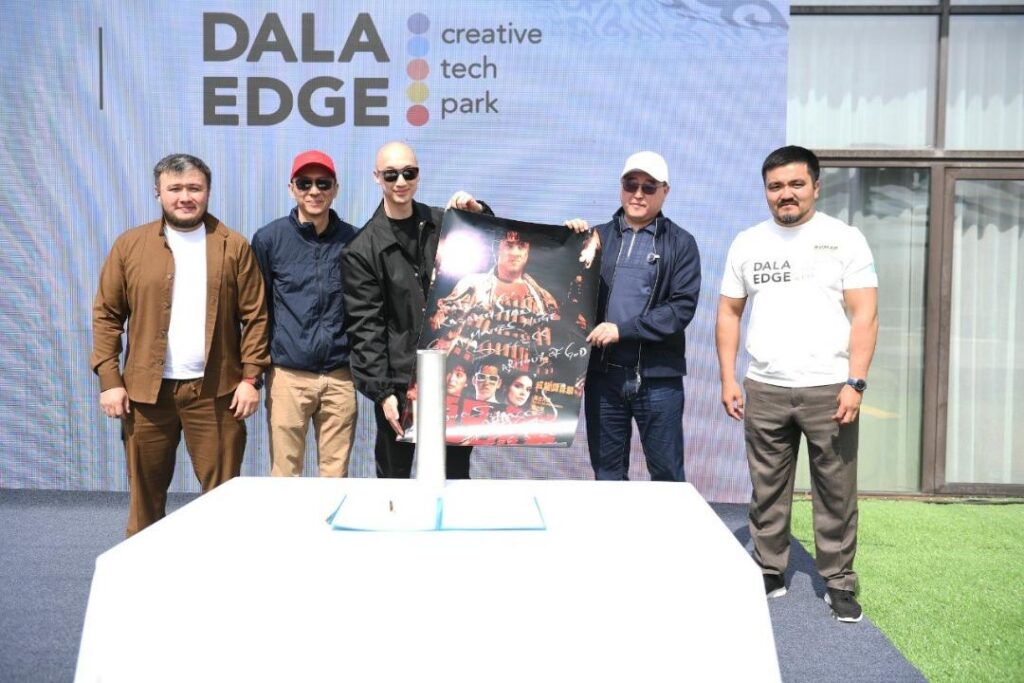
A project has been launched in Kazakhstan’s Almaty region that could significantly transform the local film industry. Construction has begun in the city of Kaskelen on the “Dala Stage” film studio project, which is positioned as a world-class facility and is being developed with the participation of international partners. According to local authorities, one of the most notable moments at the project’s groundbreaking ceremony was the delivery of a time capsule from Jackie Chan, which was transported by helicopter. The capsule was received by director Robert Koon, who is set to work on the first production at the new site, Armor of God 4: Ultimatum. “The film industry is developing rapidly, requiring increasingly large-scale solutions and advanced technologies. This new project will allow local professionals to compete at a global level,” said Almaty Region Akim Marat Sultangaziev. Producer Li Chiu Wa conveyed greetings from Jackie Chan and said the project is progressing quickly. He said that just six months ago it was still at the discussion stage, but construction has already begun. The key parameters of the future facility have already been outlined. The total site will cover 15 hectares, with built-up space of 3,000 square meters. The project extends beyond the construction of a film studio and is intended to support the development of the national film industry, including training specialists and attracting investment.

Kazakh Producer Yulia Kim: “We Are Closing the Gap Between Central Asia and World Cinema”

Central Asia is increasingly being recognized as a bright new spot on the global cinema map. Films by regional directors are now regularly featured in major festival programs, and international curators are paying closer attention to the area’s filmmaking talent. One of the key platforms fostering these connections is the Post Space film camp in Kyrgyzstan, a space where emerging directors present their work directly to global festival decision-makers. The Times of Central Asia spoke with Post Space co-founder and Kazakh producer Yulia Kim about how this format works, why bridging the gap between the region and the global film industry is vital, and how campfire songs can forge creative collaborations. [caption id="attachment_42621" align="aligncenter" width="1060"] @PostSpace[/caption] TCA: Yulia, you’re one of the founders of Post Space, widely considered the most influential film camp in Central Asia. You’ve been organizing it for four years now. Has it yielded results? Yulia: Many. In 2024, the Locarno Film Festival invited two Kazakh directors, including Aruan Anartay, a Post Space participant. Last year, we had another Kazakh participant. The Lisbon Film Festival even curated a program specifically dedicated to Central Asian cinema. Its director, Portuguese producer Paulo Branco, visited Post Space for the first time in 2024 and fell in love with our filmmakers. I believe that for the festival curators we invited, Central Asia has opened up in new ways. They now approach our films with a deeper understanding and, hopefully, greater interest. TCA: Would you say international interest is growing? Yulia: Yes, but Post Space aims for more than just professional development. We also strive to create a friendly, supportive atmosphere. The connections formed here often become lasting collaborations. For instance, we ran a screenwriting lab, and soon several films developed during that project will be released. One participant, Diaz Bertis, refined his script with the help of an international mentor we brought in. These are vital steps for our industry. TCA: Many local initiatives fizzle out quickly. Are you planning for the long term? Yulia: Absolutely. Our project is just gaining momentum. But we’re working with a minimal budget and little external support, which limits what we can do. We'd like to offer more grants and long-term support to the projects emerging from Post Space, but for now, it’s mostly moral support. Still, we’re pushing forward, and young filmmakers are eager to grow with us. We focus on giving a voice to emerging artists who aren’t even recognized at local festivals, let alone international ones. TCA: So Post Space is a launchpad for debut filmmakers? Yulia: For many, yes. There’s so much talent in the region, but a lot of it has no connection to the film industry. We want to be the space where they gain confidence, present their work, and receive feedback. Many participants hadn’t shown their films anywhere before Post Space, often due to fear or inexperience. They were thrilled to screen their work here. TCA: What stood out about Post Space 2025? Yulia: Each year has its...

“Music Is Born in Pain”: Kazakh Composer Robert Ziganshin on Inspiration, Integrity, and Creative Freedom

Robert Ziganshin is one of Kazakhstan’s most in-demand film composers. A graduate of the Lyon Conservatory in France, where he studied classical guitar and earned master’s degrees in both music for the visual arts and musicology, he returned home to rapidly establish himself in the country's film and television industry. Ziganshin’s credits include music for popular TV series and films such as Alisher Utev’s crime drama 5:32 (IMDB), the box office hit Kazakh Business in Brazil, and Malika, a feature film by Russian director Natalya Uvarova about a family of Ingush migrants. In an interview with The Times of Central Asia, Ziganshin spoke about the influence of the French school, the ethics of film composition, and why writing music “that simply comments on the action” can mean sacrificing artistic integrity. TCA: Robert, you graduated from KIMEP in Kazakhstan. How did you end up in France? Ziganshin: I’ve been passionate about music since early childhood. Even when I was playing with building blocks, I was always humming something, as if adding a soundtrack to my own stories. I didn’t get into music school, and it wasn’t until I was fifteen that I started taking private guitar lessons. There were times I practiced six hours a day. There was no higher education in classical guitar in Kazakhstan at the time, so I enrolled at KIMEP. After graduating, I applied to two conservatories in France and was accepted to the one in Lyon. TCA: Why France? Ziganshin: I spoke fluent French. My father had sent me to language school, and I took part in competitions. Later, a professor from Lyon gave a master class in Almaty, and I helped translate for him. He assessed my level and encouraged me to apply to his course. TCA: Was tuition really that affordable? Ziganshin: For foreign students, it was about €900 per year, including health insurance. Compared to the UK, it was a bargain. I spent four years there and earned a bachelor’s degree. TCA: How did you shift into composing for film? Ziganshin: I met students from the program Musique appliquée aux arts visuels, music created for film, theater, performance, and media art. I wanted to try it. The entrance exam was creative: we had to score scenes and compose music for a three-minute video in a week. I got in on my second try, only twelve of us were accepted. It was a two-year program, starting with orchestration and sound engineering, then moving into practical work on student film projects. TCA: What was the subject of your master’s thesis? Ziganshin: When should a composer start work on a film? Personally, I prefer being involved from the script stage. After finishing that degree, I also enrolled in a master’s in musicology. In 2021, I returned to Kazakhstan. I struggled to find paid work in music and almost joined my father’s printing business. I even started hand-making notebooks, neat and beautiful ones. But soon, small offers started coming in, and I returned to composing full-time, initially...

Kazakhstan’s Film Industry Surges: Domestic Productions Outperform Foreign Blockbusters at the Box Office

Kazakhstan's domestic film industry is experiencing a renaissance, successfully competing with and even surpassing foreign productions in box office revenue, an outcome that was unthinkable just a decade ago. Ten years ago, Kazakhstani films and television were seldom watched. Western and Russian blockbusters dominated cinemas, leaving little room for domestic content. Filmmakers lamented that their work attracted only a niche audience of aesthetes and patriots. Today, however, Kazakh productions are filling theaters and attracting millions of online views. “In 2024, the output of Kazakhstani films increased by 58%. Among the top 10 highest-grossing films, every second one was a domestic production. Revenue from foreign and domestic films was nearly equal. This demonstrates the growing interest of audiences in national content,” Kazakhstan’s Prime Minister, Olzhas Bektenov, said on March 18. By the end of 2024, Kazakhstani films had grossed more than 22 billion tenge, a 30% increase compared to 2023, according to Alexander Aksyutits, general director of the Top Pro Cinema production center. The number of films released during the year surged from 65 to 107. “What’s even more important is that Kazakhstanis’ attention to national cinema continues to grow. Looking at the top 20 highest-grossing films of last year, 70% were locally produced. Just a few years ago, foreign films dominated the market. As a result, our film industry is attracting increasing interest from private investors. Equally significant are the positive changes in the state financing system for film production,” Aksyutits said. [caption id="attachment_29923" align="aligncenter" width="1280"] YouTube/frame from the series "5:32"[/caption] Streaming Demand and Cultural Shift Aksyutits also noted a surge in Kazakhstan's TV series production, largely due to the rising popularity of streaming platforms. However, demand for local content currently outstrips the country’s production capacity, primarily due to a shortage of skilled professionals. Some experts believe this shift in audience preferences is linked to a growing cultural divide between Kazakhstan and the Western and Russian film industries. As narratives diverge, local audiences increasingly seek stories that reflect their own experiences and values. “In recent years, I’ve started watching Kazakhstani TV much more often. Before, I had little interest in them and barely knew they existed. Now, I remember titles like Meow, 5:32, Patrol, and Sake. These are mostly crime dramas or comedies. What draws me in are the relatable characters, people you might see in your own neighborhood. The familiar settings, humor, and natural dialogue make the stories feel real,” said Alexander, a resident of Almaty. The TV series Meow follows drug couriers and the battle against them, while 5:32 delves into the world of serial killers. Sake and Patrol take a comedic approach, with the former portraying a charmingly corrupt mid-level official and the latter focusing on the daily lives of police officers. According to critics, this new wave of TV content, which is currently achieving high ratings on television and accumulating millions of online views, successfully blends serious themes with strong performances and humor. Countries including Russia, Kyrgyzstan, Ireland, Germany, Azerbaijan, Turkey, India, South Korea, the UK,...