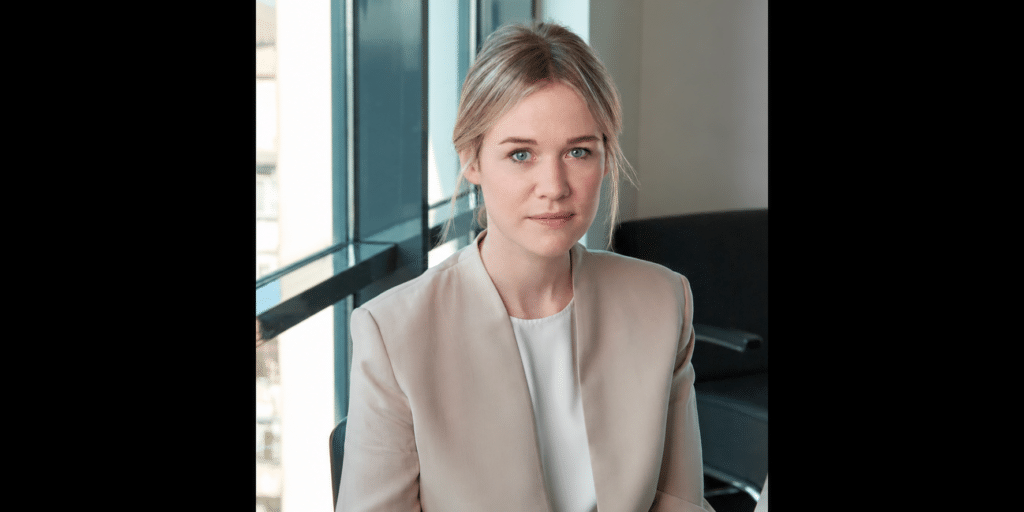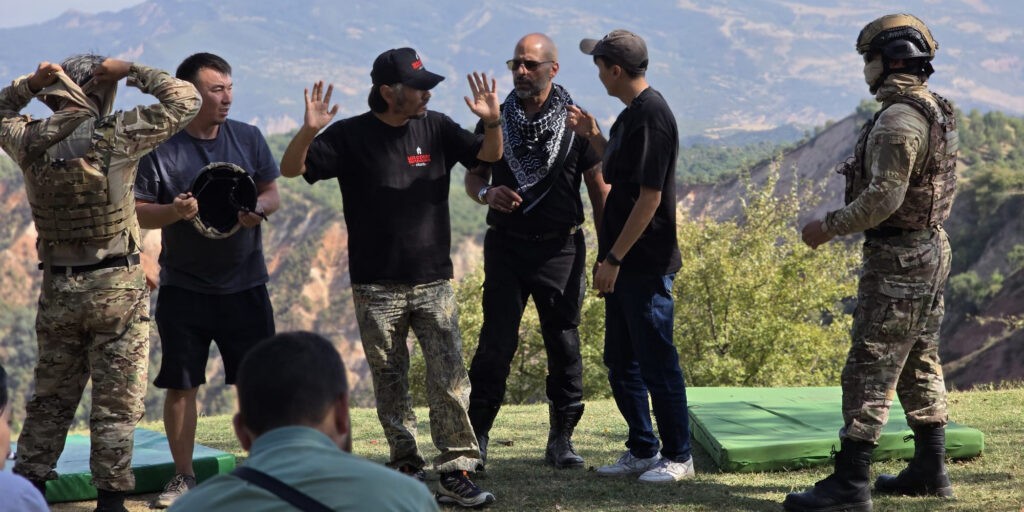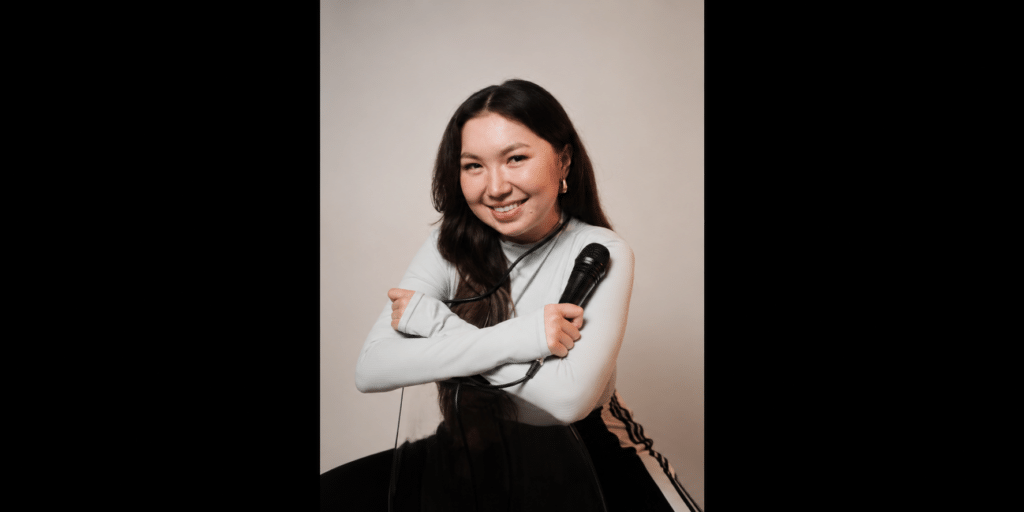
Makpal Kursabayeva is a sound engineer whose work has increasingly extended beyond Kazakhstan’s local film industry. Over the years, she has contributed to projects with international teams, from working alongside The Matrix cinematographer Bill Pope to taking part in series produced for global streaming platforms. Her career highlights the expanding role of Kazakhstani professionals in international production and shows that local crews can compete with their Western counterparts. Her work includes on-set recording, post-production, and sound capture in environments ranging from military airbases and nighttime steppes to urban locations.
In an interview with The Times of Central Asia, she discusses how the industry works and why crews from Kazakhstan are competitive in international productions.
TCA: You are a highly experienced sound engineer, but most of your work has been on local projects. Do you think Kazakhstani specialists are competitive in the global market?
Makpal: I have no doubt about it, however confident that may sound. Recently, we worked on an international series filmed in Kazakhstan by Turkish filmmakers. Many department heads were Turkish, but I led the sound department. We worked and communicated seamlessly; there were no barriers at all. And that’s always the case.
I also worked on a commercial project for Chevron, where the cinematographer was Bill Pope, who shot the legendary film The Matrix, the Ant-Man films, Shang-Chi, and more.
TCA: Was the entire crew international as well?
Makpal: The second director was American. Playback equipment was brought from Moscow. It was a mix, bringing together the best. The Russian team even said that such sound equipment isn’t available in Moscow. Technically, we are not lagging behind at all. We also have plenty of talented and highly skilled professionals.
TCA: Were they at all arrogant?
Makpal: Not at all. Bill Pope was great to work with. He’s like a rock star, very open, loves music. We talked about ethnic music; I let him listen to the band Turan. He even asked me to play the dombra. I was a bit nervous because the executive producer was very strict, and I thought she might say I was disrupting the workflow. But he went to her himself and asked, and then she was the one chasing me to make it happen, so the question isn’t whether we can work at a Western level; we already do.
TCA: You’ve also worked with German teams on Emir Baigazin’s films, and with French teams on projects by Yermek Shinarbayev and Akan Satayev’s epic Myn Bala: Warriors of the Steppe?
Makpal: Yes. There was an interesting experience with one Western specialist, I won’t say from which country. I thought they had a different school and that I could learn from him. But while he was good on set, he wasn’t very strong in post-production. It even got to the point where I was teaching him, explaining how to properly edit sound and the technology behind it. Sometimes I would suggest something, and the next day those ideas would be presented as his own. But that didn’t matter much to me, the important thing was that the work was done correctly. I think it’s because we are more versatile specialists, we can work on set and actively participate in post-production. It seems they don’t always have that breadth.

TCA: What is most important to you in working with sound, and which part of the process do you enjoy most?
Makpal: I love the entire process: recording clean sound on set, capturing atmospheres and sync sounds, editing, and sitting in on the final mix. I adore dubbing, it’s about interacting with actors, finding the right intonation, when an actor delivers a line exactly as you imagined it, or even better. That’s pure joy.
TCA: Your projects range from dramas to blockbusters. Which one stands out the most?
Makpal: Every shoot is special, something interesting always happens. For example, on Time of Patriots, we recorded real fighter jets. We were on an airbase, setting up multiple microphones in the field and recording flyovers. It’s an incredibly powerful sound; you have to capture it perfectly.
On another commercial project involving cars, we had to record a vehicle driving at high speed. We placed microphones all over the track, and I got into the car with the driver, directing how to drive to get the right sound. It was quite extreme but very exciting.
TCA: In Yermek Tursunov’s Shal, you even worked with wolves?
Makpal: They were actually wolf-dog hybrids. They were brought from Russia and were very friendly, even wagging their tails, which annoyed the director because it didn’t look wolf-like. Sometimes I even walked three wolves on leashes.
It was a very unusual process. We were in a canyon, without the film crew. My colleague and I set up microphones, and I started howling, and the wolves responded. That’s how you capture the sound. We were on the same wavelength. I remember that shoot very fondly. I also had to record the sound of a snowmobile, and they gave me rides on it, one of those rare moments where work and enjoyment align perfectly.
TCA: Have you experienced extreme conditions on set?
Makpal: Every time, especially due to the weather. Once, during a shoot, a young cameraman asked me to film a message for his mother, saying, “Mom, everything is fine, I’m warm.” Then we had a 20-hour shoot in freezing conditions. Emergency services announced school closures due to a snowstorm, we were still filming. At least we could occasionally warm up at a checkpoint. But that cameraman didn’t step inside once in 20 hours. I think he was traumatized after that.
TCA: You must be constantly freezing, most filming is outdoors, right?
Makpal: We do freeze, even with the warmest gear, special boots, heated insoles powered by power banks. Once I got so cold I thought, “Can I please never work in winter again?” Somehow, that wish came true, I didn’t work winters for a while. Of course, if I’m called, I’ll go but I’d rather avoid the discomfort.
TCA: Your whole life seems to take place on set. Do you ever feel like life is passing you by?
Makpal: Yes. As long as I can remember, I’ve been on set. I feel like I’ve missed important moments in my life. When Seven Days of May premiered, I came home and discovered my 75-year-old father was seriously ill. Two weeks later, he passed away, I learned about it on set, at the end of the workday. It was painful, but I didn’t allow myself to grieve and returned to work on the third day.
When my grandmother passed away, I was in the middle of a 30-hour editing session on a critical project. The entire studio was working. I didn’t even attend the funeral, and I regret that.
TCA: Was that a kind of defense mechanism?
Makpal: Probably. It was hard to process. But I wasn’t only on set during difficult moments, I missed celebrations too. For example, I didn’t celebrate my graduation.
I graduated with honors. My thesis project was Prokofiev’s cantata Alexander Nevsky, a large-scale work with a symphony orchestra and double choir. We recorded and mixed it, and I used it as the basis of my thesis, adding a theoretical part which I actually wrote on set during The Sky of My Childhood.
I came in for one day to defend it. My supervisor, Sergey Lobanov, was on the committee, and right after that he asked me to work on post-production materials with Gérard Depardieu. Everyone was celebrating, and I was editing until late at night.
I always felt everything depended on me, that I had to do it perfectly, that no one else could do it.
TCA: What has changed in the industry over the years?
Makpal: Everything. The biggest change is that we now achieve 100% clean sound. The first time I managed that was on Kempir by Yermek Tursunov. The cast was exceptional: Gaziza Abdinabieva, Kadyrbek Demessinov, Isbek Abilmazhinov, Murat Nurasylov, and legends like Asanali Ashimov and Meruert Utekesheva. It would have been a shame to dub them.
At the time, the producer kept asking me what percentage of clean sound we would get. I said, “I don’t know, I’m not Nostradamus.” In the end, we didn’t dub anything, the entire film used original sound. That was a shock, because it had rarely been done before.
TCA: Has the industry become more technological?
Makpal: Yes, but there are still many nuances that technology can’t replace. For example, it’s now very hard to find quiet locations. We sometimes worked from 2 a.m. to 5 a.m. just to capture silence. Once, we had only one night to record all background sounds before a lockdown began. If we hadn’t made it in time, it wouldn’t have been possible at all.
TCA: How sensitive are directors to sound?
Makpal: It varies. Some are very sensitive, others less so. Some like to sit through dubbing and relive everything, the shoot, the edit. Others get tired of their own material and don’t attend at all.
TCA: But you ensure everything sounds right?
Makpal: It depends. The director is responsible for acting if a line is delivered insincerely or incorrectly. Editors and script supervisors handle dialogue continuity. My role is to ensure the technical quality and clarity of sound, it has to be clean, rich, and expressive. If a plane flies overhead or a phone rings, I ask for another take. Sometimes we decide to fix it in post-production. I always explain what can be cleaned later and what cannot, then the team decides how much they are willing to adjust for sound quality.
TCA: What most often interferes with good sound on set?
Makpal: Location is key. The main issue isn’t phones — they’re usually switched off — but the environment itself: city noise, machinery, random sounds. Technology has advanced a lot, and we can clean many things in post-production but not everything. That’s why the main task is to capture sound correctly from the start.
TCA: Do you have a dream project or director you’d like to work with?
Makpal: Recently, I realized that all my professional dreams are already coming true. I’m working with the people I always wanted to work with.