• KZT/USD = 0.00213
  • TJS/USD = 0.10810
  • UZS/USD = 0.00008
  • TMT/USD = 0.29760
  • KZT/USD = 0.00213
  • TJS/USD = 0.10810
  • UZS/USD = 0.00008
  • TMT/USD = 0.29760
  • KZT/USD = 0.00213
  • TJS/USD = 0.10810
  • UZS/USD = 0.00008
  • TMT/USD = 0.29760
  • KZT/USD = 0.00213
  • TJS/USD = 0.10810
  • UZS/USD = 0.00008
  • TMT/USD = 0.29760
  • KZT/USD = 0.00213
  • TJS/USD = 0.10810
  • UZS/USD = 0.00008
  • TMT/USD = 0.29760
  • KZT/USD = 0.00213
  • TJS/USD = 0.10810
  • UZS/USD = 0.00008
  • TMT/USD = 0.29760
  • KZT/USD = 0.00213
  • TJS/USD = 0.10810
  • UZS/USD = 0.00008
  • TMT/USD = 0.29760
  • KZT/USD = 0.00213
  • TJS/USD = 0.10810
  • UZS/USD = 0.00008
  • TMT/USD = 0.29760
08 August 2026

Viewing results 1 - 6 of 4

Tajikistan Turns to Satellites to Discover How Much Forest It Has Left

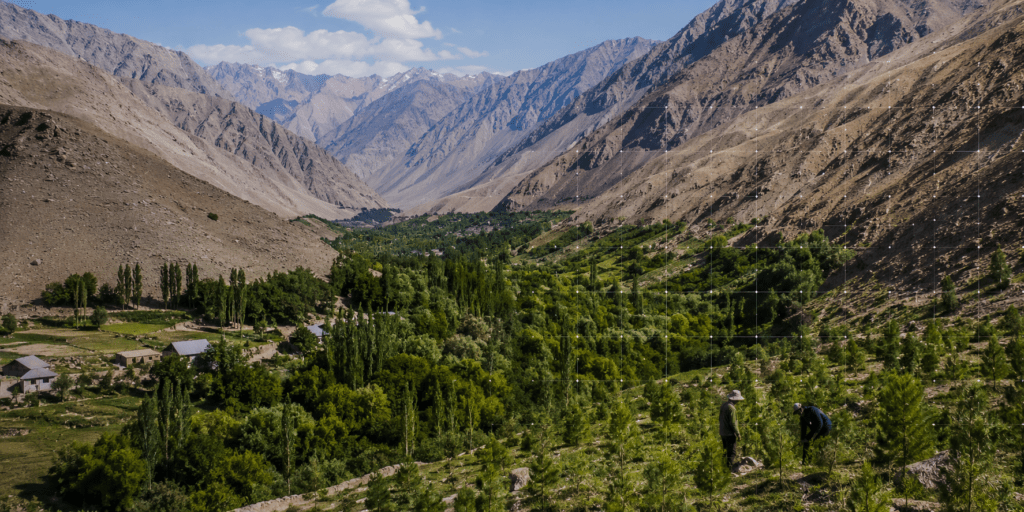
In Barvoz village in the Western Pamirs, Zarifkhon Gulchinov watched a green forest near his home become a semi-desert during the 1990s. The collapse of the Soviet Union and Tajikistan’s civil war left the isolated region short of electricity and coal. Families cut trees to heat their homes and cook. “I also went to the forest for firewood, but I cut down only old and dry trees and bushes,” Gulchinov recalled. He later joined a community forestry program and received five hectares of degraded land to restore. Villagers now plant hundreds of trees and protect young growth from livestock. They also maintain an irrigation canal fed by mountain water. Such places explain why a forest inventory is more than a technical count. A strip of trees can supply fuel or hay. It can also hold a riverbank together and shield fields from erosion. Yet Tajikistan has spent decades without a reliable national picture of where its forests remain or what condition they are in. Counting What the Country Has On July 15, Deputy Forestry Agency Director Davlatali Sharifzoda announced a national inventory using satellite images and field inspections. The work will cover forests under every form of ownership, and its results will support ten-year management plans for each state forestry enterprise. Local coverage has described the exercise as Tajikistan’s first complete forest inventory using satellite data. A World Bank project appraisal says the country last conducted a national inventory in 1990. The current exercise is therefore the first nationwide inventory since independence and the first to use modern mapping methods across the country. The inventory combines Sentinel-2 and RapidEye images with geographic information systems. Machine-learning tools classify forest types, while mobile laser scanners can create three-dimensional models of tree stands. Field teams will still visit selected plots to measure tree diameter and height, and count the number of trees in each area. Their observations will show whether the satellite classifications match conditions on the ground. The work is being carried out by Aerogeodesy Dushanbe and Austria’s Umweltdaten GmbH through the World Bank-backed Tajikistan Resilient Landscape Restoration Project. A June progress update said the team carrying out the inventory had been appointed and work was underway. The project is due to close on September 30, 2027. Why the Numbers Diverge Tajikistan has long been described as one of Central Asia’s least forested countries. The figure most often used is about 3% of the national territory, or roughly 420,000 hectares. The World Bank has also noted that land administered by the Forestry Agency covers a much larger area, but much of that land is pasture rather than forest. Preliminary satellite work has now put forest cover at about 4.7%. The higher estimate does not mean that Tajikistan suddenly gained trees. Better mapping may be capturing sparse woodland and remote areas missed by older records. The final inventory should also separate actual forest cover from land that belongs to the state forest fund but carries little or no tree cover. That distinction affects...


Kazakhstan Develops Specialized Firefighting Vehicle for Forest Fires

Kazakhstan has developed a prototype of a new high-mobility firefighting vehicle designed specifically to combat forest fires, drawing on lessons from the devastating wildfire that swept through the Abai region in 2023, the Ministry of Ecology and Natural Resources said. In June 2023, a major wildfire broke out in the Semey Ormany State Forest Nature Reserve  in eastern Kazakhstan’s Abai region, killing 14 forestry workers and burning tens of thousands of hectares of forest. Authorities later estimated the damage at more than $354 million. The disaster prompted forestry and emergency response specialists to conclude that Kazakhstan needed specialized equipment better suited to fighting large-scale forest fires. “Following an analysis of the events in the Abai region, it was decided to develop a prototype of a modern, maneuverable firefighting vehicle capable of responding rapidly to forest fires,” the Ministry of Ecology said. The prototype later underwent field testing in the Akmola, Karaganda, Pavlodar, and Abai regions. Engineers incorporated feedback from firefighters and forestry specialists, along with technical requirements identified during firefighting operations. “As a result, a firefighting vehicle was created that meets all the key operational requirements,” the ministry said. The new vehicle is built for off-road conditions and is powered by an engine producing approximately 300 horsepower. It carries a 3,000-liter water tank and is equipped with a high-capacity pump that allows firefighters to combat flames while stationary or moving. The pump system can be operated from inside the cab or directly from the firefighting compartment, providing greater flexibility during emergency operations. The vehicle is also fitted with a rear-view camera to improve maneuverability in low-visibility conditions and difficult terrain. One of the vehicle’s most notable features is an integrated self-protection system. In the event of approaching flames, the system creates a protective barrier around the vehicle, shielding the wheels, cab, and engine compartment from fire. According to the developers, the technology is particularly valuable during large forest fires, where rapidly changing conditions and extreme temperatures can place firefighting crews and equipment at significant risk. Officials say the vehicle has no direct equivalent elsewhere in the post-Soviet region and represents a modern solution tailored specifically to forest firefighting operations. Kazakhstan has increasingly focused on improving its wildfire response capabilities following recent disasters. As previously reported by The Times of Central Asia, engineers in the Karaganda region last year unveiled a prototype drone capable of detecting forest fire hotspots and supporting wildfire monitoring efforts.

Kazakhstan and South Korea Forward Cooperation in Forestry

On June 17, Kazakhstan’s ambassador to South Korea, Nurgali Arystanov, participated in a celebration of the World Day to Combat Desertification and Drought, established by a UN General Assembly resolution in 1994. Organized in Seoul by the Korea Forest Service, the event was attended by major Korean companies, private and international organizations including the Asian Forest Cooperation Organization (AFoCO), as well as students from ecological clubs promoting anti-desertification activities. In his speech, reported by Kazakhstan’s Foreign Ministry, Arystanov noted the successful cooperation between Kazakhstan and the Republic of Korea in the development of forestry, including a joint project to plant saxaul on the desiccated bed of the Aral Sea. He also hailed Astana’s Kazakhstan-Korea Friendship Garden a “symbol of friendship between the Kazakh and Korean peoples.” The ambassador expressed his appreciation of the signing of a Memorandum of Understanding between the Ministry of Ecology and Natural Resources of Kazakhstan and the Korea Forest Service during Korean President Yoon Suk Yeol’s state visit to Kazakhstan on June 11-13. The document provides for cooperation in combating forest fires and the introduction of advanced technologies for monitoring forests using drones, artificial intelligence, and satellites. Progress on cooperation in the forestry sector was further discussed by Ambassador Arystanov and the Minister of the Korea Forest Service, Nam Sung-Hyun, during the former’s visit to Seoul.    

Kazakhstan Establishes Forest Protection Service 

On May 4, Prime Minister of Kazakhstan Olzhas Bektenov signed a government resolution establishing a national Forest Protection Service. Administered by the Ministry of Ecology, the agency is tasked to enhance the efficiency of forestry institutions in dealing with emergency situations, including forest fires, as well as instilling a more scientific approach to subsequent forest rehabilitation and clearance. In addition to improving coordination between government agencies in the elimination of large-scale wildfires, the Forest Protection Service will ensure that personnel responsible for preventing and extinguishing forest fires are fully qualified. Machinery and equipment required for the job will also be updated and increased. Kazakhstan currently has 15 national civil defense services, including the Firefighting Service, Medical Service, Chemical Protection Service, Radiation Protection Service, and Hydrometeorological Service.